


Levodopa powder(link:https://www.bloomtechz.com/synthetic-chemical/api-researching-only/levodopa-powder-cas-59-92-7.html), core ingredient levodopa, molecular formula C9H11NO2, CAS 59-92-7, molecular weight 165.19, is a synthetic amino acid. White or off-white crystalline powder. Melting point 285.5°C (decomposition). It has a bitter taste and poor solubility. It is only slightly soluble in water, soluble in hot water, dilute acid and dilute alkali, and insoluble in ethanol, ether and chloroform. Odorless and tasteless, turns black in air. When humid, it oxidizes easily in the air and becomes darker. Easily soluble in dilute hydrochloric acid and formic acid, soluble in water (66mg/ml), almost insoluble in ethanol, benzene, chloroform and ethyl acetate. It is an important prodrug that can be converted by the body into levodopa, a pharmacologically active amino acid. Levodopa can treat neurological diseases such as Parkinson's disease in the human body. Its mechanism of action is to relieve the symptoms of Parkinson's disease by supplementing the lack of dopamine in the brain. It can also be used as a precursor for the synthesis of other drugs and biocatalysts, and for research and development of new drugs. Therefore, it has a wide range of applications in the medical field. In addition to its application in the medical field, it also plays an important role in the fields of chemistry and biochemistry. It should be noted that Shaanxi Chuxuan Technology is only used for laboratory reagents.
Levodopa
|
|
|

Levodopa Synthesis
The concrete steps of synthetic Levodopa are as follows:
1. Phenylalanine generates phenylalanine primary amine under the action of reducing agent:
Mix phenylalanine with an appropriate amount of reducing agent and react at room temperature for 1-2 hours until the reaction is complete. Add an appropriate amount of water, adjust the pH value to neutral with sodium hydroxide, filter to remove insoluble impurities, and then wash with water until neutral to obtain phenylalanine primary amine.
C6H5CH2CH (NH2) COOH + [H] → C6H5CH2CH(NH2)COH + [H2O]
2. Phenylalanine primary amine reacts with acetyl chloride to form phenylalanine acetylate:
Mix phenylalanine primary amine with an appropriate amount of acetyl chloride and react at room temperature for 1-2 hours until the reaction is complete. Add an appropriate amount of water, adjust the pH value to neutral with sodium hydroxide, filter to remove insoluble impurities, and then wash with water until neutral to obtain acetylated phenylalanine.
C6H5CH2CH(NH2)COH + ClCOCH3 → C6H5CH2CH(NH2)COCH3 + HCl
3. Phenylalanine acetylate reacts with hydriodic acid to generate phenylalanine iodine:
Mix phenylalanine acetylate with an appropriate amount of hydriodic acid and water, and react at room temperature for 1-2 hours until the reaction is complete. Add an appropriate amount of water, adjust the pH value to neutral with sodium hydroxide, filter to remove insoluble impurities, and then wash with water until neutral to obtain phenylalanine iodine.
C6H5CH2CH(NH2)COCH3 + HI → C6H5CH2CH(NH2)COI + H2O
4. Phenylalanine iodine reacts with hydrazine to generate phenylhydrazine:
Mix phenylalanine iodine with an appropriate amount of hydrazine and water, and react at room temperature for 1-2 hours until the reaction is complete. Add an appropriate amount of water, adjust the pH value to neutral with hydrochloric acid, filter to remove insoluble impurities, and then wash with water until neutral to obtain phenylhydrazine.
C6H5CH2CH(NH2)COI + H2NNH2·H2O → C6H5CH=NH + NH4I + CO2
5. Phenylhydrazine reacts with hydrazine hydrate and hydrochloric acid to form hydrazinobenzylketone:
Mix phenylhydrazine with an appropriate amount of hydrazine hydrate, hydrochloric acid and water, and react at room temperature for 1-2 hours until the reaction is complete. Add an appropriate amount of water, adjust the pH value to neutral with sodium hydroxide, filter to remove insoluble impurities, and then wash with water until neutral to obtain hydrazinobenzylketone.
C6H5CH=NH + NH4I + HCl + H2NNH2·H2O → C6H5CH=N(Ag)NH·HNO3 + AgCl
6. Hydrazinobenzylketone generates disodium dihydrogen benzofuran under the action of metallic sodium:
Mix hydrazinobenzyl ketone with metal sodium, ethanol, etc., and react at room temperature for 1-2 hours until the reaction is complete. Add an appropriate amount of water, adjust the pH value to neutral with sodium hydroxide, filter to remove insoluble impurities, and then wash with water until neutral to obtain disodium dihydrogen benzofuran.
C6H5CH=N(Ag)NH·HNO3 + NaBH4 → C6H5C(O)C(O)NH2·NaBH4 + AgNO3 + NH3
7. Disodium dihydrogen benzofuran generates dopaquinone under the action of oxidant:
Mix disodium dihydrogen benzofuran with oxidant, sodium hydroxide and water, and react at room temperature for 1-2 hours until the reaction is complete. Add an appropriate amount of water, adjust the pH value to neutral with hydrochloric acid, filter to remove insoluble impurities, and then wash with water until neutral to obtain dopaquinone.
C6H5C(O)C(O)NH2·NaBH4 + Br2 → C6H5C(O)C(O)NH2·NaB(OH)4 + NH3
8. Dopaquinone generates Levodopa under the action of reducing agent:
Mix dopaquinone, reducing agent and water, and react at room temperature for 1-2 hours until the reaction is complete. Add an appropriate amount of water, adjust the pH value to neutral with sodium hydroxide, filter to remove insoluble impurities, and then wash with water until neutral to obtain Levodopa.
C6H5C(O)C(O)NH2 + NaBH4 → Levodopa + NaB(OH)4 + NH3
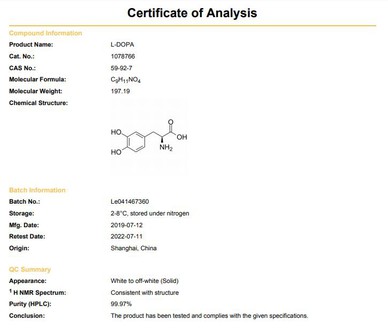
Levodopa Structure
Levodopa, also known as levodopa (L-DOPA), is a drug widely used to treat Parkinson's disease. The molecular formula of Levodopa is C9H11NO4, and its chemical name is 3-(3,4-dihydroxyphenyl)-L-alanine. It is an amino acid derivative consisting of a benzene ring and an amino acid moiety.
In the structure of Levodopa, the benzene ring part has an ortho-substituted hydroxyl group and a meta-substituted hydroxyl group, which makes Levodopa have two hydroxyl groups. At the third position on the benzene ring is an amino acid side chain. This side chain consists of a carbon atom and its attached hydrogen atom.

The three-dimensional configuration of Levodopa is left-handed (L-), so it is called "levodopa". It is a white crystalline solid that is soluble in water. Levodopa is polar and therefore may experience some effects on drug absorption and metabolism.
Levodopa is a prodrug that is converted into dopamine in the brain after being administered orally into the body. Dopamine is an important neurotransmitter that is severely deficient in people with Parkinson's disease. After Levodopa enters the brain, it is converted into dopamine through the action of dopa decarboxylase, thereby increasing dopamine levels and relieving the symptoms of Parkinson's disease.
In general, Levodopa is a drug with a specific molecular structure, its chemical name is 3-(3,4-dihydroxyphenyl)-L-alanine. It is a prodrug that treats Parkinson's disease by converting it to dopamine in the body.