


Urolithin A(link:https://www.bloomtechz.com/synthetic-chemical/api-researching-only/urolithin-a-powder-cas-1143-70-0.html), English name Urolithin A, is a yellow or light yellow solid powder at normal temperature and pressure. Urolithin A is the intestinal microbial metabolite of ellagic acid, which has anti-inflammatory, anti-proliferative and anti-oxidative properties, and can be used as organic synthesis, biochemical intermediates and cell biological reagents, and can be applied to drug molecules and bioactive molecules modification and derivatization. Urolithin A can be dissolved in strong polar organic solvents such as dimethyl sulfoxide, N,N-dimethylformamide, but it is poorly soluble in low-polarity petroleum ether and diethyl ether and also soluble in water. very bad. Urolithin A is an intestinal metabolite of ellagic acid with antioxidant and antiproliferative effects; the IC50 values for inhibiting the growth of T24 and Caco-2 cells were 43.9 and 49 μM, respectively, and urolithin A can mainly inhibit prostate cancer and Growth of colon cancer cells.
Urolithin A (Urolithin A) is a natural bioactive substance that has various health benefits such as anti-oxidation, anti-inflammation and anti-muscular atrophy.
The first method is the specific steps and chemical equations of synthesizing Urolithin A by using urolithin A precursor compound and AlCl3.
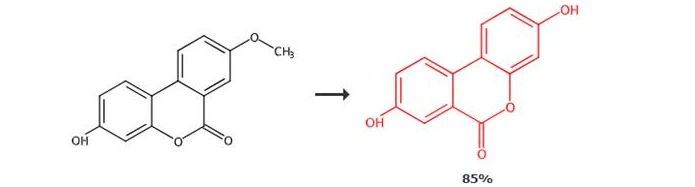
Step 1: Synthesis of urolithin A precursor compound
Oakic acid + H2O + acidic condition → urolithin A precursor compound
Urolithin A precursor compounds can be obtained through a variety of synthetic routes, one of the typical methods is to subject natural polyphenolic compounds (such as oak acid in oak bark) in plants to acidic hydrolysis, oxidation and acylation reactions, etc. Steps Synthesis of urolithin A precursor compound.
Step 2: Condensation reaction of urolithin A precursor compound with AlCl3
Urolithin A precursor compound + AlCl3 → condensation product
The urolithin A precursor compound obtained in step 1 is condensed with aluminum trichloride (AlCl3) under appropriate solvent and conditions. This reaction usually needs to be carried out under an inert atmosphere, such as a nitrogen atmosphere, to prevent oxidation reactions from occurring.
Step 3: Acid Hydrolysis
Condensation product + HCl + H2O → urolithin A
The condensation product obtained in step 2 is subjected to acidic hydrolysis, for example, dilute hydrochloric acid (HCl) is used for hydrolysis under acidic conditions. This step can hydrolyze the ester bond in the condensation product to generate the urolithin A structure.
Step 4: Crystallization and Purification
After acidic hydrolysis, urolithin A is precipitated in crystalline form. The urolithin A product with higher purity can be obtained by performing proper solvent washing and purification operations.
The second method is to reflux the mixture of 2-bromo-5-hydroxybenzoic acid (0.5g, 2.3mmol) and resorcinol (1.5g, 13.8mmol) in 16.8mmol NaOH aqueous solution (25mL) for 1h, and then to the Aqueous CuSO4 solution (28%, 25ml) was added to the mixture, and the reaction was refluxed for 10 minutes. After the reaction, the mixture was cooled, the precipitate was filtered, and washed with ice-cold water to obtain the target product.

Urolithin A is a natural product metabolized in the human body by flavonoid dyes such as cherries and walnuts in plants. At present, the laboratory synthesis method of urolithin A is still being researched and developed, so there is no simple and routine synthesis route.
Step 1: Synthesis of 2,6-Dimethoxybenzaldehyde (2,6-Dimethoxybenzaldehyde):
p-methoxybenzyl alcohol + PBr3 → 2,6-dimethoxybenzaldehyde
2,6-Dimethoxybenzyl alcohol can be obtained by reacting p-methoxybenzyl alcohol with phosphorus tribromide (PBr3). Then, p-methoxybenzyl alcohol can be converted to 2,6-dimethoxybenzaldehyde through an oxidation reaction.
Step 2: Synthesis of 2-Hydroxy-5-methoxybenzaldehyde (2-Hydroxy-5-methoxybenzaldehyde):
2,6-dimethoxybenzaldehyde + NaOH → 2-hydroxy-5-methoxybenzaldehyde
2-Hydroxy-5-methoxybenzaldehyde can be obtained by reacting 2,6-dimethoxybenzaldehyde with sodium hydroxide (NaOH) solution.
Step 3: Synthesis of 2-Hydroxy-5-methoxybenzoic acid (2-Hydroxy-5-methoxybenzoic acid):
2-Hydroxy-5-methoxybenzaldehyde + dilute acid → 2-hydroxy-5-methoxybenzoic acid
By oxidizing 2-hydroxy-5-methoxybenzaldehyde with dilute acid, 2-hydroxy-5-methoxybenzoic acid can be obtained.
Step 4: Synthesis of 2-bromo-5-hydroxybenzoic acid (2-Bromo-5-hydroxybenzoic acid):
2-Hydroxy-5-methoxybenzoic acid + Br2 → 2-bromo-5-hydroxybenzoic acid
2-Bromo-5-hydroxybenzoic acid can be obtained by bromination of 2-hydroxy-5-methoxybenzoic acid.
Step 5: Synthesis of Urolithin A:
2-bromo-5-hydroxybenzoic acid + C6H5(OH)2 → urolithin A
Urolithin A can be obtained by reacting 2-bromo-5-hydroxybenzoic acid with resorcinol in NaOH aqueous solution. Specific reaction conditions and operational details may require more detailed studies and experiments to be determined.
App conversion:
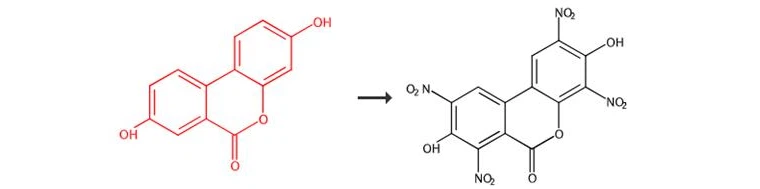
Nitric acid (65%, 0.83 g, 13.2 mmol) was added to a solution of urolithin A in AcOH (25 ml), and the resulting mixture was heated at 50°C for 4 hours, and was spotted by TLC (EtOAc/n-hexane/ MeOH, 7:2:1) to monitor the progress of the reaction. After the reaction, the solvent was evaporated under reduced pressure, and the resulting residue was recrystallized with acetic acid to obtain 3,8-dihydroxy-2,4,7,9-tetranitro -6H-Dibenzo[b,d]pyran-6-one.
Eriodictyol can be isolated from plants, directly synthesized or semi-synthesized from hesperidin. Semi-synthetic eriodictyol is obtained by hydrolysis and demethylation of hesperidin. The method uses hesperidin as raw material, after being hydrolyzed by acidic glycolic acid aqueous solution, adding anhydrous aluminum chloride for demethylation to obtain eriodictyol, the disadvantage is that the semi-synthesized eriodictyol is easy to introduce uncontrollable impurities, and during the reaction process Wastewater is difficult to handle. The specific steps are as follows:
(1) Air-dry the fresh water chestnut skin, pulverize it, and set aside; by weight, get 1 part of water chestnut skin powder, add it to the extraction tank, add 4-10 parts of 70% by volume acetone aqueous solution each time, and extract it at 25°C Soak for 24 hours, soak for 3 times, filter, combine the filtrates, concentrate under reduced pressure to a paste, and obtain the extract.
(2) By weight, 1 part of the extract is dispersed in 5 parts of water to make a suspension, extracted 3 times with ethyl acetate of 1-2 times the volume of water, the combined extracts are concentrated to dryness under reduced pressure to obtain Extracts.
(3) Add methanol to the extract until completely dissolved, mix the sample with polyamide 2-4 times the mass of the extract, volatilize the methanol to dryness, load the column, connect to the MCI column for medium pressure separation, and use 40-100% volume The percent methanol aqueous solution is used for gradient elution of the mobile phase and detected by thin-layer chromatography. The eluate with a combined mobile phase concentration of 65-69% by volume is collected and concentrated under reduced pressure to obtain crude product A.
(4) Add methanol to the crude product A until completely dissolved, mix the sample with 2-4 times the mass of polyamide, volatilize the methanol to dryness, transfer to a polyamide column for separation, and use a volume ratio of 6:1-3: 1 in chloroform-methanol solution and detected by thin-layer chromatography, the eluate containing eriodictyol was collected and combined, and concentrated under reduced pressure to obtain crude product B.
(5) By weight, 1 part of the crude product B is dissolved in 4-8 parts of methanol, and an equivalent volume of methanol is added to make a suspension, purified with a Sephadex LH-20 gel chromatographic column, and eluted with methanol, Detection by thin-layer chromatography, collecting and combining the eluate containing eriodictyol, and concentrating under reduced pressure to obtain crude product C.
(6) Gained crude product C is recrystallized in methanol aqueous solution or ethanol aqueous solution, is dried, and obtains eriodictyol that content reaches more than 95%.