


We continue to digest and absorb new technologies and new experiences of domestic and foreign 3 methyl 4 piperidone, tetracaine hcl, melamine powder. We have been committed to providing customers with high-quality, one-stop value-added services and products from material procurement to shipment production, continuously improving our own advantages, and promoting large-scale business operations. Our company's business has achieved rapid and fruitful development, and has been more widely recognized in the market. Strengthening talents has become an important and urgent task, which is related to the sustainable development of our company and the strategic issue of enhancing core competitiveness.
Pentocaine, also known by its generic name Tetracaine Hydrochloride, is a long-acting ester-type local anesthetic. It mainly works by reversibly blocking voltage-gated sodium ion channels, thereby inhibiting the depolarization of nerve cell membranes and the generation of action potentials, thus interrupting the conduction of nerve impulses such as pain signals. Compared with amide-type local anesthetics like lidocaine, pentocaine has stronger anesthetic efficacy, with a slightly slower onset time (about 5-10 minutes), but its duration of action is significantly prolonged (up to 2-3 hours). This drug has strong penetration ability through mucous membranes, and is therefore widely used in surface anesthesia (such as ophthalmic surgeries, ear-nose-throat examinations, bronchoscopy) and spinal anesthesia (lumbar anesthesia).

|
|
|

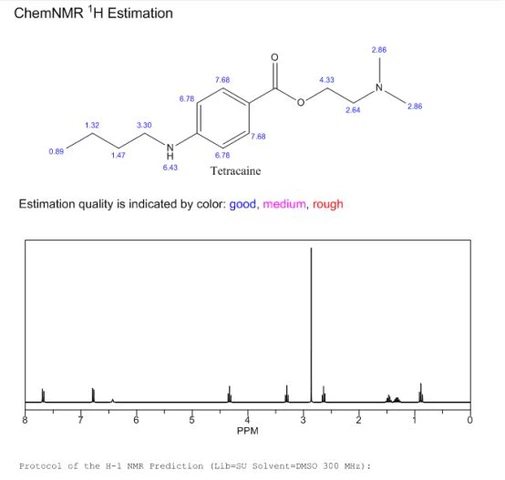
|
Chemical Formula |
C15H24N2O2 |
|
Exact Mass |
264 |
|
Molecular Weight |
264 |
|
m/z |
264 (100.0%), 265 (16.2%), 266 (1.2%) |
|
Melting point |
41.0 to 45.0 °C |
|
Boiling point |
407.59°C (rough estimate) |
|
Density |
1.0200 (rough estimate) |
The white crystalline powder form of this drug needs to be prepared before use, and the solution is unstable and sensitive to light. However, pentocaine is of great concern due to its higher systemic toxicity, especially cardiac toxicity (inhibiting myocardial contraction, conduction blockage) and central nervous system toxicity (convulsions, respiratory depression). Its safety window is narrow, and excessive use is prone to cause serious adverse reactions, so its clinical application (especially large-area surface anesthesia) has gradually been replaced by safer drugs. When using it, the dosage must be strictly controlled and resuscitation preparations must be made.
Pontocaine is a long-term ester local anesthesia, similar to the effect of other anesthetic, but the toxicity of Tetracaine is relatively large, and the use process is prone to poisoning, abnormal, allergy and other reactions.
Its chemical name is 2-(dimethylamino) ethyl 4-(butylamino) benzoate CAS 94-24-6. After entering the blood, most of tetrakaine combines with plasma proteins and accumulates in tissues, with the greatest accumulation in skeletal muscle, which is released when the plasma concentration drops. Most of tetracaine solution is hydrolyzed and transformed by plasma cholinesterase (about 0.31μM/ml/hr) and metabolized by liver into p-aminobenzoic acid and dimethylaminobenthanol, which is then degraded or combined with dimethylaminobenthanol and excreted in urine.
|
|
|


Anesthetic Applications
Surgical Procedures: Commonly used as a local anesthetic for various surgical procedures, including dental surgeries, minor skin surgeries, and other procedures where a local anesthetic is needed to numb the area and reduce pain.
Pain Management: It can also be used for pain management, particularly in cases of chronic pain or post-operative pain, where it can provide relief by blocking nerve impulses that transmit pain signals.
Obstetric Procedures: During obstetric procedures, such as episiotomies or repairs of tears during childbirth, to provide local anesthesia and reduce pain.
Gynecological Procedures: It is also used in gynecological procedures, such as cervical biopsies or dilation and curettage (D&C), to numb the area and make the procedure more comfortable for the patient.
Local Anesthesia for Diagnostics: Administered to provide local anesthesia during diagnostic procedures, such as endoscopies or biopsies, where a numbing effect is desired to reduce patient discomfort.


Nerve Blocks: Pontocaine can be used in nerve blocks to treat pain arising from specific nerves, such as those causing headaches, neck pain, or back pain.
Infiltration Anesthesia: Injected into the tissue surrounding a surgical site to provide anesthesia and reduce pain during and after the procedure.
Topical Anesthesia: In some cases, such as in creams or ointments, to provide local anesthesia for superficial wounds or skin conditions.
Combination Therapy: It is sometimes used in combination with other drugs or anesthetics to enhance its effects or to provide a more comprehensive anesthetic regimen.
The local anesthetic effect is stronger than procaine, 10 times greater than procaine. The toxicity is also greater, 10-12 times greater than procaine. It can penetrate the mucosa and is mainly used for mucosal anesthesia. It acts quickly and takes effect in 1 to 3 minutes. It lasts for 2-3 hours. 0.5% to 1% solution is used in ophthalmology, and there are no serious adverse reactions such as corneal damage. 1% to 2% solution is used in nasopharyngeal department, and the total amount should not exceed 20ml. When used, 1 drop of 0.1% epinephrine hydrochloride solution should be added to every 3ml. 0.025% to 0.03% solution is used for infiltration anesthesia, and 0.1% to 0.3% solution is used for nerve conduction block. 10 to 15mg is mixed with cerebrospinal fluid and injected during spinal anesthesia. 0.15% to 0.3% solution is used for epidural anesthesia, and the highest concentration is 0.3% when used in combination with lidocaine. Due to its high toxicity, infiltration anesthesia is generally not performed. Maximum dose: infiltration anesthesia, nerve conduction block, 0.1g per time.

Dicaine, as a local anesthetic, plays an important role in medical practice. However, some patients may experience allergic reactions after using tetracaine, mainly due to individual differences in sensitivity to local anesthetic drugs. In order to further explore the causes of allergies caused by tetracaine, we need to analyze from multiple aspects.
An allergic reaction is a complex immune response that involves multiple stages of the immune system. When the human body comes into contact with certain substances, such as tetracaine, the immune system may recognize them as a threat and activate a series of defense mechanisms. During this process, immune cells release bioactive substances such as histamine, leading to physiological reactions such as vasodilation, increased vascular permeability, and smooth muscle contraction. These reactions may cause a series of symptoms, such as skin itching, redness and swelling, difficulty breathing, and in severe cases, may even lead to allergic shock.


The chemical structure and properties of Pontocaine may also be one of the causes of allergies. Dicaine has a certain degree of irritancy and may cause irritation to the skin or mucous membranes of certain individuals, leading to allergic reactions. In addition, the metabolism and excretion process of tetracaine in the body may also be related to the occurrence of allergic reactions. Some patients may have weaker metabolic ability to tetracaine due to differences in metabolic enzymes in their bodies, leading to its accumulation in the body and increasing the risk of allergic reactions.
Individual differences also play an important role in tetracaine induced allergies. Each person's immune system status, genetic background, past allergy history, and other factors may affect their response to tetracaine. For example, people with a history of bronchial asthma may be more sensitive to local anesthetics such as tetracaine because their immune system may be more easily triggered. Meanwhile, factors such as age, gender, and physical constitution may also affect an individual's tolerance to tetracaine.

Allergies caused by tetracaine, a type of local anesthetic, can indeed stem from multiple factors. One significant cause is individual differences in sensitivity to such drugs. Different people may have varying degrees of reactivity to tetracaine, and some may be more prone to developing allergic reactions.Additionally, the chemical properties of tetracaine itself play a role. As a pharmacological agent, it has specific molecular structures and interactions that can trigger immune responses in certain individuals.
Moreover, individual differences in overall health status, immune system functioning, and genetic predispositions can also influence the likelihood of developing an allergy to tetracaine.To mitigate the risk of allergic reactions, it is crucial for medical professionals to conduct a thorough assessment of the patient's allergy and medication history before administering tetracaine. This helps to identify any potential risks and allows for more informed decision-making regarding the use of the drug.


Furthermore, careful monitoring of the patient during the medication process is essential. Any signs of an allergic reaction, such as skin rash, itchiness, difficulty breathing, or swelling, should be promptly recognized and addressed.
Medical staff must also be proficient in the correct administration methods of tetracaine, including appropriate dosage, injection technique, and monitoring for adverse effects. They should also be well-versed in emergency rescue measures to effectively manage any allergic reactions that may occur.In summary, a multi-faceted approach involving patient assessment, careful monitoring, and proficiency in medication administration and rescue measures is crucial for reducing the risk of allergic reactions caused by tetracaine.
Other properties
Pontocaine, often confused with phonetically similar names such as Ponaxen or affected by minor spelling and translational variations, is primarily used to refer to Ponatinib, a highly effective targeted antitumor drug widely applied in clinical oncology. As an oral tyrosine kinase inhibitor, it features strong molecular targeting and significant inhibitory activity against abnormal kinase signaling, and has obtained official approval from the U.S. Food and Drug Administration (FDA) for the treatment of multiple refractory malignant tumors, mainly covering specific hematological tumors such as various leukemias and lymphomas, as well as pleural mesothelioma.
Its core mechanism of action lies in selectively binding and inhibiting the activity of abnormal tyrosine kinases, especially the Bcr-Abl fusion protein closely related to leukemia, thereby cutting off the abnormal signal transmission inside tumor cells, inhibiting abnormal cell proliferation and survival, and ultimately achieving the purpose of controlling tumor progression. In clinical trials and real-world applications, ponatinib has shown outstanding efficacy in patients with chronic myeloid leukemia (CML) and Philadelphia chromosome-positive acute lymphoblastic leukemia (Ph+ ALL), especially for those who are resistant to other targeted drugs, providing an important and previously difficult-to-replace treatment option.


However, due to its potent pharmacological effects, ponatinib may also induce a variety of adverse reactions during clinical use, including hypertension, skin rashes, gastrointestinal reactions such as diarrhea and abdominal pain, systemic fatigue, and hematological toxicity. These conditions require clinicians to conduct continuous monitoring and timely intervention. In conclusion, as a key drug in the field of targeted therapy for malignant tumors, ponatinib has significant clinical value, but its use must follow strict medical guidance, implement individualized medication plans, comprehensively evaluate the patient's disease type, physical tolerance and risk-benefit ratio, so as to maximize therapeutic effects while ensuring medication safety.
Taking into account the importance of product development and technical innovation, our company designs Water Soluble Skin Surface Anesthesia Tetracaine HCl USA Wholesales Tetracaine Safe Delivery CAS: 136-47-0 based on the philosophy of simplicity, environmental protection, science and stability. With the innovative spirit of constantly moving forward, we inspire the passion to challenge ourselves, advance with the times, and reach new heights. We have the spirit of innovation that dares to break the rules and take risks to promote innovation and practice in all aspects.