

Honesty, professional management, and continuous efforts to continuously optimize our Phenol red powder, Tetrahydrobiopterin BH4 Powder, dithizone test are our tenet. Selling our products causes no risks and brings high returns to your company instead. We follow the people-oriented concept, create a safe and healthy working environment, and share the achievements of enterprise development with employees.
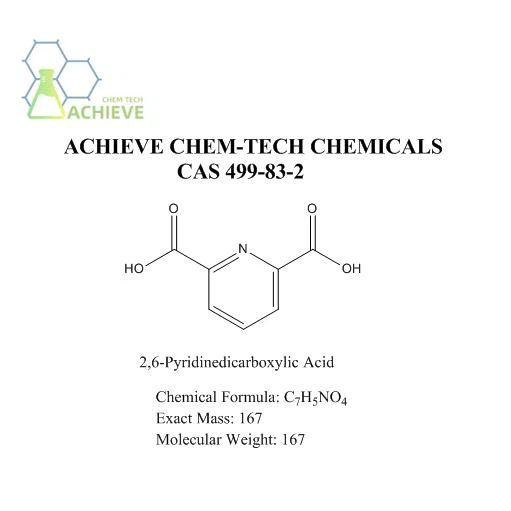
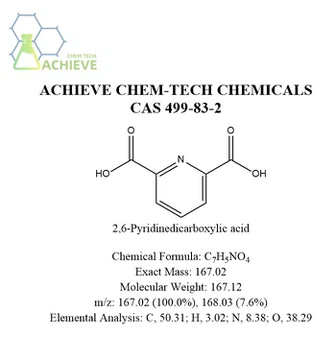
2,6-Pyridinedicarboxylic acid is an organic compound with CAS 499-83-2 and chemical formula C7H5NO4. It is a white or light yellow crystalline powder with a slight irritating odor. Soluble in organic solvents such as water, ethanol, and ether, slightly soluble in benzene, chloroform, etc. Stable at room temperature, but easily decomposes at high temperatures. It is an important intermediate in drug synthesis with a wide range of applications. It can be used to synthesize 2,6-diacetylpyridine, 2,6-diamino-4-chloropyridine, and can also be used for the next step of synthesizing metal ligand compounds, functional materials, and pharmaceutical intermediates. Pyridine-2,6-dicarboxylic acid naturally exists in bacterial spores, but its content is low and cannot meet the demand, making extraction difficult. Not conducive to industrial production and application. The first synthetic literature report was in 1935, in which Alvin W. Singer and s. m. mcelvain oxidized 2,6-dimethylpyridine in water with potassium permanganate in a yield of 64%. In industry, 2,6-dimethylpyridine is usually prepared by oxidation method. Pyridine-2,6-dicarboxylic acid is released from the spores of thermophilic fatty acid bacteria killed by high-pressure sterilization; It induces the aggregation of chitosan stabilized gold nanoparticles and changes the color of the solution from red to blue.

|
Chemical Formula |
C7H5NO4 |
|
Exact Mass |
167.02 |
|
Molecular Weight |
167.12 |
|
m/z |
67.02 (100.0%), 168.03 (7.6%) |
|
Elemental Analysis |
C, 50.31; H, 3.02; N, 8.38; O, 38.29 |
|
|
|
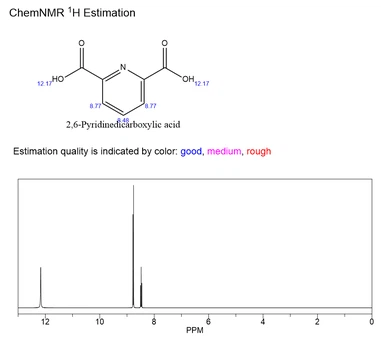

This is our advanced product 2,6-Pyridinedicarboxylic acid. Remark: BLOOM TECH(Since 2008), ACHIEVE CHEM-TECH is the subsidiary of us.
Synthetic pyridine-2,6-dicarboxylic acid: put 500ml of water, 2.0g of initiator ammonium persulfate, 2.0g of catalyst cutpp1, 100g of raw material 2,6-dimethylpyridine into a 1000ml three neck flask with thermometer, start stirring, add air (until the end of the reaction), heat up to 80 ℃, control the temperature to 80 ℃, after reaction for 3h, HPLC detection shows that the conversion rate is 98.0%, stop air supply, filter the chemicalbook and recover the catalyst, Add sodium hydroxide solution with a mass percentage concentration of 15% to the filtrate, adjust the pH to 9, let it stand for layering, separate the solution, acidify the lower water layer with hydrochloric acid with a mass percentage concentration of 15%, adjust the pH to 5, precipitate, filter, and dry the filter cake at room temperature under reduced pressure to obtain 150.3g of the product. Molar yield: 96.4%. The purity of the product was 99.84% by HPLC.
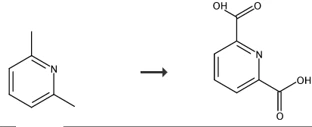

2,6-Pyridinedicarboxylic Acid can be used for the preparation of 2,6-pyridinediethanol, 2,6-disubstituted pyridine is an important class of organic synthesis intermediates, especially 2,6-pyridinediethanol has strong application. Hydroxyl groups can be derived to aldehydes, halogenated hydrocarbons, amino and many other functional groups, and then synthesize other important compounds. Moreover, due to the substitution of 2 and 6 positions, macrocyclic compounds can also be generated, which are widely used in synthesis and have high research value.
 |
 |
The use of Pyridine-2,6-dicarboxylic acid in metal ion extraction is very important. As an organic ligand, it can form stable complexes with various metal ions, thereby achieving the extraction and separation of metal ions.
+
-
In metal ion extraction, it can act as a ligand to bind with the target metal ion, forming soluble complexes. The formation of this complex allows metal ions to be separated from the solution, which can then be separated from the complex through centrifugation, filtration, washing, and other operations.
The application in metal ion extraction has the following advantages:
(1) High selectivity: It can form stable complexes with specific metal ions, thereby achieving highly selective extraction of metal ions.
(2) High extraction efficiency: It can form complexes with various metal ions, thus having high extraction efficiency.
(3) Easy to operate: Pyridine-2 6-dicarboxylic acid has good solubility, is easy to bind with target metal ions, and the formed complex has good stability, making it easy to separate and purify.
In terms of metal ion extraction, Pyridine-2 6-dicarboxylic acid has a wide range of applications and can be used to extract various metal ions, such as copper, zinc, iron, cobalt, nickel, etc. For example, in the extraction of copper, Pyridine-2 6-dicarboxylic acid can be used as a ligand to bind with copper ions to form soluble complexes, thereby achieving copper extraction. It has a wide range of applications in the field of drug carriers. As an organic compound, it can bind with drug molecules to form a stable drug carrier, thereby achieving targeted delivery and controlled release of drugs.
In the field of drug carriers, it can serve as a ligand for drug carriers and form stable complexes with drug molecules. The formation of this complex allows drug molecules to be encapsulated inside or outside the molecules of Pyridine-2 6-dicarboxylic acid, forming a complex with special properties.
+
-
This complex can achieve targeted delivery and controlled release of drugs in different ways within the body. For example, by introducing the complex into the body through oral or injection, the complex can slowly release the drug in the body, thereby achieving sustained release of the drug. At the same time, it can also bind to specific cell surface receptors to achieve targeted drug delivery.
The application in the field of drug carriers has the following advantages:
(1) Improving drug stability: It can form stable complexes with drug molecules, thereby protecting them from external environmental damage and improving drug stability.
(2) Realize drug sustained release: It can serve as a drug carrier to slowly release drugs in the body, thereby achieving drug sustained release. This sustained release effect can reduce the side effects of drugs and improve their efficacy.
(3) Targeted drug delivery: It can bind to specific cell surface receptors to achieve targeted drug delivery. This targeted delivery can increase the concentration of drugs at the lesion site, thereby enhancing the efficacy of drugs.
(4) Reducing drug side effects: As a drug carrier, it can reduce the amount of drug used, thereby reducing drug side effects.
(5) In the field of drug delivery, it has a wide range of applications and can be used to deliver various types of drugs, such as anti-cancer drugs, anti-inflammatory drugs, antibiotics, etc. For example, in the delivery of anti-cancer drugs, 2,6-Pyridinedicarboxylic Acid can be used as a carrier to deliver anti-cancer drugs to the tumor site, thereby improving the efficacy of anti-cancer drugs and reducing side effects.
Biological Significance of DPA
► Role in Bacterial Endospores
DPA is a hallmark of bacterial endospores, formed by species like Bacillus and Clostridium under stress. It comprises:
Calcium-DPA Complex: Binds Ca²⁺ in a 1:1 ratio, forming a chelate that stabilizes spore DNA and proteins.
Thermal Protection: Reduces water content in spores, preventing heat-induced denaturation.
Germination Trigger: Release of Ca²⁺-DPA during spore rehydration initiates metabolic activity.
Diagnostic Applications:
Fluorescent dyes (e.g., terbium-DPA complexes) detect spores in food safety and biodefense.
► Pharmacological Potential
Antimicrobial Activity: DPA derivatives inhibit bacterial biofilm formation by disrupting calcium homeostasis.
Anticancer Agents: Metal-DPA complexes (e.g., platinum-DPA) show cytotoxicity against tumor cells via DNA intercalation.
Neuroprotection: DPA scavenges reactive oxygen species (ROS), offering potential in Alzheimer's disease therapy.
Industrial and Technological Applications
Coordination Chemistry and Catalysis
DPA's tridentate chelating ability makes it a versatile ligand in:
Metal-Organic Frameworks (MOFs): DPA-based MOFs exhibit high surface areas for gas storage (e.g., CO₂ capture).
Homogeneous Catalysis:
Palladium-DPA complexes catalyze Suzuki-Miyaura cross-coupling reactions.
Ruthenium-DPA complexes mediate hydrogenation of alkenes.
Materials Science
Polymer Additives: DPA enhances thermal stability of polyamides and epoxy resins.
Corrosion Inhibitors: DPA-based films protect steel surfaces in acidic environments.

Analytical Chemistry
Chromatography: DPA derivatives serve as stationary phases in HPLC for separating aromatic compounds.
Spectroscopy: Terbium-DPA complexes emit intense fluorescence, enabling trace metal detection (e.g., Ca²⁺ in biological samples).
Innovations and Future Directions
► Sustainable Synthesis
Photocatalytic Oxidation: Using TiO₂ nanoparticles and visible light to oxidize 2,6-lutidine without strong acids.
Flow Chemistry: Continuous-flow reactors improve yield and reduce solvent use in DPA production.
► Advanced Drug Delivery
Nanocarriers: Encapsulating DPA in liposomes or mesoporous silica enhances bioavailability and targets specific tissues.
Prodrugs: Esterifying DPA's carboxyl groups improves membrane permeability, with enzymatic cleavage releasing active DPA intracellularly.
► Bio-Inspired Materials
Spore-Mimetic Coatings: Incorporating Ca²⁺-DPA complexes into polymer matrices creates heat-resistant coatings for electronics.
Self-Healing Polymers: DPA-based dynamic covalent bonds enable materials to repair cracks autonomously.
► Artificial Intelligence in DPA Research
Machine Learning: Predicting DPA-metal complex structures and catalytic activities to accelerate ligand design.
Robotics: High-throughput screening of DPA derivatives for antimicrobial or anticancer properties.
2,6-Pyridinedicarboxylic acid occupies a unique niche at the intersection of chemistry, biology, and materials science. Its dual carboxyl groups and pyridine nitrogen confer exceptional chelating properties, enabling applications from bacterial spore detection to green catalysis. While challenges like synthetic waste and biological barriers persist, innovations in sustainable synthesis, nanotechnology, and AI-driven design are poised to overcome these hurdles. As industries prioritize eco-friendly and high-performance materials, DPA's role in biotechnology, energy storage, and advanced manufacturing will expand, solidifying its status as a "small molecule with big potential."
We have absorbed advanced technology and craftsmanship, improved the quality of 99% Bulk Nifedipine Yellow Crystals Powder Nifedipine and production efficiency, and ensured its stability and durability. On the world stage, we will present more professional and honest products and considerate services. Thanks to our professional, dedicated, and sophisticated growth team, in the past few years, we have provided customers and partners with high-quality, cost-effective, and high-satisfaction quality services, and won the reputation and Certainly, it also won the continuous development and growth of the team.