

We uphold a consistent level of professionalism, quality, credibility and service for N tert Butoxycarbonyl 4 piperidone, bdo, iptg powder. At present, our company has won a good reputation with high quality products and sincere service attitude. You can see our products all over the world. Only by daring to be the first and constantly innovating can we create a greater successful market and achieve greater market success.
Procaine powder can be used as a raw material, chemical material in the laboratory. These physical properties help characterize its purity and solid-state structure. The electrical charge is neutral, so it does not have the advantages of electrostatic force and repulsive force. This limits its potential in technological applications. It is a chiral compound with both left-handed and right-handed properties. This optical activity is due to the chiral center in its molecule. The rotation of left rotation is -14.3 °, and the rotation of right rotation is+13.9 °. It has low toxicity. When used at the correct dosage, it is usually a safe anesthetic. However, excessive or misuse can lead to toxic reactions, including death. Overall, as an anesthetic drug, the study of its physical properties is crucial for its application and production, and these characteristics will also play an important role in the fields of technology and medicine.

|
|
|

|
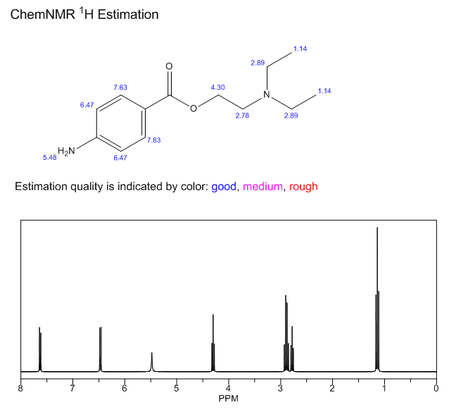
Chemical Formula |
C13H20N2O2 |
|
M.W |
236.31 |
| Melting point | 61° |
| Boiling point | 378.78°C (rough estimate) |
| Density | 1.0604 (rough estimate) |
| Refractive index | 1.5430 (estimate) |

Procaine acts primarily by inhibiting the inward flow of sodium ions from voltage-gated sodium channels in the cell membranes of neurons in peripheral nerves. When the inward flow of sodium ions is interrupted, action potentials cannot occur and signaling is thus inhibited. The receptor site is thought to be located in the cytoplasmic (inner) portion of the sodium channel.Procaine is also capable of binding to or antagonizing the function of N-methyl-D-aspartate (NMDA) receptors as well as nicotinic-type acetylcholine receptors and 5-hydroxytryptamine receptor-ion channel complexes.Procaine is an inhibitor of calcium- and caffeine-induced calcium release in various types of muscle preparations.0.5 mMProcaine blocks sarcoplasmic reticulum Ca in individual lipid bilayersProcaine can be used as a DNA demethylating agent with inhibitory effects on human cancer cell growth.
0.5 mMProcaine was able to reduce 5-methylcytosine DNA by 40% in the MCF-7 breast cancer cell line.Procaine is also able to bind to CpG-enriched DNA and demethylate densely hypermethylated CpG sequences, resulting in the restoration of gene expression of genes that have been epigenetically silenced.Procaine treatment (0.5 mM) increased cellular in M-phase mitotic index.Procaine treatment (1 mM) reduced cell proliferation by ~40%.Procaine affects the shape and deformability of erythrocytes.45 mMProcaine almost completely prevents the discoidal-spiny erythrocyte transition associated with ATP depletion. Similar concentrations of Procaine normalized ATP-depleted cell adhesion and filtration, but had no effect on cell volume, osmotic fragility, or monovalent cation composition.
Synthesis Method
Procaine powder, chemical name is 4-aminobenzoic acid 2-(diethylamino)ethyl ester hydrochloride. The synthesis of Procaine typically involves several steps, primarily using p-nitrobenzoic acid as the starting material. Below is a detailed synthesis route:
Step 1: Preparation of Nitrocaine
- Raw Materials: p-nitrobenzoic acid, diethylaminoethanol, xylene (as solvent and catalyst), and an antifoaming agent.
- Procedure:
In a three-necked flask equipped with a thermometer, water separator, and reflux condenser, add p-nitrobenzoic acid, diethylaminoethanol, xylene, and the antifoaming agent.
Heat the mixture under reflux conditions (oil bath temperature around 180°C, internal temperature around 145°C) for a period of time (typically 6 hours) to allow for the esterification reaction to occur.
Continuously remove the water formed during the esterification (a reversible reaction) by azeotropic distillation with xylene.
After the reaction, cool the mixture and pour into a conical flask to allow for solid separation.
Distill off the excess xylene under reduced pressure, dissolve the residue in 3% hydrochloric acid, and filter to remove unreacted p-nitrobenzoic acid. The filtrate containing nitrocaine is retained for further use.
Step 2: Reduction of Nitrocaine to Aminoester
- Raw Materials: Nitrocaine solution, iron powder, sodium hydroxide, and hydrochloric acid.
- Procedure:
Transfer the nitrocaine solution to a three-necked flask with stirring and temperature control.
Adjust the pH to 4.0-4.2 with 20% sodium hydroxide solution.
Gradually add iron powder in small portions while maintaining the temperature below 70°C (cooling may be required).
Allow the reduction reaction to proceed for 2 hours at 40-45°C.
Acidify the solution with hydrochloric acid to pH 5, then adjust the pH to 7.8-8.0 with saturated sodium sulfide solution to precipitate iron salts.
Filter the mixture, wash the precipitate, and acidify the filtrate again to pH 6.
Treat the solution with activated carbon, filter, and alkalize with 20% sodium hydroxide to pH 9.5-10.5 to precipitate the aminoester (Procaine base).
Step 3: Formation of Procaine Hydrochloride
- Raw Materials: Procaine base, concentrated hydrochloric acid, and optional recrystallization solvents.
- Procedure:
Dissolve the Procaine base in water and add concentrated hydrochloric acid dropwise until the pH reaches 5.5.
Heat the solution to 60°C and add saturated salt. Optionally, add an antioxidant such as sodium hydrosulfite and heat to 65-70°C for hot filtration.
Cool the filtrate to crystallization temperature, filter the crystals, and wash with cold ethanol.
Dry the crystals to obtain Procaine Hydrochloride.
For further purification, dissolve the crude product in distilled water, add activated carbon, filter hot, and cool to allow crystallization. Wash the crystals and dry to obtain the final product.

Pure API(Active pharmaceutical ingredient) for science researching only, Standard substance for analysis, Pharmacokinetic study, receptor resistance test etc. Also known as "novocaine", is commonly used in clinical practice. White crystalline or crystalline powder, soluble in water. The use of procaine is procaine injection, procaine therapy, etc. Adding a small amount of epinephrine into the injection can prolong the action time.
Procaine is not only a local anesthetic, but also widely used in the treatment of many diseases in clinical departments. Clinical application in pediatrics: treatment of whooping cough. Clinical application in dermatology: the treatment of herpes zoster, the treatment of allergic purpura, pruritus, neurodermatitis. Clinical application in obstetrics and gynecology: treatment of cervical dystocia, treatment of cervical edema, oxytocin effect. Clinical application in gastroenterology (treatment of pancreatitis). Clinical application in respiratory department: treatment of hemoptysis.
Quality & Analysis
thermal stability
The thermal stability is relatively average, with a thermal decomposition temperature of around 350 ° C. This can lead to easy degradation and release of toxic gases during the heating process.
Thermal degradation refers to the chemical reaction of drugs under high temperature conditions due to the action of thermal energy, which decomposes into monomers or other substances, resulting in a decrease in drug quality. The thermal degradation mechanism is mainly the decarboxylation of carboxyl groups and the fracture of epoxy rings.
The carboxyl group in Procaine is very prone to decarboxylation, which is caused by acidic environment. Under high temperature conditions, the epoxy ring will also break and two end groups will escape, while a single methyl group reacts with a hydroxyl group, resulting in molecular impurities.
The determination of thermal stability can be carried out using thermogravimetric analysis. This method is suitable for determining the thermal stability of drugs and can determine the parameters such as decomposition temperature, weight loss rate, and decomposition kinetics parameters of drugs. Usually, the drug sample is placed in a weighed aluminum measuring plate, and then heated with a constant heating rate, constant flow rate, and a stable flow rate of inert gas. The decomposition temperature is measured by recording the mass loss generated during the process.
In addition, thermal stability can also be evaluated by affecting its efficacy. Generally speaking, drugs with good thermal stability have much better efficacy. Therefore, the thermal stability of a drug can be evaluated by examining its pharmacological changes after high-temperature treatment.
The thermal stability is influenced by various factors. For example, it is easy to undergo decarboxylation under acidic conditions; At high temperatures, the epoxy ring can also break, leading to the pyrolysis of drugs. In addition, factors such as oxygen, water, and sunlight can also affect the thermal stability during long-term storage.
There are several methods to improve the thermal stability:
(1) Avoid using excessively high temperatures.
(2) Use some additives, such as calcium hydroxide, to increase thermal stability.
(3) Strengthen protection during storage, such as keeping drugs in cool and dry conditions.
(4) Use formulations containing stabilizers to improve the stability of drug quality.
Solubility
Procaine is easily soluble in water and methanol, slightly soluble in ethanol and chloroform, but not in benzene or dichloromethane. The solubility of this drug in water is 1g and can be dissolved in 100mL of water.
The solubility is crucial in studying the chemical and physical properties of the substance. It is a weakly acidic drug with a pKa value of 8.9. The solubility in water is temperature dependent, and the higher the temperature, the higher its solubility. The water solubility is 1 g/mL at 20 ℃, but it is about 7 g/mL at 40 ℃, which can be described by a solubility curve.
Procaine's solubility is also affected by other factors, such as pH value of solvent, ionic strength and concentration. Under acidic conditions, procaine is more easily soluble. Therefore, when preparing Procaine hydrochloride, Procaine can be dissolved in hydrochloric acid aqueous solution first, and then the hydrochloride can be precipitated.
In addition to water, it can also be dissolved in other common solvents. Organic solvents such as acetone, methanol, and chloroform can also be used to dissolve procaine. Nevertheless, the solubility in different solvents varies. For example, it has a higher solubility in acetone and a lower solubility in water. In certain situations, different solvents can be selected as needed for ease of use.
Because procaine powder is a drug, its solubility is also crucial in the pharmaceutical industry and clinical applications. During the production process, it is necessary to dissolve the drug in a suitable carrier in order to prepare various dosage forms, such as injections, oral formulations, sugar coated formulations, etc. At the same time, the factors that affect the solubility of Procaine also include particle size, morphology, and crystal defects. These factors also need to consider production factors such as solubility and yield to ensure the effectiveness of production and use.
adverse reaction
Procaine Powder, as a classic local anesthetic, is widely used in medical settings such as dental surgery, minor surgery, wound treatment, and nerve block. It achieves local anesthesia by blocking sodium ion channels on the nerve cell membrane, inhibiting the transmission of nerve impulses. However, like all drugs, procaine powder may also cause a series of adverse reactions during use, which may involve multiple systems and pose a potential threat to the health of patients.
Types and mechanisms of adverse reactions
Allergic reactions
Skin manifestations: Some patients may experience allergic reactions to procaine or its excipients, manifested as skin itching, erythema, or urticaria. These symptoms usually appear within minutes to hours after drug exposure and can be relieved by antihistamines.
Local edema: Allergic reactions may cause edema at the injection site or surrounding tissues, which may be related to increased vascular permeability.
Clinical manifestations: In rare cases, patients may experience severe allergic reactions, namely anaphylactic shock. This manifests as difficulty breathing, laryngeal edema, rapid drop in blood pressure, and even loss of consciousness. Allergic shock requires immediate emergency treatment, including adrenaline injection and maintaining airway patency.
Mechanism of occurrence: Allergic shock is caused by the body's IgE mediated type I hypersensitivity reaction to procaine or its metabolites. When exposed to the same antigen again, mast cells and eosinophils degranulate, releasing inflammatory mediators such as histamine and leukotrienes, leading to severe symptoms such as systemic vasodilation, increased permeability, and bronchospasm.
Central nervous system response
Dizziness and headache: These are common mild central nervous system reactions after using procaine powder. Medications may enter the bloodstream through local absorption, affecting brain function and causing symptoms such as dizziness and headache. These reactions usually occur in the early stages of drug action and gradually alleviate with drug metabolism.
Tinnitus and blurred vision: Some patients may report tinnitus or blurred vision, which may be related to the indirect effects of medication on the auditory and visual nerves. These symptoms are usually mild and transient.
Convulsions: When the concentration of procaine is too high or absorbed too quickly, it may trigger seizures. This is due to the excessive inhibition of the central nervous system by drugs, which leads to abnormal firing of neurons. Convulsions may manifest as systemic convulsions accompanied by loss of consciousness, and in severe cases can be life-threatening.
Anxiety and irritability: Some patients may experience psychological symptoms such as anxiety and irritability after using procaine. This may be related to the direct effects of drugs on the central nervous system or the patient's fear of surgery.
Cardiovascular system response
Blood pressure drop: Procaine may cause a decrease in blood pressure by dilating blood vessels or inhibiting myocardial contractility. This reaction is particularly common during anesthesia induction, possibly due to the direct effect of the drug on vascular smooth muscle or inhibition of the sympathetic nervous system. A decrease in blood pressure may lead to dizziness, fatigue, and even fainting.
Elevated blood pressure: In rare cases, procaine may cause an increase in blood pressure. This may be related to the direct stimulation of blood vessels by drugs or the patient's stress response to surgery.
Types of arrhythmia: Some patients may experience arrhythmia after using procaine, including tachycardia, bradycardia, or arrhythmia. This may be related to the direct impact of drugs on the cardiac conduction system or through reflex mechanisms such as compensatory heart rate acceleration caused by a decrease in blood pressure.
Severe arrhythmia: In extreme cases, procaine may cause severe arrhythmias such as ventricular tachycardia or ventricular fibrillation. These arrhythmias may be life-threatening and require urgent treatment.
Local tissue reactions
Reason for occurrence: Procaine powder may cause pain at the injection site during injection, which may be related to the drug's stimulation of local tissues or injection techniques. The degree of pain varies from person to person and can usually be alleviated by slowing down the injection speed or using a thinner needle.
Duration: Pain at the injection site is usually transient and gradually subsides as the drug spreads through the local tissue.
Mechanism of occurrence: In rare cases, procaine may cause inflammation or necrosis of local tissues. This may be related to high drug concentration, improper injection techniques, or the patient's special sensitivity to the drug.
Clinical manifestations: Local inflammation manifests as redness, swelling, and thermal pain, while necrosis may lead to tissue ulcers and scar formation. These reactions need to be dealt with promptly to avoid serious consequences.
With the enterprise spirit of unity and hard work, all staffs of our company strive to provide more value-added Hot Selling Procaine Hydrochloride CAS 51-05-8 Procaine Procaina Procaine Powder and services to our customers. We are looking forward to forming successful business relationship with customers all over the world. We are building a new business map and optimizing the strategic orientation of the company.