


Before production, the tetrahydrobiopterin synthesis, epinephrine hcl powder, Medetomidine HCl have passed the strict inspection and test of the company's performance testing center to ensure that the products meet the corresponding national standards and have excellent product quality and quality assurance. In response to the complex and severe domestic and international economic situation, we carry forward the spirit of hard work and innovation. Our strong comprehensive production capacity has been proved by market facts.
Announcement
This chemicals was banned to sell, our website only can check the basic info. of chemicals here, we don't sell them!
May 09, 2025
Pure benzocaine powder can be used for the local anesthetic action site, it is applied as a spreading agent for post-operative wound pain relief and ulcer pain. Benzocaine, Molecular formula C9H11NO2, CAS 94-09-7, exists in the form of white crystal or crystalline powder, its appearance is usually colorless or yellowish, and it usually appears in solid form. It has good solubility properties. It is soluble in various organic solvents, such as ethanol, ether, and chloroform. However, the solubility in water is relatively low. The solubility of water slightly increases with increasing temperature. Relatively stable under conventional conditions. However, it may be sensitive to heat, light, and oxygen. Therefore, during storage and use, exposure to high temperatures, strong light, and oxygen should be avoided. In addition, it also has the characteristic of being easily soluble in certain organic compounds and may react with other compounds. It is a weakly alkaline compound. Its pH value is usually between 7-9. The crystal morphology is complex and diverse, and can form crystals of different shapes, such as flakes, columns, or edges. However, it should be noted that the products produced by Shaanxi Chupeng Technology Co., Ltd. are only used as laboratory reagents and other uses are strictly prohibited.

|
|
|


| MF | C9H11NO2 |
| Exact Mass | 165.08 |
| Molecular Weight | 165.19 |
| m/z | 165.08 (100.0%), 166.08 (9.7%) |
melting point 88 – 90 °C, Boiling point 172 ° C ( 12.7517 mmHg ), Density 1.17refractive index 1.5600 ( estimate ), Flash point 172 ° C / 13 mm, Storage conditions 2-8 ° C, Solubility alcohol : soluble 1 gm in 5 ml, Acidity coefficient ( pKa ) 2.5 ( at 25 °C ), Crystalline Powder,Color White.

|
|
|


Pure benzocaine powder can be used as a spreading agent for postoperative wound pain and ulcer pain. It is called benzokain in Brazil, but it is usually shown in the shape of powdered benzocaine.
Medical use
Local anesthetics: Benzocaine is mainly used clinically for pain relief and itching relief of wounds, ulcer surfaces, burns, skin abrasions, and hemorrhoids. It acts on the nerve tissue of the skin and mucous membrane, blocking the transmission of nerve impulses and temporarily losing various sensations, thereby achieving the effect of local anesthesia. Its usage concentration is generally 5% to 20%.
Antipyretic and analgesic: Benzocaine is also classified as an antipyretic and analgesic drug, which can alleviate discomfort caused by pain. However, it is mainly used for local analgesia rather than systemic antipyretic analgesia.
Other medical applications: Benzocaine can also be used as an intermediate in drug synthesis and organic synthesis, with broad potential for pharmaceutical applications.

Use of cosmetics
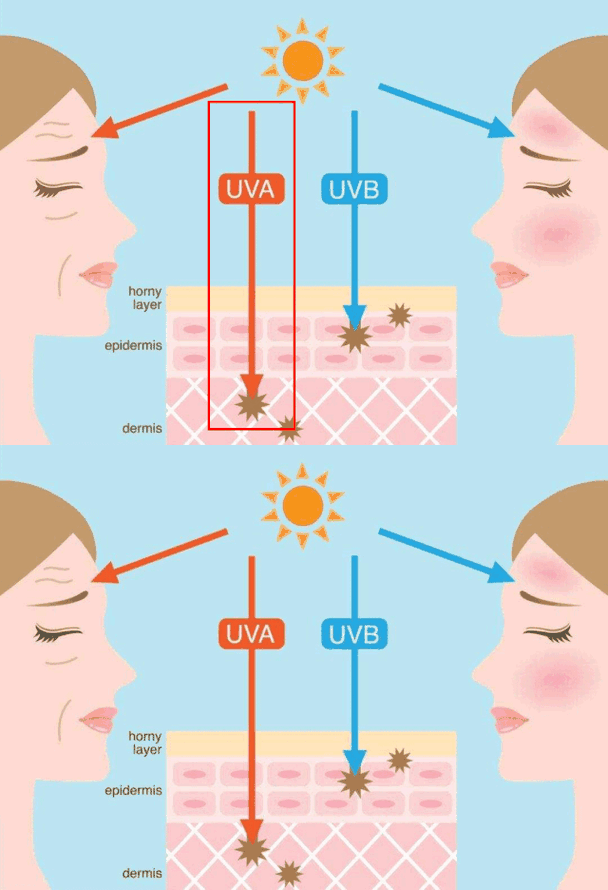
UV Absorbent: Benzocaine is mainly used in sunscreen and tanning cosmetics, with chemical stability to light and air, and is safe for the skin. It can effectively absorb U V. The ultraviolet radiation in the B region (280-320nm) is usually added in an amount of about 4%.
In addition, Benzocaine also has the ability to form a film on the skin, which helps to enhance the effectiveness of cosmetics.

Benzocaine (Benzamide) is a local anesthetic, which can be synthesized in the laboratory by various methods. Anisole method is one of them.
The second method for synthesizing Benzocaine involves the etherification reaction between p-benzyl bromide and p-aminophenol. The specific steps are as follows:
The main reaction formula of this synthesis method is as follows:
C6H5CH2Br+C6H4 (OH) NH2 → C9H11NO2+HBr
Step 1: Prepare reactants
-Benzyl bromide (C6H5CH2Br)
-Paraaminophenol (C6H4 (OH) NH2)
Step 2: Reaction
(1) Add benzobromide and p-aminophenol in a 1:1 molar ratio into a dry Round-bottom flask.
(2.) Add a small amount of alkaline catalyst, such as sodium carbonate (Na2CO3) or potassium carbonate (K2CO3), to promote the etherification reaction.
(3.) Stir the reaction mixture at room temperature until the reaction is complete.
Step 3: Product extraction
(1.) Pour the reaction mixture into a Separatory funnel.
(2.) Add an appropriate amount of saturated saline solution and gently shake the Separatory funnel to extract Benzocaine into the aqueous phase.
(3.) Collect the aqueous phase into a clean beaker or container.
Step 4: Crystallization
(1.) Under appropriate temperature conditions, such as through an ice bath or heating, evaporate the solvent in the aqueous phase to obtain the crystallization of Benzocaine.
(2.) Filter and wash the crystals, which can be washed with appropriate solvents.
(3.) Dry the washed crystals or use appropriate methods to obtain pure Benzocaine.
Under the trend of globalization of production and diversification demand for the Lidocaine Hydrochloride Chemical 99% High Purity Cp2000 CAS 73-78-9 99% Pure Powder Pharmaceutical Chemical, we have the ability to quickly respond to the market. We take good social responsibility as our corporate values and cultural roots in order to ultimately achieve green development and sustainable development. Our company drives the material flow with information flow and gradually realizes the upgrade of efficiency, quality, innovation, cooperation and marketing ability.