




Shaanxi BLOOM Tech Co., Ltd. is one of the most experienced manufacturers and suppliers of sclareolide cas 564-20-5 in China. Welcome to wholesale bulk high quality sclareolide cas 564-20-5 for sale here from our factory. Good service and reasonable price are available.
Sclareolide is a common volatile oil component in plants, with a unique aromatic odor and biological activities such as antibacterial and anti-inflammatory. It is a colorless or white powder with a unique aromatic odor. There are multiple double bonds and hydroxyl groups in its molecular structure, making it highly polar and hydrophilic. The boiling point is relatively high, around 250-260 ℃. It is easy to decompose at high temperatures, so the temperature should be controlled during distillation or heating. It can be soluble in organic solvents such as ethanol and ether, but not in water. The solubility in water is very low, usually less than 1%. It has high volatility and a lower boiling point, so it can evaporate at lower temperatures. During the evaporation process, the double bonds in its molecular structure will undergo changes, producing different aroma components. Under conditions such as light, high temperature, and oxygen, it is unstable and prone to oxidation, polymerization, and other reactions, leading to its deterioration. Therefore, attention should be paid to avoiding direct sunlight, high temperatures, and contact with oxygen during storage and use. It is a substance isolated from sage flowers and has antibacterial and cytotoxic effects. Widely used as a tobacco flavoring agent; In adipocyte culture, it can significantly promote fat breakdown and reduce adipocyte volume, and can be used as a weight loss agent; Perilla lactone can prevent skin cancer and can also be used as a tanning agent.

|
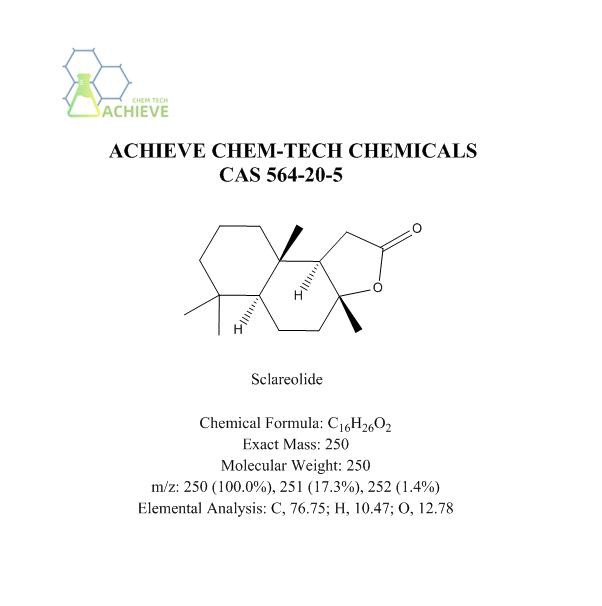
Chemical Formula |
C16H26O2 |
|
Exact Mass |
250 |
|
Molecular Weight |
250 |
|
m/z |
250 (100.0%), 251 (17.3%), 252 (1.4%) |
|
Elemental Analysis |
C, 76.75; H, 10.47; O, 12.78 |
|
|
|


Perilla frutescens lactone, also known as decahydrotetramethylnaphthofuranone, has a molecular formula of C16H26O2 and a molecular weight of approximately 250.38 g/mol. It is a white or off white crystalline powder with a weak amber aroma, strong diffusion, and long-lasting odor. Perilla lactone is insoluble in water, but soluble in organic solvents such as ethanol. Its chemical name is decahydroxy-3a, 6,6,9a-tetramethylnaphtho (2,1b) furan-2 (1h) - one, and its CAS registry number is 564-20-5.
Perilla lactone is mainly extracted from the flowers of Salvia sclarea, especially the Perilla grass grown in the shallow mountainous areas of northern Shaanxi. Due to its unique temperature, humidity, and altitude, it has a high ester content and pure aroma. Extraction methods include steam distillation, etc.

Application Fields
Perilla frutescens lactone has been widely used in various fields due to its unique aroma and biological activity.
Food industry: As a seasoning to enhance the sensory effect of food, it can be used in foods containing sweet seasonings to improve the olfactory experience. In the coffee industry, adding a small amount of perilla lactone can increase the bitterness of coffee and enhance its refreshing effect.
Tobacco industry: As a flavoring agent, it masks the coarse impurities in tobacco, improves the quality of aroma, and gives tobacco a pleasant characteristic aroma.
Spice industry: Sclareolide is used to synthesize natural ambergris substitutes, such as ambergris ether, and is an important raw material for advanced perfume and cosmetics.
Weight loss products: help reduce body fat and improve the quality of lean bodies without cardiovascular stimulation.
Beauty industry: It has antioxidant, anti-inflammatory and antibacterial effects, and is widely used in skin care products, facial mask, essence and other products.


Medical applications
Perilla frutescens lactone has shown significant application value in the field of medicine.
Antibacterial activity: It has good antibacterial activity against Staphylococcus aureus, Pseudomonas aeruginosa, Escherichia coli, and Enterococcus faecalis.
Anticancer effect: In cancer treatment, perilla lactone enhances gemcitabine induced cell death by mediating the NICD and Gli1 pathways in gemcitabine resistant human pancreatic cancer, showing the potential as a new drug for gemcitabine resistant pancreatic cancer combined with gemcitabine.
Biological activity
Perilla frutescens lactone has various biological activities, making it widely used in the beauty industry.
Antioxidant effect: It can neutralize free radicals, reduce oxidative damage, and help the skin maintain a youthful and healthy state.
Anti inflammatory effect: Inhibits the production of inflammatory factors, alleviates skin inflammation symptoms, and promotes skin recovery.
Antibacterial effect: effectively inhibits bacterial growth, reduces acne formation, and keeps the skin clean and healthy.
Enhance skin barrier function: Improve the skin's moisturizing ability, prevent moisture loss, and keep the skin moisturized.
Regulating skin oil secretion: reducing problems such as oiliness and enlarged pores.


At present, the chemical synthesis method is usually used to synthesize sclareolide in China, which requires the oxidation of coriolol with oxidant potassium permanganate. In this process, the use of a large number of oxidants and catalysts will cause great harm to the environment, and the chemical synthesis of coriolide is used in food, but its purity is not high enough, and it is used in cosmetics, and the aroma components are easily affected.
The purpose of this method is to provide a method for biosynthesis of coriolide that can solve the problems of unfriendly environment, cumbersome steps and low safety in the process of chemical synthesis of coriolide. To achieve the above purpose, the technical scheme adopted in this method is:
Take the yeast culture medium and add 3%~8% of coriol alcohol and 4%~10% of Cryptococcus albicans protoplast fluid to the yeast culture medium to obtain the mixture;
Place the mixture in a glass container, and then ferment it in a shaker at 23-28 ℃ and 140~180 r/min for 10 days to obtain coriolactone.
The ph value of the yeast culture medium is 6.0.
Tween 80 with a mass of 1.5%~4% is also added to the yeast culture medium.
The light white Cryptococcus cerevisiae was mutated by ultraviolet light for 3 to 4 minutes.
This method uses the microbial transformation method, uses the basil alcohol as the sclareolid, and uses the light white Cryptococcus cerevisiae to transform it to produce basil lactone, which solves the problems of unfriendly environment, cumbersome steps and low safety in the process of chemical synthesis of basil lactone, and provides a new way for the synthesis of basil lactone.
Specific implementation mode:
Example 1:
1) Take the yeast culture medium and add 3% of caryol alcohol and 6% of Cryptococcus albicans protoplast fluid to the yeast culture medium to obtain the mixture;
2) Place the mixture in a glass container, and then ferment it in a shaker at 25 ℃ and 140 r/min for 10 days to obtain coriolide.
Example 2:
1) Take the yeast culture medium with a ph value of 6.0 and add 5% caryol, 1.5% tween 80, and 4% protoplast fluid of Cryptococcus albicans mutated by ultraviolet light for 3 minutes to obtain the mixture;
2) Place the mixture in a glass container, and then ferment it in a shaker at 23 ℃ and 160 r/min for 10 days to obtain coriolide.
Example 3:
1) Take the yeast culture medium with a ph value of 6.0 and add 8% of the yeast culture medium mass of coriol, 3% of tween 80, and 8% of the protoplast fluid of Cryptococcus albicans mutated by ultraviolet light for 4 minutes to obtain the mixture;
2) Place the mixture in a glass container, and then ferment it in a shaker at 26 ℃ and 150 r/min for 10 days to obtain coriolide.
Example 4:
1) Take the yeast culture medium with a ph value of 6.0 and add 6% of perilla alcohol, 4% of tween 80 and 10% of protoplast fluid of Cryptococcus albicans mutated by ultraviolet light for 3.5 min to obtain the mixture;
2) Place the mixture in a glass container, and then ferment in a shaker at 28 ℃ and 180 r/min for 10 days to obtain coriolide.
The invention selects a strain with high yield of perilla lactone by mutation of Cryptococcus albicans by ultraviolet rays. According to the preparation method in Example 4, the yield of coriolide is the highest, 35.2g/l. Two strains with high yield of perilla lactone were obtained by UV mutagenesis of Cryptococcus albicans for 3~4 min, and the yield was 18.2% higher than that of the original strain.
The invention relates to a method for biosynthesis of sclareolide, which takes yeast culture medium and adds 3% - 8% caryophyllol and 4% - 10% of Cryptococcus albicans protoplast fluid of yeast culture medium respectively to obtain the mixture; Place the mixture in a glass container, and then ferment it in a shaker at 23 ‑ 28 ℃, 140~180 r/min for 10 days to obtain coriolactone. The invention uses the microbial transformation method, uses the coriol alcohol as the substrate, and uses the light white cryptococcus to transform it to prepare coriolide, which solves the problems of unfriendly environment, cumbersome steps and low safety in the process of chemical synthesis of coriolide, and provides a new way for the synthesis of coriolide.

The chemical properties of Sclareolide (fragrant perilla lactone) can be summarized as follows:


I. Molecular Structure and Basic Properties
Sclareolide is a sesquiterpene lactone compound with the molecular formula C₁₆H₂₆O₂, and its molecular weight is approximately 250.38. Its structure consists of a ten-hydroxy-naphthalenone skeleton and contains four chiral centers (3aR, 5aS, 9aS, 9bR). This stereoconfiguration endows it with unique chemical stability. The compound is white to off-white crystalline powder at room temperature, with a melting point range of 124-126℃, a predicted boiling point of 321.4℃, and a density of approximately 1.009 g/cm³ (25℃), indicating its high thermal stability and moderate density.
II. Solubility and Solvent Compatibility
The solubility of sclareolide shows a significant polarity-dependent behavior. It exhibits excellent solubility in non-polar or weakly polar organic solvents, such as ethanol, dimethyl sulfoxide (DMSO), and methanol, with a concentration of up to 50 mg/mL (199.69 mM); it is slightly soluble in chloroform. However, its solubility in water is extremely low (only 10 mg/L at 25°C), which limits its direct application in aqueous systems. This property can be improved through the use of surfactants or chemical modification.
III. Chemical Stability and Reactivity
Sclareolide exhibits stable chemical properties under normal storage conditions (sealed, dry, at room temperature), but it should be avoided from strong oxidants or extreme pH environments. The lactone ring structure of this compound may undergo hydrolysis under acidic conditions, generating corresponding hydroxy acid derivatives; in alkaline environments, it may undergo structural transformation through an opening-closing mechanism. Additionally, this compound is sensitive to light and prolonged exposure may lead to degradation, so it is recommended to store it in a dark place. Its thermal stability allows for maintaining the structural integrity during high-temperature distillation processes (such as when extracting from plants).
IV. Functional Groups and Potential Reactions
The lactone ring within the molecule is the most active functional group of Sclareolide and can participate in various organic reactions:
Reduction reaction: Under the action of a catalyst, the lactone ring can be reduced to a diol structure, generating derivatives with different biological activities.
Ester exchange reaction: By reacting with alcohols, a series of ester derivatives can be synthesized, which are used for fragrance blending or drug modification.
Ring addition reaction: Under specific conditions, the lactone ring may participate in the Diels-Alder reaction to construct more complex cyclic systems.
These reactions provide a theoretical basis for the chemical modification of Sclareolide, supporting its diverse applications in the fields of perfumery and medicine.
V. Physical Properties and Sensory Attributes
Sclareolide has unique sensory characteristics. Its solid form exhibits a light woody aroma. When diluted (such as a 10% isopropyl tetradecanoate solution), it can emit an elegant musk-like note, accompanied by base notes of amber and labdanum. This aroma characteristic makes it a core fixative in high-end perfumes and cosmetics, significantly enhancing the persistence and complexity of the fragrance.
FAQ
1. What is sclareolide used for?
Fragrance: Sclareolide has a characteristic fragrance that is used in perfumes and as a masking agent in various products. It helps mask the undesirable smell of other ingredients in a product. Hair Care: Sclareolide is used in formulations of shampoos, conditioners, and other hair care products.
2. What is the molecule sclareolide?
Sclareolide is a sesquiterpene lactone natural product derived from various plant sources including Salvia sclarea, Salvia yosgadensis, and cigar tobacco. It is a close analog of sclareol, a plant antifungal compound.
3. What is the solubility of sclareolide?
Sclareolide has a solubility of approximately 0.33 mg/ml in a 1:2 solution of DMF:PBS (pH 7.2) using this method. We do not recommend storing the aqueous solution for more than one day.
Hot Tags: sclareolide cas 564-20-5, suppliers, manufacturers, factory, wholesale, buy, price, bulk, for sale, Sucrose Powder CAS 57 50 1, Sorbic Acid Powder CAS 110 44 1, Pure Trisodium Citrate Dihydrate CAS 6132 04 3, Yeast Extract Powder CAS 8013 01 2, Alpha Amylase Powder CAS 9000 90 2, s allyl l cysteine