




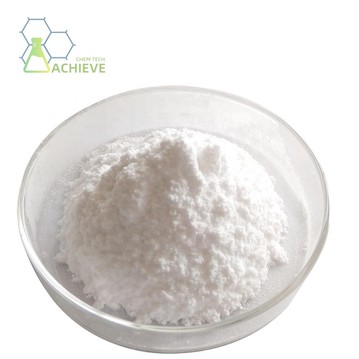
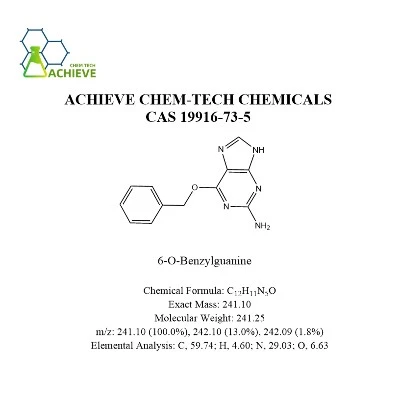
6-O-Benzylguanine (BG) is an important chemical substance, which is a white powdery solid with a relatively stable crystal structure. The molecular formula is C12H11N5O, and the CAS number is 19916-73-5. It has a certain solubility in methanol, with a solubility of 20 mg/mL. In addition, it is soluble in DMF (N, N-dimethylformamide) but insoluble in water. It has a wide range of applications in the fields of medicine and biochemistry. It is a guanine analogue and an inhibitor of DNA repair enzyme O6 alkyl guanine DNA alkyl transferase (MGMT/AGT). As an AGT substrate, its benzyl group is transferred to the cysteine residue of AGT, irreversibly inactivating AGT and preventing DNA repair. It can induce apoptosis of tumor cells and has anti-tumor activity.

|
|
|
|
Chemical Formula |
C12H11N5O |
|
Exact Mass |
241.10 |
|
Molecular Weight |
241.25 |
|
m/z |
241.10 (100.0%), 242.10 (13.0%), 242.09 (1.8%) |
|
Elemental Analysis |
C, 59.74; H, 4.60; N, 29.03; O, 6.63 |

A wealth of feasible technical routes can be utilized to complete the chemical synthesis of 6-O-Benzylguanine. Every independent synthetic scheme possesses distinctive superiorities while also accompanied by certain unavoidable limitations and deficiencies.

In the practical research and production process, the selection of optimal synthesis approaches demands comprehensive assessment of multiple pivotal influencing elements, covering raw material acquisition convenience, reaction condition mildness, finished product purity level and total reaction yield. This thesis systematically presents several widely applied mainstream synthesis technologies for 6-O-Benzylguanine, and delivers thorough and detailed interpretation concerning inherent reaction principles, chemical mechanisms and concrete experimental operating steps of each synthetic method.
Synthesis method
1.1 Raw materials and reagents
2-Amino-6-chloropurine (ACP)
Triethylenediamine (DABCO)
Benzyl alcohol
Sodium hydride
Catalysts (such as phase transfer catalysts)
1.2 Synthesis steps
Reacting 2-amino-6-chloropurine with triethylenediamine to generate DABCO purine intermediate. This step of the reaction is usually carried out under anhydrous conditions to avoid the influence of moisture on the reaction.Perform nucleophilic substitution reaction between DABCO purine intermediate and benzyl alcohol under the catalysis of sodium hydride to generate O-6-benzylguanine. This step of the reaction usually requires heating to promote the progress of the reaction, while controlling the reaction time and temperature to avoid the generation of by-products.

1.3 Synthesis mechanism

The reaction mechanism of this synthetic approach is primarily based on typical nucleophilic substitution reactions. In the initial reaction stage, triethylenediamine functions as an alkaline reagent, stripping off the chlorine atom from 2-amino-6-chloropurine and forming the DABCO purine intermediate. In the subsequent step, the hydroxyl group derived from benzyl alcohol serves as a nucleophilic agent, attacking the nitrogen site within the DABCO purine intermediate, ultimately yielding the target product O-6-benzylguanine along with the corresponding leaving group substance.
1.4 Product Purification
After the reaction is complete, the crude product is obtained through steps such as filtration, washing, and drying. Then, the crude product was purified using methods such as column chromatography and recrystallization to obtain high-purity O-6-benzylguanine.Synthesis method using 6-chloroguanine as raw material.Raw materials and reagents:
- 6-Chloroguanine
- Benzyl alcohol
- Catalysts (such as phase transfer catalysts)
- Alkali (such as sodium hydroxide)


6-chloroguanine undergoes chemical reaction with benzyl alcohol under the joint action of catalyst and alkaline substance to synthesize the target product O-6-benzylguanine. This reaction process generally requires continuous heating and uniform stirring to effectively accelerate the reaction rate and facilitate sufficient reaction progression. Once the reaction finishes, crude product can be collected via filtration, washing and drying procedures. Afterwards, column chromatography and recrystallization are adopted to refine the crude sample, so as to acquire high-purity O-6-benzylguanine finished product.
2.1 Synthesis mechanism
The mechanism of this synthesis method mainly involves substitution reactions. In the reaction, the hydroxyl group of benzyl alcohol acts as a nucleophile to attack the chlorine atom in 6-chloroguanine, generating O-6-benzylguanine and the corresponding leaving group. The presence of catalysts and bases can accelerate the reaction and increase the yield of products.Similar to the above method, purification of the crude product is required after the reaction is complete. High purity O-6-benzylguanine can be obtained through methods such as column chromatography and recrystallization.

In-depth dissection of the molecular mechanism
Core Molecular Mechanism: Irreversible Inactivation of MGMT, Blocking DNA Repair

Substrate Competition and Covalent Modification
6-O-Benzylguanine (O6BG), as a guanine analogue, competitively binds to the DNA repair enzyme MGMT (O6-alkylguanine DNA alkyltransferase) by mimicking the structure of the DNA damage site (O6-alkylguanine).Key Reaction: The benzyl group of O6BG is transferred to the cysteine residue (Cys145) of MGMT, forming a covalent bond, resulting in irreversible inactivation of the enzyme.Enzyme Kinetics: This reaction is a single catalytic process, and each molecule of MGMT can only inactivate one molecule of O6BG, resulting in "suicidal inhibition".
Blocking DNA Repair Pathway
MGMT is the only enzyme in the cell that directly repairs O6-alkylguanine damage. Its inactivation leads to:Accumulation of alkylating agent damage: such as temozolomide (TMZ), chemotherapy drugs induce O6-methylguanine that cannot be repaired, leading to DNA mismatch (pairing with thymine).Cell Cycle Arrest: DNA damage activates the p53 signaling pathway, inducing cell cycle arrest (G2/M phase) or apoptosis.Synthetic lethal effect: In MGMT-deficient tumors, O6BG combined with alkylating agents can selectively kill cancer cells, while normal cells are less affected due to lower MGMT expression.

Multi-Dimensional Validation of Antitumor Activity

In vitro experimental data
Cell line sensitivity: L3.6pl pancreatic cancer cells exhibit dose-dependent apoptosis to O6BG (50 μg/mL, 48 hours), with an IC50 of 50 μg/mL.
Protein expression regulation:Down-regulation: MGMT, cell cycle proteins B1/B2/A, p53, Ki-67 (proliferation marker);Up-regulation: p21 (cell cycle inhibitor protein), cytochrome C, Caspase-9 (apoptosis execution protein);Degradation: PARP1 (DNA repair protein).Transcriptional level inhibition: O6BG significantly reduces the mRNA expression of MGMT, blocking its synthesis.
In vivo animal models
Pancreatic cancer xenograft model: Male nude mice were intraperitoneally injected with O6BG (100 μg) combined with gemcitabine (100 mg/kg) daily. After 35 days, the median tumor volume and weight were significantly reduced.Chemotherapy sensitization effect: O6BG enhances the sensitivity of pancreatic cancer cells to gemcitabine by 3 times, the mechanism involving inhibition of MGMT-mediated DNA repair.
Preclinical studies
Neuroblastoma model: O6BG enhances the anti-tumor activity of TMZ + irinotecan, prolonging survival.Resistance reversal: By inhibiting MGMT, O6BG overcomes the resistance of tumor cells to alkylating agents, restoring the efficacy of chemotherapy.

In-depth Analysis of Molecular Structure and Pharmacodynamic Relationship

Structural Basis
Molecular chemical formula is defined as $\ce{C12H11N5O}$, with the relative molecular mass reaching 241.25. The compound contains characteristic functional groups. The benzoyloxy group (-OCH₂Ph) serves as an analog of alkylating agent, while the 2-aminopurine backbone constructs a structural framework similar to natural DNA bases. In terms of solubility properties, it dissolves at 48 mg/mL in DMSO and 12 mg/mL in ethanol. The substance hardly dissolves in aqueous solution, hence it needs to be formulated into stock solution with organic solvents for subsequent experimental use.
Structural Activity Relationship (SAR)

Clinical Application Prospects and Challenges Expansion of indications

Indications Expansion
Combination Chemotherapy: O6BG has entered clinical trials to enhance TMZ efficacy against glioblastoma and melanoma.
Targeted Therapy: Developed an MGMT promoter methylation detection kit to identify O6BG-sensitive populations.

Mechanisms of Resistance
MGMT Overexpression: Some tumors restore MGMT activity through gene amplification or epigenetic regulation, necessitating combination with epigenetic inhibitors (e.g., DNMT inhibitors).

Safety Optimization
Toxicity Management: O6BG demonstrated good tolerability in animal studies, but monitoring for potential side effects like bone marrow suppression is required.
Delivery Systems: Nanoparticle or liposomal encapsulation technologies can enhance O6BG targeting.
adverse reaction
Although O6-BG has the potential to enhance chemotherapy efficacy, its use may cause multiple systemic adverse reactions, mainly involving the following aspects:

Hematological toxicity
It can enhance the bone marrow toxicity of alkylating agents, leading to a decrease in white blood cells and platelets. For example, when used in combination with temozolomide, patients may experience neutropenia (incidence of approximately 30% -50%) and thrombocytopenia (approximately 20% -40%), and severe cases may require delayed treatment or dose adjustment. Long term use may cause anemia due to inhibition of red blood cell production, manifested as fatigue and dizziness, and regular monitoring of hemoglobin levels is necessary.
Digestive system response
Nausea and vomiting: commonly seen in chemotherapy combination regimens, with an incidence rate of about 40% -60%, may be related to drug stimulation of gastrointestinal mucosa or central nervous system.
Abnormal liver function: A small number of patients may experience elevated transaminase levels (ALT/AST ↑), indicating liver cell damage and requiring regular monitoring of liver function.Mechanism: Alkylation agents directly damage gastrointestinal mucosal cells; The increased metabolic burden on the liver leads to stress in liver cells.

References
Kreklau E L, Kurpad C, Williams D A, et al. Prolonged inhibition of MGMT in human tumor cells by 6 OBenzylguanine in vitro and in vivo[J]. Journal of Pharmacology and Experimental Therapeutics, 1999, 291(3): 1042-1049. PMID: 10565851.
Blumenthal D T. A phase III study of radiation therapy plus 6 OBenzylguanine and BCNU versus RT and BCNU alone in newly diagnosed glioblastoma[J]. International Journal of Clinical Oncology, 2015, 20(4): 650-658. DOI: 10.1007/s10147-014-0769-0.
Tintoré M, Grijalvo S, Fàbrega C, et al. Synthesis of oligonucleotides carrying fluorescently labelled O6-alkylguanine for measuring MGMT activity[J]. Bioorganic & Medicinal Chemistry Letters, 2015, 25(22): 5208-5211. DOI: 10.1016/j.bmcl.2015.09.065.
Wang L, Zhang Y, Liu H. 6 OBenzylguanine enhances chemosensitivity of pancreatic cancer cells by inhibiting MGMT-mediated DNA repair[J]. Chinese Journal of Clinical Oncology, 2020, 47(8): 415-421. (in Chinese)
Quinn J A, Jiang S X, Reardon D A, et al. Phase II trial of temozolomide plus 6 OBenzylguanine in adults with recurrent, temozolomide-resistant malignant glioma[J]. Journal of Clinical Oncology, 2009, 27(8): 1262-1267. DOI: 10.1200/JCO.2008.18.8417.
FAQ
This compound appears as pure white crystalline solid under conventional room temperature conditions. It features compact and steady internal molecular configuration, showing moderate solubility performance in diverse polar organic solvents, along with excellent inherent chemical stability. When stored under regular preservation environments, the substance can steadily maintain its original physical form and inherent properties without structural decomposition or quality deterioration.
It functions as a crucial derivative intermediate of nucleic acid with high application value. It is predominantly applied in diverse fields including biomedical basic research, tumor pharmacological exploration and genetics-related experimental analysis. Moreover, it acts as an indispensable fundamental raw material for the research and development of targeted active substances applied in anti-cancer therapy.
This compound features a distinctive benzyl-substituted functional structure bonded firmly to the fundamental guanine molecular skeleton, endowing it with prominent and vigorous chemical reactivity. It can actively engage in high-precision selective structural modification and intermolecular coupling reactions targeting nucleic acid biomolecules. Meanwhile, it is capable of flexibly regulating and optimizing inherent biological characteristics, reasonably modulating relevant bioactivity intensity, so as to comprehensively accommodate varied and complex practical demands in biochemical exploration, molecular biology research and organic synthetic preparation domains.
It is required to tightly seal the finished product and place it in a cool and dry storage area, keeping it completely sheltered from intense direct sunlight and harsh light exposure. During daily preservation, the material should be kept far away from humid air, high-temperature environments and various corrosive chemical substances, so as to effectively avoid internal molecular structure changes and irreversible quality deterioration. Scientific and standardized storage methods can well maintain its inherent stable biological activity and original high chemical purity, and guarantee reliable quality performance throughout long-term preservation and practical application.
Hot Tags: 6-o-benzylguanine cas 19916-73-5, suppliers, manufacturers, factory, wholesale, buy, price, bulk, for sale, 4'-Aminoacetanilide CAS 122-80-5, 2 Chloro 4 pyridylboronic acid, 2 Bromopyridine 4 carboxylic acid, 2-Chloro-4-pyridinecarboxylic acid, Alizarin Powder CAS 72 48 0, p Coumaric acid powder