


Shaanxi BLOOM Tech Co., Ltd. is one of the most experienced manufacturers and suppliers of titanium carbide powder cas 12070-08-5 in China. Welcome to wholesale bulk high quality titanium carbide powder cas 12070-08-5 for sale here from our factory. Good service and reasonable price are available.
Titanium carbide powder presents itself as a grayish-black, incredibly fine powder with a metallic luster, renowned for its exceptional combination of properties that place it among the most advanced engineering ceramics. It possesses an extraordinary melting point, exceptional hardness rivaling that of diamond, outstanding mechanical strength, and remarkable resistance to wear and corrosion. This powder is chemically stable and exhibits excellent electrical and thermal conductivity.
These superior characteristics make it an indispensable raw material for manufacturing ultra-hard composites and high-performance cermets, widely used in cutting tools, wear-resistant coatings, and aerospace components. Furthermore, it serves as a crucial precursor in the synthesis of advanced materials like MXenes, opening up new possibilities in fields such as energy storage and catalysis, showcasing its vast potential in cutting-edge technological applications.

|
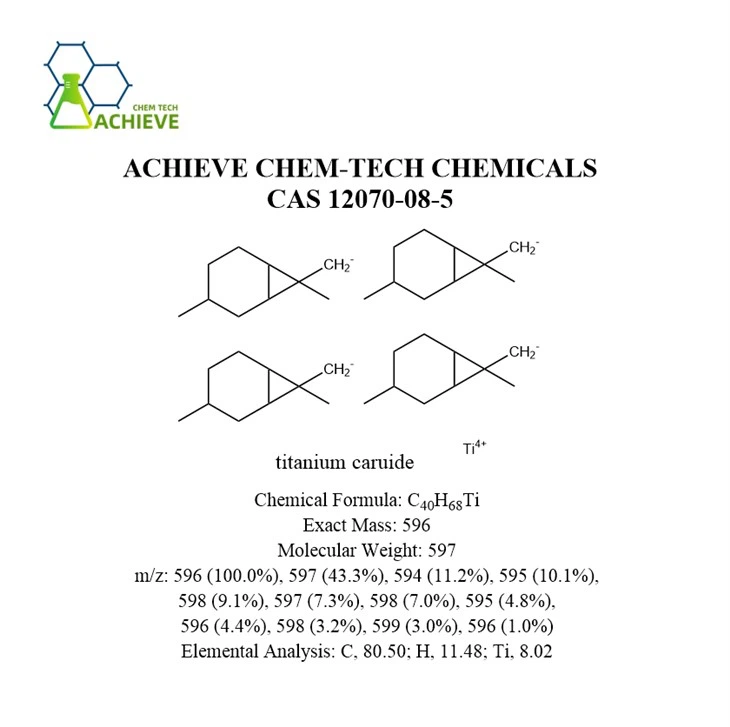
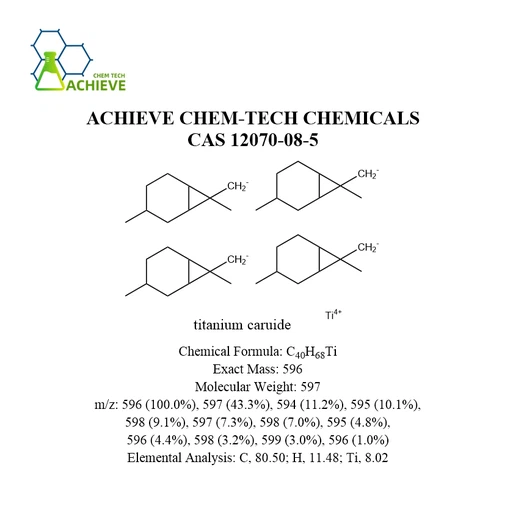
Chemical Formula |
C40H68Ti |
|
Exact Mass |
596 |
|
Molecular Weight |
597 |
|
m/z |
596 (100.0%), 597 (43.3%), 594 (11.2%), 595 (10.1%), 598 (9.1%), 597 (7.3%), 598 (7.0%), 595 (4.8%), 596 (4.4%), 598 (3.2%), 599 (3.0%), 596 (1.0%) |
|
Elemental Analysis |
C, 80.50; H, 11.48; Ti, 8.02 |

Titanium carbide powder, with its unique physical and chemical properties, has demonstrated extensive application value in various fields ranging from traditional manufacturing to cutting-edge technology. With the development of interdisciplinary fields such as material genomics engineering, nanotechnology, and intelligent manufacturing, the application boundaries of TiC materials continue to expand.
Titanium carbide (TiC) is a interstitial compound formed by the reaction of titanium and carbon at high temperatures, with a face centered cubic crystal structure (Fm3m space group) and a lattice constant of a=4.329 Å. Its intrinsic characteristics include:
Ultra high hardness: Mohs hardness 9.0, microhardness up to 3200kg/mm ² (31.4GPa)


Excellent wear resistance: friction coefficient<0.2 (dry friction condition), wear resistance 3-5 times higher than hard alloy
High temperature stability: melting point of 3140 ℃, excellent oxidation resistance below 1100 ℃
Good conductivity: resistivity of 40 μ Ω· cm (pure TiC), between metal and semiconductor
Chemical inertness: acid resistant (except HF), alkali resistant, and resistant to organic solvent corrosion
Metal cutting tools
Tool material: As a reinforcing phase of hard alloy (WC Co), TiC nanoparticles can enhance the red hardness of the tool. Experiments have shown that the hardness retention rate of cutting tools containing 10wt% TiC increases by 42% at 1000 ℃.
Coating technology: TiC coating (thickness 2-5 μ m) is deposited on the surface of high-speed steel cutting tools through PVD/CVD process, which extends the tool life by 3-5 times.


Typical applications: milling cutters for titanium alloy processing and stainless steel turning tools.
Superhard cutting tool: PCD cutting tool made of diamond composite, suitable for efficient processing of CFRTP (carbon fiber reinforced thermoplastic).
Wear resistant protective coating
Mechanical seal: TiC coated pump mechanical seal rings (thickness 8-12 μ m) have a lifespan 200% longer than WC Co seals when transporting sand containing crude oil.
Valve components: The valve seat of high-pressure gate valves used in oil extraction is coated with TiC, which can withstand sand erosion under a pressure difference of 15000psi.
Aerospace: The TiC/Al ₂ O3 gradient coating on the surface of turbine blades has a 7 times higher erosion resistance than uncoated parts in a 1100 ℃ gas environment.
Manufacturing of molding molds

Hot extrusion mold: TiC reinforced copper based composite material mold (TiC volume fraction 40%), can continuously extrude titanium alloy rods at 800 ℃, with a lifespan 5 times longer than traditional molds.
Injection mold: TiC DLC composite coating is prepared on the surface of plastic mold steel to solve the problem of sticking during PVC injection molding, and the demolding rate is increased to 99.8%.
Glass forming mold: TiC coated quartz mold can withstand the erosion of 1400 ℃ high temperature glass liquid, with a surface roughness Ra<0.05 μ m.
In the field of electronic devices
Electrode material: TiC nanoparticles are used as negative electrode materials for lithium-ion batteries, with a theoretical capacity of 372mAh/g and a capacity retention rate of 82% after 500 cycles (current density of 0.5C).
Supercapacitors: TiC/graphene composite electrode, with a specific capacitance of 320F/g at a current density of 1A/g, and an energy density better than RuO ₂ electrode.


Field emission cathode: TiC nanowire array field emission device, with an open electric field strength as low as 1.5V/μ m and a current density of 10mA/cm ².
Photocatalytic material
Pollutant degradation: The TiC/TiO ₂ heterojunction catalyst exhibits a degradation rate constant of 0.028 min ⁻¹ for methylene blue under visible light (λ>420nm), which is 6 times higher than that of pure TiO ₂.
Photocatalytic hydrogen production from water: The titanium carbide powder composite catalyst achieved a hydrogen production rate of 21.8 mmol/h · g and a quantum efficiency of 12.4% in methanol aqueous solution.
CO ₂ reduction: The Cu TiC interface catalyst achieved a Faraday efficiency of 63% for ethylene and a current density of 420mA/cm ² in electrocatalytic CO ₂ reduction.
biomedical applications


Orthopedic implants: Porous TiC coated titanium alloy artificial joint with a porosity of 65% and a compressive strength of 120MPa, which promotes bone cell growth more effectively than hydroxyapatite coating.
Dental material: TiC reinforced zirconia ceramic crown, with a fracture toughness of 12MPa · m ¹/² and translucency close to natural enamel.
Drug carrier: Mesoporous TiC nanospheres (pore size 3-5nm) are used as carriers for doxorubicin, with a drug loading capacity of 38% and significant pH responsive release characteristics.
Nuclear engineering
Neutron absorbing material: TiC-B ₄ C composite material has a neutron absorption cross-section of 1200 targets and is used for pressurized water reactor control rods. Its response speed is three times faster than Ag In Cd alloy.
Molten salt stack container: TiC SiC composite coated graphite container, corrosion rate<0.05mm/a in 700 ℃ fluoride salt environment, better than 0.2mm/a of pure graphite.
Ultra high temperature thermal protection
Reentry spacecraft: TiC ZrC SiC ultra-high temperature ceramic nose cone, with an ablation rate of<0.1mm/s in an aerodynamic thermal environment at 2200 ℃, which is 40% lower than that of C/C composite materials.


Rocket throat lining: TiC HfC composite material engine throat lining, can withstand 3000 ℃ gas erosion, and has a lifespan twice that of niobium alloy throat lining.
Deep sea equipment
Submersible pressure shell: TiC particle reinforced titanium alloy (Ti-6Al-4V-10TiC), with a yield strength of 1450MPa, meets the requirements of deep-sea pressure at 11000 meters.
Underwater cutting tool: TiC coated hydraulic shear, capable of cutting 100mm diameter cables at depths of 4500 meters.
Metal based composite materials (MMCs)
Aluminum based composite material: TiC/Al composite material (TiC volume fraction 15%), with an elastic modulus of 95GPa and a specific strength of 3.2 × 10 ⁵ N · m/kg, used for satellite supports.
Copper based composite material: TiC Cu composite material (TiC content 30wt%), thermal conductivity 280W/m · K, expansion coefficient 8.5 × 10 ⁻⁶/℃, suitable for electronic packaging materials.
Ceramic based composite materials (CMCs)


TiC SiC composite material: prepared by hot pressing sintering, with a bending strength of 580MPa and a fracture toughness of 6.2MPa · m ¹/², used for high-temperature gas cooled reactor fuel cladding.
TiC Al ₂ O3 nanocomposite material: with a hardness of 28GPa and a flexural strength retention rate of>70% at 1300 ℃, suitable for ceramic bearings.
polymer matrix composite
Wear resistant coating: TiC PEEK composite material coating (TiC content 40vol%), friction coefficient 0.12, used for artificial joint friction interface.
Electromagnetic shielding material: TiC/polyaniline composite material, conductivity 12S/cm, shielding effectiveness>45dB (1-18GHz), meets military standard MIL-STD-285.
Application of Nanotechnology
Quantum dots: TiC quantum dots (particle size 3-5nm) are used as fluorescent probes with a quantum yield of 48% for cell imaging and heavy metal ion detection.
Nanofluid: TiC nanoparticles (particle size 20nm) dispersed as a thermal conductive medium, with a thermal conductivity increase of 35%, used for chip heat dissipation.
3D printing materials
Direct metal printing: TiC reinforced Inconel 718 powder, with a printed tensile strength of 1320MPa and an elongation of 12%, suitable for repairing aircraft engine blades.


Ceramic 3D printing: TiC Si ∝ N ₄ composite slurry, printing accuracy up to 50 μ m, porosity<0.5% after sintering, used for precision ceramic components.
Hydrogen related applications
Hydrogen storage material: TiC nanotubes (inner diameter 10-20nm) have a hydrogen storage capacity of 3.2wt% (77K, 10MPa), which is superior to traditional metal hydrides.
Hydrogen Separation Membrane: Titanium carbide powder Composite Membrane, with a hydrogen permeability of 3.8 × 10 ⁻⁸ mol/m · s · Pa and selectivity>10 ⁶ (H2/N2).
Water treatment materials
Photocatalytic degradation: The TiC/BiVO ₄ composite catalyst achieved a degradation efficiency of 98% (2h) and a TOC removal rate of 72% for Rhodamine B under visible light.
Heavy metal adsorption: The adsorption capacity of aminated TiC nanosheets for Pb ² ⁺ reaches 420mg/g, with a pH range of 3-6.
air pollution control
NOx catalytic decomposition: The Pt TiC catalyst has a NO decomposition rate of 85% at 300 ℃, and its resistance to SO ₂ poisoning is superior to Pt/Al ₂ O3.


CO ₂ capture: The TiC MOF composite material has a CO ₂ adsorption capacity of 4.2 mmol/g at 25 ℃ and 1 bar, with a regeneration energy consumption of<2.5 GJ/t CO ₂.
Solid waste resource utilization
Electronic waste recycling: Utilizing the conductivity of TiC, metal and non-metal components in waste circuit boards are separated by electrostatic selection method, with a recovery rate of>95%.
Plastic cracking catalyst: TiC/AC composite catalyst reduces the cracking temperature of polyethylene by 80 ℃ and increases the yield of liquid products by 30%.
Automotive engine piston rings
Material scheme: TiC Cr ∝ C ₂ composite coating (thickness 15 μ m)
Technical specifications: Wear rate<5 × 10 ⁻⁶ mm ³/N · m at 1000 ℃, fatigue life>10 ⁷ cycles
Economic benefits: Compared to traditional cast iron rings, it reduces weight by 40% and fuel consumption by 2.3%
5G base station filter
Material scheme: TiC AlN composite material (dielectric constant 9.5, Q × f=120000GHz)


Technical advantages: Insertion loss<0.5dB (3.5GHz), power capacity>300W
Market application: Replace tungsten copper alloy, reduce costs by 35%, suitable for Massive MIMO antennas
Shell of deep-sea hydrothermal detector
Material scheme: TiC NiTi shape memory alloy
Key performance: Corrosion rate<0.02mm/a in 350 ℃ hydrothermal environment, able to withstand static water pressure of 60MPa
Innovation point: Utilizing NiTi's superelasticity (ε=8%) to achieve self-healing of sealing structures

synthetic method
Carbon thermal reduction method:
Reduce TiO2 with carbon black, reaction temperature range is 1700-2100 ℃, chemical reaction equation is: TiO2(s)+3C(s)=TiC(S)+2CO(g).
Direct carbonization method:
Generate TiC by reacting Ti powder and carbon powder. The chemical reaction equation is: Ti(s)+C(s)=TiC. Due to the difficulty in preparing submicron sized metal Ti powder, the application of this method is limited. The above reaction takes 5-20 hours to complete, and the reaction process is difficult to control. The reactants agglomerate severely, requiring further grinding processing to prepare fine TiC powder particles. To obtain a purer product, it is necessary to purify the fine powder after ball milling using chemical methods.
Chemical vapor deposition:
This synthesis method utilizes the reaction between TiCl4, H2, and C. The reactants react with hot tungsten or carbon filaments, and TiC crystals grow directly on the filaments. The yield and sometimes even quality of TiC powder synthesized by this method are strictly limited. In addition, due to the strong corrosiveness of TiCl4 and HCl in the product, special caution should be taken during synthesis.
Sol-gel method:
A method of preparing small particle size products by thoroughly mixing and dispersing materials with a solution. It has the advantages of good chemical uniformity, small and narrow powder particle size distribution, and low heat treatment temperature, but the synthesis process is complex and the drying shrinkage is large.
Microwave:
Using nano TiO2 and carbon black as raw materials, utilizing the principle of carbon thermal reduction reaction, and utilizing microwave energy to heat the materials. In fact, it utilizes the dielectric loss of materials in high-frequency electric fields to convert microwave energy into thermal energy, enabling the synthesis of TiC from nano TiO2 and carbon.
Explosion impact method:
Mix titanium dioxide powder with carbon powder in a certain proportion, press it into a cylindrical shape with a diameter of 10mm × 5mm to prepare the precursor, with a density of 1.5g/cm3, and place it in a metal constrained outer cylinder in the laboratory. Put it into a self-made sealed explosion container for experimentation, and collect the detonation ash after the explosion shock wave is applied. After preliminary screening, large impurities such as iron filings are removed to obtain black powder. After soaking the black powder in aqua regia for 24 hours, it turned brown. Finally, it was placed in a muffle furnace and calcined at 400 ℃ for 400 minutes to obtain a silver gray powder.
High frequency induction carbon thermal reduction method:
Weigh and mix pigment grade titanium dioxide powder and charcoal powder in a molar ratio of 1:3 and 1:4, add them to a ball milling jar, and ball mill them on a planetary ball mill for 6-10 hours at a speed of 300-400 r/min. Then press the ball milled material into 2cm × 2cm ~ 2cm × 4cm blocks on a tablet press. Finally, load the material into a graphite crucible and place it in a high-frequency induction heating device. Use argon gas as a protective atmosphere, gradually adjust the current of the high-frequency induction device to 500A to cause carbon thermal reduction reaction of the material, and keep it warm for 20 minutes. After the insulation is completed, the reduced product is naturally cooled to room temperature in an argon atmosphere. The reduced product is taken out, ground and crushed to obtain ultrafine titanium carbide powder.
Metal thermal reduction method:
A solid-liquid reaction method, which is an exothermic reaction, has a low reaction temperature and low energy consumption. However, the raw materials are relatively expensive, and CaO and MgO in the products are pickled and cannot be recycled.
High temperature self propagating synthesis method:
The SHS method originates from exothermic reactions. When heated to an appropriate temperature, fine Ti powder has high reactivity. Therefore, once the combustion wave generated after ignition passes through the reactants Ti and C, Ti and C will have enough reaction heat to generate TiC. The SHS method reacts extremely quickly, usually in less than one second. This synthesis method requires high-purity and fine Ti powder as raw material, and the yield is limited.
Reaction ball milling technology method:
Reactive ball milling technology is a technique that utilizes chemical reactions between metal or alloy powders and other elements or compounds during the ball milling process to prepare the required materials. The main equipment for preparing nanomaterials using reactive ball milling technology is the high-energy ball mill, which is mainly used to produce nanocrystalline materials. The mechanism of reactive ball milling can be divided into two categories: one is mechanically induced self propagating high-temperature synthesis (SHS) reaction, and the other is reactive ball milling without significant heat release, which has a slow reaction process.

I. Continuous Expansion of Traditional Application Fields
As a core raw material for cemented carbides, its applications in cutting tools and abrasives will continue to deepen. With the modernization and upgrading of the manufacturing industry, the requirements for the purity and particle size of titanium carbide powder in high-end cutting tools have increased, driving its development toward high purity and refinement.Meanwhile, in fields such as mechanical coating and metallurgical refractory materials, its wear resistance and high-temperature resistance can extend the service life of equipment. Demand will grow steadily along with the expansion of industrial capacity, becoming core support for the stable development of the industry.


II. Broad Expansion Potential in Emerging Fields
In the new energy and electronics sectors, titanium carbide powder can be used as a photocatalyst for water splitting to produce hydrogen, and also as electrode and heat-dissipating materials to support the upgrading of electronic devices. In the aerospace industry, its lightweight and high-temperature-resistant properties suit the manufacturing of high-end components, with demand continuously unlocking.In addition, the popularization of additive manufacturing technology will enable it to play an important role in the production of customized parts, forming a new growth engine.
III. Technological Upgrading Drives Industrial Quality Improvement and Efficiency Enhancement
The ongoing optimization of current preparation processes will break industry bottlenecks, reduce production costs while improving product quality, and gradually reduce reliance on imported high-end products.Policy support and increased corporate R&D investment will promote its development toward nanoscale and spheroidized forms, adapting to more high-end scenarios. It is expected that the global market will maintain steady growth in the coming years, and its core position in the high-end manufacturing industrial chain will be further highlighted.

FAQ
What is titanium powder used for?
+
-
Titanium powder is used in aerospace, medical implants, 3D printing, powder metallurgy, and surface coatings due to its strength, low weight, and corrosion resistance. It also plays a vital role in energy generation, in sports equipment, and as a catalyst in chemical processes.
Is titanium carbide safe?
+
-
The dusts of titanium or most titanium compounds such as titanium oxide may be placed in the nuisance category. Carbides: Pure carbon has extremely low toxicity to humans and can be handled and even ingested safely in the form of graphite or charcoal.
Does titanium carbide tarnish?
+
-
Ceramic jewelry, like many of the "alternative metals" is lightweight, hypoallergenic, and tarnish resistant. Jewelry grade ceramic is also called titanium carbide.
Hot Tags: titanium carbide powder cas 12070-08-5, suppliers, manufacturers, factory, wholesale, buy, price, bulk, for sale, 2-chloro-6-fluorotriphenylene, 10 bromobenzo b naphtho 2 1 d furan, Sodium Diethyldithiocarbamate, CAS 65642 94 6, 9 chloro 11H benzo a fluorene, CAS 2395048 90 3