





Shaanxi BLOOM Tech Co., Ltd. is one of the most experienced manufacturers and suppliers of acetamide powder cas 60-35-5 in China. Welcome to wholesale bulk high quality acetamide powder cas 60-35-5 for sale here from our factory. Good service and reasonable price are available.
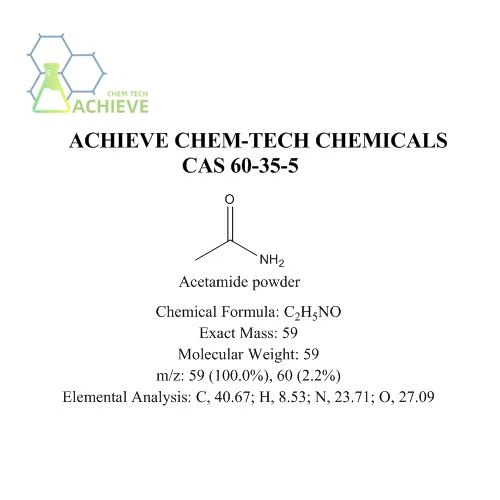
Acetamide powder, molecular formula C2H5NO, CAS 60-35-5, white crystalline solid, pure acetamide odorless, but usually with mouse odor and easy deliquescence. Easy to dissolve in liquid ammonia, fatty amines, water, alcohol, pyridine, chloroform, glycerol, hot benzene, butanone, butanol, benzyl alcohol, cyclohexanone, isoamyl alcohol, slightly soluble in benzene, insoluble in ether. It can dissolve most inorganic salts well, making acetamide solution colored. Stable at room temperature and pressure, away from strong oxidants, strong reducing agents, strong acids, and strong bases. As a solvent, it has been widely used in chemical experiments, industrial production, scientific research, and other fields. Its high polarity, good solubility, dehydration, and properties as an NMR solvent provide strong support for its application in various fields.

|
C.F |
C2H5NO |
|
E.M |
59 |
|
M.W |
59 |
|
m/z |
59 (100.0%), 60 (2.2%) |
|
E.A |
C, 40.67; H, 8.53; N, 23.71; O, 27.09 |
|
|
|


Acetamide (chemical formula C2H5NO), as a multifunctional organic compound, has demonstrated diverse application values in industry, medicine, agriculture, cosmetics, and emerging fields due to its unique chemical properties and extensive reactivity. The following systematically summarizes its uses from four dimensions: core applications, special detoxification effects, industrial application expansion, and potential innovation directions.
1. Organic synthesis intermediates
Acetamide is a key intermediate for the synthesis of pharmaceuticals, pesticides, dyes, and fragrances. For example:
In the pharmaceutical field, acetamide participates as a solvent in the synthesis of antibiotics such as chloramphenicol, promoting the construction of target molecules; Its derivatives, such as N-acetylacrylamide, can be developed into anti-inflammatory and anti-tumor active compounds through structural modification.
In the field of pesticides, acetamide is a raw material for fluoroacetamide insecticides, which generates molecular structures with insecticidal activity through reactions such as nitrification and reduction.
Dyes and spices: The amide group of acetamide can participate in the synthesis of azo dyes, or produce volatile essence precursors through chemical modification to improve food flavor.


2. Solvent and extractant
Acetamide has high dielectric constant and good solubility, and can dissolve various polar and non-polar substances:
Industrial solvents: Molten acetamide can dissolve cellulose, inorganic salts, and metal organic compounds, and is used as a solvent and solubilizer for dyes in the fiber industry to improve dyeing uniformity.
Extraction separation: In analytical chemistry, acetamide is used as an extractant to separate target components from a mixture, such as extracting metal ions from organic phases.
3. Analytical reagents and stabilizers
Acetamide powder is used as a reagent in chemical analysis to detect or quantify specific compounds; As a stabilizer, it also prevents the degradation of materials such as plastics and rubber during processing. For example:
Plasticizer stabilizer: Adding acetamide to PVC products can inhibit plasticizer migration and extend material service life.
Lubricant additive: Acetamide's hygroscopicity can reduce friction and improve mechanical operating efficiency.

Special use: Antidote and emergency medicine

1. Special antidote for organic fluorine compound poisoning
Acetamide is the preferred detoxifying agent for organic fluorine insecticides/rodenticides such as fluoroacetamide, sodium fluoroacetate, and glycerol fluoride. Its mechanism of action includes:
Competitive inhibition: Acetamide has a similar structure to fluoroacetic acid and can competitively bind to enzyme active sites, reducing the production of toxic metabolite fluoroacetate.
Blocking the tricarboxylic acid cycle: Fluoroacetate can interfere with cellular energy metabolism, while acetamide protects key organs such as myocardium and liver by inhibiting its toxic effects.
Extending incubation period and reducing symptoms: Early and sufficient use of acetamide can delay the onset of poisoning and reduce the incidence of severe symptoms such as convulsions and coma.
Clinical application:
Dosage and Administration: Adults should take 2.5-5 grams per dose, 2-4 times a day, via intramuscular injection; Children should be given 0.1-0.3 grams per kilogram of body weight per day in divided doses.
Combination therapy: often used in combination with antispasmodics (such as diazepam) and cysteine to enhance detoxification effects.
Attention: It is necessary to strictly control the dosage to avoid excessive damage to liver and kidney function; Use with caution in patients with liver and kidney dysfunction.


2. Other auxiliary treatments for poisoning
Acetamide also has certain applications in poisoning caused by tetramine and zinc phosphide, by reducing toxicity or promoting metabolic excretion to alleviate symptoms. For example:
Tetramine poisoning: Acetamide can alleviate convulsions and improve neurological function.
Zinc phosphide poisoning: Assist in reducing gastrointestinal symptoms and respiratory distress, combined with emergency measures such as gastric lavage and diarrhea.
1. Cosmetics industry
Acetamide powder is mainly used as an antacid and conditioner in cosmetics:
Antacids: Adjust the pH value of the product, prevent formula deterioration, and extend shelf life.
Conditioner: Increases product luster and maintains moisture, widely used in shampoo, conditioner, and facial moisturizer. Its safety has been recognized by the Cosmetic Ingredient Review (CIR) expert group, and it is safe and non irritating when the concentration does not exceed 7.5%.
2. Paper industry
Acetamide as a wetting agent improves the smoothness and water absorption of paper:
Fiber wetting: promotes the combination of cellulose and water, reduces paper burrs, and improves printing quality.
Adhesive: Compound with rosin and other substances to enhance the water resistance of paper.


3. Plastic and rubber industry
Acetamide expands its application scenarios by improving material properties:
Plasticizers: Enhance the flexibility and processability of plastics such as PVC, and reduce brittle fracture.
Antioxidants: delay rubber aging and extend the service life of products.
4. Food industry (potential applications)
Although acetamide has not yet been widely used in the food industry, its chemical properties endow it with multiple potentials:
Preservatives: Acetamide derivatives can inhibit bacterial growth and extend the shelf life of food.
Thickener: A water-soluble polymer formed through chemical modification, suitable for beverages and dairy products.
Packaging material: Modified acetamide can be used to prepare lightweight, corrosion-resistant, and biodegradable packaging, enhancing food protection performance.
1. Synthesis of biomaterials
Acetamide is used as a basic raw material to synthesize peptides and amide polymers through biotransformation technology, and develop new food ingredients:
Protein substitutes: simulate natural protein structures to meet vegetarian or special dietary needs.
Structural modifier: improves the colloidal properties of food and enhances stability.
2. Green manufacturing process
Acetamide is easily degradable and produces fewer by-products, which is in line with environmental trends:


Solvent substitution: Replace traditional organic solvents in coatings and inks to reduce volatile organic compound (VOC) emissions.
Catalytic reaction: As a catalyst or ligand, it promotes the progress of green chemical reactions.
3. Precise nutrition carrier
By utilizing the chemical properties of acetamide, it is modified into a carrier molecule:
Nutrient encapsulation: achieving targeted release of active ingredients such as vitamins and minerals, enhancing the effectiveness of functional foods.
Drug delivery: In the pharmaceutical field, acetamide derivatives can be used as drug carriers to improve bioavailability.

Chemical property: Acetamide powder aqueous solution will hydrolyze when heated to produce ammonium acetate. Acetonitrile is formed when heated with a strong dehydrating agent such as phosphorus pentoxide. And reacted with methylamine hydrochloride to form N-methylacetamide CH3CONHCH3. In acetic acid solution, n-acetylacrylamide is formed by reaction with acetylene and nickel carbonyl at 40 ~ 50 ℃. Reaction with nitrous acid to produce acetic acid and nitrogen:
In alkaline solution, it reacts with sodium hypochlorite to form n-chloroacetamide, and then Hofmann reaction occurs to produce methylamine:
It reacts with Trichloroacetaldehyde to form CCl3CH(OH)NHCOCH3. In the presence of calcium carbonate, acetamide aqueous solution undergoes photolysis reaction when exposed to sunlight.
Acetamide (CH3CONH2) is an important organic compound widely used in fields such as chemistry, medicine, and pesticides.
Under the action of acetonitrile and ammonia water, through the catalysis of copper chloride, acetonitrile undergoes hydrolysis reaction to produce acetamide and ammonium chloride. The chemical equation is as follows:
CH3CN + H2O + NH3 + CuCl2 → CH3CONH2 + NH4Cl
This reaction is a typical substitution reaction, in which the cyanide group (- CN) of acetonitrile is replaced by an amino group (- NH ₂) to form acetamide. At the same time, hydroxide ions (OH ⁻) in ammonia combine with carbon atoms in acetonitrile to form water molecules. Copper chloride, as a catalyst, can reduce the activation energy of the reaction and promote its progress.
1. Experimental preparation
Raw material preparation: Firstly, we need to prepare sufficient acetonitrile (CH ₂ CN) and ammonia water (NH ₂ · H ₂ O). According to the experimental requirements, ensure that the molar ratio of ammonia to acetonitrile is 1.23:1. Meanwhile, prepare an appropriate amount of copper chloride (CuCl2) as a catalyst.
Equipment preparation: Prepare experimental equipment such as reaction kettle, thermometer, agitator, condenser, receiving bottle, etc., and ensure that these equipment are clean and free of impurities.
Safety measures: Due to the irritating odor of ammonia water, protective goggles and gloves should be worn during the experiment. At the same time, ensure good ventilation in the laboratory and avoid ammonia accumulation.
2. Experimental steps
Raw material mixing:
Add the calculated acetonitrile and ammonia water in a molar ratio of 1:1.23 to the reaction vessel. Turn on the mixer to thoroughly mix the two ingredients.
Add catalyst:
Add an appropriate amount of copper chloride catalyst to the reaction vessel. Note that the amount of catalyst should be adjusted according to experimental conditions and raw material quantity to ensure efficient reaction.
Heating reaction:
Heat the reaction kettle to 160 ° C and maintain this temperature for reaction. During the reaction process, the operation of the thermometer and stirrer should be continuously observed to ensure that the reaction takes place under constant temperature and stirring conditions.
Reaction monitoring:
During the reaction process, the progress of the reaction can be monitored through sampling analysis. When the reaction reaches a certain level, the endpoint of the reaction can be determined by observing the physical properties such as the color and odor of the reaction solution.
Cooling and separation:
After the reaction is completed, cool the reactor to room temperature. Then, the acetamide in the reaction solution is separated from the unreacted raw material by distillation. During the distillation process, attention should be paid to controlling the distillation temperature and speed to avoid the decomposition and loss of acetamide powder.
Product collection:
Collect the distilled acetamide in a receiving bottle and perform necessary post-treatment (such as drying, filtering, etc.). The final acetamide obtained should be a white or slightly yellow crystalline form.
Hot Tags: acetamide powder cas 60-35-5, suppliers, manufacturers, factory, wholesale, buy, price, bulk, for sale, Raw Materials, Triphenylsilyl Chloride CAS 76 86 8, 4 Hydroxyacetophenone CAS 99 93 4, Tallowamine, propylene oxide market, terephthalic acid powder