




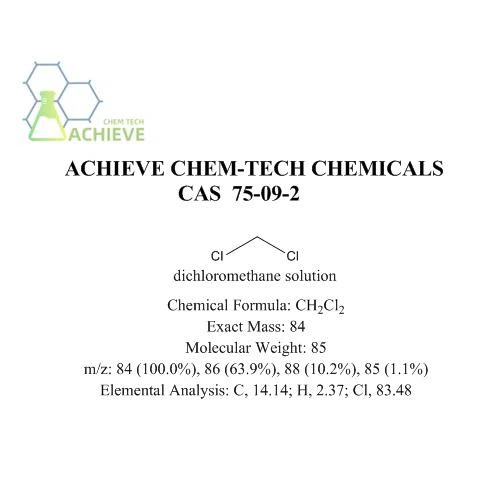
Shaanxi BLOOM Tech Co., Ltd. is one of the most experienced manufacturers and suppliers of dichloromethane solution cas 75-09-2 in China. Welcome to wholesale bulk high quality dichloromethane solution cas 75-09-2 for sale here from our factory. Good service and reasonable price are available.
Dichloromethane solution (DCM), another name is methylene chloride, is a colorless transparent liquid with a pungent smell similar to ether. It is slightly soluble in water, ethanol, and ether. It is a nonflammable solvent with a low boiling point under normal use conditions. When its vapor becomes high concentration in high-temperature air, it will generate a mixture of gas with weak combustion. It is often used to replace flammable petroleum ether, ether, etc. Dichloromethane has the advantages of strong solubility and low toxicity.
It is widely used in the manufacture of safety film and polycarbonate. The rest are used as coating solvent, metal degreasing agent, gas smoke spray agent, polyurethane foaming agent, release agent, and paint remover. Dichloromethane flammable shall be equipped with emergency response equipment that can be used to extinguish the fire and deal with leakage at any time.

|
Chemical Formula |
CH2Cl2 |
|
Exact Mass |
84 |
|
Molecular Weight |
85 |
|
m/z |
84 (100.0%), 86 (63.9%), 88 (10.2%), 85 (1.1%) |
|
Elemental Analysis |
C, 14.14; H, 2.37; Cl, 83.48 |
|
|
|


Dichloromethane solution (chemical formula CH2Cl2) is a colorless and transparent organic compound with a pungent odor similar to ether. Its boiling point is 39.8 ℃ and it is volatile at room temperature. It is slightly soluble in water but infinitely miscible with most organic solvents such as ethanol and ether. With its excellent solubility, chemical stability, and low toxicity, it has become an indispensable solvent and intermediate in industries such as medicine, electronics, and food.
Core application areas: Industrial solvents and intermediates

1. Plastic processing industry
It is a key raw material in the plastic industry, especially in the production of polyurethane foam. As a physical foaming agent, it can absorb reaction heat and dilute exothermic, so as to control the elongation and internal temperature of foam and ensure the uniform and stable structure of foam. For example, in the production of polyether polyurethane flexible foam, by adjusting the viscosity of the reaction system to promote the formation and stability of the bubble core, high elasticity and low density foam materials are finally obtained, which are widely used in furniture, car seats and other fields. In addition, it can also dissolve cellulose acetate for the preparation of cellulose triacetate films (such as film substrates) and fiber drawing. Its solubility is better than traditional solvents, which can significantly improve product transparency and mechanical strength.
2. Metal cleaning and surface treatment
In the field of metal processing, it has become the preferred solvent for degreasing and paint stripping of precision instruments due to its strong solubility and low surface tension. It can quickly penetrate and swell paints, varnishes, and resin coatings, while removing organic pollutants such as oil stains and fingerprints from metal surfaces. For example, in the aerospace industry, it is used to clean engine components to ensure surface cleanliness meets micrometer level standards; In electronic manufacturing, it can remove solder residue on printed circuit boards (PCBs) to prevent the risk of short circuits. Although some countries restrict its use due to environmental pressures, it is still difficult to completely replace it in high-precision cleaning scenarios.


3. Coatings and Ink Industry
As a coating solvent, it has the characteristics of fast evaporation speed and strong solubility, which can significantly shorten the drying time of coatings and improve leveling. In automotive coatings, wood coatings, and industrial anti-corrosion coatings, it is often compounded with ester and ketone solvents to adjust the viscosity of the coating to adapt to the spraying process. In addition, it can also be used in ink manufacturing as a binder to dissolve resins and pigments, ensuring the transferability and dryness of ink during the printing process. For example, in gravure printing ink, its rapid evaporation characteristics can prevent ink bleeding and improve printing accuracy.
4. Production of Film and Optical Materials
It is the core solvent for traditional film production, used to dissolve cellulose acetate and prepare film substrates. Its low boiling point characteristic allows the solvent to evaporate rapidly during the coating process, forming a uniform and dense thin film structure, while avoiding damage to the emulsion layer of the film at high temperatures. Despite the impact of digital technology on the film market, it still dominates the production of specialty films such as medical X-rays and industrial inspection films. In addition, it can also be used to prepare optical grade polycarbonate (PC) films. By dissolving PC resin and controlling crystallinity, high transmittance and low birefringence optical materials can be obtained, which are widely used in fields such as lenses and displays.

Special Purpose: Pharmaceutical and Food Industry

1. Pharmaceutical intermediates and reaction media
In the pharmaceutical industry, dichloromethane is a key solvent for extracting active ingredients such as antibiotics and vitamins. Its low polarity allows it to efficiently dissolve lipid soluble drug components while avoiding interference from water-soluble impurities. For example, in the preparation process of ampicillin and amoxicillin, as reaction media, the target product is extracted from the fermentation broth through extraction and separation techniques, significantly improving yield and purity. In addition, it can also be used as a pharmaceutical intermediate to participate in fluorination, oxidation and other reactions, and synthesize fungicides such as nitrile fungicides. It is worth noting that its anesthetic effect has led to its use as a local anesthetic in dentistry, but due to toxicity issues, it has gradually been replaced by safer alternatives.
2. Food degeneracy and spice extraction
It is the core solvent in the traditional coffee dehydration process. The principle is to dissolve caffeine and float it on the surface through steaming, then extract caffeine from it, and recover the solvent through distillation to obtain low caffeine coffee. Although supercritical CO ₂ extraction technology has gradually become popular due to its environmental advantages, its process is still retained in some areas due to low cost and high efficiency. In addition, it can also be used to extract essential oil components from spices, such as capsaicin in chili peppers and eugenol in cloves. Its selective solubility can retain the activity of natural flavor substances.


3. Grain fumigation and refrigerants
In the agricultural field, it has been used as a grain fumigant to achieve insecticidal effects by inhibiting the respiratory system of pests. However, its residual issues and potential environmental hazards have led to the gradual phasing out of this use. In the refrigeration industry, it was once used as a refrigerant in low-pressure freezers and air conditioning units, but its contact with open flames may generate highly toxic phosgene (COCl ₂), and its corrosiveness to metals increases with humidity. Currently, it has been replaced by safer refrigerants such as ammonia and Freon.
Dichloromethane, as a multifunctional organic solvent, has applications in various fields such as industrial manufacturing, pharmaceutical synthesis, and food processing, and has become an indispensable "chemical tool" in modern industrial systems.

chemical property
Dichloromethane can undergo hydrolysis reaction under alkaline conditions. For example, in the presence of aqueous solutions of sodium hydroxide (NaOH) or potassium hydroxide (KOH), the reaction is a nucleophilic substitution reaction, in which hydroxide ions act as nucleophiles to attack carbon atoms in dichloromethane molecules. The result of the reaction is the formation of formaldehyde (HCHO), chloride ions, and water. However, the hydrolysis reaction of dichloromethane is relatively slow because the covalent bonds between carbon atoms and chlorine atoms in its molecular structure have a certain degree of stability.
Dichloromethane can undergo further halogenation reactions. For example, under conditions of light or high temperature, when reacting with chlorine gas, the hydrogen atoms in the molecule can be gradually replaced by chlorine atoms, producing polyhalogenated methane such as chloroform and carbon tetrachloride.
When dichloromethane reacts with benzene in the presence of aluminum trichloride, it produces diphenylmethane. In this reaction, aluminum trichloride acts as a Lewis acid catalyst, which can react with dichloromethane to polarize the carbon chlorine bond of dichloromethane, making it easier to undergo electrophilic substitution reaction with benzene. The π - electron cloud of benzene acts as a nucleophile to attack polarized dichloromethane molecules, which undergo a series of reaction steps to ultimately generate diphenylmethane.
Dichloromethane can decompose into hydrochloric acid (HCl), carbon dioxide, carbon monoxide, and highly toxic phosgene (COCl2) when exposed to heat and moisture. Phosgene is a very dangerous chemical substance with strong toxicity. During industrial production and use, special attention should be paid to avoiding the decomposition of dichloromethane in high temperature and humid environments.

We are the supplier of Dichloromethane Solution.
Remark: BLOOM TECH(Since 2008), ACHIEVE CHEM-TECH is the subsidiary of us.
Synthetic dichloromethane:
Natural gas chlorination method: after natural gas reacts with chlorine gas, hydrogen chloride by-product hydrochloric acid is absorbed by water, residual traces of hydrogen chloride are removed with alkali solution, and then dried, compressed, condensed and distilled to obtain finished products, including 100% 4000 chlorine gas, natural gas (under standard conditions), 97% 1000m3 / T methane content and 100% 274 liquid alkali. 2. Chloromethane chlorination method chloromethane reacts with chlorine under 4000kW light to produce dichloromethane, which is washed with alkali, shrunk, condensed, dried and rectified to obtain the finished product. The main by-product is chloroform. Chloromethane ≥ 98%, liquid chlorine ≥ 99.5%, caustic soda 30%. The industry is generally synthesized by chlorination of methane.
The direct chlorination method of dichloromethane is one of the main methods for preparing dichloromethane. The following are the detailed steps and chemical reaction formulas of this method:
Chemical reaction formula:
CH4 + Cl2 → CH3Cl + HCl
CH3Cl + Cl2 → CH2Cl2 + HCl
CH2Cl2 + Cl2 → CHCl3 + HCl
CHCl3 + Cl2 → CCl4 + HCl
Methane and chlorine are the main raw materials for preparing dichloromethane. Before starting the preparation, it is necessary to ensure that these raw materials are ready.
In order to facilitate the direct chlorination process, it is necessary to control the reaction temperature, pressure, and molar ratio of raw materials within an appropriate range. Normally, the reaction temperature is between 80-120 ° C, the pressure is between 2-5 atmospheres, and the molar ratio of methane to chlorine is 1:1 or 1:2.
In order to improve the rate and selectivity of the chlorination reaction, it is usually necessary to add a catalyst. Commonly used catalysts include aluminum chloride, iron chloride, copper chloride, etc. These catalysts can be used alone or in combination to achieve the best catalytic effect.
Add methane and chlorine gas in a molar ratio to the reactor, control the reaction temperature and pressure, and start the chlorination reaction under the action of a catalyst. During the reaction process, products such as dichloromethane, trichloromethane, and carbon tetrachloride will be generated.
Separating and purifying dichloromethane from the products of the chlorination reaction is an important step. Distillation is usually used to separate products with different boiling points. During the distillation process, components with lower boiling points are first separated, while components with higher boiling points are later separated. In order to obtain high-purity dichloromethane, further treatment such as crystallization and filtration may be required.
The direct chlorination method has the advantages of fast reaction rate and high selectivity, but at the same time, it also has some disadvantages, such as more intense reaction conditions and easy to produce side reactions. Therefore, in actual production, it is necessary to choose appropriate process conditions and operating methods based on the specific situation to ensure the safety and economy of the production process.

The indirect chlorination method of dichloromethane is a commonly used method for preparing dichloromethane. The following are the detailed steps and chemical reaction formulas of this method:
Chemical reaction formula:
CH4 + Cl2 → CH3Cl + HCl
CH3Cl + Cl2 → CH2Cl2 + HCl
Steps of indirect chlorination method:
Methane and chlorine are the main raw materials for preparing dichloromethane. Before starting the preparation, it is necessary to ensure that these raw materials are ready.
In order to ensure the smooth progress of the chlorination reaction, it is necessary to control the reaction temperature and pressure, as well as the molar ratio of raw materials, within an appropriate range. Normally, the reaction temperature is between 50-100 ° C, the pressure is between 1-5 atmospheres, and the molar ratio of methane to chlorine is 1:1 or 1:2.
In order to improve the rate and selectivity of the chlorination reaction, it is usually necessary to add a catalyst. Commonly used catalysts include copper chloride, iron chloride, aluminum chloride, etc. These catalysts can be used alone or in combination to achieve the best catalytic effect.
Add methane and chlorine gas in a molar ratio to the reactor, control the reaction temperature and pressure, and start the chlorination reaction under the action of a catalyst. During the chlorination reaction, the hydrogen atoms in methane molecules are replaced by chlorine atoms, generating derivatives of chloromethane.
Separating and purifying dichloromethane from the products of the chlorination reaction is an important step. Distillation is usually used to separate products with different boiling points. During the distillation process, components with lower boiling points are first separated, while components with higher boiling points are later separated. In order to obtain high-purity dichloromethane, further treatment such as crystallization and filtration may be required.
The indirect chlorination method has the advantages of mild reaction conditions, high yield, and fewer side reactions, making it widely used in industry. However, it should be noted that indirect chlorination requires the use of a large amount of chlorine and methane, resulting in higher dichloromethane solution costs. In actual production, it is necessary to consider whether to adopt this method based on market demand and cost.
FAQ
What is dichloromethane used for?
Dichloromethane (also known as methylene chloride) is a colorless and volatile liquid chemical that has a mild, sweet odor. It is used as an industrial and laboratory solvent, as a paint stripper, and in the manufacture of photographic film.
Is dichloromethane harmful to humans?
Dichloromethane can also be absorbed into the body via inhalation, ingestion or skin contact. Symptoms include headache, light-headedness, blurred vision, confusion, agitation and skin rashes. In severe cases kidney damage, fitting, heart problems and coma can occur.
Why is dichloromethane being banned?
Due to risk arising from DCM exposure, the EPA issued a final rule in 2024 regulating DCM under the Toxic Substances Control Act (TSCA).
Why is dichloromethane a bad solvent?
Dichloromethane was classified as "likely to be carcinogenic to humans," based primarily on evidence of carcinogenicity at two sites (liver and lung) in male and female B6C3F1 mice (inhalation exposure) and at one site (liver) in male B6C3F1 mice (drinking-water exposure), and supported by an association between ...
Hot Tags: dichloromethane solution cas 75-09-2, suppliers, manufacturers, factory, wholesale, buy, price, bulk, for sale, Mesitylene 98 , Solvent, 4'-Hydroxyacetophenone CAS 99-93-4, Basic Chemicals, N N Dimethylformamide pure, terephthalic acid powder