




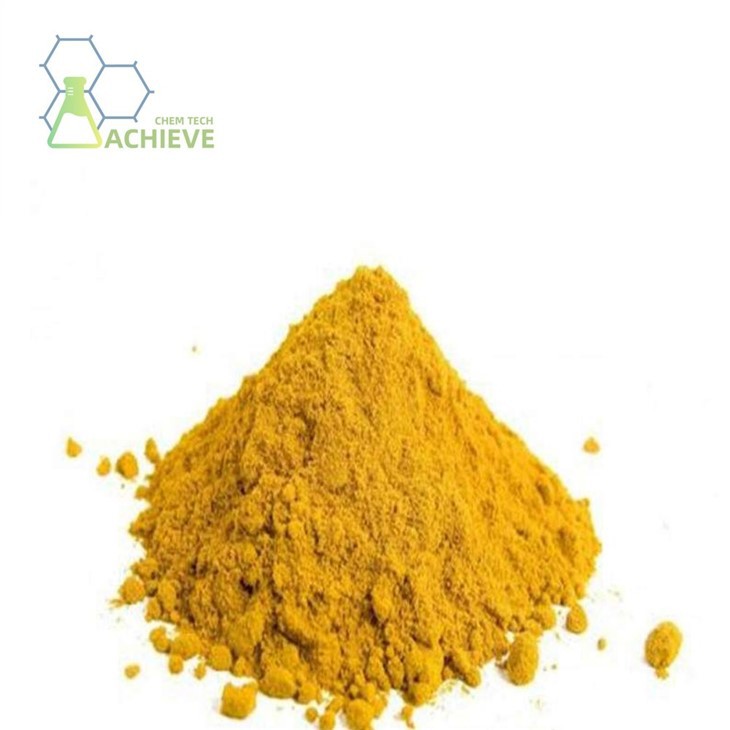

Shaanxi BLOOM Tech Co., Ltd. is one of the most experienced manufacturers and suppliers of tetrazolium blue chloride cas 1871-22-3 in China. Welcome to wholesale bulk high quality tetrazolium blue chloride cas 1871-22-3 for sale here from our factory. Good service and reasonable price are available.
Tetrazolium blue chloride, chemical formula C40H32Cl2N8O2, CAS 1871-22-3, usually appears as a colorless or lemon yellow crystalline solid. Soluble in hot water and acetone, but poorly soluble in chloroform. It has a certain degree of hygroscopicity and is sensitive to light. It can be reduced to blue tetrazolium nitrogen under the action of a reducing agent. Blue tetrazolium can be used to determine the activity of succinate dehydrogenase (SDH) in yeast strains, which has been reduced to a substrate. Extract blue tetrazolium nitrogen from cells using dimethyl sulfoxide and test the absorption spectrum of blue tetrazolium nitrogen. Blue tetrazolium displays a wide wavelength range of 480-600nm, with visible absorbance at 540nm. Blue tetrazolium binds to succinate dehydrogenase (SDH). It is a blue dye used for microbial research, which can stain bacteria and fungi and has good applications in basic biochemical research. In addition, this substance can also be used for the determination of oxidoreductases (such as succinate dehydrogenase).

|
|
|


|
Chemical Formula |
C40H32N8Cl2O22+ |
|
Exact Mass |
726 |
|
Molecular Weight |
728 |
|
m/z |
726 (100.0%), 728 (63.9%), 727 (43.3%), 729 |
|
Elemental Analysis |
C, 66.03; H, 4.43; Cl, 9.74, N, 15.40; O, 4.40 |

Tetrazolium chloride blue (CAS number: 1871-22-3) is a light yellow powdery compound with good solubility in acetone and hot water, and active chemical properties at room temperature.
1. Determination of oxidoreductase activity
It is a sensitive detection reagent for oxidoreductases such as succinate dehydrogenase (SDH) and heparinase. Its mechanism of action is based on a reduction reaction: under alkaline conditions, tetrazolium chloride is enzymatically reduced to blue formazan, and enzyme activity is quantitatively analyzed by colorimetric method (540nm wavelength).
Heparin enzyme detection: The accuracy of colorimetric and electrophoretic methods is comparable, but the operation is simpler and the sample processing capacity is larger. It is suitable for studying the relationship between heparinase and tumors and screening inhibitors.


SDH activity analysis: The absorbance of blue formamide shows a linear relationship with SDH activity, with sensitivity at the Dana molar level, and is commonly used in mitochondrial function research.
2. Assessment of cellular metabolic activity
As a substrate of dehydrogenase, it can reflect the respiratory intensity of cells. In microbial culture, the amount of formaldehyde produced is positively correlated with bacterial metabolic activity, and the vitality of the strain can be quickly determined by colorimetric method. For example, in yeast screening, this method is three times more efficient than traditional plate counting methods.
3. Determination of reducing sugar content
Under alkaline heating conditions, it reacts with reducing sugars such as glucose and fructose to produce red triphenylformazan precipitate. After centrifugal separation and precipitation, the absorbance can be measured at a wavelength of 485nm to quantify the concentration of reducing sugars.
Micro 2-deoxy-D-glucose detection: the improved colorimetric method has increased the sensitivity to 80pg/mL, and the data reproducibility is better than the traditional method, which is suitable for the research of diabetes related metabolism.

Medical Diagnosis: Pathological Research and Clinical Testing

1. Analysis of tumor related enzyme activity
Heparin enzyme plays a crucial role in tumor metastasis, and the tetrazolium chloride colorimetric method can detect heparinase activity in tissue samples to assist in determining the malignancy of tumors. Clinical studies have shown that this method has a 92% consistency with immunohistochemical results, but reduces costs by 60%.
2. Rapid assessment of seed vitality
The tetrazolium chloride staining method determines the germination potential of seeds by detecting the dehydrogenase activity in seed embryo cells. After staining, the active seeds turn red and the dead seeds are colorless. Batch testing can be completed within 1 hour and is suitable for agricultural breeding screening.
3. Microbial staining and classification
Can be used for staining and identification of bacteria and fungi. The reduced product A is deposited inside the cell, and the staining distribution can be observed under a microscope to distinguish Gram positive bacteria from Gram negative bacteria. The sensitivity is 40% higher than traditional staining methods.

Agricultural field: Biological insecticides and crop protection

1. Crystal producing Bacillus subtilis insecticide
As an active ingredient of Bacillus cereus, it kills insects by producing endotoxins (companion crystals) and exotoxins. Endotoxins damage the intestinal lining of insects, causing bacteria to invade the hemolymph and trigger sepsis; Exotoxins interfere with insect development during molting.
Forestry application: The effect of preventing and controlling pine caterpillars is significant, with a mortality rate of 85% within 72 hours after application, and a duration of effectiveness exceeding 30 days.
Agricultural application: Excellent control effect on Lepidoptera pests such as corn borer, rice borer, and corn borer, with a dosage of 50-100g per mu and a cost reduction of 35% compared to chemical pesticides.
2. Optimization of preparation process
The fermentation production of crystal producing Bacillus requires strict control of temperature (28-30 ℃) and pH value (6.8-7.2). By adding a supported Pd catalyst, the side reaction of polychlorination can be suppressed, and the yield of 6-ethyl trichlorosucrose can be increased to 90% with a purity of 98%.

Organic synthesis: Preparation of intermediates and functional materials

1. Synthesis of 6-Ethyl Trichlorosucrose
Trichlorosucrose 6-ethyl ester was synthesized by reacting sucrose 6-ethyl ester with tetrazolium chloride. This intermediate is a key precursor for the sweetener sucralose, and the selectivity and stability of the catalyst directly affect product quality.
2. Preparation of DNA cationic complexes
Can serve as a ligand to form complexes with cationic polymers, enhancing the efficiency of DNA transport within cells. The application of this technology in gene therapy vector development can increase transfection efficiency by 2-3 times.
3. Anti DNA antibody immunoadsorbent
By modifying the surface of the carrier with tetrazolium chloride, it can specifically bind to anti DNA antibodies for the diagnosis of autoimmune diseases. Clinical validation shows that this method has a sensitivity of 95% and a specificity of 90% for the diagnosis of systemic lupus erythematosus.


The method for producing Tetrazolium blue chloride in the laboratory is mainly based on the o-phenylenediamine method, which is a classic synthesis method and has undergone multiple improvements to improve product yield and purity. The following are the detailed production steps and their corresponding chemical equations:
1. Ortho phenylenediamine atmospheric pressure method
(1) Raw material preparation:
Dissolve o-phenylenediamine in acetic acid aqueous solution and prepare sodium nitrite aqueous solution. Both solutions need to be pre cooled to 0 ℃ before mixing.
(2) Mixing reaction:
In an ice bath, rapidly mix a solution of o-phenylenediamine and a solution of sodium nitrite to initiate the reaction. In this step, o-phenylenediamine undergoes a diazotization reaction with sodium nitrite to form diazonium salts.
Chemical equation: C6H8N2+2NaNO2+2HCl → C6H4 (N2) 2Cl2+2NaCl+2H2O
(3) Closed loop reaction:
Subsequently, the temperature is rapidly raised to 80 ℃, causing the diazonium salt to undergo a closed loop reaction and generate nitrotetrazolium chloride.
Chemical equation: C6H4 (N2) 2Cl2 → C10H8N4O2Cl2 (nitrotetrazolium chloride)
(4) Post treatment:
After the closed-loop reaction is completed, cool and filter the reaction solution to obtain the crude product of nitrotetrazolium chloride. Then, further purification is carried out through steps such as washing and drying.
2. Improved high-pressure method for o-phenylenediamine
This method was invented by the United States, and compared to the atmospheric pressure method, it increases the reaction temperature and pressure, thereby increasing the product yield and purity.
(1) Raw material preparation:
Similar to the atmospheric pressure method, dissolve o-phenylenediamine and sodium nitrite in appropriate solvents. But in this method, higher temperature and pressure conditions are usually used.
(3) Post treatment:
Similarly, after the reaction is completed, steps such as cooling, filtering, washing, and drying are required to purify the product.
(2) Reaction process:
Under high temperature and pressure, o-phenylenediamine undergoes diazotization reaction with sodium nitrite, followed by a closed-loop reaction. Due to changes in reaction conditions, this method has a faster reaction rate and higher yield.
The chemical equation is the same as the atmospheric pressure method.
3. matters needing attention
Safety:
Due to the toxic nature of both o-phenylenediamine and sodium nitrite, it is necessary to strictly follow safety operating procedures and wear appropriate protective equipment during the experiment.
Reaction conditions:
Reaction temperature and pressure are important factors affecting product yield and purity. Therefore, in practical operation, it is necessary to adjust the reaction conditions according to the specific situation.
Purification steps:
The purification step of nitrotetrazolium chloride is crucial for obtaining high-purity products. In practical operation, multiple purification methods may be required, such as recrystallization, column chromatography, etc.
Summary:
The production of tetrazolium chloride in the laboratory is mainly based on the o-phenylenediamine method and its improved methods. By adjusting the reaction conditions and purification steps, high-purity chloronitrotetrazolium chloride products can be obtained. In practical operation, it is necessary to strictly follow safety operating procedures to ensure the safety and smooth progress of the experimental process.
Hot Tags: tetrazolium blue chloride cas 1871-22-3, suppliers, manufacturers, factory, wholesale, buy, price, bulk, for sale, dithizone test, Dithizone Indicator, p Naphtholbenzein, Chloramine-T powder, p-Dimethylaminobenzaldehyde, Phenol red powder