




Shaanxi BLOOM Tech Co., Ltd. is one of the most experienced manufacturers and suppliers of metformin capsule in China. Welcome to wholesale bulk high quality metformin capsule for sale here from our factory. Good service and reasonable price are available.
Metformin Capsule is one of the core drugs in the treatment of type 2 diabetes. The active ingredient metformin hydrochloride belongs to the metformin class of oral hypoglycemic drugs, which improves insulin resistance, reduces hepatic glucose output, and enhances peripheral tissue uptake and utilization of glucose through a multi-target mechanism of action. Since its first clinical application in 1957, this drug has become the first line drug for the management of type 2 diabetes worldwide with its clear hypoglycemic effect, good safety and cardiovascular protection. It belongs to the biguanide class of hypoglycemic drugs, and forms the main category of oral hypoglycemic drugs along with sulfonylureas, thiazolidinediones, and other drugs.



Additional information of chemical compound:

|
|
|


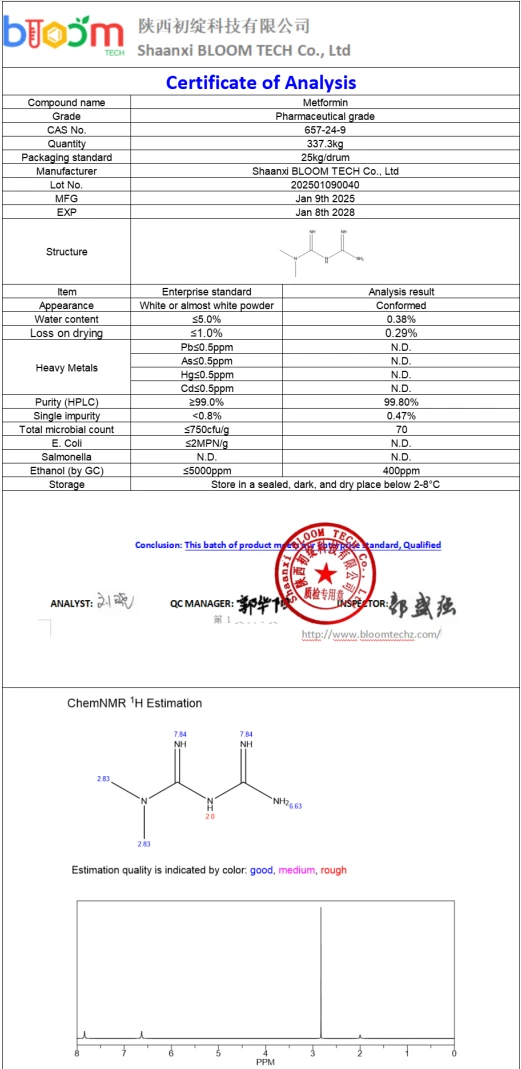
Metformin COA

First-Line Therapeutic Use in Type 2 Diabetes Mellitus
Metformin Capsule is one of the first-line drugs for the treatment of type 2 diabetes mellitus, especially suitable for patients with mild to moderate type 2 diabetes whose blood glucose is still inadequately controlled despite diet and exercise alone.
As monotherapy, it effectively reduces fasting blood glucose, 2-hour postprandial blood glucose, and glycated hemoglobin (HbA1c) levels without causing hypoglycemia. It enables long-term stable glycemic control and delays the progression of diabetes.For obese patients with type 2 diabetes, this product not only lowers blood glucose but also induces mild weight loss and improves metabolic disorders, better meeting the therapeutic needs of this population.


Application in Combination Antidiabetic Therapy
When monotherapy fails to achieve satisfactory efficacy, this product can be combined with various antidiabetic agents to enhance the hypoglycemic effect.
Combination with sulfonylureas compensates for the hypoglycemia risk associated with sulfonylureas and produces synergistic glucose-lowering effects.Combination with insulin reduces insulin dosage, lowers the risk of weight gain caused by insulin therapy, and better controls postprandial glucose fluctuations, especially for patients with poor islet function who require insulin treatment.
In addition, combination with novel antidiabetic agents such as dipeptidyl peptidase-4 (DPP-4) inhibitors and sodium-glucose cotransporter 2 (SGLT-2) inhibitors achieves multi-target glucose regulation and further optimizes glycemic control.
Interventional Application in Prediabetes
In addition to the treatment of diabetes, this product can be used for the intervention of prediabetes.For individuals with impaired glucose tolerance (IGT) and impaired fasting glucose (IFG), rational use of this product on the basis of diet and exercise can effectively reduce blood glucose levels, delay the progression from prediabetes to type 2 diabetes, and lower the risk of developing diabetes.
It is particularly suitable for prediabetic individuals with high-risk factors including a family history of diabetes, obesity, and hypertension, providing an effective strategy for the early prevention and control of diabetes.


The product, as the most widely used oral hypoglycemic drug in the world, has become the cornerstone drug in the field of diabetes management since it was approved by the US FDA for the treatment of type 2 diabetes in 1994. It achieves hypoglycemic effects by inhibiting hepatic gluconeogenesis, increasing peripheral tissue glucose uptake, improving insulin sensitivity, and other mechanisms, and has advantages such as no weight gain, no induction of hypoglycemia, and cardiovascular protection.
The dosage form design adopts enteric coated materials to encapsulate the drug particles, allowing the drug to be released in an alkaline intestinal environment, reducing the damage of gastric acid to the drug, and reducing upper gastrointestinal irritation, significantly improving patient tolerance. By using micro pill controlled release technology or osmotic pump system, drugs can be released smoothly for 24 hours, maintaining stable blood drug concentration, reducing the number of daily medication doses (usually 1-2 times a day), and improving patient compliance.With the advancement of formulation technology, metformin capsule has become one of the commonly used clinical formulations due to its convenient administration and stable bioavailability.

Characteristics and selection of active pharmaceutical ingredients
Chemical structure and physicochemical properties
The chemical name of the product is 1,1-dimethylbiguanide, with a molecular formula of C ₄ H ₁ N ₅ and a molecular weight of 129.16. Its appearance is a white crystalline powder with a melting point of 199-200 ℃, which decomposes at around 229 ℃. This substance is slightly soluble in water, extremely soluble in ethanol, almost insoluble in dichloromethane, but soluble in dilute acid. This solubility characteristic determines that it needs to be well dispersed and released through excipient optimization in formulation development.
Quality standards for active pharmaceutical ingredients
According to the Chinese Pharmacopoeia and international standards such as USP and EP, it raw materials need to meet the following key indicators:
Content: ≥ 98.0% (calculated as dry product)
Impurity control:
Single impurity ≤ 0.1%
Total impurities ≤ 0.5%
Specific impurities (such as melamine, guanidinoacetic acid, etc.) must meet the limit requirements
Heavy metal: ≤ 10ppm
Moisture content: ≤ 0.5%
Residual solvents: comply with ICH guidelines (such as ethanol ≤ 0.5%)
Supplier selection and certification
Raw material suppliers need to pass GMP certification and have stable production capacity and quality traceability system. Taking Pushan Industrial (Shaanxi) Co., Ltd. as an example, its metformin raw material has a purity of 98-101%, meets pharmaceutical grade standards, and has passed ISO 9001 quality management system certification, providing full chain services from research and development to commercial production. We can also provide raw materials of different specifications, and suitable suppliers need to be selected according to the formulation requirements.
Accessory selection and formula design

Auxiliary Material Function and Classification
Excipients are key factors affecting the quality of capsule formulations, and should be selected based on drug properties, release requirements, and process adaptability. Common excipients for metformin capsule include:
Fillers: Microcrystalline cellulose (MCC), lactose, starch, etc., used to increase particle flowability and compressibility.
Adhesives: Hydroxypropyl methylcellulose (HPMC), polyvinylpyrrolidone (PVP), etc., promote particle formation.
Disinfectant: Crosslinked carboxymethyl cellulose sodium (CCNa), carboxymethyl starch sodium (CMS Na), etc., accelerate capsule disintegration and drug release.
Lubricants: Magnesium stearate, talcum powder, etc., reduce friction between particles and equipment.
Coating materials: polyacrylic acid resin, hydroxypropyl methylcellulose phthalate (HPMCP), etc., used for the controlled release layer of sustained-release capsules.
Formula design principles
Formula design needs to balance drug release rate, bioavailability, and stability. For example:
Ordinary capsules: using direct filling method, the formula is it (main drug)+microcrystalline cellulose (filler)+magnesium stearate (lubricant), which is filled after high-speed mixing and granulation.

Sustained release capsules: controlled release materials need to be added, such as the formula disclosed in patent CN105476995A: metformin+inositol nicotinate ester (synergistically reducing blood sugar)+polyacrylic acid resin (controlled release layer)+hydroxypropyl methylcellulose (thickener)+microcrystalline cellulose (filler), which is prepared by wet granulation and filled.

Formula optimization case
Taking Metformin Capsule produced by a certain enterprise as an example, the formula optimization process is as follows:
Initial screening test: Determine the types of excipients (HPMC, CCNa, MCC) and their proportion range through a single factor test.
Response surface methodology optimization: Using disintegration time and dissolution rate as response values, establish a mathematical model to determine the optimal formula: HPMC 15%, CCNa 5%, MCC 75%, magnesium stearate 5%.
Validation test: Prepare 3 batches of samples, measure the disintegration time to be ≤ 15 minutes, and the 12 hour dissolution rate to be ≥ 85%, which meets the quality standards.
Production process flow
Production process of ordinary capsules
Process Flow Diagram
Raw material screening → auxiliary material pretreatment → mixing → granulation → drying → whole granule → total mixing → filling → polishing → quality inspection → packaging
Detailed explanation of key steps
Screening of raw materials: Use an 80 mesh sieve to remove clumps and ensure uniform particle size.
Auxiliary material pretreatment: Microcrystalline cellulose needs to be dried at 60 ℃ for 2 hours to reduce the moisture content to ≤ 3%.
Mixing: Use a V-shaped mixer with a speed of 15rpm and a mixing time of 30 minutes to ensure even distribution of the main drug and excipients.
Granulation: Wet granules are prepared using a 5% hydroxypropyl methylcellulose ethanol solution as a binder through a high-speed mixing granulation mechanism, with a mesh size of 16.
Drying: A boiling dryer is used, with an inlet temperature of 60 ℃ and an outlet temperature of 40 ℃, to dry until the moisture content is ≤ 3%.
Whole granule: Use a 20 mesh sieve to remove oversized particles.
Total mixing: Add magnesium stearate and mix for 10 minutes.
Filling: Fully automatic capsule filling machine (such as Bosch GKF series) is used, with a filling accuracy of ± 3% and a filling volume difference of ≤ 5%.
Polishing: Use a capsule polishing machine to remove surface dust and improve appearance quality.
Production process of sustained-release capsules
Process Flow Diagram
Screening of raw materials → pre-treatment of excipients → mixing → preparation of soft materials → pill making → drying → coating → filling → quality inspection → packaging
Detailed explanation of key steps
Soft material preparation: Mix it, nicotinate inositol ester, and microcrystalline cellulose in proportion, and add hydroxypropyl methylcellulose aqueous solution to prepare soft material. The humidity of the soft material should be suitable for "holding it in a ball and lightly pressing it to disperse".
Pill making: Micro pellets are prepared by extrusion rolling method, with an extruder aperture of 0.8mm, a rolling machine speed of 1000rpm, and a time of 5 minutes.
Drying: Fluidized bed drying, with an inlet temperature of 50 ℃, and drying until the moisture content is ≤ 5%.
Coating: Using polyacrylic acid resin as the coating material, a bottom jet fluidized bed coating machine is used to increase the weight of the coating by 20%, forming a controlled release layer.
Filling: Fill the coated microspheres into capsule No. 0, with each capsule containing 500mg of the main drug.
Selection of Production Equipment
| Device Name | Model | Purpose | Key Parameters |
| Mixer | V-mixer | Mixing of raw materials and excipients | Speed 15rpm, capacity 50L |
| Granulator | High speed mixing granulator | Wet granulation | Mixing blade speed 300rpm, cutting blade speed 1500rpm |
| Dryer | Boiling dryer | Wet particle drying | Inlet air temperature 60 ℃, processing capacity 50kg/batch |
| Capsule filling machine | Bosch GKF 70 | Capsule filling | Filling speed 20000 particles/hour |
| Fluidized bed coating machine | GLATT GPCG-1 | Micro pill coating | Spray gun pressure 0.2MPa, inlet air temperature 40 ℃ |
Quality Control and Testing
Raw material testing
Content determination: High performance liquid chromatography (HPLC) was used, with methanol water (70:30) as the mobile phase, detection wavelength of 233nm, and retention time of about 5 minutes.
Impurity analysis: Impurities such as melamine and guanidinoacetic acid were detected by HPLC-DAD, and the limits met the requirements of the pharmacopoeia.
Heavy metal detection: Atomic absorption spectroscopy (AAS) is used, with lead content ≤ 10ppm.


Intermediate detection
Particle content uniformity: Take 10 samples and measure the coefficient of variation (CV) of the content to be ≤ 5%.
Particle size distribution of microspheres: Using laser diffraction method, D50=0.6 ± 0.1mm, D90 ≤ 1.0mm.
Finished product testing
Quantity difference: Take 20 capsules, weigh them, and the limit of quantity difference is ± 5%.
Dissolution rate: Using the paddle method, 900ml of 0.1mol/L hydrochloric acid solution is used as the medium, and the speed is 100rpm. The dissolution rate is ≥ 85% after 12 hours.
Microbial limit: The total number of aerobic bacteria is ≤ 1000 CFU/g, the total number of mold and yeast is ≤ 100 CFU/g, and Escherichia coli cannot be detected.

Packaging And Storage
Selection of Packaging Materials
Inner packaging: Made of medicinal polyvinyl chloride (PVC)/polyethylene (PE) composite hard sheets or medicinal aluminum foil to ensure barrier performance and sealing.
Outer packaging: paper box or plastic bottle, printed with information such as drug name, specifications, batch number, expiration date, etc.
Storage conditions
Temperature: 2-8 ℃ (raw material) or dry at room temperature (finished capsules).
Humidity: Relative humidity ≤ 65%, avoid moisture absorption and agglomeration.
Avoid light: Use opaque packaging materials to prevent drug degradation.
FAQ
Does the product come in capsules?
+
-
Metformin comes as a tablet, an extended-release (long-acting) tablet, and a solution (liquid) to take by mouth. The solution is usually taken with meals one or two times a day. The regular tablet is usually taken with meals two or three times a day.
Can the product cause seizures?
+
-
It seems that metformin per se is not proconvulsant but in the condition of hypoglycemia, the low level of glucose trigger seizure. Although epileptic seizures are the rare consequences of hypoglycemia but it has been reported in some cases
Can the product cause a rash?
+
-
Metformin, a widely used antidiabetic and antiobesity drug, exerts multiple effects on the skin, and could potentially induce a variety of dermatoses. Among others, the most commonly described drug-induced skin reactions include rash, urticaria, and lichenoid eruption.
Hot Tags: metformin capsule, suppliers, manufacturers, factory, wholesale, buy, price, bulk, for sale