


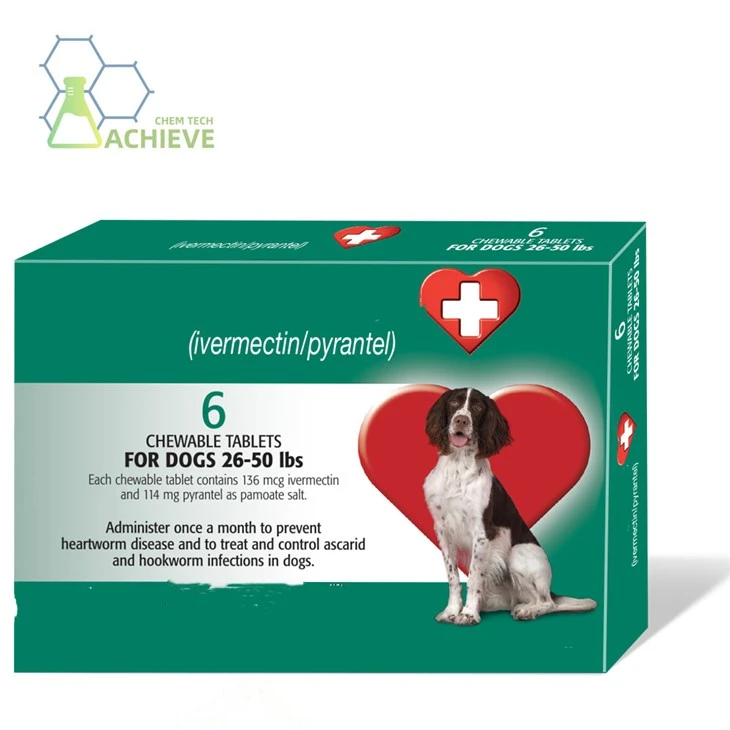


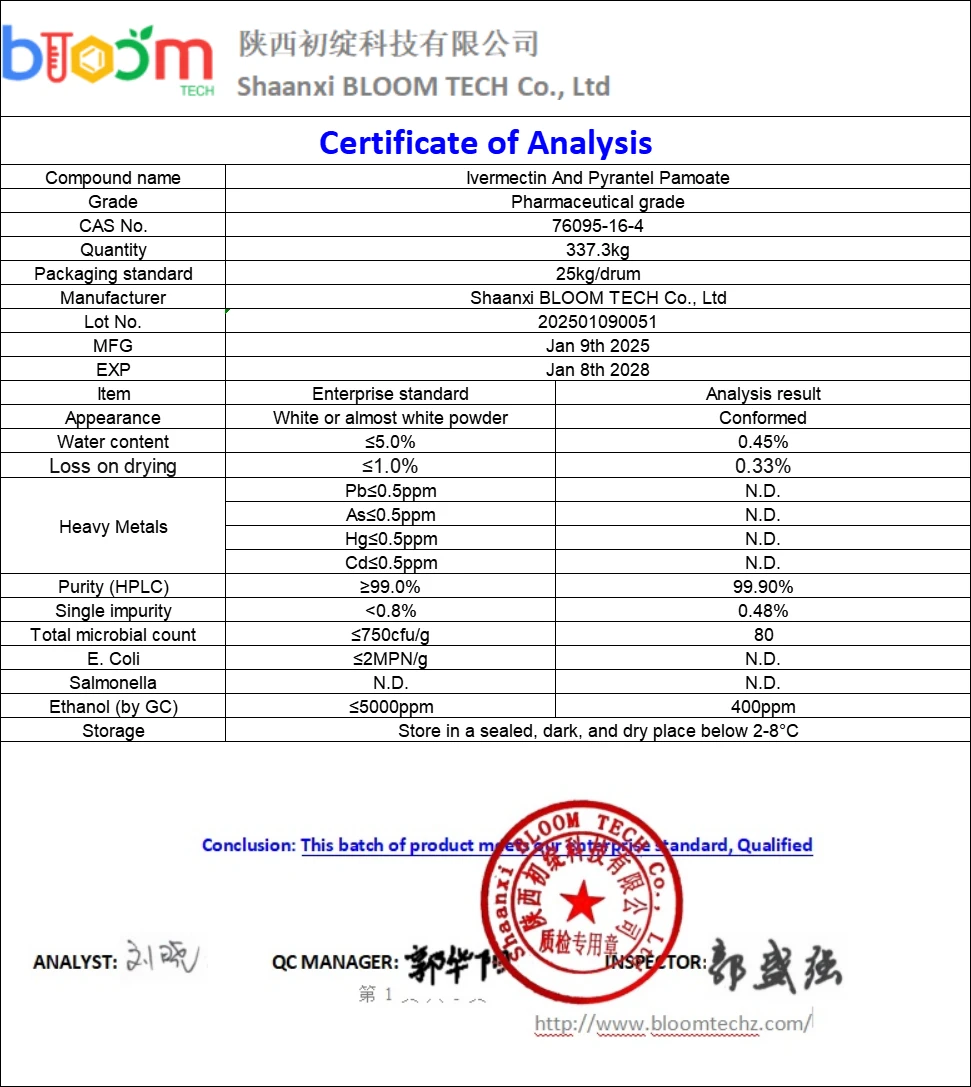
Shaanxi BLOOM Tech Co., Ltd. is one of the most experienced manufacturers and suppliers of ivermectin and pyrantel pamoate tablets in China. Welcome to wholesale bulk high quality ivermectin and pyrantel pamoate tablets for sale here from our factory. Good service and reasonable price are available.
Ivermectin And Pyrantel Pamoate Tablets are oral antiparasitic drugs designed specifically for dogs and cats, achieving broad-spectrum deworming effects by combining two active ingredients. Its core component, Ivermectin, belongs to the macrolide class of antibiotics and causes paralysis and death by interfering with parasitic nerve conduction; Pyrantel Pamoate, as a tetrahydropyridine anthelmintic, induces muscle spasmodic paralysis by inhibiting the activity of parasitic acetylcholinesterase. The synergistic effect of the two can simultaneously target multiple types of parasites both inside and outside the body, forming a three-dimensional protective network. It mainly targets roundworms (such as canine roundworm), hookworms (such as canine hookworm, Brazilian hookworm), and also has partial effects on whipworms. As a cholinesterase inhibitor, it blocks the degradation of acetylcholine at the neuromuscular junction, causing persistent muscle contraction and paralysis of parasites. The oral absorption rate is low (about 10%), mainly acting in the intestine, and the unabsorbed part is excreted with feces, reducing the risk of systemic side effects.
 |
 |

The disturbance of the intestinal ecosystem by this tablet
The gut ecosystem is an important interface for the interaction between the human body and the external environment, consisting of a dynamic equilibrium system composed of microbial communities, host immune systems, and metabolites. In recent years, with the increasing demand for parasitic disease prevention and control, compound tablets centered around Ivermectin And Pyrantel Pamoate Tablets have been widely used in companion animals such as dogs and cats.
Potential correlation between drug mechanism of action and intestinal ecology

Ivermectin: Neuroinhibition and Cell Membrane Regulation
Ivermectin belongs to the macrolide class of antibiotics, and its core mechanism of action is to activate the glutamate chloride ion channel (GluCl) on the membrane of parasitic nerve cells, causing chloride ion influx and neuronal hyperpolarization, ultimately leading to parasite paralysis and death. Although this process targets parasites, it may indirectly affect gut ecology through the following pathways:
Microbial metabolic interference: Ivermectin has non-specific binding ability to chloride ion channels of some Gram positive bacteria (such as Lactobacillus) in the gut microbiota, which may inhibit their metabolic activity.
Immune regulatory effect: Drug induced parasite death releases a large amount of antigens, activating the host's Th2 immune response, leading to an increase in the secretion of IgA in the intestinal mucosa, thereby altering the colonization environment of the microbiota.
Thiopyrimidine dihydroxynaphthalene: cholinergic blockade and muscle contraction
Thiamethoxazole, as a depolarizing neuromuscular blocker, triggers spastic paralysis of the parasite by continuously activating the nicotinic acetylcholine receptor (nAChR). The main impact of its intestinal ecology is reflected in:
Direct bactericidal effect: In vitro experiments have shown that high concentrations of thiamethoxam (>100 μ M) can inhibit the formation of Escherichia coli biofilm, which may be related to the physical damage of the drug to bacterial cell membranes.
Metabolite interaction: The hydroxylation products generated by the metabolism of thiacloprid in the intestine may participate in the aromatic amino acid metabolism pathway, affecting the energy supply of key microbial communities such as butyrate producing bacteria.

Disruption of intestinal microbiota structure by drugs
Decline in microbial diversity and imbalance in composition
Preclinical studies have shown that after oral administration of Ivermectin And Pyrantel Pamoate Tablets for three consecutive days in dogs and cats, the alpha diversity index (Shannon index) of gut microbiota significantly decreased (p<0.05), and the ratio of Firmicutes/Bacteroidetes decreased from 3.2 ± 0.8 to 1.7 ± 0.5. Specific changes include:
Reduction of beneficial bacteria: The abundance of Bifidobacterium decreased by 62% and Lactobacillus decreased by 48%, which may be related to the inhibitory effect of drugs on Gram positive bacteria.
Conditional pathogenic bacteria expansion: The relative abundance of Enterobacteriaceae (such as Escherichia coli and Klebsiella) increases by 3.1 times, which may trigger intestinal inflammatory reactions.


Metabolic inhibition of key functional microbial communities
Short chain fatty acid producing bacteria: Roseburia and Faecalibacterium have a 57% decrease in butyric acid synthesis ability, leading to reduced host energy supply and impaired intestinal mucosal barrier function.
Bile acid metabolizing bacteria: The activity of 7 α - dehydroxylase in Clostridium is reduced, and the production of secondary bile acids (such as deoxycholic acid) is reduced, which may affect host lipid metabolism and immune regulation.
The selection pressure of drug-resistant strains
Long term low-dose use of Ivermectin And Pyrantel Pamoate Tablets may lead to the evolution of gut microbiota resistance. For example, in a study on Canadian horse farms, after using ivermectin for six consecutive months, the resistance rate of Enterococcus faecalis to macrolide antibiotics increased from 12% to 34%, suggesting that drugs may promote the spread of resistance genes through horizontal gene transfer.

Drug induced disruption of intestinal barrier function
Physical barrier damage
Drug induced parasite death releases a large amount of proteolytic enzymes, disrupting the tight junctions between intestinal mucosal epithelial cells. Experiments have shown that 24 hours after administration, intestinal permeability markers (such as lactulose/mannitol ratio) in dogs increase by 2.3 times, indicating impaired intestinal mucosal barrier function.
Immune barrier disorder
Th1/Th2 imbalance: Ivermectin activates dendritic cell TLR4 receptors, promotes IL-12 secretion, inhibits Th2 type immune response, and may lead to excessive clearance of intestinal worms and increased risk of subsequent allergic reactions.
Reduced regulatory T cells: After 7 days of administration, the proportion of FoxP3+Treg cells in gut associated lymphoid tissue (GALT) decreased by 41%, weakening the inhibitory effect on inflammatory response.
Weakening of chemical barriers
Drug metabolites may interfere with mucus layer synthesis. For example, the hydroxylation products of thiazide can inhibit the O-glycosylation modification of mucin MUC2, resulting in a 38% reduction in mucus layer thickness and an increased risk of pathogen colonization.
Indirect effects of drugs on host metabolism
Disruption of energy metabolism
Dysbiosis of the microbiota leads to a decrease in short chain fatty acid (SCFA) production, with a 65% decrease in acetate levels, which may affect host fat storage and insulin sensitivity through the G protein coupled receptor (GPR43) signaling pathway. Clinical cases have shown that dogs on long-term medication experience slow weight gain (an average monthly decrease of 0.3kg) and fluctuations in blood sugar levels.
Vitamin synthesis disorder
The reduction of bifidobacteria and lactobacilli leads to a decrease in the synthesis ability of vitamin K and B vitamins. For example, a 42% decrease in vitamin B12 levels may lead to anemia and neurological symptoms.
Drug microbiota metabolite interactions
Ivermectin can be metabolized by the gut microbiota into hydroxylated products, and its blood drug concentration is negatively correlated with the abundance of Bacteroidetes (r=-0.72, p<0.01), suggesting that microbiota composition may affect drug bioavailability.
Ecological disturbance in special scenarios 马线虫感染
Complex effects in co infection models
In the multi mammary mouse experiment in Tanzania, although the combination of ivermectin and thiamethoxam significantly reduced the nematode infection rate (by 85%), it did not change the infection dynamics of MORV virus and Bartonella. This indicates that the clearance of macro parasites by drugs may indirectly affect the transmission of micro parasites through immune regulation, but the specific mechanism still needs to be further explored.


Selection pressure of drug-resistant parasites
A study by Canadian horse farms showed that the insecticidal efficiency of ivermectin against Parascaris equorum decreased from 92% to 33.5%, while thiamethoxam remained effective at 97.6%. This difference may lead to the coevolution of drug-resistant strains and parasites, exacerbating the imbalance of intestinal ecology.
Differences in host age and variety
Young animals (<6 months old) have incomplete colonization of their gut microbiota, and the recovery time of the microbiota after medication is extended to 21 days, while adult animals only need 7 days. In addition, the sensitivity of short haired cats to thiacloprid is 1.8 times that of long haired cats, which may be related to differences in the structure of the microbiota associated with their hair type.

Strategies for alleviating ecological disturbances caused by drugs
Precision medication plan
Dose optimization: Adjust the dose according to body weight (dogs: Ivermectin 6 μ g/kg, Thiamethoxam 5mg/kg; Cats: Ivermectin 0.024mg/kg, Thiamethoxam 20mg/kg), to avoid overdose.
Course design: Take medication every 3 months to reduce the pressure of continuous selection.
Microbial remediation intervention
Probiotic supplementation: The combined use of Lactobacillus GG strain (10 ⁹ CFU per day) and Bifidobacterium BB-12 strain (10 ⁸ CFU per day) can accelerate the recovery of microbial diversity (reducing the recovery time to 10 days).
Probiotic intake: Adding oligofructose (FOS, 2g/kg daily) can promote the growth of SCFA producing bacteria and improve intestinal mucosal barrier function.
Immune regulation support
Omega-3 fatty acid supplementation: Daily intake of EPA+DHA 200mg/kg can inhibit Th1 type immune overactivation and reduce the risk of intestinal inflammation.
Vitamin D3 supplementation: Maintain serum 25 (OH) D levels>30ng/mL and enhance the expression of tight junction proteins in intestinal mucosa.
Hot Tags: ivermectin and pyrantel pamoate tablets, suppliers, manufacturers, factory, wholesale, buy, price, bulk, for sale