

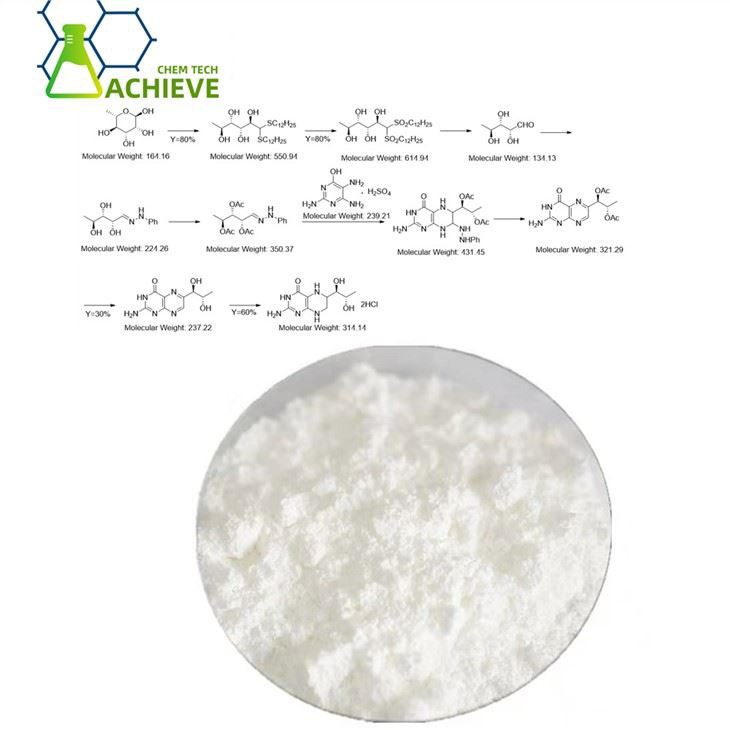
We take customer satisfaction as our service tenet, adhere to 'quality for survival, reputation for development', and provide our customers with high quality 99 9 pure lidocaine powder, tetravisc, naphtholbenzein indicator. Pursue quality, technology as respect, service is satisfactory. We sincerely hope to be your partner in the industry market with high quality and low maintenance cost products. We adhere to the business philosophy of winning with variety and quality and pursuing excellent performance. We create a broad career platform for our employees and create opportunities and conditions for them to realize their self-worth.
Sapropterin Hydrochloride, The chemical name is (6R) -5,6,7,8-tetrahydrobiopterin dihydrochloride, which appears as a white powder and is an important organic and biochemical reagent widely used in biochemistry and medical research. It has certain toxicity, with an LD50 (oral administration to rats) of 1g/kg. Therefore, when using and coming into contact with this compound, it is necessary to strictly follow safety operating procedures, wear appropriate protective equipment, and avoid direct contact with skin and eyes. It is a natural cofactor for key enzymes such as phenylalanine hydroxylase (PAH), tyrosine hydroxylase (TH), tryptophan hydroxylase (TPH), and nitric oxide synthase (NOS). These enzymes are involved in various important metabolic processes in organisms, such as amino acid metabolism, neurotransmitter synthesis, and vasodilation. As a cofactor, it can stabilize the structure of enzymes, promote enzyme substrate binding, and accelerate enzymatic reactions. This is crucial for maintaining normal physiological functions and metabolic balance within the organism.
CAS No.: 69056-38-8, Molecular formula: c9h17cl2n5o3, Molecular weight: 314.17, EINECS No.: 663-669-3
|
Form |
white to off white powder |
|
Color |
colorless to slightly yellow |
|
soluble |
19.60 - 20.40mg/ml |
|
PH |
5-7 (10g/ L, H2O, 20℃) |
|
Density |
1.43 (rough estimate) |
|
Storage conditions |
- 20 ° C |
|
Specific rotation |
D25 - 6.81 ° (C = 0.665 in 0.1 M HCl) |
|
Melting point |
245-246 ° (DEC) |
White powder, GC>99.8%, the top quality for Japan senior parmaceutical company.Reference price for sample: 1g, $420, EXW 10g,$430/g.
Sapropterin Hydrochloride, Also known as tetrahydrobiopterin hydrochloride (BH4 HCl), it plays a crucial role in biochemistry. As a naturally occurring cofactor, it plays a crucial role in various biochemical reactions, particularly in amino acid metabolism, neurotransmitter synthesis, and nitric oxide (NO) production.
As a cofactor of enzymes
Natural cofactors of various enzymes that perform important metabolic functions within the organism.

Phenylalanine hydroxylase (PAH)
(1) Function: PAH is a key enzyme in the phenylalanine metabolic pathway, responsible for converting phenylalanine into tyrosine. This conversion is crucial for preventing the accumulation of phenylalanine and its metabolites, as these metabolites may cause damage to the nervous system.
(2) Mechanism of action: As a cofactor of PAH, it enhances the catalytic efficiency of PAH by stabilizing the enzyme's active conformation and promoting substrate enzyme binding.
Tyrosine hydroxylase (TH)
(1) Function: TH is a key enzyme in the biosynthesis of dopamine and norepinephrine, responsible for converting tyrosine to dopa (L-DOPA). These neurotransmitters play important roles in regulating emotions, movement, cognition, and reward mechanisms.
(2) Mechanism of action: Similar to PAH, it is also a cofactor of TH, promoting enzyme catalytic activity through a similar mechanism.


Tryptophan Hydroxylase (TPH)
(1) Function: TPH is a key enzyme in the biosynthesis of serotonin, responsible for converting tryptophan to 5-hydroxytryptophan. Serotonin plays an important role in regulating emotions, sleep, appetite, and pain perception.
(2) Mechanism of action: As a cofactor of TPH, it also enhances the catalytic activity of the enzyme by stabilizing its structure and promoting substrate enzyme binding.
Nitric oxide synthase (NOS)
.(1) Function: NOS is a type of enzyme that catalyzes the reaction between L-arginine and molecular oxygen to produce nitric oxide (NO) and L-citrulline. NO, as an important signaling molecule, plays a wide range of physiological roles in the cardiovascular system, nervous system, and immune system.
(2) Mechanism of action: Although not a direct cofactor of NOS, it indirectly regulates the activity of NOS by affecting the metabolism of NOS substrates (such as L-arginine) and the pathway of NO production.

Treat genetic metabolic diseases
Has shown significant therapeutic effects in treating certain genetic metabolic diseases, particularly those related to BH4 Deficiency.

Hyperphenylalaninemia (PKU)
(1) Cause: PKU is an autosomal recessive genetic disease caused by mutations in the PAH gene. The decrease or complete loss of PAH activity in the patient's body leads to the inability to metabolize phenylalanine normally, resulting in the accumulation and production of toxic metabolites in the body.
(2) Treatment: For PKU patients caused by BH4 deficiency, it can be used as an alternative treatment. By supplementing, the activity of PAH can be restored or partially restored, thereby reducing serum phenylalanine levels and improving patients' clinical symptoms.
Other BH4 deficiencies
In addition to PKU, there are also other genetic metabolic disorders caused by BH4 deficiency, such as hyperthyroidism and Dopa responsive dystonia (DRD). Patients with these diseases can also alleviate symptoms and improve their quality of life through treatment.

Pharmacological effects and clinical applications
It has multiple pharmacological effects and advantages in clinical applications.

Enhance enzyme activity
As a cofactor of multiple enzymes, it can significantly enhance the activity of these enzymes, thereby accelerating the rate of related metabolic pathways and reducing the accumulation of harmful metabolites.
Improve clinical symptoms
By supplementing Sapropterin Hydrochloride, clinical symptoms of BH4 deficiency patients can be significantly improved, such as reducing serum phenylalanine levels, increasing dopamine and norepinephrine levels, and improving neurological function.


Safety and tolerability
In clinical trials, it has shown good safety and tolerability, and most patients are able to tolerate and benefit from the treatment of this drug. However, it is still necessary to monitor the patient's liver and kidney function as well as serum phenylalanine levels during use.
|
|
|


Sapropterin Hydrochloride CAS 69056-38-8 manufactured by BLOOM TECH Xi'an city Huyi GMP polit factory.
Remark: ACHIEVE CHEM-TECH is the subsidiary of us, BLOOM TECH(Since 2008)
Based on the above steps, the following are the key chemical equations:
1. Oxidation reaction of hydroxybenzyl alcohol:
4-Hydroxybenzyl alcohol → oxidation + C7H6O2
2. Sulfonation reaction of PABA:
PABA+ SO3 → sulfonation + C8H15NO2
3. Reduction reaction of PABS:
C8H15NO2 + H2 → reduction + PABAS
4. Cyclization reaction of PABAS:
PABAS → cyclization + C15H10O4
5. Hydrogenation reaction of DHF:
C15H10O4 + H2 → hydrogenation + C4H8O
6. Reduction reaction of THF:
C4H8O + H2 → reduction + 9H15N5O3
7. Hydrochlorination reaction of BH4:
9H15N5O3 + HCl → C9H17Cl2N5O3
Through these steps, it can be effectively synthesized, and each reaction step is controlled by precise synthesis methods and reaction conditions to ensure high yield and purity of the product.
The route for synthesizing product can be traced back to the chemical synthesis of Tetrahydrofolic acid (THF) and its derivatives.
The first step is to synthesize 4-hydroxybenzaldehyde. This is an important starting material that can be obtained through the following reaction steps:
Oxidation reaction: 4-Hydroxybenzyl alcohol can be oxidized to obtain 4-hydroxybenzaldehyde.
4-Hydroxybenzyl alcohol → oxidation + 4-Hydroxybenzaldehyde
The next steps involve the synthesis of tetrahydrofolate. Tetrahydrofolate is its structural basis, and its synthesis usually includes the following steps:
Sulfonation reaction of PABA:
para aminobenzoic acid (PABA) undergoes sulfonation reaction to obtain para aminobenzoyl sulfonic acid (PABS), Para-Aminobenzoyl Sulfate).
PABA+ SO3 → sulfonation + PABS
01
Reduction:
Perform a reduction reaction on PABS to generate p-aminobenzamidopropane sulfonic acid (PABAS, Para-Aminobenzoyl Aminopropane Sulfate).
PABS+ H2 → reduction + PABAS
02
Cyclization reaction:
PABAS undergoes cyclization reaction to generate dihydrofolic acid (DHF).
PABAS → cyclization + DHF
03
Hydrogenation reaction:
DHF undergoes further hydrogenation reaction to obtain tetrahydrofolate (THF).
DHF+ H2 → hydrogenation + THF
04
After obtaining tetrahydrofolate (THF), it needs to be reduced to heptahydrotetrahydrofolate (7,8-Dihydrobiopterin, BH4). This step typically involves the following reaction:
Reduction: Tetrahydrofolate (THF) undergoes a reduction reaction to produce heptahydrofolate (BH4).
THF+ H2 → reduction + BH4
The final step is to react heptahydropetrahydrofolate (BH4) with hydrochloric acid to form the hydrochloride form of Sapropterin Hydrochloride.
Hydrochlorination: Heptahydrotetrahydrofolate (BH4) reacts with hydrochloric acid to produce the product.
BH4+ HCl → C9H17Cl2N5O3
The Sell Supply Sapropterin Hydrochloride Price CAS 69056-38-8 Buy Sapropterin Hydrochloride Supplier Seller Manufacturer Factory company has successively introduced a large number of foreign capital and advanced technology with a number of joint ventures, and has continued to pay attention to and investigate other investment plans with resource advantages and industrial upstream and downstream integration effects, highlighting the three major aspects of "industrial resources, product technology, and industry leadership" Advantage. We hope to build an interactive relationship in which employees love the company, the company cares for the employees, and the employees and the company develop together. We have rich experience in international logistics operation and management team.