




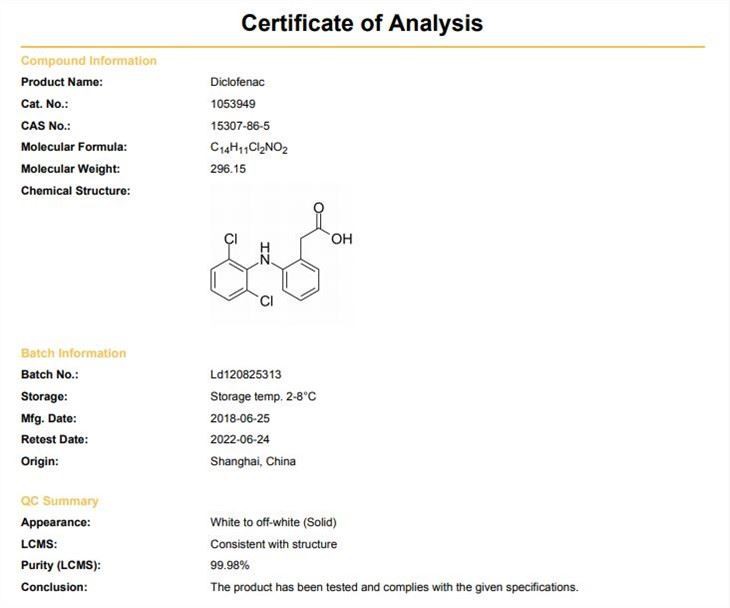
Shaanxi BLOOM Tech Co., Ltd. is one of the most experienced manufacturers and suppliers of 1-(2,6-dichlorophenyl)-2-indolinone cas 15307-86-5 in China. Welcome to wholesale bulk high quality 1-(2,6-dichlorophenyl)-2-indolinone cas 15307-86-5 for sale here from our factory. Good service and reasonable price are available.
1-(2,6-Dichlorophenyl)-2-Indolinone (diclofenac), white to light yellow crystalline powder, insoluble in water, otherwise known as diclofenac acid, is a non-steroidal anti-inflammatory drug with anti-inflammatory, analgesic, and antipyretic effects. Clinically, it is used for pain caused by rheumatoid arthritis, adhesive spondylitis, non-inflammatory arthritis, arthritis, non-articular rheumatism, non-articular inflammation, various neuralgia, cancer pain, post-traumatic pain, and fever caused by various inflammation. It is toxic to some animals, such as vultures. Diclofenac powder is mainly used in chemistry, but diclofenac solution is mainly used for animals, such as diclofenac solution for dogs or cats eyes when sick.

|
|
|
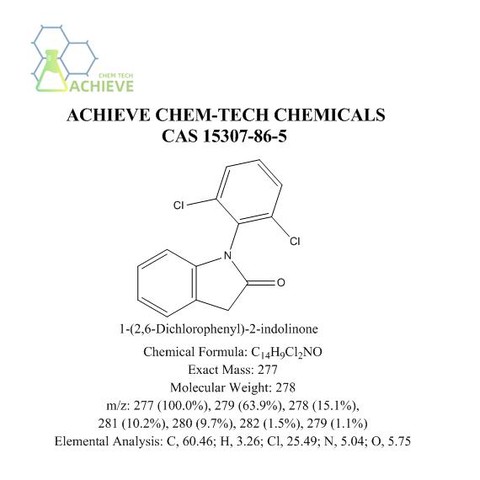
| Chemical Formula | C14H9Cl2NO |
| Exact Mass | 277 |
| Molecular Weight | 278 |
| m/z | 277 (100.0%), 279 (63.9%), 278 (15.1%), 281 (10.2%), 280 (9.7%), 282 (1.5%), 279 (1.1%) |
| Elemental Analysis | C, 60.46; H, 3.26; Cl, 25.49; N, 5.04; O, 5.75 |



01 Analgesia
02 Anti inflammation
Diclofenac achieves comprehensive anti-inflammatory effects by significantly inhibiting the synthesis and release of core inflammatory mediators during inflammatory responses. It can effectively block the production of prostaglandins that induce vasodilation, tissue edema and pain sensitization, and reduce the release of leukotrienes that mediate inflammatory cell infiltration and tissue damage. It is clinically applicable to a variety of inflammatory diseases, including chronic joint inflammation, autoimmune inflammatory lesions, soft tissue inflammatory swelling, and inflammatory reactions caused by trauma or surgery, which can effectively control local redness, swelling, heat and pain, and inhibit the progression of inflammatory lesions.


03 Arthritis
As a core therapeutic drug for joint diseases, Diclofenac is widely used in the clinical treatment of multiple types of arthritis. It covers common types such as rheumatoid arthritis, osteoarthritis and ankylosing spondylitis. For inflammatory arthritis, it can suppress autoimmune-induced joint inflammation; for degenerative osteoarthritis, it can relieve synovial congestion and sterile inflammation. Long-term standardized use can significantly reduce joint pain, eliminate synovial swelling, relieve morning stiffness and joint movement limitation, and effectively improve patients' daily joint activity and motor function, delaying the deterioration of joint lesions.
04 Antipyretic
Diclofenac has reliable antipyretic activity for moderate to high fever caused by various etiologies. It acts on the hypothalamic thermoregulatory center, inhibits the synthesis of prostaglandins that cause body temperature set-point elevation, and promotes peripheral vasodilation and heat dissipation to reduce elevated body temperature. It is suitable for fever symptoms induced by bacterial and viral infections, inflammatory diseases and postoperative stress reactions. Compared with conventional antipyretic drugs, it has rapid fever-reducing effect and long duration of action, and can effectively avoid repeated fever attacks.


05 Acute gout
06 Postoperative pain control
In clinical surgical treatment, Diclofenac is routinely used for postoperative analgesia and anti-inflammatory intervention. Surgical trauma will cause tissue damage and local inflammatory reaction, leading to persistent postoperative pain and wound swelling. As a potent NSAID, it can effectively relieve moderate postoperative pain caused by surgical incision and tissue injury, reduce postoperative inflammatory exudation and wound edema, alleviate patients' postoperative discomfort, and help patients recover early postoperative motor function, which is widely used in general surgery, orthopedics, obstetrics and gynecology and other surgical fields.


07 Dental applications
Diclofenac is commonly used in stomatology for the treatment and symptomatic relief of various dental painful inflammatory diseases. It is clinically applicable to spontaneous toothache and pulp pain caused by pulpitis and periapical periodontitis, and can also relieve postoperative pain, swelling and inflammatory discomfort after tooth extraction, root canal treatment, dental surgery and other invasive dental operations. It can effectively inhibit oral local inflammatory reactions, reduce soft tissue swelling and nerve pain sensitivity in the oral cavity, and significantly improve patients' discomfort during and after dental treatment.
08 Other uses


1- (2,6-Dichlorophenyl) -2-Indolinone, commonly known as diclofenac, is mainly manifested in its anti-inflammatory properties due to its pharmacological mechanism, as follows:

Inhibit cyclooxygenase and lipoxygenase
Dual inhibitory effect: Diclofenac has a dual effect of inhibiting cyclooxygenase (COX) and lipoxygenase in inflammatory reactions. When cyclooxygenase is inhibited, its metabolites, prostaglandins, are significantly reduced.
Reduce inflammatory mediators: The reduction of prostaglandins reduces local inflammatory reactions, tissue congestion and swelling, and pain sensitivity to bradykinin, thereby exerting their anti-inflammatory effects.
Anti inflammatory effect
Clinical validation: Diclofenac has been proven to have good anti-inflammatory effects in both animal experiments and human clinical practice.
Targeted inhibition: Diclofenac has a significantly stronger inhibition of COX-2 than COX-1. Due to the close relationship between COX-2 and inflammation and pain, while COX-1 is related to maintaining normal functions of the human gastrointestinal tract, this selective inhibition results in relatively low gastrointestinal adverse reactions caused by diclofenac, lower than drugs such as aspirin and indomethacin.
Indications
Chronic arthritis: Diclofenac acid is widely used to treat the swelling and pain of various chronic arthritis diseases, including rheumatoid arthritis, osteoarthritis, ankylosing spondylitis, gouty arthritis, etc. It is the first-line treatment drug for these diseases.


Soft tissue rheumatic pain: also used to treat non joint soft tissue rheumatic pain, such as shoulder pain, tenosynovitis, bursitis, muscle pain, etc.
Acute pain: Diclofenac has significant therapeutic effects on some acute pain conditions, such as postoperative pain, swelling, post-traumatic lesions (such as sprains, strains), primary dysmenorrhea, headache, toothache, etc.
Precautions
Symptomatic effect: It should be noted that diclofenac mainly has symptomatic effects, namely anti-inflammatory, analgesic, and antipyretic, and cannot directly treat the cause. Therefore, it is essential to simultaneously treat the underlying causes during the application process.
Adverse reactions: Although the gastrointestinal adverse reactions caused by diclofenac are relatively low, there are still a few people who may experience gastrointestinal damage. In addition, there may be other potential adverse reactions, such as allergic reactions, so it is important to fully understand and follow medical advice before use.
In summary, the specific manifestations of 1- (2,6-Dichlorophenyl) -2-indolinone (diclofenac) in anti-inflammatory aspects mainly include its dual mechanism of inhibiting inflammatory mediators, significant anti-inflammatory effects, broad indications, symptomatic effects that need attention, and potential adverse reactions.

Melting point 156 – 158° , Boiling point 412.0 ± 45.0 ° C ( Predicted ) , Density 1.431 ± 0.06 g / cm3 ( Predicted ) , Storage conditions Sealed in dry, Room Temperature , Acidity coefficient ( pKa ) pKa4 ( Uncertain ) , Water solubility 1.278 mg / L ( 30 oC ) , Hazard Signs ( GHS ) , GHS06 , warning word Danger , Hazard description H301 , Prevention instructions P264-P270-P301 + P310 + P330-P405-P501 , Transport of dangerous goods No. 3249 , RTECS AG6310000 , HazardClass 6.1 ( b ) , Packing Group III.

The common synthesis route of 1-(2,6-Dichlorophenyl)-2-Indolinone (Diclofenac) usually involves the following Committed step:
The synthesis of Diclofenac usually starts with 2,6-dichlorobenzoic acid. This step typically involves reacting 2,6-dichlorobenzoic acid with a certain amount of anhydride and solvent to generate the corresponding anhydride.
After the initial compound undergoes an amination reaction, 2-cyano-3-amino-4-imino-5-fluoropyridine is generated. This step typically involves the use of ammonia reagents (such as ammonia or ammonia water) and solvents.
The next step is to combine 2-cyano-3-amino-4-imino-5-fluoropyridine with β- The beta bromo ketonic ester reacts to form a Simple aromatic ring structure. This step usually requires alkaline conditions and appropriate solvents.
Elimination reaction is an important step in the synthesis of diclofenac. By Elimination reaction β- The partial removal of bromone esters and the introduction of a carbonyl functional group ultimately form the amide structure of diclofenac.
After synthesis, the obtained product is usually purified through crystallization and purification steps. Crystallization can be achieved through solvent control and temperature conditions to obtain high-purity diclofenac products.

1-(2,6-Dichlorophenyl)-2-Indolinone, also known as diclofenac, is an important pharmaceutical raw material (API) with broad application prospects. As a type of nonsteroidal anti-inflammatory drug (NSAID), diclofenac is mainly used clinically to relieve pain, reduce inflammation, and cool down. With the global aging population and increasing health awareness, the demand for high-quality and high-performance pharmaceutical products continues to grow, and the market prospects for diclofenac are becoming increasingly broad.
Market demand analysis
The promotion of population aging
With the aggravation of global population aging, the incidence rate of chronic pain, arthritis and other elderly diseases is increasing year by year. Diclofenac, as an effective drug for treating these diseases, will continue to grow in market demand. Especially in developed countries, due to the high degree of population aging, the demand for pharmaceutical products such as diclofenac is more urgent.
Improvement of Health Awareness
With the improvement of people's living standards and the enhancement of health awareness, more and more people are paying attention to their own health status.


Diclofenac, as a safe and effective nonsteroidal anti-inflammatory drug, can meet people's pursuit of high-quality life. Especially in the fields of sports and fitness, occupational disease prevention, etc., diclofenac has broad application prospects.
The Development of Emerging Markets
Emerging market countries such as China and India have a growing demand for pharmaceutical products due to their large populations and rapid economic development. The improvement of medical standards and healthcare security systems in these countries will further drive the market demand for pharmaceutical products such as diclofenac.
Market competition pattern and trend
Market competition pattern
At present, the competitive landscape of the diclofenac market is relatively scattered, with both international large pharmaceutical companies and domestic small and medium-sized pharmaceutical enterprises. These enterprises have certain differences in product quality, price, market share, and other aspects. With the intensification of market competition and the increasing demand for high-quality drugs from consumers, the competition in the diclofenac market will become more intense.
Market trends
In the future, the diclofenac market will show the following development trends: firstly, high-quality and high-performance products will become the mainstream of the market; The construction of intelligent and automated production lines will improve production efficiency and product quality; Thirdly, international trade liberalization and facilitation will promote the international development of pharmaceutical products such as diclofenac; Fourthly, personalized medicine and precision medicine will become important development directions for pharmaceutical products such as diclofenac.
FAQ
Is diclofenac a strong painkiller?
+
-
Diclofenac is a prescription-strength nonsteroidal anti-inflammatory drug (NSAID) used to treat mild-to-moderate pain and inflammation. It is generally considered more potent than over-the-counter painkillers like ibuprofen.
What is diclofenac mostly used for?
+
-
Diclofenac is a prescription-strength nonsteroidal anti-inflammatory drug (NSAID) primarily used to reduce inflammation, swelling, and mild-to-moderate pain.
Hot Tags: 1-(2,6-dichlorophenyl)-2-indolinone cas 15307-86-5, suppliers, manufacturers, factory, wholesale, buy, price, bulk, for sale, Adrenochrome Powder, tetramisole hcl powder, Iodomethane d3, 18 Glycyrrhetinic Acid CAS 471 53 4, Best Phenibut powder, Cyproheptadine hydrochloride sesquihydrate