




Shaanxi BLOOM Tech Co., Ltd. is one of the most experienced manufacturers and suppliers of bisoprolol powder cas 66722-44-9 in China. Welcome to wholesale bulk high quality bisoprolol powder cas 66722-44-9 for sale here from our factory. Good service and reasonable price are available.
Bisoprolol powder is a highly selective β₁-adrenergic receptor blocker. The molecular formula is C₁₈H₃₁NO₄. It appears as a white to off-white crystalline powder, which is slightly soluble in water and readily soluble in organic solvents such as methanol or ethanol.As a raw material for cardiovascular drugs, Bisoprolol inhibits sympathetic nerve activity, reduces myocardial contractility and heart rate, and is used to treat hypertension, angina pectoris and chronic heart failure.Its high β₁-selectivity reduces the impact on β₂ receptors and lowers the risk of side effects such as bronchospasm. The raw material needs to strictly meet GMP standards to ensure purity and stability. It is often further processed into tablets or capsules. Storage should be protected from light and moisture, and kept in a cool and dry place.

|
|
|


|
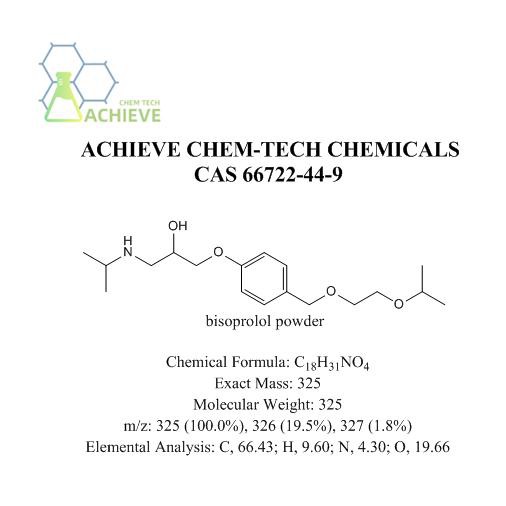
Chemical Formula |
C18H31NO4 |
|
Exact Mass |
325 |
|
Molecular Weight |
325 |
|
m/z |
325 (100.0%), 326 (19.5%), 327 (1.8%) |
|
Elemental Analysis |
C, 66.43; H, 9.60; N, 4.30; O, 19.66 |
We can provide bisoprolol synthesis. After reading the above information, if you want bisoprolol buy online, please send an email for specific bisoprolol price.

Bisoprolol, or bisoprolol fumarate, is a widely used drug primarily used to treat a variety of cardiovascular diseases.
Clinical Therapeutic Application in Hypertension
Hypertension constitutes one of bisoprolol powder's primary indications, and the drug is indicated for standardized long-term management of essential hypertension. Bisoprolol exerts antihypertensive effects via multiple pharmacological mechanisms. For one thing, it blocks cardiac β1-receptors to slow the sinus heart rate, attenuate myocardial contractility, reduce stroke volume and cardiac output per minute, directly lower hemodynamic load on the circulatory system and diminish pressure borne by peripheral blood vessels.


For another, it suppresses renin secretion by juxtaglomerular cells in the kidneys, inhibits excessive activation of the renin-angiotensin-aldosterone system, alleviates vasoconstriction and sodium-water retention, and thereby delivers sustained and stable blood pressure reduction. Possessing long-acting pharmacological properties, bisoprolol maintains consistent blood pressure control over 24 hours, covering blood pressure levels during daytime activities and nighttime rest to avoid excessive circadian blood pressure fluctuations. It is especially suitable for hypertensive patients with heightened sympathetic nerve excitability and elevated resting heart rate, as it stabilizes blood pressure rhythm while lowering blood pressure.
Therapeutic Application in Coronary Heart Disease and Stable Angina Pectoris
Bisoprolol plays a pivotal role in secondary prevention of coronary heart disease and management of angina pectoris. The core trigger of myocardial ischemia and angina attacks lies in myocardial oxygen consumption exceeding the oxygen supply capacity of coronary arteries. By slowing heart rate and weakening myocardial contractile force, bisoprolol markedly reduces overall myocardial oxygen consumption, balances the supply and demand of myocardial oxygen, and effectively relieves clinical manifestations of angina such as chest pain and chest tightness.


Regular long-term administration persistently ameliorates myocardial ischemia, decreases the frequency and duration of stable angina episodes, and improves patients' exercise tolerance and quality of life. Meanwhile, the drug stabilizes myocardial electrical activity in patients with coronary heart disease, mitigates cardiovascular fluctuations induced by myocardial ischemia, and substantially cuts the risk of severe adverse cardiovascular events including myocardial infarction. It serves as a core agent for long-term maintenance therapy of coronary heart disease.
Standardized Therapeutic Application in Chronic Heart Failure
Bisoprolol is a cornerstone therapeutic drug for stable chronic heart failure, widely prescribed for patients with heart failure with reduced ejection fraction. During the progression of chronic heart failure, persistent excessive activation of the systemic sympathetic nervous system accelerates heart rate, aggravates myocardial load, exacerbates myocardial remodeling, further impairs cardiac function and creates a vicious cycle. Bisoprolol effectively blocks overexcitation of cardiac sympathetic nerves, inhibits aberrant neuroendocrine activation, delays and reverses myocardial remodeling, and improves myocardial diastolic and systolic function.


Long-term intervention with this drug gradually optimizes cardiac pumping function, alleviates clinical symptoms of heart failure, and significantly reduces readmission rates and long-term mortality among heart failure patients. As an indispensable component of the heart failure "triple therapy" regimen, bisoprolol requires standardized dosage titration based on patients' cardiac function to achieve long-term disease control.
Clinical Control Application in Tachyarrhythmias
Bisoprolol is indicated for clinical control of various supraventricular tachyarrhythmias, including idiopathic sinus tachycardia and paroxysmal supraventricular tachycardia. By blocking β1-receptors in the sinoatrial node and atrioventricular node of the heart, the drug reduces the automaticity of the sinoatrial node, prolongs the conduction time and effective refractory period of the atrioventricular node, suppresses abnormal rapid cardiac pacing and conduction, steadily lowers heart rate, regularizes cardiac rhythm, curtails tachyarrhythmia attacks, preserves normal cardiac electrophysiological activity, and relieves discomforts such as palpitations experienced by patients.


The main pathway of action of bisoprolol powder in the body involves regulation of the cardiovascular system. As a selective beta 1 receptor blocker, it exerts its therapeutic effects in the body through specific mechanisms. The following is a detailed explanation of the mechanism of action of Sorol in vivo:
Mechanism of action

Lowering blood pressure:
Bisoprolol reduces myocardial contractility and heart rate by blocking β 1 receptors, thereby lowering cardiac output and reducing peripheral vascular resistance, resulting in a steady decrease in blood pressure. This effect is particularly important for patients with hypertension, as it can effectively control blood pressure levels and reduce the occurrence of cardiovascular events.
Improve heart function:
Bisoprolol can reduce myocardial oxygen consumption, improve myocardial ischemia, and alleviate symptoms of angina pectoris.
In the treatment of coronary heart disease, it helps stabilize the condition and improve the quality of life of patients. In addition, bisoprolol also has the effect of inhibiting cardiac remodeling, maintaining the normal structure and function of the heart, and reducing the mortality rate of heart failure patients.
Antiarrhythmic treatment:
Bisoprolol reduces the occurrence of arrhythmia by regulating the electrophysiological activity of the heart. This effect is particularly important in patients with arrhythmia, as it can reduce complications and mortality caused by arrhythmia.


Central inhibitory effect:
Bisoprolol also has a certain central inhibitory effect, which can suppress the excitability of the sympathetic nervous system, thereby achieving the effect of calming the nerves. This effect helps alleviate patients' tension and anxiety, and improve sleep quality.
Anti-inflammatory effect:
In some cases, bisoprolol also has certain anti-inflammatory effects. When the body is infected with bacteria or viruses, local inflammation may occur. Bisoprolol can inhibit the release of inflammatory mediators, alleviate inflammatory reactions, and thus help with disease recovery.

We can supply bisoprolol powder.
Remark: BLOOM TECH(Since 2008), ACHIEVE CHEM-TECH is the subsidiary of us.
Using p-hydroxybenzaldehyde (compound I) as the starting material and following the steps you described, bisoprolol free base can be prepared.
1. Reduction to obtain p-hydroxybenzyl alcohol (compound ii)
C7H6O2+reducing agent → C7H8O2
By using reducing agents such as hydrogen or phosphite, p-hydroxybenzaldehyde is reduced to p-hydroxybenzyl alcohol. This step reduces the aldehyde functional group to an alcohol functional group.
2. Etherification with isopropoxyethanol to obtain compound III
C7H8O2+C5H12O2+acid catalyst → product of ether formation with isopropoxyethanol (compound III)
React p-hydroxybenzyl alcohol with isopropoxyethanol (etherification of isopropanol and ethylene glycol) to produce compound III. This reaction generally requires acidic conditions, and the commonly used catalyst is sulfuric acid.

3. Etherification with epichlorohydrin to obtain compound IV
Compound III+C3H5ClO+alkali catalyst → product of ether formation with epichlorohydrin (Compound IV)
React compound III with epichlorohydrin to form compound IV. In this reaction, epichlorohydrin opens the ring and undergoes a substitution reaction with the ether functional group. This step requires alkaline conditions, and alkaline catalysts such as sodium hydroxide or sodium carbonate can be selected.
4. Ring opening reaction with isopropylamine to obtain bisoprolol free base
Compound IV+C3H9N → Bisoprolol free base
Compound IV undergoes a ring opening reaction with isopropylamine to form a bisoprolol free base. In this step, the epoxy group is attacked by isopropylamine, generating the final bisoprolol free base.
Bisoprolol was synthesized from 4 - hydroxybenzyl alcohol and isopropyl alcohol, epichlorohydrin, isopropylamine and fumaric acid in four steps.
For the complex first step reaction, the acid-base treatment method was used to obtain the product, so as to avoid the high temperature and high vacuum distillation method, which not only greatly improved the yield, but also greatly reduced the reaction energy consumption.
The structure of the product was characterized by liquid chromatography, melting point, Fourier transform infrared spectroscopy and nuclear magnetic resonance spectroscopy. This synthetic method has the advantages of mild conditions, simple post-processing operation and high product yield, which can be industrialized.

Bisoprolol powder is a white crystalline powder at ambient temperature with no peculiar odor, featuring a melting point of approximately 100 °C, while bisoprolol fumarate has a melting point ranging from 78 to 82 °C.
This substance possesses both lipophilic and hydrophilic properties with a moderate oil-water partition coefficient. It is readily soluble in polar organic solvents such as methanol and ethanol, moderately soluble in water, and sparingly soluble in nonpolar alkane solvents. Its molecular structure contains secondary amine, hydroxyl and ether functional groups, rendering it weakly basic. It can form stable salts with organic acids including fumaric acid, which improves water solubility and formulation stability.
It exhibits favorable chemical stability and resists degradation when stored away from light at room temperature. Nevertheless, its ether linkages are prone to hydrolytic cleavage under strongly acidic or alkaline conditions, and high temperatures will accelerate oxidative deterioration of amino groups. The molecule contains a chiral carbon atom, giving rise to levorotatory and dextrorotatory enantiomers.
The levorotatory form bears the predominant pharmacological activity, and most pharmaceutical-grade raw materials exist as racemates. It lacks characteristic strong UV absorption peaks, so thin-layer chromatography and acid-base salt-forming reactions are commonly adopted for chemical identification. Being non-volatile, it is suitable for processing into oral solid preparations such as tablets and capsules.
FAQ
What is bisoprolol used for?
+
-
Bisoprolol is a highly selective beta-1 blocker mainly applied to manage cardiovascular disorders. It treats hypertension to stabilize 24-hour blood pressure, relieves stable angina by lowering myocardial oxygen consumption, improves cardiac function in stable chronic heart failure, and controls supraventricular tachycardia to ease palpitations. It also serves as secondary prevention for coronary heart disease to reduce severe cardiovascular events.
How does bisoprolol work in the body?
+
-
It selectively blocks beta-1 receptors on cardiac tissue without obvious interference with beta-2 receptors in bronchi and peripheral vessels. It slows heart rate, weakens myocardial contraction, decreases cardiac output, and suppresses renin release to restrain the RAAS system, thus lowering blood pressure and reducing cardiac workload to relieve myocardial ischemia.
Hot Tags: bisoprolol powder cas 66722-44-9, suppliers, manufacturers, factory, wholesale, buy, price, bulk, for sale, Medetomidine hydrochloride, Diphenhydramine Hydrochloride Powder CAS 147 24 0, Norepinephrine Tartrate, cholesterol powder, Loperamide Hydrochloride Powder CAS 34552 83 5, 1 Naphthaleneacetic Acid CAS 86 87 3