




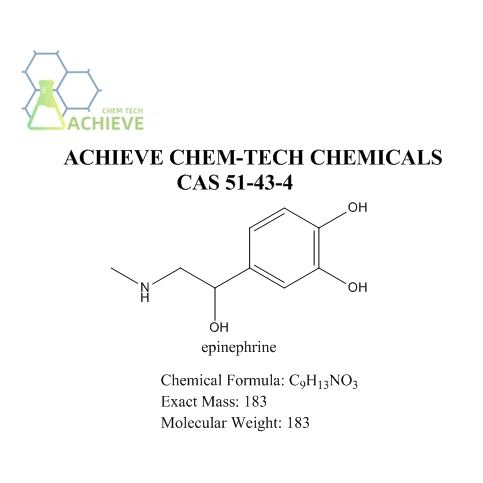

Shaanxi BLOOM Tech Co., Ltd. is one of the most experienced manufacturers and suppliers of epinephrine powder cas 51-43-4 in China. Welcome to wholesale bulk high quality epinephrine powder cas 51-43-4 for sale here from our factory. Good service and reasonable price are available.
Epinephrine powder, also known as adrenaline powder, is a potent drug that belongs to the class of sympathetic nervous system amines. The molecular formula C9H13NO3, CAS 51-43-4, is a naturally occurring hormone and neurotransmitter primarily produced by the adrenal gland in response to stress or hypotension. Pure form is a crystalline substance that can be used for medical applications after appropriate dilution or preparation.
This powder exerts its effects by stimulating the body's fight-or-flight response, triggering a surge of energy and preparing the body for intense physical activity or emergency situations. It works by acting on both alpha- and beta-adrenergic receptors throughout the body, causing vasoconstriction (narrowing of blood vessels), increased heart rate and contractility, dilation of bronchioles in the lungs, and a decrease in mucus production.
In medicine, it is often formulated into injectable solutions or auto-injectors for emergency treatment of life-threatening allergic reactions (anaphylaxis), cardiac arrest, and severe asthma attacks. Its rapid onset of action makes it a crucial lifesaving drug in these situations. Additionally, diluted forms of epinephrine may be used topically to control bleeding from certain injuries or to improve blood flow in certain surgical procedures.
However, due to its potent effects, it must be handled with caution and administered only by trained medical professionals or under strict medical supervision to avoid potentially serious side effects, including irregular heartbeat, high blood pressure, and, in extreme cases, cardiac arrest.
|
|
|


| Chemical Formula | C9H13NO3 |
| Exact Mass | 183.09 |
| Molecular Weight | 183.21 |
| m/z | 183.09 (100.0%), 184.09 (9.7%) |
| Elemental Analysis | C, 59.00; H, 7.15; N, 7.65; O, 26.20 |
Epinephrine powder is a hormone and neurotransmitter secreted by the adrenal medulla, belonging to the catecholamine class of compounds. It plays a core regulatory role in the cardiovascular, respiratory, metabolic, and nervous systems by activating alpha and beta adrenergic receptors. As the "golden medicine" of clinical emergency, adrenaline is applied in multiple fields such as critical care, surgical support, and chronic disease management.
The first choice for emergency treatment of anaphylactic shock
Allergic shock is a severe systemic reaction of the body to allergens (such as drugs, food, insect venom), characterized by sudden drops in blood pressure, laryngeal edema, bronchospasm, and multiple organ dysfunction. Adrenaline achieves rapid reversal through the following mechanisms:
Vasoconstriction: Activate vascular alpha receptors, constrict skin, mucosal, and visceral blood vessels, increase peripheral resistance, and correct hypotension.
Bronchiectasis: Excites bronchial beta ₂ receptors, relaxes smooth muscles, relieves airway spasms, and improves ventilation.


Inhibition of mediator release: Reduce the release of allergens such as histamine and leukotrienes, and alleviate mucosal edema.
Clinical studies have shown that early (within 5-10 minutes of symptom onset) intramuscular injection of adrenaline (0.3-0.5mg) can reduce the mortality rate of patients with anaphylactic shock from 6% to 0.5%. The American Heart Association (AHA) guidelines explicitly recommend it as a first-line treatment for anaphylactic shock.
2. Core drugs for cardiac arrest and cardiopulmonary resuscitation
In the rescue of cardiac arrest (ventricular fibrillation, avascular ventricular tachycardia, cardiac arrest), the success rate of resuscitation can be improved by the following actions:
Enhance myocardial contractility: Activate myocardial beta receptors, increase calcium ion influx, and improve myocardial contractility.
Increase coronary artery perfusion pressure: contract peripheral blood vessels, increase aortic diastolic pressure, and improve myocardial blood supply.


Promoting autonomous heart rhythm recovery: Intravenous injection of 1mg adrenaline every 3-5 minutes can increase the success rate of defibrillation in patients with ventricular fibrillation by 20%.
The 2020 International Guidelines for Cardiopulmonary Resuscitation emphasize that adrenaline is an essential medication in the standard resuscitation process for patients with cardiac arrest, especially for non defibrillation rhythms such as cardiac arrest and avascular electrical activity.
3. Rapid relief of acute attacks of bronchial asthma
During acute asthma attacks, airway smooth muscle spasms, mucosal edema, and increased secretions lead to severe respiratory distress. Rapid spasmolysis can be achieved through the following methods:
β ₂ receptor activation: relaxes bronchial smooth muscle, dilates airways, and reduces airway resistance.
Reduce mucosal secretion: Inhibit glandular secretion and alleviate airway mucus blockage.
Improve ventilation/blood flow ratio: dilate pulmonary blood vessels, reduce pulmonary shunting, and improve oxygenation.
In clinical practice, intramuscular injection of adrenaline (0.3-0.5mg) can alleviate moderate to severe asthma attacks within 5 minutes, especially for patients who have poor response to inhaled beta agonists.


4. Circulating support for critically ill patients
In critically ill patients such as septic shock and cardiogenic shock, circulatory stability is maintained through the following mechanisms:
Positive inotropic effect: enhances myocardial contractility and increases cardiac output.
Vasoactive regulation: At low doses, β - κ receptors are preferentially activated (enhancing myocardial contraction), while at high doses, α - κ receptors are activated (constricting blood vessels).
Metabolic support: promotes liver glycogen breakdown, raises blood sugar, and provides energy for the body.
Research has shown that in septic shock patients, adrenaline can increase mean arterial pressure (MAP) by 10-15 mmHg, but it should be noted that it may increase lactate levels and the risk of arrhythmia.
1. Local control of surgical bleeding
Epinephrine powder can be used as a vasoconstrictor for surgical wound hemostasis, and its mechanism includes:
Contraction of local blood vessels: Activate vascular alpha receptors and reduce blood flow at the surgical site.
Extended anesthesia duration: When used in combination with local anesthetics such as lidocaine, it can slow down the absorption of local anesthetics and prolong the duration of action.
For example, in nasal endoscopic surgery, a 1:100000 concentration of adrenaline solution can significantly reduce intraoperative bleeding and improve visual field clarity by 30%.


2. Enhancers for local anesthesia
Combined use with local anesthetics (such as "lidocaine+adrenaline") can optimize anesthesia effects through the following effects:
Reduce systemic absorption: shrink the blood vessels at the injection site, reduce the rate of local anesthetic entering the bloodstream, and decrease the risk of poisoning.
Extended action time: Local anesthetics can prolong the action time by 50% -100%.
Reduce bleeding: Local vascular constriction can reduce bleeding at the surgical site.
The commonly used clinical formula is 1% lidocaine+1:100000 adrenaline, used for nerve block or local infiltration anesthesia.
3. Acute hypotension of glaucoma
The intraocular pressure (IOP) can be reduced through the following mechanisms:
Reduce aqueous humor production: activate ciliary body vascular alpha receptors, constrict blood vessels, and reduce aqueous humor secretion.
Increase water outflow from the room: It may be promoted through the small beam network pathway to facilitate water outflow from the room.
0.1% adrenaline eye drops can reduce intraocular pressure by 20% -30% in patients with open-angle glaucoma, but it should be noted that it may cause side effects such as conjunctival congestion and allergic reactions.

Frontier exploration: from anti-aging to neuroprotection

1. Potential breakthroughs in anti-aging research
In recent years, the research on adrenaline in the field of anti-aging has attracted attention:
Regulation of mTOR signaling pathway: By inhibiting mTORC1 (mammalian target protein complex 1 of rapamycin), autophagy is activated, intracellular damaging proteins and organelles are cleared, and cellular aging is delayed.
Mitochondrial function protection: Animal experiments have shown that adrenaline can increase mitochondrial biosynthesis, improve energy metabolism, and prolong the lifespan of model organisms such as nematodes and mice.
Clinical translational exploration: A small-scale clinical trial targeting the elderly showed that intermittent use of low-dose adrenaline (0.1mg twice a week) can improve immune function and reduce the incidence of infection, but its safety and long-term efficacy need to be further validated.
2. Intervention for neurodegenerative diseases
Potential therapeutic value demonstrated in neurodegenerative diseases such as Alzheimer's disease and Parkinson's disease:
Alzheimer's disease: By activating beta ₂ receptors, reducing beta amyloid deposition, and improving cognitive function. Animal models showed that after continuous administration for 6 months, spatial memory ability improved by 30%.
Parkinson's disease: protects dopaminergic neurons and reduces alpha synuclein aggregation. Cell experiments have shown that adrenaline treatment can increase the survival rate of neurons by 40%.
Cerebral ischemia protection: In stroke models, activation of beta receptors reduces cerebral infarction volume and improves neurological deficits.


3. Regulation of metabolic diseases
Adrenaline can regulate metabolic diseases such as metabolic syndrome and diabetes:
Improvement of insulin sensitivity: A mouse model showed that adrenaline can activate the AMPK signaling pathway, enhance insulin sensitivity, and reduce fasting blood glucose.
Fat metabolism regulation: promotes browning of white fat, increases energy expenditure, and improves obesity related metabolic disorders.
Clinical application challenge: Long term use may activate mTORC2, leading to elevated blood sugar levels, requiring the development of more targeted adrenergic receptor agonists.
Epinephrine powder, as an important bioactive molecule, has a wide range of applications in medicine, biochemistry, and physiology research. However, there are many limitations to directly extracting adrenaline from living organisms, such as low yield and complex extraction process. Therefore, chemical synthesis of adrenaline has become an important alternative method.
Michael addition reaction
Michael addition reaction is an organic chemical reaction that typically occurs on carbon carbon double bonds of compounds with alpha, beta unsaturated carbonyl groups. In this reaction, a nucleophile (such as tyrosine) attacks the double bond, forming a new carbon carbon bond. During the chemical synthesis of adrenaline, tyrosine undergoes a 1,4-Michael addition reaction with formaldehyde to produce the intermediate methyldopa.
(1) Selection and preparation of reactants
Tyrosine is an amino acid containing both amino and carboxyl groups, and the phenolic hydroxyl group in its structure gives it a certain degree of nucleophilicity. Formaldehyde is a simple aldehyde compound with a carbon oxygen double bond. Before the reaction, it is necessary to ensure the purity of tyrosine and formaldehyde to avoid impurities from affecting the reaction.
(2) Control of reaction conditions
The Michael addition reaction needs to be carried out under suitable reaction conditions. This includes controlling the reaction temperature, pH value, and selecting appropriate solvents. Temperature can affect reaction rate and product stability, while pH value can affect the dissociation state and nucleophilicity of tyrosine. The choice of solvent is also important, as it should be able to dissolve the reactants without affecting the progress of the reaction.
(3) Reaction mechanism
In the Michael addition reaction, the phenolic hydroxyl group of tyrosine first attacks the carbon oxygen double bond of formaldehyde, forming a new carbon carbon bond. During this process, the amino and carboxyl groups of tyrosine remain unchanged, while the oxygen atom of formaldehyde combines with the hydrogen atom of tyrosine to form water molecules. Finally, the intermediate of methyldopa is generated.
(4) Separation and purification of products
After the reaction is completed, appropriate separation and purification steps are required to obtain the intermediate of methyldopa. This usually includes steps such as filtration, washing, drying, and possible recrystallization. Through these steps, impurities such as unreacted raw materials, by-products, and solvents can be removed to obtain pure methyldopa intermediates.
Decarboxylation reaction
Decarboxylation is an organic chemical reaction in which carboxylic acid molecules lose one carboxyl group (COOH), typically forming corresponding hydrocarbons or derivatives of hydrocarbons. In the process of synthesizing adrenaline by chemical method, the intermediate of methyldopa is decomposed into adrenaline through decarboxylation reaction at high temperature.
- Control of reaction conditions: The decarboxylation reaction needs to be carried out at high temperature, usually 60 ℃ is chosen as the reaction temperature. This is because at this temperature, the intermediate of methyldopa can undergo a decomposition reaction, losing its carboxyl group and forming adrenaline. At the same time, it is necessary to control parameters such as reaction time and pressure to ensure the smooth progress of the reaction.
- Reaction mechanism: In the decarboxylation reaction, the carboxyl group of the methyl dopa intermediate first breaks, forming a carbon oxygen double bond and a hydroxyl group. Then, the hydroxyl group further loses one water molecule, forming a carbon carbon double bond in the adrenaline molecule. In the end, pure adrenaline molecules were obtained.
- Separation and purification of products: Similar to the Michael addition reaction, the decarboxylation reaction also requires separation and purification of the product after completion. This includes steps such as filtration, washing, drying, and possible recrystallization. Through these steps, unreacted methyldopa intermediates, by-products, solvents, and other impurities can be removed to obtain pure epinephrine powder molecules.
Hot Tags: epinephrine powder cas 51-43-4, suppliers, manufacturers, factory, wholesale, buy, price, bulk, for sale, iptg powder, Cyclophosphamide monohydrate powder, Pravadoline, Clascoterone Powder CAS 19608 29 8, Norepinephrine Powder CAS 51 41 2, Ethacridine Lactate Monohydrate CAS 6402 23 9