





Shaanxi BLOOM Tech Co., Ltd. is one of the most experienced manufacturers and suppliers of flibanserin powder cas 167933-07-5 in China. Welcome to wholesale bulk high quality flibanserin powder cas 167933-07-5 for sale here from our factory. Good service and reasonable price are available.
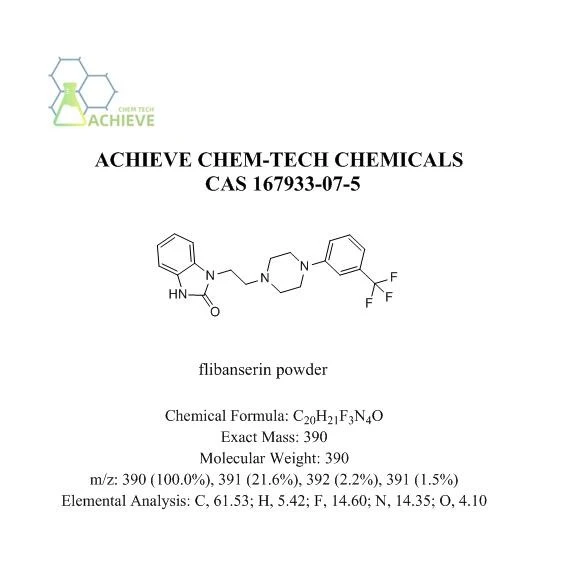
Flibanserin powder generally exists in the form of white to almost white crystalline solids, and sometimes it can also be a light yellow powder. The solubility in water is relatively low, approximately 2 milligrams per liter. Its solubility is relatively high in organic solvents such as ethanol and ether. The chemical formula is C20H21F3N4O, CAS 167933-07-5, with a complex organic structure. It belongs to the benzodiazepine heterocyclic class of drugs, including structural units such as benzene ring, trifluoromethylbenzene ring, and diazine ring. It is relatively stable at room temperature and can maintain its chemical properties for a long time when stored in a dry and weakly lit environment. It should avoid contact with strong oxidants and strong acids. In clinical practice, it is a psychotropic drug commonly used to treat low libido disorders in women. Used as a research reagent in the laboratory.

|
|
|


|
Chemical Formula |
C20H21F3N4O |
|
Exact Mass |
390 |
|
Molecular Weight |
390 |
|
m/z |
390 (100.0%), 391 (21.6%), 392 (2.2%), 391 (1.5%) |
|
Elemental Analysis |
C, 61.53; H, 5.42; F, 14.60; N, 14.35; O, 4.10 |

Flibanserin (trade name Addyi) is a multi-target drug with a unique pharmacological mechanism. Its chemical name is 3- [2- [4- [4- (trifluoromethyl) phenyl] piperazin-1-yl] ethyl] -1H-benzimidazol-2-one, and its molecular weight is 390.4. As a 5-hydroxytryptamine 1A receptor agonist and 5-hydroxytryptamine 2A receptor antagonist, flupentosimide has shown significant value in female sexual dysfunction, neurological and psychiatric disorders, and potential indications by regulating neurotransmitter balance in the central nervous system.
1. Disease background and treatment needs
Hypoactive Sexual Desire Disorder (HSDD) is the most common subtype of female sexual dysfunction (FSD), characterized by persistent or recurrent lack of sexual fantasies or desires, leading to significant psychological distress or interpersonal relationship disorders. About 10% -15% of women of childbearing age worldwide suffer from this problem, but previously there was a lack of targeted medication, and the treatment mainly relied on psychological intervention.
2. The mechanism of action of Fluriptyline
Flibanserin powder regulates the serotonin system through dual regulation:
Activation of 5-HT1A receptors: promotes dopamine release in the prefrontal cortex and enhances activation of brain regions related to sexual motivation.


Antagonistic 5-HT2A receptor: reduces the excessive regulation of serotonin on the sexual inhibitory center and decreases sexual aversion.
This bidirectional regulation of "excitation reduction inhibition" can restore the balance of neurotransmitters related to sexual desire and improve sexual desire from a physiological perspective.
3. Clinical evidence and efficacy evaluation
Key Phase III Trial (DAISY Study): 2400 premenopausal women with HSDD were enrolled and orally administered 100mg of Fluriptyline per day for 24 weeks. The results show that:
The frequency of sexual satisfaction events (SSE) increased by 0.5-1.0 times per month in the treatment group compared to the placebo group (p<0.05).
Sexual distress score (FSDS-DAO): The treatment group reduced by 1.2-1.6 points (out of 26 points, p<0.001).
Long term safety study: A 52 week open label trial showed that continuous use of medication resulted in sustained functional improvement until the 12th month. Common adverse reactions were dizziness (11%), drowsiness (10%), and nausea (8%), which mostly occurred in the early stages of medication and improved over time.
4. FDA Approval and Medication Standards
In 2015, the US FDA approved the marketing of Fluriptyline based on a risk benefit assessment, but with strict restrictions:
Contraindications: Combination use of alcohol or potent CYP3A4 inhibitors (such as ketoconazole).
Medication time: Take before bedtime daily to reduce the risk of low blood pressure.
Patient education: An informed consent form must be signed, clearly informing of the risk of fainting and avoiding dangerous activities such as driving.

Neuropsychiatric disorders: potential exploration from depression to Parkinson's disease

1. Unexpected discovery of depression
Fluriptyline was initially developed as an antidepressant, but its efficacy is significantly weaker than traditional SSRIs such as fluoxetine. However, in clinical trials, patients reported increased libido, which prompted research and development to shift towards HSDD. However, its neurotransmitter regulatory mechanism still provides a theoretical basis for the treatment of comorbid functional disorders in depression.
2. Early research on sexual dysfunction in Parkinson's disease
Parkinson's disease patients often experience decreased libido, which may be related to degeneration of dopaminergic neurons and imbalance of the serotonin system.
Animal experiments have shown that flubendamine can improve the sexual performance of Parkinson's disease model rats, but human research is still in the conceptual verification stage and further exploration is needed to optimize the dosage and the impact on motor symptoms.
Sleep disorders and circadian rhythm regulation
5-HT1A receptor agonists have sedative effects, and flibanserin powder may improve sleep quality by regulating the hypothalamic pituitary adrenal axis (HPA axis). A small-scale trial targeting postmenopausal women showed that after 4 weeks of daily medication at a dose of 100mg, the time to fall asleep was shortened by 20 minutes and sleep efficiency was improved by 8%. However, larger sample studies are needed to verify this.


Generally speaking, the synthesis process of chloramphenicol can be divided into the following steps:
1. Synthesis of fluorophenylacetone
Firstly, fluorobromobenzene is reacted with aluminum trichloride to produce a compound that undergoes alcoholysis to obtain 3-formyl-1-hydrogen-2-trifluoromethylpyridine. Finally, the target product fluorophenylacetone is obtained by reacting with acetic acid.
The chemical equation for this step is:
(C6H5) BrF3 + AlCl3 → (C6H5) F3AlCl2
(C6H5) F3AlCl2 + CH3OH → (C6H5) F3Al (OCH3) Cl
(C6H5) F3Al (OCH3) Cl + CH3COOH → (C6H5) FCOOCH3
2. Synthesis of aminopropanol
Mix ethanol and ammonia water and react to obtain aminopropanol under the action of a catalyst.
The chemical equation for this step is:
CH3CH2OH + NH3 → CH3CH2NHCH2OH
3. Condensation reaction
Chlorobenzylamine is obtained by condensation reaction of fluorophenylacetone and aminopropanol under the action of alkali.
The chemical equation for this step is:
(C6H5) FCOOCH3 + CH3CH2NHCH2OH → (C6H5) FCONHCH2CH2NHCH3 + CH3OH
It should be noted that the above reaction equation only represents a synthesis method of chlorpyrifos ammonia, and the specific synthesis method may vary depending on factors such as raw material sources and equipment conditions. In addition, these chemical reactions need to be carried out under specific conditions such as temperature, pressure, and solvent, while also paying attention to safety and environmental protection issues. If you would like to learn more detailed information about the preparation of chloramphenicol, it is recommended that you consult professional chemical literature or consult experts in the relevant field.

The following is another common synthesis method of Flibanserin powder in the laboratory:
Using acetophenone as the raw material, acetylation reaction occurs under the action of concentrated sulfuric acid and acetic anhydride to generate 2- (4-hydroxyphenyl) -2-chloroethane. It then reacts with trifluoromethyl sulfonate to obtain 2- (4-trifluoromethylsulfonyloxyphenyl) -2-chloroethane, and finally reacts with 1-methyl-3-aminopropane to obtain Flibanserin.
The specific steps are as follows:
Add acetophenone, acetic anhydride, and concentrated sulfuric acid to a round bottomed flask, stir and heat for reflux for 6 hours. After cooling, neutralize the excess acid with a saturated sodium carbonate solution, and then extract with dichloromethane. After standing for layering, discard the aqueous phase. Dry the organic phase with anhydrous sodium sulfate and perform vacuum distillation. Collect the fraction at a column pressure of 55-60 ℃/1mm Hg to obtain 2- (4-hydroxyphenyl) -2-chloroethane (I).
Add 2- (4-hydroxyphenyl) -2-chloroethane (I), trifluoromethanesulfonic acid trifluoromethyl ester, and anhydrous trifluoromethane to a circular bottom flask, stir at room temperature for 30 minutes, and then reflux for 3 hours. After the reaction is completed, cool to room temperature. Neutralize the excess trifluoromethanesulfonic acid with a saturated sodium bicarbonate solution, and then extract with dichloromethane. After standing and layering, discard the aqueous phase. Dry the organic phase with anhydrous sodium sulfate and perform vacuum distillation, Collect fractions at a column pressure of 60~65 ℃/1mm Hg to obtain 2- (4-trifluoromethylsulfonyloxyphenyl) -2-chloroethane (II).
Add 2- (4-trifluoromethylsulfonyloxyphenyl) -2-chloroethane (II), 1-methyl-3-aminopropane, and anhydrous dichloromethane to a circular bottom flask, stir at room temperature for 30 minutes, then heat and reflux for 3 hours. After the reaction is completed, cool to room temperature, neutralize excess acid with saturated sodium bicarbonate solution, and then extract with dichloromethane. After standing and layering, discard the aqueous phase. Dry the organic phase with anhydrous sodium sulfate and perform vacuum distillation, Collect fractions with a column pressure of 110-115 ℃/1mm Hg to obtain Flibanserin.

In the long history of drug development, few molecules have experienced such a dramatic fate twist as Flibanserin. The initial goal of its synthesis was to treat depression, but it failed in clinical trials and eventually became the first drug approved by the US Food and Drug Administration to treat premenopausal acquired generalized sexual desire disorder (HSDD). Its brand name is "Addyi" because of its unexpected effects on female sexual function. The journey of its active pharmaceutical ingredient Flibanserin Powder is a unique history that integrates science, business, society, and politics.
The story of Flibanserin began in Germany in the 1990s. At that time, scientists from pharmaceutical giant Boehringer Ingelheim were developing a new generation of antidepressant drugs. At that time, mainstream antidepressants such as fluoxetine and selective serotonin reuptake inhibitors (SSRIs), although effective, had significant side effects such as delayed onset and sexual dysfunction.
The research team of Boehringer Ingelheim has turned their attention to other targets of the serotonin (5-HT) system. They are based on a new theoretical hypothesis that simultaneously regulating multiple subtypes of 5-HT receptors may produce better antidepressant effects and may avoid certain side effects caused by SSRIs. Specifically, their goal is to create a molecule that can both activate 5-HT1A receptors (associated with mood enhancement and anti anxiety) and antagonize 5-HT2A receptors (associated with improving sleep and potentially reducing side effects).
After extensive medicinal chemical synthesis and screening, a compound with the code name BIMT-17 stood out from numerous candidate molecules. It exhibits ideal pharmacological properties in preclinical models: efficient 5-HT1A receptor agonist activity and 5-HT2A receptor antagonist activity. This molecule later became fluobanserin. At this moment, it is wrapped in powder bottles in the laboratory, with the potential to become a heavyweight antidepressant and enter the next stage of development.
Frequently Asked Questions
Is it a "stimulant" or a "sedative"? Will you be happy after eating?
+
-
Answer: Neither, it's actually a neurotransmitter tuner in the brain. It does not act on blood vessels like Viagra, nor does it directly excite the central nervous system like amphetamines. Interestingly, it can actually cause drowsiness (with an incidence of 11.2% in clinical trials), so it must be taken before bedtime. It works by altering the balance of serotonin and dopamine in the brain, rather than directly stimulating or inhibiting.
Is its chemical structure "alkaline" or "acidic"? Is the powder stable?
+
-
Answer: It is a weakly alkaline drug. From a chemical structure perspective, it contains a basic group (pyrazine ring), usually existing in the form of hydrochloride or free base. As an active pharmaceutical ingredient powder, it is sensitive to light and humidity. Long term storage requires sealing, avoiding light, and moisture, otherwise it may degrade or clump.
Is its target in the body very "fancy"? Which receptors are affected exactly?
+
-
Answer: Yes, it is a typical "multi-target" drug. It is both a 5-HT1A receptor agonist (activating it) and a 5-HT2A receptor antagonist (inhibiting it), while also having a certain affinity for the dopamine D4 receptor. This "versatile" characteristic aims to restore the excitation/inhibition balance of the brain's reward center, but the exact mechanism is still not fully understood.
What are the "taboos" for powder state? What cannot be paired with?
+
-
Answer: At the level of active pharmaceutical ingredients, the most important things to pay attention to are strong oxidants and strong acids/bases. If coexisting with strong oxidizing excipients during formulation development, it may lead to structural damage of fenbanserin; Mixing with strong acids or bases may catalyze the hydrolysis of their amide bonds. In addition, storage must be kept away from alcohol solvents, as their interaction with alcohol is absolutely contraindicated in clinical practice.
What disease was it originally developed to treat? Is it 'crooked and straight'?
+
-
Answer: Yes, it's a typical case of new use of old medicine. It was initially developed by a German pharmaceutical company as an antidepressant for clinical trials. Although it has poor efficacy in treating depression, researchers unexpectedly found that female patients taking it reported an increase in sexual desire, which led to the indication of hypoactive sexual desire disorder (HSDD) in premenopausal women.
Hot Tags: flibanserin powder cas 167933-07-5, suppliers, manufacturers, factory, wholesale, buy, price, bulk, for sale, Camptothecin Powder CAS 7689 03 4, Promethazine Hydrochloride Powder CAS 58 33 3, 3 DiMethylaMino 1 4 Methoxyphenyl prop 2 en 1 one CAS 18096 70 3, L Sulforaphane CAS 142825 10 3, Norepinephrine Powder CAS 51 41 2, tofacitinib powder