




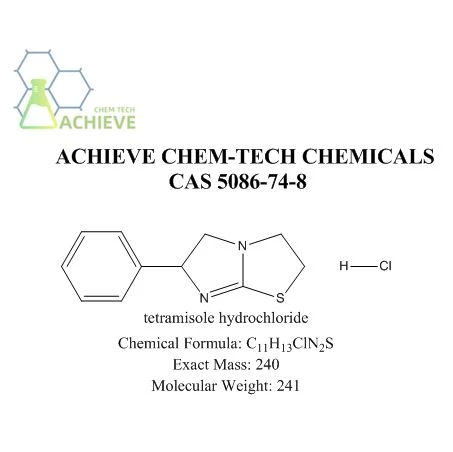
Tetramisole hcl powder CAS 5086-74-8 also known as Tetramisole hydrochloric, generally exists in the form of tetramisole hydrochloride powder, color, eye shadow powder appearance and character: white to milky white crystalline powder, veterinary medicine raw material. It is a white crystalline powder that can sometimes appear in a light yellow or purple color. Its appearance has a certain degree of transparency, and the crystal structure can be clearly seen. It has high solubility in water and can also be dissolved in ethanol and methanol. At room temperature, every 1 gram of Tetramisole Hydrochloride can be dissolved in 1ml of water. When this drug reacts with acids and bases, precipitation occurs. The refractive index is 1.583, which can be used for the detection and identification of this drug. When it is dissolved in water, its refractive index does not change much, which enables high-precision measurement and detection of the drug in experiments. Widely used veterinary and human drugs are used as antidotes and antiparasitic drugs.

|
Chemical Formula |
C11H13ClN2S |
|
Exact Mass |
240 |
|
Molecular Weight |
241 |
|
m/z |
240 (100.0%), 242 (32.0%), 241 (11.9%), 242 (4.5%), 243 (3.8%), 244 (1.4%) |
|
Elemental Analysis |
C, 54.88; H, 5.44; Cl, 14.72; N, 11.64; S, 13.32 |
Solubility:
Tetramisole hcl powder has good solubility and is easily soluble in polar solvents such as water, ethanol, chloroform, and benzene. Its solubility increases with temperature. Poor solubility in non-polar solvents such as petroleum ether.
Melting point:
The melting point of Tetramisole Hydrochloride is around 275 ℃.
Acid-base properties:
Tetramisole Hydrochloride is a highly alkaline compound whose amino functional groups can react with weak acids to form salts. In water, Tetramisole Hydrochloride undergoes hydrolysis reactions, generating free amino and electrophilic Tetramisole.
Stability:
Tetramisole Hydrochloride can be stored for several years without deterioration under dry and ventilated conditions. However, under sunlight or high temperature and humidity conditions, decomposition reactions can occur, leading to drug degradation and failure.
Oxidation-reduction properties:
Tetramisole Hydrochloride is a weak reducing agent with the ability to reduce iron ions. It can react with some oxidants, such as bromine water, iodine water, and perchloric acid.
|
|
|


The most commonly used method in the synthesis of tetramisole hcl powder is the reaction of imidazole methyl acetate and 2-chloropropionyl chloride. The following will provide a detailed introduction to all the synthesis methods of Tetramisole Hydrochloride.
The first method is the reaction of imidazole methyl acetate with 2-chloropropionyl chloride, which is one of the most commonly used methods in TH synthesis.
The process is as follows:
Firstly, dissolve methyl imidazole acetate and 2-chloropropionyl chloride in anhydrous dimethylformamide (DMF), respectively. Slowly mix the two solutions and stir for 10 to 20 hours. The reaction product is the precursor of TH -2-chloro-N, N, 2-trimethylacetylimidazole (2-Cl-MH), which can be further reacted to prepare TH after separation and purification of 2-Cl-MH. Finally, add a dilute hydrochloric acid (HCl) aqueous solution to obtain TH.
The second method is to react with imidazolacetone and crotonic acid:
The main step of this method is to prepare a precursor of 2-amino-2-methyl-1-propanol (AMP) through a reduction reaction in the presence of imidazolacetone and crotonic acid; Subsequently, AMP was subjected to sulfonylation reaction to obtain TH.

The following is a detailed description of all uses of Tetramisole hcl powder:
Animal use
Tetramisole Hydrochloride can be used to treat cordyceps infection in animals. Cordyceps is a fungus that can infect various mammals. Cordyceps infection can lead to weight loss, anemia, and other health problems. Tetramisole Hydrochloride can help control cordyceps infection and promote animal health.

Animal husbandry
Tetramisole Hydrochloride can be used in animal husbandry to prevent and treat roundworm infections. Ascaris infection is a common animal parasitic infection that can lead to increased production costs in animal husbandry and animal health issues. Tetramisole Hydrochloride can control roundworm infection and improve livestock production efficiency.

Poultry
Tetramisole Hydrochloride can be used to prevent and treat small nematode infections in poultry. Small nematode infection is a common parasitic infection in poultry, which can lead to decreased production performance and reduced feed conversion rate. Tetramisole Hydrochloride can control small nematode infections and improve poultry production efficiency.

A researcher named Wright from ITRI (British Industrial Research Institute) discovered some new sulfuryl compounds while searching for new drug synthesis methods. Among them, 4-phenyl-2,3,5,6-tetrahydro-1H-pyrazole (THCP) has achieved excellent anti infective activity against the majority of the main intestinal parasite, Helicobacter.
the medical field is conducting extensive research and experiments on THCP, which is expected to be used to treat human parasitic infections. Research has shown that THCP has no significant therapeutic effect on human intestinal parasites, but its cocaine associated compound has been proven to be an effective anti intestinal parasite drug.
Researchers began to improve the structure of 4-phenyl-2,3,5,6-tetrahydro-1H-pyrazole in search of better antibacterial activity. After a long period of research, researchers ultimately transformed THCP into THFA, which has stronger anti parasite activity. At the same time, the solubility of Tetramisole Hydrochloride has also been significantly improved.
Tetramisole Hydrochloride was first marketed as a drug for treating intestinal ileitis. Then, Tetramisole Hydrochloride is widely used to treat various diseases such as roundworm disease, canine parvovirus disease, hookworm disease, and some parasitic infections.
Over time, Tetramisole Hydrochloride has gradually become a widely used drug for the diagnosis and treatment of canine infections and certain human diseases. Tetramisole Hydrochloride is considered one of the top choice drugs for treating parasitic infections.
What are the side effects of this compound?
1.Common side effects
Gastrointestinal reactions
Patients may experience nausea after taking tetraimidazole hydrochloride, which is due to the stimulating effect of the medication on the gastrointestinal mucosa. Some patients may experience vomiting after taking medication, which is also related to the stimulation of the gastrointestinal tract by the medication. When vomiting is severe, it may lead to dehydration, electrolyte imbalance, etc. in patients. Tetraimidazole hydrochloride may cause accelerated intestinal peristalsis, leading to diarrhea. Diarrhea not only affects the quality of life of patients, but may also lead to problems such as poor nutrient absorption
Neurological response
Medications may affect the central nervous system, leading to symptoms of dizziness in patients. When dizziness is severe, it may affect the patient's daily life and work. Some patients may experience headaches after taking medication, which may be related to the neurotoxicity of the drug. When the headache is severe, it may affect the patient's sleep and mood.
Allergic reactions
Some patients may be allergic to certain components of tetraimidazole hydrochloride, leading to the appearance of a rash. Rash usually manifests as symptoms such as redness, swelling, and itching of the skin. Urticaria is a manifestation of allergic reactions, and patients may experience systemic or local symptoms such as wheals and itching after taking medication. Severe allergic reactions may cause patients to experience difficulty breathing and even trigger anaphylactic shock. Therefore, once symptoms such as difficulty breathing occur, medical attention should be sought immediately.
Other side effects
Some patients may experience fever symptoms after taking medication, which may be related to the immune response of the medication. Medications may cause patients to experience symptoms of general fatigue, affecting their daily life and work.
 |
 |
 |
2.Drug interactions and side effects
Interactions with other drugs
Tetraimidazole hydrochloride may interact with other drugs, leading to increased or decreased efficacy, and even new side effects. Therefore, when taking tetraimidazole hydrochloride, patients should inform their doctors of other medications they are taking so that they can adjust their treatment plan.
Interaction with alcohol
Drinking alcohol during the use of tetraimidazole hydrochloride may increase the risk of drug side effects. Alcohol itself has a stimulating effect on the gastrointestinal mucosa, and co administration with tetraimidazole hydrochloride may exacerbate gastrointestinal reactions. In addition, alcohol may also affect the metabolism and excretion of drugs, leading to drug accumulation in the body and increasing the risk of side effects.
3.Precautions and preventive measures
- Follow the doctor's advice on medication: Patients should consult a doctor before taking Tetraimidazole Hydrochloride to understand the indications, dosage, precautions, etc. of the medication. At the same time, patients should strictly follow the doctor's instructions for medication, avoiding self adjustment of dosage or discontinuation of medication.
- Observing drug reactions: Patients should closely monitor their reactions during the use of tetraimidazole hydrochloride. Once serious side effects or allergic reactions occur, the medication should be stopped immediately and medical attention sought.
- Special populations should use with caution: Pregnant women, lactating women, children, elderly people and other special populations should be particularly cautious when taking tetraimidazole hydrochloride. These populations should take medication under the guidance of a doctor and closely monitor the side effects of the medication.
- Avoid co administration with other medications: Patients should avoid co administration with other medications during the use of tetraimidazole hydrochloride to prevent drug interactions. If you need to take other medications, please consult a doctor and inform yourself that you are taking tetraimidazole hydrochloride.
- Avoid drinking alcohol: Patients should avoid drinking alcohol during the use of tetraimidazole hydrochloride to avoid exacerbating gastrointestinal reactions or increasing the risk of other side effects.
- Regular monitoring of liver and kidney function: Patients who have been taking tetraimidazole hydrochloride for a long time should regularly monitor their liver and kidney function in order to promptly detect and treat drug damage to the liver and kidneys.
What are the sales channels for this compound?
Sales channel type
Manufacturer direct sales
Some pharmaceutical or chemical companies with production capacity will directly sell tetraimidazole hydrochloride powder to end customers or distributors. These enterprises usually have a complete production, quality inspection, and sales system to ensure product quality and delivery time.
Distributor Agent
Distributors and agents play an important role in sales channels, often collaborating with multiple manufacturers to distribute products to a wider market. Through distributor agency, manufacturers can expand sales channels and increase market share.
E-commerce platform
With the development of e-commerce, more and more chemical and pharmaceutical products are sold through e-commerce platforms. Tetramisole Hcl Powder can also be found on some specialized chemical or pharmaceutical e-commerce platforms, which usually provide detailed product information and convenient purchasing methods.
International trade
For the international market, tetraimidazole hydrochloride is usually sold through international trade channels. Manufacturers or distributors will collaborate with foreign importers or distributors to export their products to overseas markets.
FAQ
1. What are the main applications of tiamulin hydrochloride?
It is a classic broad-spectrum deworming medicine, which is highly effective in eliminating roundworms and nematodes in various animals (especially livestock). Note: This medicine is currently not suitable for human use.
2. Why is it less commonly seen in veterinary clinical practice nowadays?
Due to its narrow therapeutic window, the effective dose is very close to the toxic dose, which can easily lead to side effects (such as neurotoxicity). Meanwhile, safer new deworming drugs (such as albendazole and ivermectin) have been widely available, gradually replacing it in mainstream applications.
3. What special value does it have in the field of scientific research?
Its levorotatory form (levamisole) was once of interest in immunopharmacological research as an immunomodulator, but it was not widely used. The more important current application is that its dextrorotatory form (dexamisole) is often used as a chiral catalyst or resolving agent in certain chemical synthesis processes.
4. What are the main risks if accidental ingestion or improper contact occurs?
It is toxic to humans. The symptoms of poisoning may include nausea, headache, dizziness, and in severe cases, it can lead to central nervous system inhibition, respiratory failure and even death. It must never be used on humans under any circumstances. Personal protection measures should be taken during the operation.
Hot Tags: tetramisole hcl powder cas 5086-74-8, suppliers, manufacturers, factory, wholesale, buy, price, bulk, for sale, pure benzocaine powder, Hydrocortisone Powder CAS 50 23 7, IPTG reagent, levamisole hydrochloride powder, 1 Butyl 3 Methylimidazolium Tetrafluoroborate, Primidone powder