



2-Chloro-4,6-dimethoxypyrimidine is an organic compound with a Molecular formula of C6H7ClN2O2, CAS 13223-25-1, and a molecular weight of 174.58 g/mol. It is a white crystalline solid. The melting point range is usually between 70 and 74 ° C. Soluble in some organic solvents at room temperature, such as ethanol, methanol, Dimethyl sulfoxide, etc. Relatively stable under conventional experimental conditions. It can be stored for a long time in dry, dark, and sealed containers. It has a wide range of applications in various aspects of electrochemistry. It plays an important role in fields such as electrode materials, electrocatalysts, electrolytes, sensors, electroanalysis, and electrochemical synthesis. By developing and optimizing relevant materials and methods, the development of electrochemical technology can be promoted, promoting progress in energy conversion, environmental monitoring, and biomedical fields.

|
|
|

|
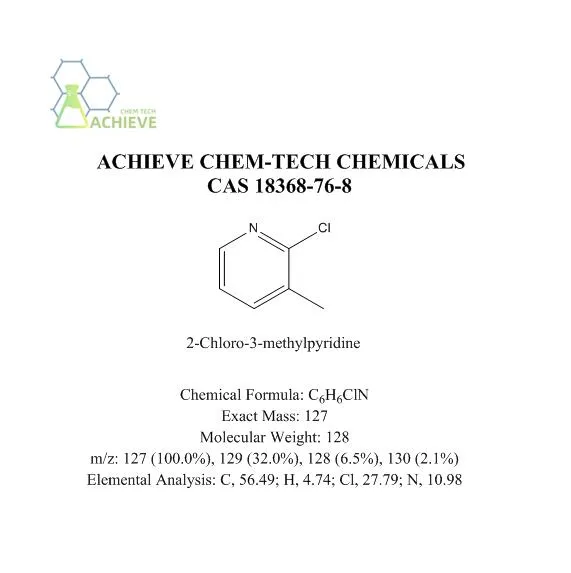
Chemical Formula |
C6H6ClN |
|
Exact Mass |
127 |
|
Molecular Weight |
128 |
|
m/z |
127 (100.0%), 129 (32.0%), 128 (6.5%), 130 (2.1%) |
|
Elemental Analysis |
C, 56.49; H, 4.74; Cl, 27.79; N, 10.98 |

2-Chloro-3-methylpyridine is an organic compound with a Molecular formula of C6H6ClN. It has extensive applications in many fields.
Pesticides and insecticides:It can be used as an intermediate for pesticides and insecticides. It can react with other compounds to form pesticide products with insecticidal, bactericidal, or herbicide properties. These pesticides are widely used in the protection of farmland, orchards, and horticultural crops, playing an important role in controlling crop diseases and pests.
Spices and food additives:It can be used to synthesize compounds with special aromas and is widely used in spices and food additives. It can provide unique flavors and aromas for food, beverages, and tobacco products. In addition, it can also be used for the synthesis of seasonings, caffeine, and other food ingredients.


Coatings and Dye Industry:It can be used as an important raw material in the dye and coating industries. It can be used to produce various dye pigments, providing different color effects for textiles, leather, plastics, and paints. In addition, it can also be used to synthesize polymer and resin materials, and to prepare high-performance coatings, inks, and adhesives.
Other applications:In addition to the above applications, It can also be used to prepare electronic materials, rubber processing aids, surfactants, dye intermediates, and preservatives. Its chemical properties and reactivity make it play an important role in many industrial and scientific fields.
2-chloro-3-methylpyridine is an organic compound with a specific chemical structure and properties. It is a product where one hydrogen atom on the pyridine ring is replaced by a methyl group, and the other hydrogen atom is replaced by a chlorine atom. This compound has unique reactivity and can participate in various chemical reactions to generate a series of biologically active derivatives.

1. Synthetic insecticides
It is an important raw material for synthesizing various insecticides. For example, it can be used to synthesize new nicotine insecticides such as imidacloprid and imidacloprid. These insecticides have the characteristics of high efficiency, low toxicity, and broad spectrum, and have good control effects on various pests. Imidacloprid is one of the representative varieties of highly efficient new insecticides worldwide, widely used in agricultural production, and has significant control effects on pests such as aphids, leafhoppers, and planthoppers.
In addition, it can also be used to synthesize other types of insecticides, such as imidacloprid and thiacloprid. These insecticides play an important role in agricultural production, helping to improve crop yield and quality.
2. Synthetic herbicides
In addition to insecticides, it can also be used to synthesize various herbicides. For example, it can be used as an important raw material for the synthesis of herbicides such as fludioxonil and fludioxonil. These herbicides have the characteristics of high efficiency, low toxicity, and good selectivity, and have good control effects on various weeds.
Pifluazin is one of the dominant herbicides in developed countries such as the United States and Japan, widely used in agricultural production. It mainly achieves weed control by inhibiting the growth and development of weeds. At the same time, it can also improve the stress resistance of crops, enhance their growth potential, and thus increase their yield and quality.


3. Synthetic fungicides
It can also be used to synthesize various fungicides. For example, it can be used as an important raw material for synthesizing fungicides such as fluazinam. These fungicides have the characteristics of broad-spectrum, high efficiency, and low toxicity, and have good control effects on various diseases.
Fluazinam is a broad-spectrum fungicide that has good control effects on various diseases such as powdery mildew, rust, leaf spot, etc. It mainly achieves the purpose of preventing and treating diseases by inhibiting the growth and reproduction of pathogenic bacteria. At the same time, it can also improve the stress resistance of crops, enhance their growth potential, and thus increase their yield and quality.
4. Application as a pesticide intermediate
It can also be used as an intermediate for other pesticides to synthesize a wider range of pesticides. For example, it can be used to synthesize new pesticides such as pyridine pyrethroids, pyridine diphenyl ether herbicides, and pyridine sulfonylurea herbicides. These pesticides have the characteristics of high efficiency, low toxicity, and good selectivity, and have good control effects on various pests and weeds.

In addition, it can also be used to synthesize new pesticides such as pyridine containing benzoylurea insecticides and pyridine containing nicotine nitroene insecticides. These pesticides play an important role in agricultural production, helping to improve crop yield and quality.

2-Chloro-3-methylpyridine can be prepared through various synthetic methods. The following are some common laboratory synthesis methods and their corresponding Chemical equation:
1. Chloroalkylation reaction:
In this method, chloroalkanes are used as alkylation reagents to carry out Substitution reaction with pyridine to generate product.
Chemical equation:
C6H5Cl+CH3CH2MgBr → C6H5CH2CH3+MgBrCl
C6H5CH2CH3+C5H5N → C6H5CH2C5H4N+H2
2. Electrophilic substitution:
This method uses electrophilic reagents (such as haloalkanes or anhydride) to generate product through Substitution reaction with pyridine.
Chemical equation:
C6H5NO2+3 HCl → C6H5NH2+2 H2O+Cl2
C6H5NH2+CH3COCl → C6H5NHC (O) CH3+HCl
C6H5NHC (O) CH3+C5H5N → C6H5NHC (O) C5H4N+CH3COOH
3. Redox:
In this method, the nitrogen atom in pyridine is reduced to amino group with reducing agent, and then Substitution reaction is carried out with haloalkane to obtain product.
Chemical equation:
C6H5N+3 H2 → C6H5NH2
C6H5NH2+CH3I → C6H5NCH3+HI
C6H5NCH3+C5H5N → C6H5NCH3C5H4N+C5H5N
4. Oxidation reaction:
This method uses oxidant to oxidize the carbon atom in pyridine into ketone group, and then Substitution reaction with haloalkane to generate product.
Chemical equation:
C6H5N+[O] → C6H5NO2
C6H5NO2+CH3I → C6H5NOC (CH3) 3+HI
C6H5NOC (CH3) 3+C5H5N → C6H5NOC (CH3) 3C5H4N+C5H5N

What are the side effects of this compound?
1. Irritation to the skin and eyes
Skin irritation: This compound may cause irritation to the skin, leading to redness, pain, or burns. Long term exposure or high concentration exposure may increase the risk of skin damage.
Eye irritation: This substance may also cause severe irritation to the eyes, leading to redness, tearing, pain, or blurred vision. In severe cases, it may even lead to permanent eye damage.
2.Stimulus to the respiratory system
Respiratory irritation: The steam or mist it produces may cause irritation to the respiratory tract, leading to coughing, difficulty breathing, or discomfort in the throat. Long term or high concentration exposure may increase the risk of respiratory diseases.
3.Other potential health impacts
Neurological effects: Although the specific mechanisms are not fully understood, certain chemicals may have adverse effects on the nervous system. Long term or high-dose exposure to this compound may cause damage to the nervous system, leading to symptoms such as headache, dizziness, and memory loss.
Liver and kidney toxicity: Some chemicals may cause damage to the liver and kidneys during metabolic processes in the body. Although there is limited research on its specific toxicity to the liver and kidneys, long-term exposure or high-dose intake may increase the risk of damage to these organs.
4.Environmental hazards
Water pollution: If discharged into the environment without proper treatment, it may cause pollution to water bodies and affect the survival and reproduction of aquatic organisms.
Soil pollution: The accumulation of this substance in the soil may also have adverse effects on soil microorganisms and plants, thereby affecting the balance of the ecosystem.
5.Safety advice
When handling, relevant safety operating procedures and protective measures should be strictly followed.
Avoid prolonged or high concentration exposure to the substance.
Wear appropriate personal protective equipment during use, such as protective gloves, goggles, and respiratory protective equipment.
In case of accidental contact or leakage, emergency measures should be taken immediately and professional medical assistance should be sought.
What are the precautions for this compound?
- The selection of substitutes should be based on specific application scenarios: different application scenarios have different requirements for the properties, reactivity, stability, etc. of substitutes, so the selection needs to be based on the actual situation.
- The safety and environmental friendliness of alternatives: When choosing alternatives, it is necessary to consider their safety and environmental friendliness to ensure that they do not pose a threat to the environment or human health.
- Cost effectiveness of substitutes: Cost effectiveness is one of the important factors to consider when choosing substitutes, which requires comprehensive consideration of the cost, production efficiency, and impact on the entire production process of substitutes.
Hot Tags: 2-chloro-3-methylpyridine cas 18368-76-8, suppliers, manufacturers, factory, wholesale, buy, price, bulk, for sale, 2 4 Quinolinediol, 3 Nitrobenzonitrile, 2 6 Pyridinedicarboxylic acid, N N N Trimethylethylenediamine, squaric acid treatment, Additive