




Shaanxi BLOOM Tech Co., Ltd. is one of the most experienced manufacturers and suppliers of 1,3-dichloro-2-propanol cas 96-23-1 in China. Welcome to wholesale bulk high quality 1,3-dichloro-2-propanol cas 96-23-1 for sale here from our factory. Good service and reasonable price are available.
1,3-Dichloro-2-Propanol, CAS 96-23-1, The molecular formula C3H6Cl2O is a colorless to pale yellow liquid at room temprature and pressure. It has a certain solubility in water and is miscible with ethanol or ether. 1,3-Dichloropropanol rapidly removes hydrogen chloride in alkaline solution to produce 3-chloro-1,2-epoxypropane. Oxidation with sodium dichromate and sulfuric acid produces α, α '- dichloroacetone. Oxidation with concentrated sulfuric acid to produce chloroacetic acid.

|
C.F |
C3H6Cl2O |
|
E.M |
128 |
|
M.W |
129 |
|
m/z |
128 (100.0%), 130 (63.9%), 132 (10.2%), 129 (3.2%), 131 (2.1%) |
|
E.A |
C, 27.94; H, 4.69; Cl, 54.97; O, 12.40 |
|
|
|
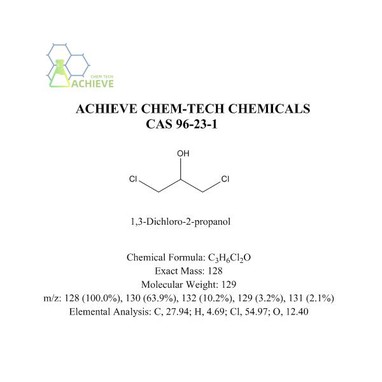

Properties and stability of 1,3-dichloropropanol:
Avoid contact with strong acids, strong oxidizing agents, strong reducing agents, acyl chlorides and acid anhydrides. It produces highly toxic phosgene in case of fire. It has strong hygroscopicity and releases hydrogen chloride quickly when it meets water. No corrosion to metal when dry.
Chemical property:
1,3-dichloro-2-propano rapidly removes hydrogen chloride in alkaline solution to generate 3-chloro-1,2-epoxypropane. Oxidize with sodium dichromate and sulfuric acid to generate α,α′- Dichloroacetone. Chloroacetic acid is produced by oxidation with concentrated sulfuric acid. Heat in excess ethanol and sodium hydroxide solution to generate 1,3-diethoxy-2-propanol.

1,3-Dichloro-2-Propanol molecules contain two halogen atoms and one hydroxyl group, making them highly polar and possessing certain water solubility and hydrophilicity. The structure contains hydroxyl and chlorine atoms, which can undergo redox reactions and react with reducing agents to produce dechlorinated compounds. Various phosphate ester compounds can be prepared by reacting with phosphoric acid, such as triphenylphosphate trichloropropyl ester, tert butyl dichloroethyl phosphate ester, etc. These compounds can be used to prepare coatings, plastics, rubber, etc.
Pharmaceutical field:
The cornerstone of the synthesis of antiviral and antibacterial drugs

(1) The core intermediate of ganciclovir
Synthesis route: Using this substance as raw matrial, semi formaldehyde is generated through polyformaldehyde reaction, and then esterified with acetic anhydride to obtain 1,3-dichloro-2-acetoxymethoxypropane. The intermediate was condensed with diacetylguanine under the catalysis of tetraalkylammonium bromide to form triacetyl ganciclovir, which was finally hydrolyzed to obtain ganciclovir with a purity of 99.6%.
Process optimization: Using benzoyl modified side chain substituents, the proportion of N-9 isomer formation is increased through steric hindrance effect, and the overall yield is increased to 64.8%. In the key reaction steps, the condensation reaction temprature is controlled at 120-150 ℃, the time is 26 hours, and the matrial molar ratio is 1:1.1-1.6.


Clinical value: Ganciclovir, as an anti herpesvirus drug, has significant therapeutic effects on cytomegalovirus (CMV) infection, especially for immunocompromised patients. The economic viability of its synthetic route directly affects drug accessibility.
(2) Key structural units of broad-spectrum antibacterial agents
Quinolone drugs: The chlorine atom of this product serves as a strong electron withdrawing group, which can activate the ortho position of the benzene ring and facilitate the introduction of active functional groups such as fluorine and piperazine. For example, in the synthesis of ciprofloxacin, the chloropropanol fragment enhances the affinity of the drug to DNA gyrase.


Antiparasitic agent: As an intermediate of chloramphenicol, the chlorine atom in its molecule enhances drug lipophilicity, promotes intestinal absorption, and is effective against schistosomiasis and tapeworm infections.
Adopting high-performance integrated joints,the CRA series can increase the tempo by 25%,and the productivity can reach a new peak;the vibration suppression algorithm is upgraded to achieve a good anti-shaking effect;the full-parameter DH compensation algorithm and TrueMotion algorithm are supported,and the absolute positioning accuracy is 0.2 ~ 0.4 mm under the change of attitude movement,and the curved motion is precise and stable.

Chemical production:
Key intermediates in multiple fields

(1) The core raw material of epoxy resin
Preparation of Epichlorohydrin:
Traditional process: High temprature chlorination of propylene produces 1,2-dichloropropanol (main product) and a small amount of 1,3-dichloropropanol, which is dehydrogenated in NaOH solution to produce epichlorohydrin (ECH). The dechlorination reaction rate of 1,3-dichloropropanol is 20 times faster than that of 1,2-dichloropropanol, but side reactions need to be controlled.
Green process: Solid alkali catalysts (such as supported MgO/NaZSM-5) are used to catalyze the removal of hydrogen chloride under gas-phase conditions, with conversion rates and selectivity reaching 100% and 96%, respectively. The reaction temprature is 360 ℃, significantly reducing wastewater discharge.
Application extension: ECH further polymerizates with bisphenol A to produce epoxy resin for high-performance coatings and electronic packaging matrials, with an annual demand of over 3 million tons.


(2) Crosslinking agent for ion exchange resin
Synthesis of chelating resin: 1,3-dichloropropanol copolymerizes with styrene and divinylbenzene to form a cross-linked network containing chloromethyl groups. By introducing amino groups through amination reaction, chelating resins with high selectivity for heavy metals such as Cu ² ⁺ and Pb ² ⁺ are prepared for industrial wastewater treatment.
Performance advantage: The strong polarity of chlorine atoms enhances the coordination ability between the resin and metal ions, resulting in a 30% increase in processing efficiency compared to traditional resins.

Materials Science:
Modifiers for Functional Matrials

(1) Additives for flame retardant plastics
PVC modification: Add 10% tris (1,3-dichloropropyl) phosphate (TDCPP) to make PVC products self extinguish upon ignition, and increase the limit oxygen index (LOI) from 27% to 32%. The chlorine content of TDCPP (63.7%) provides efficient flame retardancy while improving light resistance and anti-static properties.
Thermoplastic elastomer: Introducing chloropropanol units into SBS polymerizates to increase the flame retardant rating to V-0 level (UL-94 standard) without affecting the matrial's elastic modulus.


(2) Additives for coatings and adhesives
Film forming agent: Add 5-10% of 1,3-dichloropropanol derivatives to latex paint to reduce the minimum film-forming temprature (MFFT) to below 5 ℃ and improve low-tempeature construction performance. Its hydroxyl group forms hydrogen bonds with the carboxyl group in the resin, enhancing adhesion.
Electronic grade photoresist: synthesized by Williamson reaction with halogenated ether solvents (such as 1,3-dichloropropyl phenyl ether), used in photoresist systems to improve photosensitive resolution to the 0.1 μ m level.

Fine Chemicals:
A Synthesis Platform for Specialty Chemicals

(1) Phosphate ester flame retardant
TDCPP synthesis: This substance reacts with phosphorus oxychloride to form tris (1,3-dichloropropyl) phosphate. The compound contains three chloropropyl groups, and its flame retardant efficiency is 40% higher than that of triphenyl phosphate. The addition of 15% can make polyurethane foam reach B1 level flame retardant.
Environmentally friendly alternatives: Although TDCPP has persistent organic pollutant (POP) characteristics, its short chain chlorinated structure is more easily degraded compared to polybrominated diphenyl ethers (PBDEs), making it a transitional flame retardant solution.
(2) Spices and Precursors of Electronic Chemicals
Ether flavor: it is etherified with allyl alcohol to produce 3-chloro-1-propenyl ether with flower and fruit aroma, which is used for the preparation of daily chemical essence.
Photoresist solvent: Synthesize 1,3-dichloropropyl methyl ether as a diluent for electron beam photoresist to improve photosensitivity.

Environmental Protection:
Pollution Control and Degradable Materals

(1) Heavy metal wastewater treatment agent
Precipitation method: The precipitant prepared by compounding 1,3-dichloropropanol with FeCl ∝ has a treatment efficiency of 99.5% for wastewater containing Cr ⁶⁺ and a wide pH range (4-10). The mechanism is that chloropropanol forms soluble complexes with metal ions, which are hydrolyzed to form insoluble hydroxide precipitates.
Cost advantage: Compared to traditional sodium sulfide precipitation method, the cost of reagents is reduced by 30%, and the amount of sludge is reduced by 40%.
(2) Controllable degradation polyester
Synthesis route: 1,3-Dichloro-2-Propanol undergoes condensation with terephthalic acid to produce chlorinated polyester (PET Cl). In the hydrolysis experiment, the weight loss rate reached 65% after 30 days, and the degradation products (terephthalic acid, glycerol) were non-toxic.
Application prospects: Used for agricultural film, with a controllable degradation cycle (60-120 days), reducing white pollution.

Emerging fields:
New energy and electronic materals

Lithium ion battery electrolyte additive
Flame retardant electrolyte: The phosphate derivative of this substance serves as a co solvent, increasing the flash point of the electrolyte to above 130 ℃ while also possessing flame retardancy. Its chlorine atoms enhance the compatibility between the electrolyte and graphite negative electrode.
Organic photovoltaic materials
Electron acceptor unit: Oligomers with chloropropanol structure are used as acceptor mterials, blended with donor polymerizates to improve the photoelectric conversion efficiency (PCE) of photovoltaic devices to 8.2%. The introduction of chlorine atoms enhances intermolecular forces and improves phase separation morphology.


1. It is obtained by reaction of chloropropene and hypochloric acid.
2. It is obtained by reacting glycerol with hydrogen chloride in the presence of glacial acetic acid. Raw materal consumption quota: glycerol 796kg/t, hydrogen chloride 781.2kg/t, glacial acetic acid 66.2kg/t.
Refining method: vacuum distillation.
3. Preparation method:

Add 90% glycerol (2) 500g (4.9mol) and 10g acetic acid into the weighed reaction bottle, install a vent pipe to the bottom of the bottle, heat the oil bath, and control the temprature of the oil bath at 100-110 ℃. Inject dry hydrogen chloride gas (prepared by reaction of ammonium chloride and sulfuric acid). At the beginning, the absorption of hydrogen chloride gas is very fast, and with the extension of time, the absorption gradually slows down. When the mass is increased by about 440g, stop passing hydrogen chloride gas. After cooling, depressurize and extract hydrogen chloride. Slowly add solid sodium carbonate to neutralize the acid in the reaction system until it is weakly alkaline. Water can be properly added to facilitate the reaction with sodium carbonate, about 200mL of water can be added. Separate the water layer, and then conduct vacuum distillation to collect the fractions below 68 ℃/1.65kPa (about 110g) and 68~75/1.65kPa (about 385g). The water in the first distillate is separated and re-distilled, and 68~75/1.65kPa distillate is collected to obtain about 50g of product. The product of this fraction is redistilled, and the fraction of 70~73/1.65kPa is collected to obtain 350g of 1,3-dichloro-2-propanol (1) in a yield of 55%.
FAQ
What is 1 3 dichloro 2 propanol used for?
1,3-Dichloro-2-propanol is used in the synthesis of glycerol, the production of plastics and textiles and in the synthesis of pharmaceuticals. It is used as a solvent, and as a cement for celluloid. It is also present in some foods, e.g. soy sauce, soup spices and instant soups, from hydrolization of proteins.
What is the formula for 1 3 dichloro 2 propanol?
1,3-Dichloropropan-2-ol (1,3-DCP) is an organic compound with the formula HOCH2CHClCH2Cl. It is a colorless liquid. It is an intermediate in the production of epichlorohydrin. Except where otherwise noted, data are given for materials in their standard state (at 25 °C [77 °F], 100 kPa).
Hot Tags: 1,3-dichloro-2-propanol cas 96-23-1, suppliers, manufacturers, factory, wholesale, buy, price, bulk, for sale, Allyl Chloride CAS 107 05 1, myrcene powder, Pentadecanoic Acid CAS 1002 84 2, 5 Fluoro 2 Nitroaniline CAS 2369 11 1, 2 6 Pyridinedicarboxylic acid, 4-Fluorophenylacetone CAS 459-03-0