


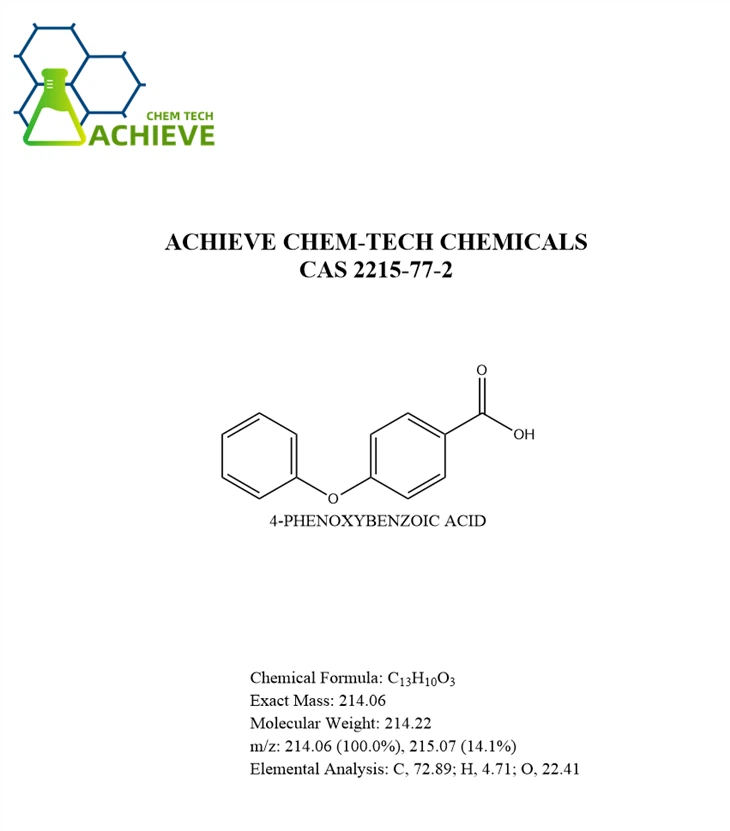


4-Phenoxybenzoic acid is an organic compound that appears as a white to pale yellow powder or crystal and is slightly soluble in hot methanol. Its specific solubility may vary depending on the conditions. Has certain chemical stability, but should avoid contact with strong oxidants, bases, etc. It can be synthesized by oxidation of 4-phenoxyacetophenone under the conditions of sodium hypochlorite as oxidant and polyethylene glycol (PEG) -400 as phase transfer catalyst. Used for synthesizing certain drugs, such as ciprofloxacin (a fluoroquinolone antibiotic). Used as raw material for synthesizing other organic compounds. In biochemical research, 4-phenoxybenzoic acid can be converted into amides under the action of certain microorganisms, such as Bacillus cereus Tim-r01. Can be used to prepare ester liquid crystals and high-temperature resistant materials. It can also be used to prepare pesticides such as pyrethroid insecticides.

Additional information of chemical compound:
|
Chemical Formula |
C13H10O3 |
|
Exact Mass |
214.06 |
|
Molecular Weight |
214.22 |
|
m/z |
214.06 (100.0%), 215.07 (14.1%) |
|
Elemental Analysis |
C, 72.89; H, 4.71; O, 22.41 |
|
Melting point |
163-165℃(lit.) |
|
Boiling point |
314.35℃(rough estimate) |
|
Density |
1.1956 (rough estimate) |
|
|
|


4-phenoxybenzoic acid is an important organic compound with a molecular formula of C ₁∝ H ₁₀ O3, a molecular weight of 214.22, and typically appears as a white or pale yellow powder or crystal. This compound has demonstrated extensive application value in multiple fields, and the following is a detailed explanation of its uses:
Materials Science Field
It has good flame retardant properties and is often used as a flame retardant additive for polymer materials. Adding an appropriate amount of this compound to the polymer can effectively slow down the spread of flames and improve the flame retardant rating of the material. This is of great significance for improving the safety of polymers, especially in applications such as electronics, construction, and transportation. In polymers such as polyolefins, polyesters, and nylon, 4-phenoxybenzoic acid can be used as a flame retardant. Introducing 4-phenoxybenzoic acid into polymer systems through blending or copolymerization can significantly improve the flame retardant properties of the material. For example, adding 4-phenoxybenzoic acid to cable materials can improve the flame retardant rating of cables and reduce the occurrence of fire accidents.
During the combustion process, 4-phenoxybenzoic acid decomposes to produce a large amount of gas and residue, which can dilute combustible gases, lower the combustion temperature, and form a dense carbon layer covering the material surface, preventing further flame spread.

Polymer modifier

It can also be used as a light stabilizer for polymers. Under the irradiation of ultraviolet rays, polymer materials are prone to yellowing, aging, and other problems, which affect the service life and performance of the materials. And 4-phenoxybenzoic acid can absorb ultraviolet light and convert it into harmless thermal energy, thereby protecting polymer materials from UV damage. In plastic products, coatings, fibers, and other materials used outdoors, 4-phenoxybenzoic acid can be used as a light stabilizer. By adding an appropriate amount of 4-phenoxybenzoic acid, the photostability of the material can be significantly improved and its service life can be extended. The benzene ring and phenoxy group in 4-phenoxybenzoic acid molecules can absorb ultraviolet radiation and convert the absorbed ultraviolet energy into thermal energy through intramolecular energy transfer and dissipation processes, thereby avoiding damage to polymer materials by ultraviolet radiation.
Polyester polymer prepolymers can be prepared through polymerization reactions. After further processing, these prepolymers can form materials such as polyester resins with excellent properties. Polyester resin has excellent mechanical properties, heat resistance, chemical corrosion resistance and other characteristics, and is widely used in packaging, construction, automotive and other fields. 4-phenoxybenzoic acid can undergo condensation reaction with diols (such as ethylene glycol, propylene glycol, etc.) under the action of catalysts to generate polyester polymer prepolymers. By controlling the reaction conditions and raw material ratios, the molecular weight and properties of the prepolymer can be adjusted. Polyester resin can be used as packaging materials, building materials, automotive components, etc. For example, in the field of packaging, polyester resin can be used to make transparent films and containers for packaging products such as food and medicine; In the field of construction, polyester resin can be used to make insulation materials, waterproof materials, etc;

Preparation of functional materials

Dyes and pigments with different colors and functions can be modified through chemical reactions. These dyes and pigments have a wide range of applications in fields such as textiles, printing, and coatings. It can undergo substitution reactions, addition reactions, etc. with compounds such as amines and alcohols to generate dyes and pigments with different colors and functions. By controlling the reaction conditions and raw material ratios, the color and properties of dyes and pigments can be adjusted. In the textile industry, 4-phenoxybenzoic acid derivatives can be used as dyes for fibers, giving them bright colors and good fastness;
In the printing field, 4-phenoxybenzoic acid derivatives can be used as pigments in inks to improve the printing effect and durability of inks; In the field of coatings, 4-phenoxybenzoic acid derivatives can be used as pigments for coatings, giving them rich colors and good coverage. It also has certain application potential in the field of biomedical materials. Due to the presence of functional groups such as benzene rings and phenoxyl groups in its molecular structure, bioactive groups or drug molecules can be introduced through chemical modification to prepare medical materials with specific biological functions. For example, 4-phenoxybenzoic acid derivatives can be blended or copolymerized with biocompatible polymers (such as polylactic acid, polyglycolic acid, etc.) to prepare medical materials with drug release function.

4-phenoxybenzoic acid derivatives can also be used as surfactants. Surfactants have the ability to reduce the surface tension of liquids or solids, allowing incompatible liquids or solids to mix evenly and form stable suspensions or solutions. In the field of materials science, surfactants can be used to prepare nanomaterials, dispersants, etc. In the preparation process of nanomaterials, surfactants can be used as dispersants to uniformly disperse nanoparticles in solvents, preventing nanoparticle aggregation and precipitation. By selecting appropriate surfactants and controlling their dosage, nanomaterials with excellent properties can be prepared. 4-phenoxybenzoic acid derivatives can also be used to prepare electrochemical materials.

Other applications in the field of materials science

For example, 4-phenoxybenzoic acid derivatives can be combined with conductive polymers (such as polyaniline, polypyrrole, etc.) to prepare materials with excellent conductivity and electrochemical properties. These materials have broad application prospects in fields such as batteries and supercapacitors. In the field of lithium-ion batteries, 4-phenoxybenzoic acid derivatives can be combined with conductive polymers to prepare electrode materials with high conductivity and high specific capacity. These electrode materials can improve the energy density and cycling stability of lithium-ion batteries, providing longer lasting power support for electric vehicles, portable electronic devices, and more.
Products Description
1.Traditional sales channels
Chemical raw material distributors are one of its traditional sales channels. These distributors usually establish cooperative relationships with multiple manufacturers, purchase products from them, and then sell them to downstream pharmaceutical companies, chemical plants, and other users. Distributors have a wide customer network and sales channels, and can provide timely and convenient supply services to customers. At the same time, they can flexibly adjust inventory and procurement plans according to market demand to meet the diverse needs of customers. For example, Hubei Jusheng Technology Co., Ltd. and Hubei Yongkuo Technology Co., Ltd. are chemical raw material distributors that provide sales of 4-phenoxybenzoic acid. These companies provide customers with high-quality products and excellent services by establishing a stable supply chain system.
Some large pharmaceutical companies, in order to ensure stable supply of raw materials and product quality, will directly establish cooperative relationships with producers of 4-phenoxybenzoic acid for direct procurement. This procurement method reduces intermediate links, lowers procurement costs, and also helps pharmaceutical companies better control the quality and supply stability of raw materials.
By participating in industry exhibitions and conferences, producers and distributors of 4-phenoxybenzoic acid can showcase their products, exchange technology, and seek potential customers. Exhibitions and trade fairs provide opportunities for face-to-face communication, which helps to establish trust relationships and promote cooperation. At the same time, this is also an important way to understand industry trends and expand the market. At domestic and international exhibitions in the chemical, pharmaceutical, and other industries, it is common to see booths for producers and distributors of 4-phenoxybenzoic acid. Through these platforms, they have successfully attracted the attention of numerous customers and facilitated multiple transactions.
2.Online sales channels

Enterprise official website and online mall
In addition to e-commerce platforms, some manufacturers and distributors have also established their own official websites and online shopping malls to showcase products, provide technical support, and offer online sales services. Enterprise official websites and online stores usually have more professional product introductions, technical support, and after-sales service. Customers can gain a deeper understanding of product features, usage methods, technical parameters, and other information through these platforms, and place orders directly online for purchase.
Social Media and Online Marketing
With the popularity of social media and the development of online marketing, more and more manufacturers and distributors are using these channels to promote and sell their products. Social media and online marketing have the characteristics of fast dissemination speed, wide coverage, and strong interactivity. Manufacturers and distributors can attract potential customers' attention and guide them to visit official websites or online stores for purchases by publishing product information, technical articles, industry news, and other content.

3.International sales

Export trade
With the deepening of globalization, more and more Chinese chemical companies are entering the international market. As an important chemical raw material, it is gradually entering the international market. Some manufacturers sell their products to overseas markets through export trade. Export trade has the advantages of large market size and high profit margins. By expanding into international markets, manufacturers can increase their sales scale, enhance brand awareness, and increase their profitability. At the same time, this also helps to promote the internationalization process of Chinese chemical products.
Overseas agency and distribution
In order to better explore the international market, some manufacturers choose to seek local agents or distributors for cooperation. These agents or distributors typically have a strong market background and extensive sales experience, and are able to provide local market information and support to manufacturers. Through overseas agency and distribution, manufacturers can reduce market development costs, improve sales efficiency, and better meet the needs of local customers. At the same time, this also helps to strengthen the connection and cooperation between producers and local markets. Some domestic manufacturers have sought professional agents or distributors to cooperate in overseas markets.

Frequently Asked Questions
What is 4 Chloromethylbenzoic acid used for?
+
-
4-(Chloromethyl)benzoic acid was used in the synthesis of dihydroxy stilbene derivatives.
What is the color?
+
-
White crystalline.
Benzoic acid appears as a white crystalline solid. Slightly soluble in water.
What are the side effects of benzoic acid?
+
-
Nose, throat and lung irritation with coughing, wheezing and shortness of breath Remove the person from exposure. Flush eyes with large amounts of water for at least 15 minutes. Remove contact lenses if worn. Seek medical attention.
How is benzoic acid used in everyday life?
+
-
Some of the common daily life uses of benzoic acid include the utilization in batteries, chemicals for adhesives and sealants, chemicals used in agriculture (non-pesticidal), beauty products and personal care, pet care products, preservative, stabilizers for heat, moisturizers and lubricant, coating and paint additives ...
Why is benzoic acid toxic?
+
-
Exposure to benzoic acid in high concentrations, particularly in susceptible individuals, may cause a skin allergy. If an allergy develops, even exposure to very low levels can cause itching and a skin rash.
Hot Tags: 4-phenoxybenzoic acid cas 2215-77-2, suppliers, manufacturers, factory, wholesale, buy, price, bulk, for sale, 4 7 Benzothiazolediol 2 1 1 biphenyl 4 yl , CAS 1547491 57 5, isoflurane powder, CAS 1674334 59 8, Cerium sulfate powder, 3 bromodibenzo b d thiophene