




Shaanxi BLOOM Tech Co., Ltd. is one of the most experienced manufacturers and suppliers of ethyl nipecotate cas 5006-62-2 in China. Welcome to wholesale bulk high quality ethyl nipecotate cas 5006-62-2 for sale here from our factory. Good service and reasonable price are available.
Ethyl Nipecotate, also known as Ethyl Hexahydronicotinate; Ethyl Piperidine-2-Carboxylate; Ethyl Ethyl Piperidine-3-Carboxylate; Ethyl Piperidine-3-Carboxylate; Ethyl Piperidine-3-Carboxylate. It is a chemical substance that appears as a colorless to yellow-brown transparent liquid. The substance is stable at room temperature and pressure and should be stored in a cool dry place protected from light and sealed. Cyanothiophene inhibitor of synthetic peptidoglycan biosynthesis.
For example, in bionic catalysis, its tertiary nitrogen atom mimics the proton shuttle mechanism of the enzyme's active center, assisting in C-H bond activation or dynamic kinetic splitting of carbonyl compounds. For example, in bionic catalysis, its tertiary nitrogen atom mimics the proton shuttle mechanism of the enzyme's active center, assisting in C-H bond activation or dynamic kinetic splitting of carbonyl compounds.

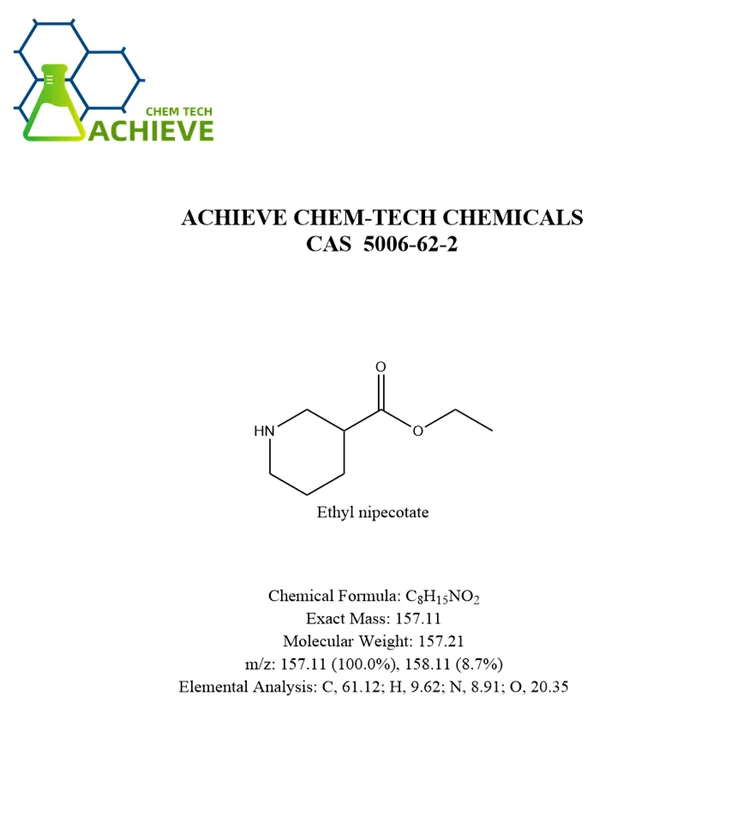
Additional information of chemical compound:
|
Chemical Formula |
C8H15NO2 |
|
Exact Mass |
157.11 |
|
Molecular Weight |
157.21 |
|
m/z |
157.11 (100.0%), 158.11 (8.7%) |
|
Elemental Analysis |
C, 61.12; H, 9.62; N, 8.91; O, 20.35 |
|
Melting point |
165-167℃ |
|
Boiling point |
102-104℃/7 mmHg (lit.) |
|
Density |
1.012 g/mL at 25℃(lit.) |
|
Storage conditions |
2–8℃ |
|
|
|


- Ethyl nipicote is a key intermediate in the synthesis of certain drugs. For example, it can participate in the synthesis of drugs with neural activity, which may be used to treat neurological diseases such as Parkinson's disease and Alzheimer's disease.
- It can also be used to synthesize drugs with antibacterial or antiviral activities to fight against various infectious diseases.

Preparation of peptidoglycan biosynthesis inhibitors
- In the development of antibacterial drugs, this compound is used as a starting material for the synthesis of peptidoglycan biosynthesis inhibitors. These inhibitors can inhibit the synthesis of bacterial cell walls, thereby killing or suppressing bacterial growth.
- These types of inhibitors play an important role in combating drug-resistant bacterial infections because they can bypass the resistance mechanisms of traditional antibiotics.
- This compound can participate in chemical reactions such as esterification, acylation, and amination as a raw material in organic synthesis, generating organic compounds with specific functional groups and properties.
- These compounds may have special physical and chemical properties, such as solubility, stability, reactivity, etc., which are suitable for specific application scenarios.

Materials Science and Surfactants

- Although the application of this compound in the field of materials science is relatively limited, its specific chemical structure may enable it to play a role in the preparation of certain polymer materials, surfactants, or functionalized materials.
- For example, it can be used as a part of surfactants to improve the dispersibility, stability, or wettability of liquids.
- In laboratory research in chemistry, biochemistry, or medicinal chemistry, the compound may be used as a standard, control, or reagent to validate experimental methods, determine reaction rates, or evaluate compound activity.
- In terms of teaching, it can also serve as a material for teaching experiments, helping students understand the basic principles and experimental skills of organic synthesis, drug synthesis, or biochemistry.

How is this substance used for synthesizing GABA receptor agonists?
This substance is a key intermediate in the synthesis of GABA reuptake inhibitors. GABA reuptake inhibitors can prevent GABA from being reabsorbed, thereby increasing its concentration in synaptic cleft and enhancing its inhibitory effect. Nipeconic acid (3-piperidinecarboxylic acid) and its derivatives can act as GABAA receptor agonists, increasing endogenous GABA concentration.
Molecular hybridization is an excellent approach in designing and developing derivatives for treating GABA related diseases. By hybridizing the aromatic skeleton with this substance, GABA reuptake inhibitors with significant effects can be designed and developed.
Tiagabine is a GABA reuptake inhibitor used to treat certain types of epilepsy and anxiety disorders. The synthesis process involves combining the substance with a compound containing a thiophene fragment. This double thiophene fragment can be obtained through various methods, including lithium halogen exchange using n-butyl lithium, and then reacting with ethyl bromobutyrate to generate unsaturated olefin units.
SAR research helps to discover the relationship between chemical structure and biological activity, and determine the chemical groups that trigger biological effects. This helps to modify the chemical structure, resulting in compounds with increased therapeutic potential and minimal side effects.
This substance is also used to synthesize other GABA receptor agonists, which can mimic the action of GABA, bind to GABA receptors, and enhance their inhibitory effect on neurotransmission.
Mechanism of Action of Ethyl Nipecotate

Ethyl nipecotate (CAS 5006-62-2) is an ethyl ester derivative of nipecotic acid. Its core mechanism of action centers on GABA transport inhibition, accompanied by prodrug properties and selective muscarinic receptor modulation, making it an important tool molecule in neuropharmacological research.
I. Prodrug Activation: The Key to Central Targeted Delivery
Ethyl nipecotate acts as a lipophilic prodrug capable of efficiently crossing the blood–brain barrier (BBB), whereas its parent compound nipecotic acid cannot easily enter the brain due to its high polarity.Upon entry into the central nervous system, its ethyl ester bond is hydrolyzed by brain esterases to release (R)-(-)-nipecotic acid (the active form), enabling central targeted delivery. This process is a prerequisite for its neuropharmacological effects and determines its in vivo activity and selectivity.

II. Core Mechanism: Potent Inhibition of GABA Transporters (GAT)

1. Target and Binding Properties
The active metabolite (R)-nipecotic acid binds specifically to GABA transporters (GAT-1/2/3) located on neuronal and glial cell membranes, competitively blocking the reuptake of GABA into cells, with the strongest inhibitory activity against GAT-1.Its structure is highly similar to GABA. The piperidine ring and carboxyl group bind precisely to the substrate pocket of the transporter, occupying the GABA-binding site and interrupting the transport cycle.
2. Regulation of Neurotransmitter Homeostasis
Inhibition of GAT leads to a marked increase in GABA concentration in the synaptic cleft, prolonging the interaction between GABA and postsynaptic GABAₐ/GABAᵦ receptors and enhancing central inhibitory neurotransmission.This effect reduces neuronal excitability and exhibits anticonvulsant and antiepileptic activities in animal models, forming its core pharmacological basis.

III. Secondary Mechanism: Selective Modulation of Muscarinic Acetylcholine Receptors (mAChR)
(R)-Ethyl nipecotate acts directly on muscarinic acetylcholine receptors in a subtype-selective manner:
It acts as an agonist at M₂ receptors, inhibiting adenylate cyclase and reducing cAMP levels, thereby mediating negative cardiac chronotropic and inotropic effects.
It acts as an antagonist at M₁ receptors, blocking phosphatidylinositol hydrolysis without inducing central excitation.
This dual modulation synergistically enhances central inhibition and supports its anticonvulsant action.
IV. Structure–Activity Relationship and Stereoselectivity
The (R)-enantiomer shows significantly higher activity than the (S)-form:
(R)-Ethyl nipecotate is hydrolyzed to (R)-nipecotic acid, which has a lower IC₅₀ for GAT inhibition and stronger anticonvulsant activity.
The (S)-form exhibits almost no in vivo activity.
The ethyl ester moiety is essential for BBB penetration; replacement with a polar group results in the loss of central activity.

Early Exploration of the Parent Compound Nipecotic Acid (1920s–1960s)
The discovery of Ethyl Nipecotate originated from research on piperidine-3-carboxylic acid (Nipecotic acid). In 1923, McElvain and Adams first synthesized Nipecotic acid via catalytic hydrogenation of nicotinic acid, laying its chemical foundation. In 1963, Morris Freifelder optimized the synthetic route, efficiently preparing it using rhodium/alumina as a catalyst, which advanced its fundamental research. Early studies focused on its chemical properties; it was not until the 1970s that its GABA transport inhibitory activity was revealed, marking a key starting point for neuropharmacological research.
Synthesis and Prodrug Design of Ethyl Nipecotate (1970s–1980s)
Nipecotic acid exhibited limited in vivo activity due to its high polarity and poor blood–brain barrier permeability. In the late 1970s, to address this issue, researchers esterified its carboxyl group to obtain Ethyl Nipecotate (CAS 5006-62-2). This derivative showed significantly enhanced lipophilicity, enabling efficient brain penetration. It is hydrolyzed by brain esterases to release active Nipecotic acid, achieving central targeted delivery. This design has become a classic paradigm for the prodrug development of GABA transport inhibitors.
Stereoselectivity and Pharmacological Validation (1980s–1990s)
In the 1980s, studies confirmed that the (R)-enantiomer is the active form of Ethyl Nipecotate, with far greater GAT inhibitory and anticonvulsant activities than the (S)-form. In the 1990s, breakthroughs in chiral synthesis technologies-such as the efficient preparation of (R)-Ethyl Nipecotate via asymmetric hydrogenation of ethyl nicotinate-provided high-purity raw materials for mechanistic research and drug development. During the same period, its core mechanism of inhibiting GABA reuptake and enhancing central inhibition was systematically verified, establishing it as an important tool for research on epilepsy, anxiety, and related disorders.
Expanded Applications and Academic Status (2000 to Present)
Entering the 21st century, Ethyl Nipecotate has served not only as a research tool for the GABA system but also as a key synthetic intermediate for clinical drugs such as Tiagabine, supporting the development of antiepileptic agents. Its prodrug strategy and stereoselective mechanism offer important references for the design of neurotransmitter-modulating drugs, and it remains widely used in neuropharmacological and medicinal chemistry research to this day.


I. Gas Chromatography (GC)
Gas chromatography is a common method for the determination of ethyl nipecotate content and volatile impurities. After the sample is dissolved in ethanol or ethyl acetate, separation is performed using a weakly polar capillary column with nitrogen as the carrier gas, and detection is carried out with a flame ionization detector (FID). Temperature programming enables effective separation of the main component from raw materials, intermediates and homologous impurities. Quantification is performed by the external standard method or area normalization method.
Featuring high sensitivity and excellent separation efficiency, this method is suitable for in-process control in industrial production and finished product purity testing, allowing rapid evaluation of synthetic reaction progress and product purity.
II. High Performance Liquid Chromatography (HPLC)
HPLC is the core analytical technique for the qualitative and quantitative analysis of ethyl nipecotate. A C18 reversed-phase column is typically employed, with an acetonitrile–water system as the mobile phase; a small amount of trifluoroacetic acid or phosphate buffer salt may be added to improve peak shape. Quantification is usually performed via end absorption at a UV detection wavelength of 200–210 nm. This method offers strong stability and good repeatability, enabling effective resolution of impurities with similar polarity.

It is suitable for accurate determination of high-purity products and serves as a common arbitration method in quality standards, meeting the quality control requirements of pharmaceutical intermediates.

III. Nuclear Magnetic Resonance Spectroscopy (NMR)
NMR is used for structural identification and auxiliary purity assessment, mainly including proton NMR (¹H NMR) and carbon-13 NMR (¹³C NMR). In solvents such as deuterated chloroform, characteristic peaks of the methyl and methylene groups of the ethyl moiety, proton signals on the piperidine ring, and ester-related carbon signals exhibit distinct chemical shifts. Molecular structure can be confirmed by peak positions, integration ratios and coupling constants, while sample purity is evaluated based on the presence and intensity of impurity peaks.
As the gold standard for structural identification, NMR is commonly used for structural confirmation of new products and verification of synthetic routes.
IV. Fourier Transform Infrared Spectroscopy (FTIR)
FTIR is mainly used for rapid qualitative identification. Ethyl nipecotate shows a strong characteristic absorption peak of the ester carbonyl group (C=O) at 1730–1750 cm⁻¹, C-O-C stretching vibration peaks in the 1100–1250 cm⁻¹ region, and characteristic absorptions from the skeletal vibrations of the piperidine ring. By comparing the measured spectrum with a standard spectrum, the authenticity of the sample can be rapidly determined. This method is suitable for rapid screening of incoming raw materials, with simple operation and short analysis time.


V. Determination of Water Content and Residual Solvents
For both powder and liquid samples, water content is determined by Karl Fischer titration to ensure compliance with requirements for subsequent reactions. Residual solvents are analyzed by headspace gas chromatography to monitor residues of organic solvents such as ethanol and ethyl acetate used in synthesis and purification processes. This ensures product safety and stability, meeting regulatory requirements for pharmaceutical intermediates.
Hot Tags: ethyl nipecotate cas 5006-62-2, suppliers, manufacturers, factory, wholesale, buy, price, bulk, for sale, 5 Sulfoisophthalic Acid Monosodium Salt CAS 6362 79 4, Cytidine 5 diphosphate disodium salt, 3-Phenyltoluene, 5 Chloroindole 2 carboxylic Acid CAS 10517 21 2, 2 Furoic Acid CAS 88 14 2, 2 6 Dichloropyrazine CAS 4774 14 5