




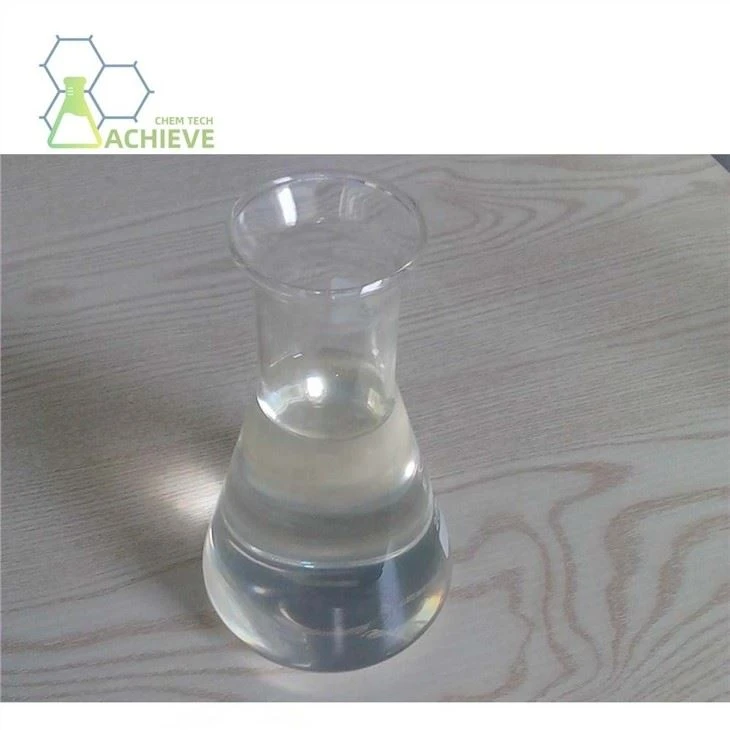

Shaanxi BLOOM Tech Co., Ltd. is one of the most experienced manufacturers and suppliers of 1-hexanol liquid cas 111-27-3 in China. Welcome to wholesale bulk high quality 1-hexanol liquid cas 111-27-3 for sale here from our factory. Good service and reasonable price are available.
1-Hexanol liquid, also known as 1-hexanol, is n-amyl methyl alcohol (1-hydroxyhexane). It belongs to the fatty primary alcohol. It is a colorless and transparent liquid under normal temperature and pressure and has a special flavor. The molecular formula is C6H14O and the structural formula is CH3 (CH2) 5OH. It is flammable and can form explosive mixture with air. Slightly soluble in water, soluble in ethanol, ether and other organic solvents, low toxicity, but irritating to skin and mucosa, mainly used as organic solvents and organic synthetic materials.
N-hexanol or its carboxylic acid ester exists in citrus and berry in a small amount. Tea leaves and fragrant oil are also contained in various essential oils such as lavender oil, banana, apple, strawberry and violet leaf oil.

|
Chemical Formula |
C6H14O |
|
Exact Mass |
102 |
|
Molecular Weight |
102 |
|
m/z |
102 (100.0%), 103 (6.5%) |
|
Elemental Analysis |
C, 70.53; H, 13.81; O, 15.66 |
|
|
|


1-Hexanol liquid (C6H14O), as a primary aliphatic alcohol, has shown wide application value in industry, medicine, daily chemical products, food, scientific research, and emerging fields due to its unique physical and chemical properties (such as colorless transparent liquid, special fruity aroma, slightly soluble in water but soluble in organic solvents, flammable and able to form explosive mixtures with air).
1.Coatings and Ink Industry
As a solvent, it can dissolve resins, pigments, and additives, improving the flowability and film-forming uniformity of coatings. Its low volatility (boiling point 157 ℃) and good solubility make it an ideal solvent for systems such as nitrocellulose and acrylic resin. In ink, viscosity can be adjusted to prevent the phenomenon of "flying ink" during the printing process, while improving ink drying speed and adhesion.
2. Adhesives and sealants
As a plasticizer solvent, it can improve the flexibility and cold resistance of polyvinyl chloride (PVC) adhesives. In polyurethane sealants, it acts as a reactive diluent, participating in isocyanate crosslinking reactions to enhance the elasticity and weather resistance of the sealant.


3. Cleaning and degreasing agents
It has strong solubility for mineral oil, animal and vegetable oil, and synthetic oil, and is widely used in metal surface cleaning, electronic component degreasing, and textile industry oil removal. Its low toxicity (rat oral LDX=4590mg/kg) and biodegradability (BOD ₅/COD=0.45) make it an environmentally friendly alternative to toxic solvents such as trichloroethylene.
4. Synthesis of chemical intermediates
Surfactant: Reacts with ethylene oxide to produce fatty alcohol polyoxyethylene ether (AEO), which is used in detergents, emulsifiers, and wetting agents.
Plasticizer: Esterify with phthalic anhydride to form di-n-hexyl phthalate (DHP), which enhances the flexibility of PVC products.
Polyester and polyurethane: As binary alcohol components, they participate in the synthesis of unsaturated polyester resins (used for fiberglass products) and polyurethane elastomers (used for shoe materials and coatings).
1. Edible flavor
It has the aroma of coconut and berry, and is widely used to make drinks, candy, baked food and dairy essence. The dosage should strictly follow GB 2760-2014 "National Food Safety Standard for the Use of Food Additives", for example, the maximum dosage in baked goods is 18mg/kg, and in meat products it is 2.2mg/kg.
fragrances
Perfume and cosmetics: As the first fragrance ingredient, it gives the product fresh fruit fragrance, and can simulate complex floral notes when mixed with citral, citronellol, etc.


Detergents and soaps: their long-lasting fragrance retention characteristics make them an important component of soap essence, improving the market competitiveness of products.
Natural spice extraction
N-hexanol is naturally found in citrus essential oil (0.1% -0.5%), tea volatile oil (0.02% -0.1%) and lavender oil (0.05% -0.2%). It can be separated with high purity through molecular distillation technology and used for high-end essence blending.
1. Drug synthesis intermediates
Tolansetron: It is oxidized to form hexanal and further synthesized into Tolansetron (5-HT ∝ receptor antagonist), which is used for the treatment of chemotherapy-induced nausea and vomiting.
Benzapride: Reacts with benzyl chloroformate to produce benzapride (a lipid-lowering drug), which lowers cholesterol levels by regulating HMG CoA reductase activity.


2. Solvent and diluent
As a solvent for non water soluble drugs, it can enhance the bioavailability of poorly soluble drugs such as the antifungal drug miconazole. In ointments, it can improve the spreading of drugs on the skin surface as a wetting agent.
3. Preservatives and disinfectants
Esterification of n-hexanol with benzoic acid produces n-hexanoate benzoate, which has broad-spectrum antibacterial activity and is used for the preservation of eye drops, oral liquids, and other preparations. The disinfectant formulated with ethanol can destroy the structure of bacterial cell membranes and achieve a 99.9% kill rate against Staphylococcus aureus.
1. Food additive
Flavor regulator: 1-Hexanol liquid is used in baking foods (such as bread and cookies) to enhance caramel aroma, simulate fat flavor in meat products, and reduce salt usage.
Solvent carrier: In lipid soluble nutrient preparations such as vitamin E and coenzyme Q10, n-hexanol can be used as a solvent to enhance product stability and absorption rate.
2. Food packaging materials
As the foaming agent of polyurethane foam, it can reduce the density of materials, improve the thermal insulation performance, and is widely used in cold chain transportation packaging. The coating prepared by compounding it with epoxy resin can extend the shelf life of food by 30% -50%.

Research and Emerging Fields: Frontiers of Technological Breakthroughs

1. Chemical analysis reagents
Gas chromatography stationary phase: As a polar stationary phase, it can be used to separate polar compounds such as alcohols and esters, with a separation efficiency 20% higher than traditional stationary phases.
Standard substance: In environmental monitoring, it is used as a standard for volatile organic compounds (VOCs) to calibrate detection instruments and ensure data accuracy.
2. Fuel cell electrolyte
Reacting with sulfonic acid groups to generate perfluorosulfonic acid n-hexanol ester, as an electrolyte component of proton exchange membrane fuel cells, can increase proton conductivity to 0.1 S/cm (25 ℃) and reduce battery internal resistance by 15%.
3. Nanomaterial synthesis
As a solvent and surface modifier, n-hexanol can be used to control the synthesis of gold nanorods (aspect ratio 3:1-5:1) and titanium dioxide nanoparticles (particle size 10-20nm) for photocatalytic degradation of organic pollutants (degradation rate>90%) and solar cell light absorbing layers.

Environmental Protection and Agriculture: A New Direction for Sustainable Development

1. Biodegradable plastic additive
Poly (lactic acid) - n-hexanol copolymer (PLA Hexanol) is formed by copolymerizing with lactic acid, which has a 300% increase in elongation at break compared to pure PLA. It can be used for disposable tableware, packaging films, etc., with a degradation rate of 90% within 6 months.
2. Pesticide adjuvant
As an emulsifier, it can enhance the wettability of pyrethroid pesticides on plant surfaces, increasing the coverage of the solution from 60% to 90% and reducing pesticide usage by 20% -30%.
3. Soil remediation agent
The chemical oxidant prepared by the combination of n-hexanol and hydrogen peroxide can degrade polycyclic aromatic hydrocarbons (PAHs) and petroleum hydrocarbons (TPH) in soil, with a degradation efficiency 40% higher than that of single hydrogen peroxide and a 50% shorter remediation cycle.

Synthesis of 1-Hexanol liquid:
(1) In industry, it is generally prepared by catalytic hydrogenation and reduction of hexanoic acid. In large-scale industrial production, ethylene is used as raw material. In the presence of triethyl aluminum catalyst, Trihexyl aluminum is first synthesized. Trihexyl aluminum is oxidized to obtain trihexoxyaluminum, and the latter is hydrolyzed to n-hexanol. This is the famous Ziegler method, which is used to synthesize primary alcohols with even carbon. The three-step reaction equation is as follows:
Synthesis of triethyl aluminum: 2Al +3H2 + 6C2H4→ 2Al(C2H5)3
Chain growth reaction: Al(C2H5)3 + 6C2H4 → [C2H5(C2H4)2]3Al
Oxidation: 2[C2H5(C2H4)2]3Al + 3O2 → 2[C2H5(C2H4)2O]3Al
Hydrolysis: 2[C2H5(C2H4)2O]3Al + 3H2O→6C2H5(C2H4)2OH +Al2O3
It can also be produced by oxidation of n-hexane, but the products obtained are often mixtures of different hexanol isomers, and n-hexanol can be obtained after distillation and separation.
Hexanol often contains other alcohols, which is difficult to separate. The better purification method is esterification with p-hydroxybenzoic acid, recrystallization of the ester, saponification, separation of the water layer, drying with potassium carbonate or calcium sulfate, distillation, and interception of n-hexanol fraction.
(2) Ethyl hexanoate was used as raw material and reduced with metal sodium in anhydrous ethanol. The product was n-hexanol and ethanol. Pure n-hexanol was obtained by rectification and separation.
(3) In the laboratory, butyl magnesium bromide can be prepared by reacting bromobutane with magnesium chips, and then reacting with ethylene oxide to obtain hexanol. In the presence of catalyst iodine, the anhydrous ether solution of bromobutane is reacted with magnesium chips under stirring. In the reaction process, reflux and anhydrous must be achieved. The dropping acceleration of bromobutane and anhydrous ether must be controlled to keep the reaction liquid boiling. After the dropping is completed, ethylene oxide is introduced. In the cooling state, the feeding speed is controlled to maintain the reaction temperature at 10 ℃. After the feeding is completed, the cooling is stopped and the temperature of the reaction system is slightly increased to produce slight boiling. After boiling, heat the reactants in a water bath. When half of the total amount of ether is evaporated, add an appropriate amount of dry benzene, stir and continue to distill until the steam temperature reaches 65 ° C, and then completely refluxe to the viscosity of the mixture. After cooling, add an appropriate amount of ice water for hydrolysis, and add 30% sulfuric acid while cooling until the precipitated magnesium hydroxide is completely dissolved. Then, steam distillation is carried out to add 20% sodium hydroxide to the oil layer of the water layer from which the distillate is separated, heat it in the steam bath, stir it for 1-2h, and then steam distillation is carried out to distill the obtained oil layer, distill the collected 85-154 ℃ fraction, and collect the 154-157 ℃ fraction, which is the finished product.
Hot Tags: 1-hexanol liquid cas 111-27-3, suppliers, manufacturers, factory, wholesale, buy, price, bulk, for sale, 4 4 Methylenedianiline, Hydroxylamine hydrochloride powder, triphenylphosphine reagent, N N Dimethylformamide pure, 37 formaldehyde, Solvent