




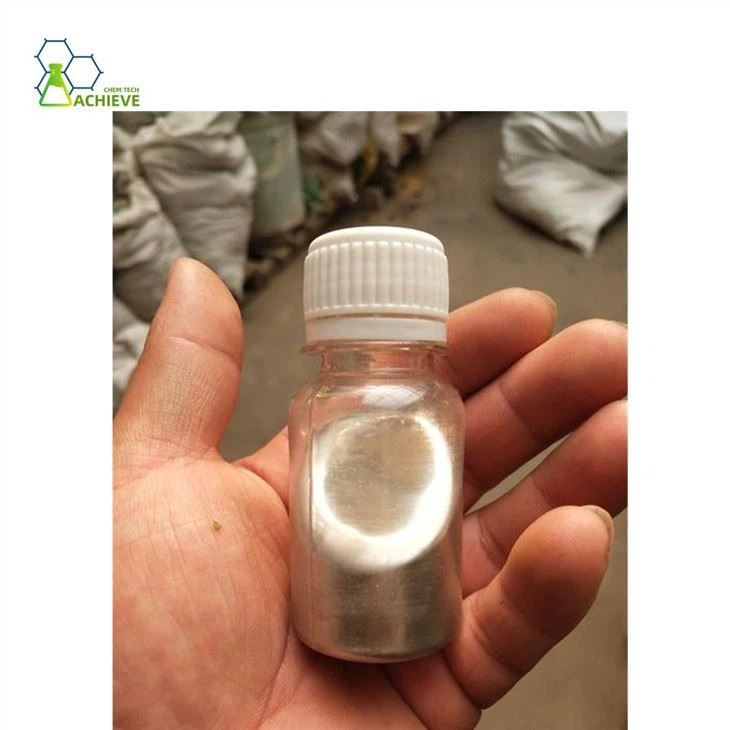
Mercury reagent, CAS 7439-97-6, mainly composed of mercury, is a chemical element with the element symbol Hg. Ranked 80th in the periodic table, located in the 6th period and IIb group of the chemical periodic table. It is commonly referred to as pure liquid mercury. Mercury, as a metal, exists strangely in the form of a mercury liquid at room temperature. The theory of relativistic contraction effects can provide an explanation for this unusual phenomenon. Similar to gold, the 6S orbitals of mercury contract and tend to stabilize, producing an effect called "inert electron pairs": the 6s2 shell of mercury is inert during the bonding process. It can be seen that the 6s26p excitation energy of mercury far exceeds the corresponding excitation energy of cadmium and zinc. According to the general periodic law, the energy interval should decrease as the main quantum number increases. Therefore, it is expected that the energy gap from zinc to cadmium will decrease, but the energy gap from cadmium to mercury will suddenly increase. Once again, it can be seen that it is the relativistic contraction effect that causes the entire 6s2 shell to be safe and stable, resulting in a sharp increase in the 6s26p energy range of Mercury. As long as the required excitation energy is not obtained, solid bonds cannot be formed between mercury atoms with an inert 6s2 shell. The ground state Hg2 is only supported by van der Waals forces, so the metal mercury is liquid at room temperature.

|
Chemical Formula |
Hg |
|
Exact Mass |
200.59 |
|
Molecular Weight |
200 |
|
Vapor pressure |
< 0.01 mm Hg ( 20 °C ) |
|
Storage conditions |
Poison room |

Mercury reagent is considered to be a rare metal because of its extremely small distribution in nature, but it has been discovered for a long time. Natural mercury sulfide, also known as cinnabar, has been used as a red pigment for a long time because of its bright red color. According to the inscriptions on oracle bones unearthed in Yin Xu painted with dansha, it can be proved that China used natural mercury sulfide before history.
According to ancient Chinese documents, before the death of Qinshihuang, some princes had already used mercury infusion in their tombs. For example, Duke Huan of Qi was buried in Linzi (now Linzi District, Zibo City, Shandong Province), and his tomb was filled with mercury as a pool. That is to say, China has obtained a large amount of mercury in the 7th century BC or earlier.
Mercury was also used as a surgical drug in ancient China. The fifty-two prescriptions in the silk book unearthed in Mawangdui Han tomb in Changsha in 1973, copied in the Qin and Han Dynasties, is the oldest medical prescription in China that has been excavated, and may be in the Warring States period. Mercury is used in four prescriptions. For example, use the mixture of mercury and realgar to treat scabies.
Artificial preparation of mercury: after crushing cinnabar ore, flotation enrichment, roasting in air or co heating with quicklime to distill mercury. This method is commonly used in industry.


chemical properties
1. It can quickly evaporate at high temperatures. Reacting with azides, acetylene, or ammonia can generate explosive compounds. Contact with ethylene, chlorine, triazene methane, and sodium carbide can cause violent reactions. Staff should take protective measures. If they accidentally touch their eyes, they should immediately rinse with plenty of flowing water.
2. It usually does not react with hydrogen or rare gases, but can directly combine with all halogens and sulfur vapors. At room temperature, it is not oxidized by air. When heated to boiling, it can slowly react with oxygen to form mercuric oxide. Reacts with ammonia water in the air to form Myron base (Hg2NOH · 2H2O).
3. It does not oxidize at room temperature, but can evaporate. When heated, it oxidizes to mercury oxide. It is toxic to form alloys (amalgam) with metals other than iron, and vapor inhalation has a cumulative hazard. Sodium amalgam is a commonly used reducing agent in organic synthesis and is also used in high-pressure sodium lamps. When pure metals of mercury and aluminum come into contact, they are prone to form aluminum amalgam because it can destroy the oxide layer that prevents further oxidation of aluminum metal (brush experiment), so even a small amount of mercury can severely corrode aluminum metal. For this reason, in the vast majority of cases, mercury cannot be brought onto airplanes because it can easily form alloys with exposed aluminum components on board, posing a danger.


4. Dissolve in nitric acid and hot concentrated sulfuric acid to produce mercuric nitrate and mercuric sulfate, respectively. Excess mercury leads to the formation of mercurous salts. It can dissolve many metals and form alloys, which are called mercury amalgam. The valences are+1 and+2. Similar to silver, mercury can also react with hydrogen sulfide in the air. Mercury has a constant coefficient of volume expansion, lower metal activity than zinc and cadmium, and cannot displace hydrogen from acidic solutions. The general valence of mercury compounds is+1 or+2. Mercury compounds with a valence of+4 only have mercury tetrafluoride, while mercury compounds with a valence of+3 do not exist.

Widely used thermometers, sphygmomanometers and other equipment have caused environmental problems such as mercury pollution indoors. If you break the mercury thermometer indoors, don't panic. You can immediately hold up the visible broken mercury beads with paper (because the cohesion of mercury is very large, you can't touch mercury with a cotton swab, which is an extremely unscientific and irresponsible statement) and put them into a sealed water bottle. If there are small mercury beads, you can push them together with paper, Mercury will automatically gather into small balls and then collect. For safety, when there are some simple chemicals, nitric acid can be used to wipe the mercury polluted ground to completely eliminate the mercury pollution.
Mercury is a naturally occurring element found in air, water, and soil.
Mercury is a highly toxic non essential element that is widely present in various environmental media and food chains (especially fish), and its traces are found in various corners of the world.
The world's mercury mineral resources are approximately 700000 tons, with a basic reserve of 300000 tons. The main countries with mercury reserves and their basic reserves include Spain with 90000 tons, Italy with 69000 tons, China with 81400 tons, and Kyrgyzstan with 45000 tons. The world's mercury deposits are mainly distributed in the Tethys Himalayan tectonic belt. The main types of mercury deposits are carbonate type, followed by clastic rock type and magmatic rock type.


Among them, carbonate type is the most important, accounting for 90% of the reserves of mercury deposits.
Mercury minerals occur in the Lower Cambrian strata, and their occurrence and enrichment are strictly controlled by comprehensive factors such as structure, rock assemblages, and wall rock alteration. The main ore body is layered, similar to layered, and also occurs in a layered lens like manner, with obvious layer controlled characteristics. It belongs to a layer controlled type of deposit and is recognized as the most typical "layered mercury deposit" in China. It is of great significance for the exploration and research of mercury at home and abroad. The ore is single, mainly composed of cinnabar. The output is mainly star shaped and disseminated, followed by vein shaped and strip shaped. The ore dressing and smelting performance is good.

Migration and Transformation:
The mercury cycle is a typical cycle of heavy metals in ecosystems, where mercury migrates and transforms in elemental states in water, soil, atmosphere, and biosphere.
The main characteristics of mercury migration and transformation:
(1) Mercury is the only heavy metal that can improve cycling in ecosystems. After mercury is discharged into water, the concentration of methylmercury in fish contaminated with mercury can be tens of thousands of times higher than in water through the food chain.
(2) The mercury cycle exhibits complex processes including: migration of particulate matter; Settlement of dry and wet matter; Volcanoes evaporate into the atmosphere; Sedimentation of sludge into water; Generate methylmercury under the action of bacteria; Entering organisms; Accumulation within organisms.
(3) Biomethylation: Under the action of microorganisms, inorganic mercury such as metal mercury and divalent ion mercury will be converted into methyl mercury and dimethyl mercury, and this conversion is called mercury biomethylation.
(4) Methylmercury is easily absorbed by the human body, discharged slowly, and has high toxicity. This is because methylmercury is easily soluble in lipids; Mercury is not easily decomposed in the body due to the presence of carbon mercury bonds in its molecular structure; It is a highly neurotoxic agent that accumulates in the brain.

Mercury comes from the "Classic". The Classic of Materia Medica: Mercury, as stated in the Classic, comes from red sand. It is a coarse vermilion sand extracted from mountain stones, used as a furnace to place sand in the middle, with water underneath and a mixture of water above. When calcined with fire, smoke flies above, and mercury slides below, resulting in a small white and turbid color. As for those who came from the Western Qiang, they also said that they were so calcined. But there are a lot of plants growing in the mountains, and as for a mountain that splits itself, people collect large pieces of sand and stone like a bucket, and the broken ones can be burned and calcined. Therefore, there is much more water and silver from the west than from the south. In the book "The Meaning of Materia Medica": Mercury coagulates when lead is obtained, solidifies when sulfur is obtained, and disperses when jujube meat is ground. Do not calcine it into greasy powder or cream. Bitter bites kill lice. Compendium: Mercury, if scattered on the ground, is collected as Sichuan pepper or tea powder. The Encounter of the Original Classic states that mercury is highly toxic and cannot enter a person's abdomen. Today, I accidentally ingested mercury and had a heavy weight in my stomach. I used two pounds of pig fat, cut it into small pieces, and baked it until cooked. I mixed it with raw honey and could eat it. It's also a recipe.
Pharmacological effects:
1. Mercury (mercury) compounds have disinfection, diarrhea, and diuretic effects, and are no longer used or rarely used. The elemental mercury does not cause pharmacological effects, and the dissociated mercury ions can bind to hydrophobic groups and interfere with cell metabolism and function. The elemental mercury cannot be absorbed from the gastrointestinal tract, but its surface can form oxides or sulfides when exposed to air, which can sometimes cause mild diarrhea and diuresis when swallowed. Most people who swallow mercury have no symptoms, and mercury is excreted from their feces. A few may have certain symptoms, while very few (sensitive or other unknown reasons) can cause immediate death.
2. Mercury is a protoplasmic toxin that can bind to the sulfhydryl groups in the respiratory enzymes of pathogenic microorganisms, inhibit their vitality, and ultimately suffocate them to death.
3. Mercury is mainly excreted by the kidneys, followed by the large intestine.
Pharmacology (Toxicology):
Mercury reagent has a corrosive effect on the digestive tract and can damage the kidneys and capillaries. Acute poisoning is mostly caused by accidental ingestion of mercuric chloride, with symptoms of digestive tract corrosion. After absorption, it can cause kidney damage, resulting in urinary closure and capillary damage, leading to plasma loss and even shock. Early application of dimercaptopropanol and other symptomatic measures is mostly effective. Chronic poisoning is generally seen in industrial poisoning, which can lead to stomatitis and toxic encephalopathy, with the latter exhibiting mental symptoms such as depression and fear, as well as muscle tremors.
Frequently Asked Questions
How toxic is mercury to humans?
+
-
The health impacts of mercury are numerous including kidney and nervous system damage and skin problems. Exposure of the fetus to methylmercury poses danger to the unborn child. The inorganic salts of mercury are corrosive to the skin, eyes and gastrointestinal tract, and may induce kidney toxicity if ingested
When was Calomel banned?
+
-
In the 1860s, calomel pills containing mercury were popular for conditions ranging from constipation to depression. Mercury was even used in teething powder until 1948, when it was banned for making children sick.
Does mercury react with vinegar?
+
-
Mercury is dissolved by all acids, which is to say by sulfuric acid, nitric acid, acid from sea salt; it also dissolves in vinegar and in acids made from plants: but for that to happen its chemical structure must be altered.
Can you remove mercury from your body?
+
-
Treatment for exposure to organic mercury usually consists of medicines called chelators. These remove mercury from the blood and move it away from the brain and kidneys. Often, these medicines will have to be used for weeks to months.
Hot Tags: mercury reagent cas 7439-97-6, suppliers, manufacturers, factory, wholesale, buy, price, bulk, for sale, diphenylcarbazide reagent, p Dimethylaminobenzaldehyde, dithizone test, p-Naphtholbenzein, Chloramine-T powder, Sodium Diethyldithiocarbamate