


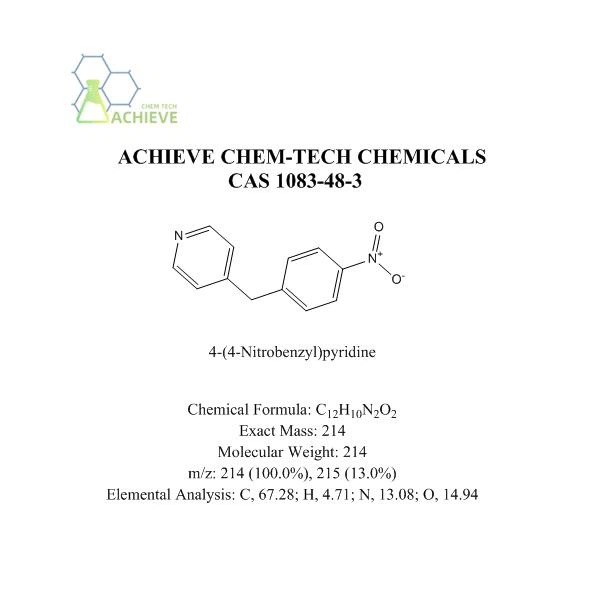


Shaanxi BLOOM Tech Co., Ltd. is one of the most experienced manufacturers and suppliers of 4-(4-nitrobenzyl)pyridine cas 1083-48-3 in China. Welcome to wholesale bulk high quality 4-(4-nitrobenzyl)pyridine cas 1083-48-3 for sale here from our factory. Good service and reasonable price are available.
4-(4-Nitrobenzyl)pyridine is an organic compound that is a light yellow to yellow solid. Soluble in benzene, methanol, ethanol and other organic solvents at room temperature, insoluble in water. The compound is relatively stable, but may decompose under high temperature or exposure to light. It has strong fluorescent and photosensitive properties, so it is often used in the preparation of fluorescent probes, photosensitizers and optical materials. In addition, it can also be used in organic synthesis reactions as transition metal ligands, organic catalysts, etc.

|
Chemical Formula |
C12H10N2O2 |
|
Exact Mass |
214 |
|
Molecular Weight |
214 |
|
m/z |
214 (100.0%), 215 (13.0%) |
|
Elemental Analysis |
C, 67.28; H, 4.71; N, 13.08; O, 14.94 |


4- (4-Nitrobenzyl) pyridine is an important organic compound with a unique chemical structure and a wide range of applications. The following is a detailed explanation of its purpose:
analytical chemistry
In gas chromatography analysis, it can be used as a derivatization reagent to enhance the volatility and detection sensitivity of certain compounds. For example, for certain compounds that are difficult to directly vaporize, a derivatization reaction with 4- (4-Nitrobenzyl) pyridine can generate more volatile derivatives, making gas chromatography analysis easier. In addition, 4- (4-Nitrobenzyl) pyridine can also be used as a stationary phase modifier to improve the selectivity and separation efficiency of chromatographic columns. In liquid chromatography analysis, it also has a wide range of applications. It can be used as an ion pair reagent to form ion pairs with the analyte, thereby changing the retention behavior of the analyte on the chromatographic column and improving separation efficiency. In addition, 4- (4-Nitrobenzyl) pyridine can also be used as a fluorescent labeling reagent to react with the test compound to generate fluorescent derivatives, which can be detected by a fluorescence detector to improve the sensitivity and selectivity of the detection.
Application in Spectral Analysis

It can be used as a chromogenic or chelating agent in UV visible spectroscopy analysis. Some compounds have weak absorption in the UV visible region and are difficult to detect directly. By undergoing color reaction or complexation reaction with 4- (4-Nitrobenzyl) pyridine, derivatives with strong UV visible absorption can be generated, thereby improving the sensitivity of detection. For example, in the analysis of metal ions, 4- (4-Nitrobenzyl) pyridine can form colored complexes with certain metal ions, and the content of metal ions can be determined by measuring the absorbance of the complexes. Fluorescence spectroscopy analysis is a highly sensitive analytical method, in which 4- (4-Nitrobenzyl) pyridine also plays an important role. It can serve as a fluorescent probe to undergo specific reactions with the tested compound, generating fluorescent products. By measuring the fluorescence intensity of the product, quantitative detection of the tested compound can be achieved. In addition, 4- (4-Nitrobenzyl) pyridine can also be used to construct fluorescent sensors for real-time monitoring of certain pollutants or biomolecules in the environment.
It can serve as a recognition element or modifier for electrochemical sensors. By fixing it on the electrode surface, electrochemical sensors with specific selectivity can be constructed. When the substance to be tested comes into contact with the sensor, a specific electrochemical reaction occurs, resulting in changes in electrode potential or current. By measuring the changes in these electrical signals, quantitative detection of the substance under test can be achieved. For example, in the construction of biosensors, 4- (4-Nitrobenzyl) pyridine can bind to biomolecules (such as enzymes, antibodies, etc.) to detect specific components in biological samples. In electrochemical analysis methods, 4- (4-Nitrobenzyl) pyridine can also be used as an additive or supporting electrolyte. It can improve the performance of electrolytes and enhance the sensitivity and accuracy of electrochemical analysis. For example, in some electrochemical titration analyses, 4- (4-Nitrobenzyl) pyridine can serve as an indicator or complexing agent, participate in the titration reaction, and determine the titration endpoint by measuring changes in the electrochemical signal.
Application as a specific analytical reagent

It has important applications in the determination of phosgene. Phosgene is a toxic gas that poses a serious threat to human health and the environment. The traditional phosgene detection method has problems such as low sensitivity and complex operation. And 4- (4-Nitrobenzyl) pyridine can undergo specific reactions with phosgene to produce products with specific optical properties. By detecting the optical properties of these products (such as absorbance, fluorescence intensity, etc.), the content of phosgene can be indirectly determined. This method has the advantages of high sensitivity, good selectivity, and easy operation, and has been widely used in the field of phosgene detection. Organophosphorus pesticides are a widely used class of insecticides, but they also pose certain hazards to human health and the environment. Therefore, accurate determination of organophosphate pesticide residues in food and agricultural products is of great significance for ensuring food safety and environmental protection. 4- (4-Nitrobenzyl) pyridine can react with organophosphorus pesticides to produce products with specific optical properties. By detecting the optical properties of these products, the content of organophosphorus pesticides can be indirectly determined. This method also has certain application potential in the field of organic phosphorus pesticide residue detection.
dye and pigment
Dye intermediates are important raw materials in the process of dye synthesis, which ultimately generate dyes with specific colors and properties through a series of chemical reactions. Due to its unique chemical structure, it can serve as an intermediate for various types of dyes, used for synthesizing different types of dyes. Azo dyes are an important class of dyes with advantages such as bright colors and good dyeing performance. 4- (4-Nitrobenzyl) pyridine can undergo coupling reaction with diazonium salts to generate dye intermediates containing azo groups. These intermediates can further react with other compounds to generate azo dyes with specific colors. For example, it can react with aniline diazonium salts to generate yellow or orange azo dye intermediates, which are then subjected to reduction, sulfonation and other reaction steps to ultimately generate azo dyes for textile dyeing. Anthraquinone dyes are a type of dye with high light resistance and weather resistance, widely used for dyeing high-end textiles and leather products. 4- (4-Nitrobenzyl) pyridine can be used as an intermediate in the synthesis of anthraquinone dyes. By reacting with other compounds and introducing specific functional groups, the properties of the dye can be improved. For example, it can undergo nucleophilic substitution reaction with anthraquinone compounds to generate anthraquinone dye intermediates containing nitro and pyridine rings. After a series of reaction steps, it ultimately produces anthraquinone dyes with excellent properties.

Functional dye additives

With the advancement of technology, the functional requirements for dyes are also increasing. It can serve as an additive for functional dyes, endowing them with special properties. Fluorescent dyes are a type of dye that can emit fluorescence under ultraviolet or visible light irradiation, and are widely used in fields such as biological labeling and optical materials. 4- (4-Nitrobenzyl) pyridine can be used as an additive for fluorescent dyes, by reacting with other fluorescent dye molecules and introducing functional groups such as nitro and pyridine rings, to improve the performance of fluorescent dyes. For example, it can improve the quantum yield, stability, selectivity, etc. of fluorescent dyes, making them more suitable for specific application scenarios. Thermal sensitive dyes are a type of dye that can undergo color changes at specific temperatures and are widely used in fields such as thermal paper and thermal labels. 4- (4-Nitrobenzyl) pyridine can be used as an additive for thermosensitive dyes, by reacting with other thermosensitive dye molecules, introducing specific functional groups, and adjusting the color change temperature and range of thermosensitive dyes. For example, it can improve the sensitivity, stability, weather resistance, etc. of thermosensitive dyes, making them more suitable for different application environments.
Pigments are fine particulate substances that are insoluble in media such as water, oil, solvents, etc. They have properties such as covering power and coloring power, and are widely used in coatings, inks, plastics, and other fields. It can be used as a raw material for pigment synthesis, reacting with other compounds to produce pigments with specific colors and properties. Organic pigments are a type of pigment with bright colors, high coloring power, and good weather resistance, widely used in high-end coatings, inks, and other fields. It can be used as a raw material for the synthesis of organic pigments, reacting with other organic compounds to produce organic pigment intermediates containing nitro and pyridine rings. These intermediates can further undergo reaction steps such as oxidation, reduction, and condensation to ultimately generate organic pigments with specific colors. Inorganic pigments are a type of pigment with properties such as covering power and coloring power, but some inorganic pigments have problems such as single color and poor weather resistance. 4- (4-Nitrobenzyl) pyridine can be used as a modifier for inorganic pigments, introducing functional groups such as nitro and pyridine rings onto the surface of inorganic pigments through surface coating, chemical grafting, and other methods to improve their properties. For example, it can improve the dispersibility, weather resistance, coloring power, etc. of inorganic pigments, making them more suitable for different application scenarios.

Special optical performance pigment raw materials

With the advancement of technology, the optical performance requirements for pigments are also increasing. It can be used as a raw material for special optical performance pigments, endowing them with special optical properties. Fluorescent pigments are a type of pigment that can emit fluorescence under ultraviolet or visible light irradiation, and are widely used in fields such as safety labeling and anti-counterfeiting labeling. 4- (4-Nitrobenzyl) pyridine can be used as a raw material for fluorescent pigments, which reacts with other fluorescent substances to generate fluorescent pigment intermediates containing nitro and pyridine rings. These intermediates can be further processed to produce pigments with excellent fluorescent properties. For example, it can improve the quantum yield, stability, weather resistance, etc. of fluorescent pigments, making them more suitable for outdoor use. Color changing pigments are a type of pigment that can undergo color changes under specific conditions such as temperature, light, humidity, etc. They are widely used in smart packaging, toys, clothing, and other fields. It can be used as a raw material for color changing pigments, reacting with other color changing substances to generate intermediate color changing pigments containing nitro and pyridine rings. These intermediates can be further processed to produce pigments with specific color changing properties. For example, it can improve the sensitivity, stability, durability, etc. of color changing pigments, making them more suitable for different application scenarios.
Hot Tags: 4-(4-nitrobenzyl)pyridine cas 1083-48-3, suppliers, manufacturers, factory, wholesale, buy, price, bulk, for sale, Cerium sulfate powder, CHICAGO SKY BLUE 6B, Consumable, Iridium III chloride, 1 AMINO 2 NAPHTHOL 4 SULFONIC ACID