




Shaanxi BLOOM Tech Co., Ltd. is one of the most experienced manufacturers and suppliers of lead powder cas 7439-92-1 in China. Welcome to wholesale bulk high quality lead powder cas 7439-92-1 for sale here from our factory. Good service and reasonable price are available.
Lead powder is a metallic chemical substance, which is a black to gray metal powder and the largest non radioactive element in terms of atomic weight. CAS 7439-92-1, Molecular formula Pb, metallic lead is a face centered cubic crystal. Lead metal is a corrosion-resistant heavy non-ferrous metal material. Blei has the advantages of low melting point, high corrosion resistance, difficult penetration of X-rays and gamma rays, and good plasticity, and is often processed into sheets and pipes.
Our company provides different specifications according to different properties of lead:
| NAME | Specifications |
| Lead powder | 99.99% metals basis |
| Lead powder | 99.95% metals basis |
| lead particles | 99.999% metals basis, granular, 1-3mm, |
| lead particles | 99.99% metals basis, granular, 1-3mm |
| lead sheet | SP |
It is widely used in industrial sectors such as chemical industry, cables, batteries, and radiation protection. Blei powder has a high density, low hardness, low melting point, high boiling point, poor conductivity to electricity and heat, and can absorb radiation. Therefore, it can also be used to manufacture containers for radioactive materials and as a protective material.

|
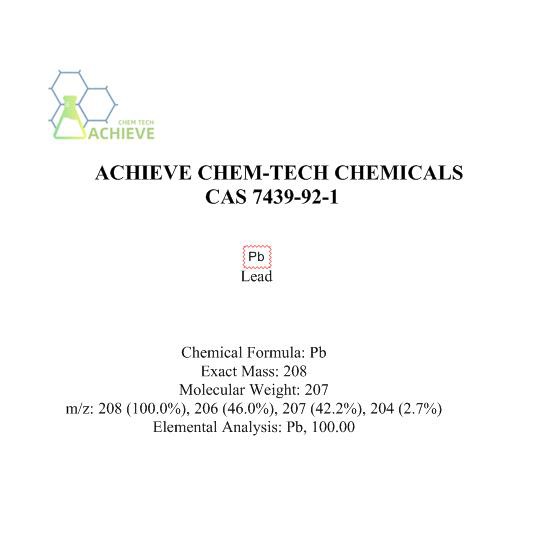
Chemical Formula |
Pb |
|
Exact Mass |
208 |
|
Molecular Weight |
207 |
|
m/z |
208 (100.0%), 206 (46.0%), 207 (42.2%), 204 (2.7%) |
|
Elemental Analysis |
Pb, 100.00 |
|
|
|


Blei is a raw material for manufacturing batteries, cables, bullets, and ammunition, as well as an additive to gasoline. Blei compounds are used as raw materials for pigments, glass, plastics, and rubber. Due to its excellent acid and alkali corrosion resistance, led metal is widely used in the manufacturing of chemical and metallurgical equipment. Led alloy is used for bearings, movable type gold, and soldering materials. In addition, led has also explored some new uses. If used as a stabilizer for asphalt to extend the service life of the road surface; Used for manufacturing nuclear power plant shielding and nuclear waste storage tanks, high-power battery packs for adjusting loads in the power industry, and magnetohydrodynamic devices.

1. Lead acid battery
Lead powder acid batteries (referred to as lead-acid batteries) have a history of more than 150 years since their introduction. Due to their low price, mature technology, and reliable performance, they have become the largest and most widely used secondary batteries in chemical power sources. They have been widely used in various occasions of social production and life for a long time.
Led acid batteries are charged and discharged through solid-state reactions of different valence states of led. During battery discharge, the active substances of the two electrodes become PbSO4, while during charging, the reaction proceeds in the opposite direction. Electrolyte sulfuric acid is an active substance. The positive and negative electrode reactions are governed by the dissolution precipitation mechanism rather than the solid-state ion transfer or membrane formation mechanism. The standard cell voltage for lead-acid batteries under room temperature is 2.1 V.


2. Cable sheath
The main sheath materials are chemical led, led alloys containing 1% antimony or arsenic, and led alloys containing 0.03% calcium or antimony. The use of lead as cable sheath mainly serves the functions of moisture-proof, anti-corrosion, and shielding support. The lead used in the cable industry is mainly for power cables and communication cables. Although most of the lead sheaths of domestic power communication cables have been replaced by other materials such as plastic, there are still a small number of cables that use lead sheaths. Due to environmental concerns abroad, the use of lad in submarine cable sheaths has caused a lot of controversy, but the lad consumption in this field still accounts for a large part of its use.
3. Chemical products
There are quite a few led compounds used in the chemical industry. Here we will only introduce a few widely used products. Led oxide is widely used in paste like mixtures of lead-acid battery grids, as well as in cement, glass, ceramics, and can be used to prepare other led compounds; Red led is an important anti rust coating used as a primer and inner paint layer to prevent steel corrosion.


The important white anti-corrosion pigments in industry are lead carbonate, lead hypophosphite, led phosphosilicate, and led silicate. Led borate can be used in glass manufacturing, fireproof coatings, and paint drying agents; Blei nitrate is used in pharmaceuticals and ore flotation. In addition, led chemical products are also used as luminescent materials in electronic powder materials and color electronic ultra black picture tubes.
4. Solder material
Blei alloy solder is commonly referred to as soft solder, among which led tin alloy solder is the most widely used and has a long history of use among all welding materials. It has a low melting point and can ideally connect most metals using a simple heating method without damaging the thermal sensing element.


5. Lead material
01.Lead plate
Generally, led materials are rolled into thin led plates with a width of less than 3.6 meters and any thickness, and led plates with a thickness of 0.4 mm are heavy. Blei plate, as a structural material, is an important corrosion-resistant material in chemistry and related industries, mainly due to its ability to resist corrosion in various corrosive environments. Of course, it can also be used as building structural materials, such as roof anti-corrosion panels and bathroom flooring. When led plates come into contact with cement, they are usually coated with a layer of asphalt on the surface.
As a shielding layer for X-rays and gamma rays, it is a well-known application. Due to the excellent shock absorption and sound insulation properties of led, a large number of led plates are also used for shock absorption and sound insulation. For example, steel and led shock absorbers installed under building foundations to impede the propagation of vibrations; Pure led can absorb most of the seismic energy released during earthquakes, and this type of shock absorber has been tested in a recent earthquake in Japan.


02. lead pipe
Blei pipes are also a major aspect of lead materials, widely used in the chemical industry and drainage pipelines. Squeeze seamless pipes using chemical led or led containing 6% antimony. Almost all thicknesses of pipes, ranging from thin tubes to 300 mm or larger, have production applications.
03. Wire mesh lead material
In the construction of led materials, in addition to using led plates, pipes, and solder, there are also led mesh fabrics used for leak sealing;
A considerable portion of the led tin solder mentioned above, as low melting point alloys (alloys of led with tin, bismuth, cadmium, indium, etc.), are almost entirely made of wire materials. The lowest melting point in the latter is below 100 ℃, used for automatic arc extinguishing, electric fuses, boiler plugs, etc. In developed countries, led has become an independent consumer destination, especially in the UK where lead sheets are used as roofing materials to prevent radiation from atmospheric atmospheric atoms. However, the production of led materials in China is very small, with an annual output of around 10000 tons.


6. Lead casting material
The main casting materials for lead are bearing alloys and lead type alloys; The cast products include bearings, led plates, counterweights, sealing gaskets, bullets, ballast counterweights, and even integral castings of radiation protection layers for large nuclear power plants.
7. Lead composite material
Insert a led sheet between two tin sheets and roll them into a tightly bonded Sn Pb Sn composite foil with a thickness of 0.01 mm or thinner, commonly known as "Blei foil". Used for moisture prevention in the construction industry, or as anti oxidation foil for grape and champagne bottles. Some are also used in the electronics industry. This' led foil 'is widely produced and used abroad. However, there is a gap in both production and application in China.


Of course, the more common and widely used led composite materials are made by combining led with stronger materials, which have better performance than both single materials. Lea can be combined with steel, concrete, wood, brick, or other suitable materials, and this structural composite material has excellent corrosion resistance and high strength. Although the strength of led plastic composite is slightly lower, the composite material has excellent sound insulation performance.
The composite material structure made by combining lead with strong hard materials includes:
Basic lead composite structure: Casting or extruding lead or lead alloy on a limited composite substrate. Such as antimony containing lead valves, pumps, anodes, and containers obtained through casting.
Lead powder composite with high-strength base: sheet, tube or other extruded lead and its alloys, firmly composite with steel, wood, concrete, copper or other metals, used for heating pipes, conveyors, floors, cable sheaths, roofs and anode plates.
Paste composite led materials: sheets, tubes, or other forms of lead and its alloys, connected to steel, concrete, wood, or other materials with adhesives, used as lad skin acid storage containers.
Metallurgical bonded led composite material: a heavy lead or lead alloy composite material that is metallurgically bonded with steel, copper, or other metals, used as a led coated steel reaction pool and a led coated copper cooling and heating coil.
Inorganic material composite lead: led sheets are embedded between concrete or steel and ceramic tile materials, and the blei sheets are mechanically or chemically connected to the inner and outer layers. For example, embedding a cushion material between the steel sheet and the inner layer for sulfuric acid mist washing, precipitation, collection, storage, etc.
Blei coated composite material: The coating is mechanically or metallurgically connected to the surface of the equipment and has corrosion resistance. Apply Pb Sn on steel for roofs, sinks, and chutes.
The above six types of led composite materials all have the advantages of low material cost, low installation and maintenance cost, excellent corrosion resistance, long service life, and are suitable for various operating conditions.

At room temperature and in air, a layer of lead oxide or alkaline lead carbonate is easily formed on the surface of blei, causing it to lose its luster and prevent further oxidation. It easily combines with halogens and sulfides to form PbCl4, PbI2, PBS, etc. Molten blei reacts with air to produce lead oxide, which can be heated in pure oxygen to obtain blei dioxide.
It reacts with hydrochloric acid to release hydrogen gas, generating slightly soluble PbCl2 that covers the surface of blei and prevents the reaction. Reacts with concentrated hydrochloric acid at high temperature to generate hpbcl3 and H2. It reacts with dilute sulfuric acid to release hydrogen gas, forming an insoluble PbSO4 coating and stopping the reaction. However, it easily dissolves in high-temperature concentrated sulfuric acid, generating Pb (HSO4) 2 and releasing SO2.

Lead nitrate Pb (NO3) 2 can be formed by reacting with dilute or concentrated nitric acid. It can dissolve in organic acids such as acetic acid and form soluble bleisalts under aerobic conditions. It reacts slowly with strong alkaline solutions, releasing hydrogen gas to produce blei sulfite. It reacts with water in the presence of oxygen to generate insoluble Pb (OH) 2.
Lead is initially oxidized to PbO2 during heating and melting, and decomposes into PbO after heating. When heated to 603-723K, Pb3O4 (i.e. blei) will be formed. Pb2O3 or Pb3O4 is easily dissociated at high temperatures to form stable PbO.
Lead powder is very stable in sulfur dioxide. Lead hardly reacts with pure carbon dioxide. Ordinary water has almost no corrosion to blei. Lead is easily soluble in nitric acid, boron fluoride acid, silicon fluoride acid, and acetic acid at room temperature, but almost insoluble in sulfuric acid, hydrochloric acid, and hydrofluoric acid.
Lead can be slowly dissolved through air, sodium hydroxide solution, or diluted sodium oxide solution. Lead can dissolve in silver nitrate solution. Other nitrates and chlorides can corrode blei. Potassium, sodium, iron, and ammonia sulfates, as well as potassium carbonate and cyanide solutions, have no effect on blei.

history
Lead is one of the earliest metals extracted by humans, discovered and applied around 3000 BC.
Small figures made of lead were already used during the pre dynastic period of Egypt (before 3000 BC), and Mesopotamia had already made small containers or hammered thin sheets of blei during the Uru III period (3000 BC).
The earliest discovered blei block in China was unearthed from the Erlitou Site in Yanshi, Henan Province, which existed about 3500 to 4000 years ago.
Lead made nobles, gourds, zuns, tripods, and spears were unearthed from tombs of the Shang and Western Zhou dynasties. The blei spears of the Western Zhou dynasty (11th century BC-771 BC) contained 99.75% blei.
Lead was not more commonly found in Palestine until after the 15th century BC.
But it was not until the 17th and 18th centuries that blei began to be produced on a large scale, with major lead producing countries including the United States, Japan, Germany, the United Kingdom, and China.
Before the 19th century, the sintering blast furnace process was mainly used to sinter blei concentrate into blocks and obtain crude lead through coke reduction. This method has high energy consumption, serious pollution, and low recovery rate (about 85%).
At the beginning of the 20th century, the application of reverberatory furnaces and electric furnaces improved melting efficiency, but there were still problems with sulfur dioxide emissions and blei dust pollution.
In the mid-20th century, electrolytic refining technology became popular and could produce refined blei with a purity of up to 99.99%, but at a higher cost.
The oxygen pressure acid leaching method (such as Finland's Outotec process) and biological leaching technology developed in recent years have significantly reduced energy consumption and pollution, making them suitable for complex ore processing.
Hot Tags: lead powder cas 7439-92-1, suppliers, manufacturers, factory, wholesale, buy, price, bulk, for sale, 2 Bromo 4 trifluoromethyl pyridine, sulfosalicylic acid powder, Butylmagnesium Chloride CAS 693 04 9, 3 Acetylphenylboronic acid, Bromophenol blue solution, Chlorosulfonyl isocyanate