




Shaanxi BLOOM Tech Co., Ltd. is one of the most experienced manufacturers and suppliers of 4-amino-1-benzylpiperidine cas 50541-93-0 in China. Welcome to wholesale bulk high quality 4-amino-1-benzylpiperidine cas 50541-93-0 for sale here from our factory. Good service and reasonable price are available.
Announcement
We don't supply all kinds of chemicals of piperidine series, even which is able to get piperidine or piperidone chemcials!
No matter it is banned or not! We Don't supply!
If it is in our webiste, it is only for check the information of chemical compound.
Mar. 25th 2025
4-Amino-1-benzylpiperidine is a crucial piperidine-based organic compound and advantageous synthetic building block. Its molecular structure integrates two key pharmacophores: a basic piperidine ring and an aromatic benzyl group, while the amino group on the ring provides a highly reactive, multifunctional handle. The piperidine nitrogen atom is protected by the benzyl group, which not only enhances stability and reduces basicity but also confers a spatial conformation structurally similar to classic neurotransmitters like dopamine or certain opioid analgesics. Consequently, it is frequently employed as a core skeleton or key intermediate in designing and synthesizing a range of centrally active drugs (CNS agents), such as κ-opioid receptor agonists, dopamine D₄ receptor ligands, or acetylcholinesterase inhibitors). The primary amino group (-NH₂) at the 4-position serves as a potent nucleophile, readily undergoing alkylation, acylation, sulfonylation, or condensation reactions to construct complex amide or urea structures. It can also undergo diazotization for further functionalization, significantly expanding its molecular diversity. Thus, it plays an indispensable role in constructing chemical libraries, studying structure-activity relationships (SAR), and derivatizing active molecules, serving as a bridge molecule connecting simple heterocycles to complex bioactive compounds.

|
|
|
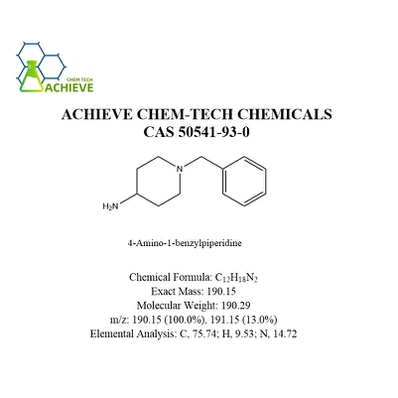
|
C.F |
C12H18N2 |
|
E.M |
190.15 |
|
M.W |
190.29 |
|
m/z |
190.15 (100.0%), 191.15 (13.0%) |
|
E.A |
C, 75.74; H, 9.53; N, 14.72 |

4-amino-1-benzylpiperidine, as an important organic compound, has a wide range of applications and specific examples in the field of materials science. It is an organic compound with a specific structure and properties, containing a pyridine ring and a benzyl group in its molecule, making it uniquely valuable in fields such as materials science and medicinal chemistry.
Application in the field of materials science

1. Synthesis of highly selective protein kinase inhibitors
It has important applications in the synthesis of highly selective protein kinase inhibitors. Protein kinases are a key class of signal transduction enzymes involved in regulating various biological processes such as cell growth, differentiation, and apoptosis. Highly selective protein kinase inhibitors can specifically inhibit the activity of certain protein kinases, thus playing an important role in the treatment of tumors, inflammatory diseases, and other conditions. As an important raw material for synthesizing such inhibitors, it can bind with other compounds to form inhibitor molecules with specific structures and activities, achieving efficient inhibition of target protein kinases.
3. Synthesis of 99mTc labeled pyridine analogs labeled with σ receptors
It can also be used to synthesize 99mTc labeled pyridine analogs for sigma receptor labeling. Sigma receptors are an important class of neurotransmitter receptors involved in regulating various physiological and pathological processes such as pain, anxiety, and depression. 99mTc is a commonly used radioactive isotope with a suitable half-life and radiation energy, suitable for medical diagnosis and treatment. By introducing organic compounds such as them, 99mTc labeled pyridine analogs with specific structures and activities can be synthesized, achieving specific recognition and imaging of the sigma receptor, providing strong support for the diagnosis and treatment of related diseases.

Specific application examples

1. Application in the synthesis of anti-tumor drugs
It has important applications in the synthesis of anti-tumor drugs. Research has shown that certain protein kinase inhibitors with specific structures can inhibit the growth and proliferation of tumor cells, thereby exerting anti-tumor effects. As one of the important raw materials for synthesizing such inhibitors, it can bind with other compounds to form molecules with anti-tumor activity. For example, by introducing specific substituents and functional groups, protein kinase inhibitors with high inhibitory effects on specific tumor cells can be synthesized, providing new drug candidates for tumor treatment.
2. Applications in the field of fiber optic communication
The synthesized light stable near-infrared blue dye has a wide range of applications in the field of optical fiber communication. This type of dye has excellent photostability and chemical stability, and can maintain its color and properties under extreme conditions. Therefore, they are widely used in optical amplifiers, optical attenuators, optical switches and other devices in fiber optic communication systems. By introducing organic compounds such as them, dye molecules with specific spectral and chemical properties can be synthesized to meet the requirements of different devices for dye performance.


3. Applications in Biomarkers and Imaging
It can also be used for synthesizing compounds for biomarkers and imaging. By introducing specific functional groups and substituents, compound molecules with recognition ability for specific biomolecules can be synthesized. These molecules can bind with biomolecules to form complexes and be imaged and detected through fluorescence, radioactivity, and other methods. For example, 99mTc labeled pyridine analogs synthesized by introducing organic compounds such as [insert compound name] can be used for imaging and detection of sigma receptors, providing strong support for the diagnosis and treatment of related diseases.
5. Application in the preparation of functional thin films
It can also be used to prepare functional films. By introducing specific functional groups and substituents, thin film material molecules with specific properties can be synthesized. These materials have wide application value in fields such as sensors, electronic devices, and optical devices. For example, functional thin films synthesized by introducing organic compounds can have excellent conductivity, transparency, mechanical strength, and other properties, meeting the requirements of different devices for thin film performance.

4-amino-1-benzylpiperidine, as an important organic compound, has a wide range of applications in the field of chemical synthesis.
It has important applications in the synthesis of highly selective protein kinase inhibitors. Protein kinases are a key class of signal transduction enzymes involved in regulating various biological processes such as cell growth, differentiation, and apoptosis. Highly selective protein kinase inhibitors can specifically inhibit the activity of certain protein kinases, thus playing an important role in the treatment of tumors, inflammatory diseases, and other conditions.
Specific application examples include:
By introducing specific substituents and functional groups, protein kinase inhibitor molecules with specific structures and activities can be formed by binding with other compounds. These inhibitor molecules can selectively inhibit the activity of target protein kinases, thereby achieving the treatment of related diseases.
For example, certain product derivatives have been shown to have significant inhibitory effects on p38 α - activated protein kinases, providing important candidates for the development of novel anti-inflammatory drugs.
It can also be used to synthesize compounds with malaria killing activity. Malaria is an infectious disease caused by malaria parasites, posing a serious threat to global public health. The development of new and efficient antimalarial drugs is of great significance for controlling the spread and treatment of malaria.
Specific application examples include:
By introducing specific functional groups and substituents, it can bind with other compounds to form compound molecules with malaria killing activity. These compound molecules can inhibit the growth and reproduction of malaria parasites, thereby achieving the treatment of malaria.
For example, certain derivatives have been shown to have significant inhibitory effects on malaria parasites, providing important candidates for the development of novel antimalarial drugs.
It can also be used to synthesize compounds with dual activity acetylcholinesterase. Cholines are an important class of hydrolytic enzymes involved in the metabolism of neurotransmitters. Cholines with dual activity can simultaneously inhibit the activity of acetylcholinesterase and butyrylcholinesterase, thus playing an important role in the treatment of neurodegenerative diseases.
Specific application examples include:
By introducing specific functional groups and substituents, it can bind with other compounds to form compound molecules with dual activity acetylcholinesterase. These compound molecules can simultaneously inhibit the activity of acetylcholinesterase and butyrylcholinesterase, thereby achieving the treatment of neurodegenerative diseases.
For example, certain derivatives have been shown to have significant dual activity acetylcholinesterase inhibitory effects, providing important candidates for the development of novel therapeutic drugs for neurodegenerative diseases.
It can also be used for synthesizing A β - aggregate inhibitors. A β - aggregates are one of the important biomarkers in the pathological process of Alzheimer's disease, and their formation and accumulation are closely related to neuronal damage and memory impairment. The development of novel and efficient A β - aggregate inhibitors is of great significance for the treatment of Alzheimer's disease.
Specific application examples include:
By introducing specific functional groups and substituents, it can bind with other compounds to form compound molecules with A β - aggregate inhibitory effects. These compound molecules can inhibit the formation and accumulation of A β - aggregates, thereby achieving the treatment of Alzheimer's disease.
For example, certain derivatives have been shown to have significant A β - aggregate inhibitory effects, providing important candidates for the development of novel Alzheimer's disease therapeutic drugs.
In addition to the above-mentioned uses, 4-Amino-1-benzylpiperidine can also be used as a raw material for synthesizing other bioactive compounds. These bioactive compounds have broad application prospects in fields such as medicine and pesticides.
Specific application examples include:
By introducing specific functional groups and substituents, it can bind with other compounds to form compound molecules with specific biological activities. These compound molecules can be used in the pharmaceutical field to treat tumors, inflammatory diseases, neurodegenerative diseases, etc; In the field of pesticides, it can be used for pest control, weeding, etc.
For example, certain derivatives have been proven to have significant anti-tumor activity, anti-inflammatory activity, or insecticidal activity, providing important candidates for the development of new pharmaceutical and pesticide products.
Hot Tags: 4-amino-1-benzylpiperidine cas 50541-93-0, suppliers, manufacturers, factory, wholesale, buy, price, bulk, for sale, 3 bromobenzo b naphtho 2 3 d thiophene, 6 6 bromopyridin 2 yl phenanthridine, 3 Nitrobenzaldehyde 99 , 4-bromo-1-chlorophenanthrene, CAS 62162 97 4, 4 4 2 4 4 6 diphenyl 1 3 5 triazin 2 yl phenyl naphthalen 1 yl phenyl 2 phenylbenzo 4 5 thieno 3 2 d pyrimidine