




5-Benzyloxyindole is an organic compound with CAS 1215-59-4 and molecular formula C18H15NO. It is a white to light yellow solid, usually in a crystalline form. Has a certain aromatic odor, but no obvious taste. This odor mainly comes from the benzene ring in its molecular structure. Its molecular structure contains benzene rings and nitrogen heterocycles, thus exhibiting distinct organic compound characteristics in appearance. It has good solubility and can be dissolved in most organic solvents, such as alcohols, ethers, ketones, etc. However, its solubility in water is relatively low. It does not have significant conductivity and can therefore be considered a non-conductive material. This is related to the lack of freely movable electrons in its molecular structure. Stable at room temperature and pressure, but may undergo decomposition or oxidation reactions under certain conditions. For example, in the presence of strong acids or bases, their molecular structure may undergo fragmentation or transformation. It has broad application value in fields such as medicine, biotechnology, and organic synthesis.

|
|
|

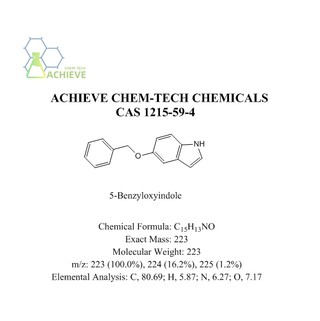
|
C.F |
C15H13NO |
|
E.M |
223 |
|
M.W |
223 |
|
m/z |
223 (100.0%), 224 (16.2%), 225 (1.2%) |
|
E.A |
C, 80.69; H, 5.87; N, 6.27; O, 7.17 |

5-Benzyloxyindole (5-benzyloxyindole) is an indole compound with a unique chemical structure, which has shown extensive application value in chemical synthesis, pharmaceutical research and development, materials science and other fields. Its uses are elaborated from multiple dimensions as follows:
Chemical synthesis field

Regional and stereoselective catalytic reactions&Metal free catalytic reaction
5-benzyloxyindole can be used as a key reagent to participate in regioselective and stereoselective catalytic reactions. For example:
Morpholine catalyzed C-3 alkynylation reaction: Under mild conditions, 5-benzyloxyindole undergoes direct C-3 alkynylation reaction with α, β - unsaturated aldehydes under morpholine catalysis, producing alkynylation products with specific stereoisomers. This reaction is of great significance in the total synthesis of natural products and the construction of drug molecules.
Debenzylation reaction under silica palladium catalytic system: In the silica palladium catalytic system, 5-benzyloxyindole can serve as a selective debenzylation reagent for protecting groups, achieving exposure of hydroxyl groups at specific positions and providing a key step for the synthesis of complex molecules.
5-benzyloxyindole can also be used in metal free catalytic reactions, such as:
Friedel Crafts alkylation reaction: As a reagent, 5-benzyloxyindole can participate in Friedel Crafts alkylation reaction under metal free conditions to generate arylalkylation products. This reaction condition is mild and avoids the use of metal catalysts, which is in line with the development trend of green chemistry.


Synthesis of protein kinase C (PKC) inhibitors
5-benzyloxyindole is an important intermediate for the synthesis of protein kinase C (PKC) inhibitors. PKC is a type of serine/threonine protein kinase that participates in various physiological processes such as cell proliferation, differentiation, and apoptosis. By modifying the structure of 5-benzyloxyindole, PKC inhibitors with specific selectivity and activity can be designed for the treatment of diseases such as tumors and inflammation.
Synthesis of Indole/Quinoline Thiohydroxyamide Derivatives
5-benzyloxyindole can also be used to synthesize indole/quinoline thiolamide derivatives. These compounds have unique biological activities, such as antibacterial, antiviral, anti-tumor, etc., and are an important direction for drug development. 5-benzyloxyindole, as a key intermediate, can be used to construct a library of derivatives with specific structures through thiohydroxy acid amidation reaction, providing a material basis for drug screening.

Pharmaceutical research and development field
Synthesis of 5-hydroxytryptophan (5-HTP)
5-benzyloxyindole is a key intermediate for the synthesis of 5-hydroxytryptophan (5-HTP). 5-HTP is a precursor substance of serotonin (5-HT) in the human body, which has sedative, antidepressant, and sleep improving effects. Through chemical synthesis methods, 5-HTP can be efficiently prepared using 5-benzyloxyindole as the raw material, meeting the needs of the pharmaceutical and health product fields.
Research and development of anti-tumor drugs
5-benzyloxyindole and its derivatives have potential application value in the development of anti-tumor drugs. Research has shown that certain indole compounds can inhibit tumor cell proliferation, induce tumor cell apoptosis, inhibit tumor angiogenesis, and so on. By modifying the structure of 5-benzyloxyindole, drug molecules with higher anti-tumor activity and selectivity can be designed.

Research on the treatment of neurological diseases
5-benzyloxyindole also has potential applications in the treatment of neurological diseases. For example, serotonin (5-HT) is an important neurotransmitter involved in regulating various physiological functions such as mood, sleep, and appetite. 5-HTP, as a precursor of 5-HT, can improve neurological function by supplementing 5-HT levels. Therefore, 5-benzyloxyindole has significant value in the development of drugs for depression, anxiety, and sleep improvement.
Research on drug metabolism and pharmacokinetics
5-benzyloxyindole can also be used as a model compound for studying the metabolic pathways and pharmacokinetic properties of drugs. By tracking its absorption, distribution, metabolism, and excretion processes in the body, the mechanism of action and sources of toxicity of drugs can be revealed, providing scientific basis for drug optimization and clinical application.
Materials Science Field
Synthesis of functional polymer materials
5-benzyloxyindole can be used to synthesize polymer materials with specific functions. For example, by introducing it into the polymer main chain or side chain, polymer materials with photoresponsiveness, electrical responsiveness, or biocompatibility can be constructed. This type of material has broad application prospects in fields such as smart sensors, biomedical materials, optoelectronic devices, etc.
5-benzyloxyindole can also be used for the preparation of nanomaterials. For example, it can serve as a template or stabilizer to guide the growth and assembly of nanoparticles, forming nanostructures with specific morphology and size. This type of nanomaterial has potential application value in fields such as catalysis, sensing, biological imaging, and drug delivery.
Preparation of nanomaterials&Surface modification materials
5-benzyloxyindole can also be used for the preparation of surface modification materials. By fixing it on the surface of the material, the surface properties and functions of the material can be changed. For example, modifying 5-benzyloxyindole on metal or polymer surfaces can improve the material's biocompatibility, corrosion resistance, and wear resistance. This type of surface modification material has important application value in fields such as medical devices, biosensors, and tissue engineering.


Agricultural field&Spices and essence
In the field of agriculture, 5-benzyloxyindole and its derivatives may have plant growth regulatory effects. Research has shown that certain indole compounds can promote plant growth and development, improve plant stress resistance and yield. By modifying and optimizing its structure, plant growth regulators with higher activity and selectivity can be designed, providing new technological means for agricultural production.
Analyze chemical standards
5-Benzyloxyindole has unique aroma characteristics and can be used in the synthesis of spices and essence. By adjusting its structure or mixing with other flavor molecules, essence products with specific fragrance and durability can be prepared, which are widely used in cosmetics, food, daily necessities and other fields.
5-benzyloxyindole can also be used as an analytical chemical standard for calibration and quality control of instruments such as chromatography and mass spectrometry. Its high purity and stability make it an important reagent in the field of analytical chemistry.

Adverse reactions
Skin and eye irritation reactions
Skin irritation and corrosiveness
According to the GHS classification on the Material Safety Data Sheet (MSDS), 5-benzyloxyindole is classified as Grade 2 skin corrosion/irritation, indicating that it may cause skin erythema, edema, or pain. Experimental data shows that the compound may trigger local inflammatory reactions by disrupting the barrier function of the stratum corneum when in contact with the skin. For example, in animal experiments, high concentration exposure can lead to epidermal cell necrosis and infiltration of inflammatory cells in the dermis. In addition, its slight solubility in organic solvents such as acetonitrile may exacerbate skin permeability and enhance irritation.
Eye irritation and injury
This compound is classified as Class 2A severe eye injury/irritation, indicating that it may cause damage to the conjunctiva and cornea. Animal experiments have shown that drops of 5-benzyloxyindole solution into rabbit eyes can cause conjunctival congestion, edema, and even corneal epithelial detachment. The mechanism may be related to the indole ring structure in the compound, which may cause symptoms by disrupting tear film stability or directly stimulating ocular nerve endings.
Emergency measures and protective recommendations
Skin contact: Immediately remove contaminated clothing and rinse with plenty of soapy water for at least 15 minutes. If symptoms of irritation occur, seek medical attention and bring an MSDS for the doctor's reference.
Eye contact: Rinse with flowing water or saline solution for at least 10 minutes, avoiding rubbing the eyes. If symptoms persist, seek medical attention immediately.
Protective equipment: Wear protective gloves (such as nitrile rubber gloves), goggles, and lab coats during operation to avoid direct contact.
Systemic toxic reactions
Acute toxicity data
At present, there is no complete acute toxicity study on 5-benzyloxyindole, but based on its chemical structure, it is speculated that toxicity may occur through the following pathways:
Metabolic activation:
Indole ring may be metabolized by cytochrome P450 enzymes to generate active intermediates, which covalently bind to DNA or proteins, leading to cell damage.
Oxidative stress:
Compounds may interfere with mitochondrial function, increase reactive oxygen species (ROS) production, trigger lipid peroxidation and DNA damage.
Neurotoxicity:
Long term exposure may affect the synthesis or release of neurotransmitters, leading to cognitive impairment such as decreased attention and memory.
Chronic exposure risk
Long term exposure to low-dose 5-benzyloxyindole may cause the following health problems:
Liver and kidney function impairment
Animal experiments have shown that indole compounds with similar structures can induce liver cytochrome P450 enzyme activity and increase liver metabolic burden; At the same time, it may lead to an increase in blood creatinine through renal tubular toxicity.
Immune system suppression
Compounds may interfere with lymphocyte proliferation or antibody production, reducing the body's resistance to pathogens.
Carcinogenicity
Although there is currently no direct evidence, the aromaticity of the indole ring makes it potentially genotoxic and requires further research.
Hot Tags: 5-benzyloxyindole cas 1215-59-4, suppliers, manufacturers, factory, wholesale, buy, price, bulk, for sale, Trimethylsilyl trifluoromethanesulfonate, Alanine CAS 107 95 9, Chlorodiphenylphosphine, Thioacetic acid powder, Copper II Acetate CAS 142 71 2, 3 5 Dichlorophenylboronic acid