




Shaanxi BLOOM Tech Co., Ltd. is one of the most experienced manufacturers and suppliers of cerium sulfate powder cas 13550-47-5 in China. Welcome to wholesale bulk high quality cerium sulfate powder cas 13550-47-5 for sale here from our factory. Good service and reasonable price are available.
Cerium sulfate powder also known as CeSO4, is an inorganic compound with the chemical formula CeSO4. It is a white powder with high purity. Its crystalline form is monoclinic, but it often becomes opaque due to moisture absorption. It can dissolve in water and form a colorless solution. Its solubility in water is not high, but it increases with increasing temperature. In addition, it can also be slightly soluble in ethanol and ether. It has optical activity, that is, it can rotate polarized light. This means that CeSO4 can be used to manufacture specific types of crystals and optical devices. Low thermal conductivity and poor thermal conductivity. Its specific heat capacity increases with the increase of temperature, due to the increased atomic vibration in its lattice structure. It is a strong acid salt with high chemical reactivity. It can react with alkali under certain conditions to generate corresponding hydroxides.

|
Chemical Formula |
Ce2O12S3 |
|
Exact Mass |
568.67 |
|
Molecular Weight |
568.40 |
|
m/z |
567.67 (100.0%), 569.67 (25.1%), 569.66 (9.0%), 569.66 (4.5%), 571.67 (3.4%), 569.67 (2.5%), 568.67 (1.6%), 571.67 (1.6%) |
|
Elemental Analysis |
Ce, 49.30; O, 33.78; S, 16.92 |
Please refer to our enterprise standard or COA, if you need to negotiate, welcome to contact our sales.
Addition information of chemical compound: Density 2.89 g/mL at 25 °C(lit.), Form solid.
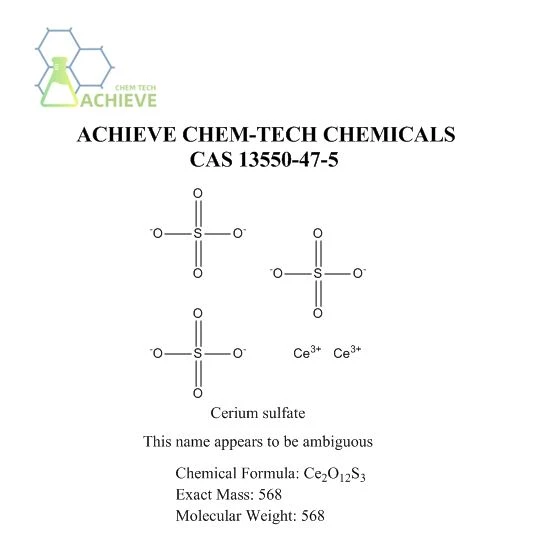
In addition, it can also form complexes with certain metal ions. The physical properties of CeSO4 make it widely used in various fields, including chemical analysis, environmental monitoring, biomedical research, industrial process control, material synthesis, and agriculture. However, the magnitude of its application value mainly depends on its chemical reaction activity and physical property changes under different conditions.

Cerium sulfate powder is a high value-added light rare earth functional compound, usually represented by the molecular formula Ce (SO ₄) ₂ · xH ₂ O. The common stable form is cerium sulfate tetrahydrate, which appears as a bright yellow crystalline powder. It combines the strong oxidation characteristics of tetravalent cerium, the unique coordination ability of rare earth elements, and the environmentally friendly properties of sulfates. It is one of the most widely used products in the field of rare earth fine chemicals.

Core applications of green oxidants in the field of fine organic synthesis
In the selective oxidation reaction scenario of fine chemicals, it is widely recognized as a highly selective green oxidant, completely avoiding the industry pain points of heavy metal pollution and excessive oxidation of products caused by traditional dichromate and permanganate oxidants. In the oxidation reaction of aromatic compounds, toluene derivatives can be accurately oxidized into corresponding benzaldehyde products in a mild aqueous organic two-phase system, with a conversion rate of over 95% and a selectivity of aldehyde products exceeding 92%, almost without generating excessive oxidation of benzoic acid by-products.
The production data of a pharmaceutical intermediate enterprise shows that using it to replace traditional chromium salt oxidants in the production of p-chlorobenzaldehyde has increased the purity of the product from 98.5% to 99.8%, and reduced the amount of heavy metal hazardous waste generated during the production process by 98%, fully complying with the latest domestic chemical environmental protection emission standards. In the synthesis of steroid drugs, it is the preferred reagent for selective oxidation of allyl hydroxyl groups in steroid molecules.


It can accurately identify specific reaction sites on steroid molecules, efficiently oxidize the methylene group at the allyl position to a ketone group without damaging other sensory groups in the molecule, and the stereoselectivity of the reaction product exceeds 98%, greatly reducing the difficulty of separating and purifying subsequent chiral drugs. In the intermediate synthesis process of vitamin E, oxidation reaction is used to increase the yield of key intermediates by more than 15%, while avoiding the impact of chromium ion residue on the final drug quality in traditional processes. The product has successfully passed the pharmaceutical impurity standard certification in the European and American markets. In the synthesis scenario of dyes and optoelectronic functional materials.
The selective oxidative coupling reaction of aromatic amine compounds can efficiently synthesize high-performance azo dyes and organic optoelectronic materials as core intermediates. The reaction process does not introduce heavy metal impurities, and the impurity content of the produced optoelectronic materials is below ppm, fully meeting the high purity requirements of organic light-emitting diode (OLED) materials. The trivalent cerium sulfate powder generated after the reaction can also be regenerated into tetravalent cerium sulfate through a simple electrochemical oxidation process, achieving the recycling of oxidants. The overall atomic utilization rate of the process exceeds 90%, significantly reducing the comprehensive cost of fine chemical production.


Deep purification applications in the field of environmental governance and water treatment
Cerium sulfate hydrate is an efficient catalytic component in advanced oxidation processes for the treatment of industrial recalcitrant organic wastewater. The preparation of heterogeneous Fenton catalyst by loading cerium sulfate hydrate on porous diatomaceous earth carrier can significantly improve the pH range of traditional Fenton system. It can efficiently catalyze hydrogen peroxide to generate hydroxyl radicals in a wide range of pH 3-9, and rapidly degrade benzene ring and heterocyclic refractory organic compounds in printing and dyeing wastewater and pharmaceutical wastewater.
Actual engineering operation data shows that the advanced oxidation process with cerium sulfate based catalyst can achieve a COD removal rate of over 88% for printing and dyeing wastewater, which is 40% higher than the traditional iron-based Fenton process. At the same time, it does not generate a large amount of iron sludge hazardous waste, significantly reducing the cost of subsequent sludge disposal. In the advanced treatment of arsenic containing wastewater, cerium ions have become an efficient arsenic removal agent due to their special coordination adsorption ability for arsenic elements.


Tetravalent cerium ions can form stable chelating precipitates with trivalent arsenic and pentavalent arsenic in wastewater, while deeply removing residual trace arsenic elements through surface adsorption. After treatment, the arsenic content in wastewater can be reduced to below 0.01mg/L, far below the national emission limit of 0.05mg/L. Compared to traditional iron salt arsenic removal processes, the arsenic removal efficiency is increased by more than three times, and the resulting arsenic containing precipitate has a stable structure. The leaching toxicity of arsenic is much lower than the hazardous waste standard, avoiding the risk of secondary pollution.
In the deep purification scenario of drinking water, ceramic filters loaded with cerium sulfate hydrate can efficiently remove harmful impurities such as fluoride ions and lead ions in water. Cerium ions form stable cerium fluoride precipitates with fluoride ions, and the adsorption capacity of fluoride in water is more than 6 times that of ordinary activated alumina. This technology can reduce the fluoride content in drinking water in high fluoride areas to the national health standard range. Currently, this technology has been widely applied in rural drinking water safety projects in many high fluoride areas in northern China.


The use of reference reagents in the field of analytical testing and standard substances
In the oxidation-reduction titration scenario of capacity analysis, cerium sulfate is a classic reference grade cerium volumetric reagent and an internationally recognized high-precision oxidation-reduction titration reference substance. The standard solution of cerium sulfate hydrate has an extremely stable oxidation-reduction potential and will not experience concentration drift after long-term storage. When titrating reducing substances such as ferrous, stannous, and iodide ions, the reaction process is smooth, the titration endpoint changes color sensitively, and the relative deviation of the measurement results can be controlled within 0.01%, far superior to the accuracy of potassium permanganate titration method.
In the detection of total iron content in iron ore in the metallurgical industry, a standard titration solution prepared with cerium sulfate powder is used to accurately determine the total iron content without the need for additional complex masking agents. The reproducibility of the detection results is much higher than that of the traditional potassium dichromate method, while completely avoiding the health hazards of experimental personnel and laboratory waste liquid pollution caused by chromium salt reagents. In the preparation scenario of standard substances for environmental monitoring, high-purity cerium sulfate hydrate is the preferred raw material for preparing cerium element standard solutions.


After drying at 105 ℃, cerium sulfate hydrate has a stable stoichiometric ratio and can be accurately prepared as a cerium element standard solution without the need for additional calibration. It is widely used for calibration of large analytical instruments such as inductively coupled plasma mass spectrometry (ICP-MS) and atomic absorption spectroscopy, and is an indispensable rare earth element standard substance in environmental monitoring and geological mineral detection laboratories. In the composition analysis of positive electrode materials for lithium batteries, cerium sulfate reference reagent can be used to accurately titrate the content of variable valence metal ions in positive electrode materials.
Helping enterprises to accurately control the nickel cobalt manganese element ratio of ternary materials and ensure the consistency of electrochemical performance of lithium batteries. In the quality control scenario of composition analysis of special glass, the standard titrant prepared with cerium sulfate hydrate can be used to accurately determine the content of ferrous impurities in the glass, precisely control the redox state of the glass, and provide reliable detection support for the stable optical performance of radiation resistant special glass.


Cerium sulfate powder is an important inorganic compound that is widely used in multiple fields due to its unique physical and chemical properties.
1. Experimental preparation
Before starting the experiment, we need to prepare the following reagents and equipment: CeCl3 solution, Na2SO4 solution, NH3 · H2O solution, distilled water, weighing paper, stirrer, heat source, beaker, filter paper.

2. Experimental steps
Weigh an appropriate amount of CeCl3 solution and pour it into a clean beaker. Next, add an appropriate amount of distilled water and stir thoroughly with a stirrer to completely dissolve CeCl3.
In another beaker, weigh an appropriate amount of Na2SO4 solution, add an appropriate amount of distilled water, and stir thoroughly with a stirrer to completely dissolve Na2SO4.
Slowly pour the Na2SO4 solution into the CeCl3 solution, while stirring continuously with a stirrer to thoroughly mix the two solutions. During this process, we can observe a change in the color of the mixed solution, which is due to the reaction between Ce3+ions and SO42- ions to generate CeSO4.
Slowly add NH3 · H2O solution to the mixed solution and monitor the pH value of the solution using a pH test strip. We need to adjust the pH value of the solution to weakly alkaline in order to promote the generation of CeSO4. When the pH value reaches the preset value, stop adding NH3 · H2O solution.
Heat the mixed solution to boiling and maintain for a certain period of time. This process is to allow the reaction to proceed fully and generate more CeSO4. During the heating process, we can observe further color changes in the solution due to the generation of more CeSO4.
After heating, cool the mixed solution to room temperature. During this process, we can observe the precipitation of solid substances from the solution, which is the generated CeSO4. More and more solid substances precipitate during the cooling process, and finally we can see a layer of white solid substance at the bottom of the beaker.
Filter the mixed solution with filter paper and collect the precipitated solid matter. This is the product we need - CeSO4. During the filtration process, we can wash the solid material several times with distilled water to remove any possible residual impurities. After washing, dry the solid substance on a weighing paper.
3. Chemical equation
The chemical equation of this synthesis method is:
CeCl3 + Na2SO4 + NH3 · H2O → CeSO4 + 2NaCl + NH4Cl + H2O
This equation represents the process of CeCl3 and Na2SO4 reacting to form CeSO4 and other byproducts under the action of NH3 · H2O. During the reaction process, Ce3+ions in CeCl3 react with SO42- ions in Na2SO4 to form CeSO4 precipitate.
Meanwhile, OH - ions in NH3 · H2O react with Cl - ions in CeCl3 to generate NH4Cl and NaCl.
Finally, solid CeSO4 is obtained through filtration. It should be noted that this reaction is carried out under weakly alkaline conditions, therefore pH value needs to be controlled. If the pH value is too high or too low, it may lead to poor synthesis efficiency of CeSO4.
In addition, in order to obtain high-purity Cerium sulfate powder, multiple washing and filtration operations are required. At the same time, the by-products generated during the reaction process also need to be properly handled to avoid pollution to the environment.
FAQ
How to dissolve cerium sulphate?
dissolve cerium sulphate tetrahydrate in water one has to add H2SO4 in it. Otherwise take cerium sulphate & dissolve in minimum quantity of H2SO4(2M) , then dilute with water.
Is cerium sulfate toxic?
CONSIDERED A HAZARDOUS SUBSTANCE ACCORDING TO OSHA 29 CFR 1910.1200. Contact with combustible material may cause fire. Irritating to eyes, respiratory system and skin. Accidental ingestion of the material may be damaging to the health of the individual.
What is cerium sulfate?
Cerium(IV) sulfate, also called ceric sulfate, is an inorganic compound. It exists as the anhydrous salt Ce(SO 4) 2 as well as a few hydrated forms: Ce(SO 4) 2(H 2O) x, with x equal to 4, 8, or 12. These salts are yellow to yellow/orange solids that are moderately soluble in water and dilute acids.
What is cerium sulfate used for?
Cerium(IV) sulfate can be used to catalyze: Selective oxidation of secondary alcohols to the corresponding ketones using sodium bromate as the oxidant. Direct sulfonation of methane with sulfur trioxide to methanesulfonic acid in sulfuric acid.
Hot Tags: cerium sulfate powder cas 13550-47-5, suppliers, manufacturers, factory, wholesale, buy, price, bulk, for sale, Cupferron, 3 Aminopyrazine 2 carboxylic acid, Caproaldehyde CAS 66 25 1, Chlorodiphenylphosphine, Cobalt II phthalocyanine, sulfosalicylic acid powder