




Shaanxi BLOOM Tech Co., Ltd. is one of the most experienced manufacturers and suppliers of diethylaminosulfur trifluoride cas 38078-09-0 in China. Welcome to wholesale bulk high quality diethylaminosulfur trifluoride cas 38078-09-0 for sale here from our factory. Good service and reasonable price are available.
Diethylaminosulfur trifluoride, commonly abbreviated as DAST, CAS 38078-09-0, molecular formula C4H10F3NS, is a brownish yellow liquid. Soluble in most non-polar organic solvents, typically used for CH2Cl2, CHCl3, and CCl4. It is a widely used fluorinating reagent in organic synthsis. It belongs to the (dialkylamino) sulfur trifluoride family. DAST is a nucleophilic fluorinating reagent that can convert hydroxyl compounds into monofluorinated compounds and aldehydes and ketones into difluorinated compounds, but is ineffective against carbonyl groups of carboxylic acids and their derivatives.

|
Chemical Formula |
C4H10F3NS |
|
Exact Mass |
161 |
|
Molecular Weight |
161 |
|
m/z |
161 (100.0%), 163 (4.5%), 162 (4.3%) |
|
Elemental Analysis |
C, 29.81; H, 6.25; F, 35.36; N, 8.69; S, 19.89 |
|
|
|


N- (trimethylsilyl) diethylamine was slowly dropped into the excessively cooled liquid SF4. After the reaction, the remaining SF4 and the by-product TMSF were removed, and diethylamino sulfur trifluoride with high purity was obtained without vacuum distillation. The above existing technology is laboratory synthesis of DAST, which requires high purity and low output, while large-scale industrial production does not require high purity, but requires high output (production above kilogram level), so this method cannot be used for large-scale production of DAST.


Usage 1: Diethylaminosulfur trifluoride (DAST), as an efficient nucleophilic fluorination reagent, is easy to obtain, and because of its unique properties in activating hydroxyl, carbonyl and other aspects, it is widely used in organic chemical reactions.
Usage 2: Organic fluorides have broad applications in biomedicine.
Usage 3: diethylamino sulfur trifluoride (DAST) is used as fluorinating agent and fluorinating agent of anticancer drugs. For example, it reacts with alcohol to obtain corresponding fluoroalkanes; Reaction with acyl chloride to obtain corresponding acyl fluoride; It reacts with aldehyde or ketone to get twin difluoride; With sulfoxide α- Fluorosulfide is oxidized with perchlorobenzoic acid to obtain α- Fluorosulfoxide.
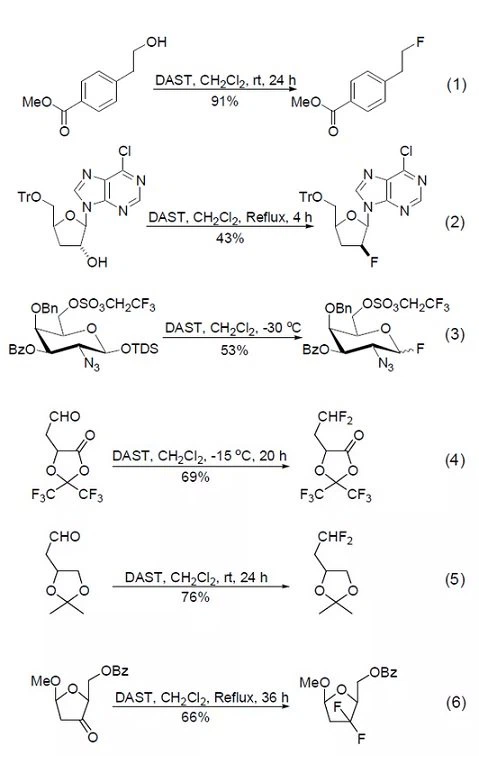
Chlorination reaction: DAST can convert primary alcohols into corresponding fluorides under very mild conditions. Usually, feed at – 78oc to inhibit the initial exothermic process, and then let the reaction automatically rise to room temperature for a moment (equation 1). Although the secondary alcohol reaction is also fed at – 78oc, in order to promote the reaction, it generally needs to be heated up or refluxed in CH2Cl2 for a long time (formula 2, formula 3). In most cases, the yield of fluorinated products is at a medium level, but the reaction has high chemical selectivity, which is suitable for selective fluorination of multi-functional molecules. Under almost the same conditions as the fluorination of alcohols, DAST can convert aldehydes and ketones into corresponding fluorides. In contrast, their reaction temperature is higher than that of alcohol; The reaction conditions of aldehydes are milder than ketones. For example, aldehydes can be treated with DAST at low temperature or room temperature to obtain corresponding fluorides (formula 4, formula 5). However, ketones need to be co heated with DAST for a long time to produce corresponding difluoride (formula 6).

Diethylamine sulfur trifluoride (DAST), with the chemical formula C4H10F3NS, is a commonly used fluorinating reagent that plays an important role in various fields such as organic synthsis, pharmaceutical research and development, and materials science.
1,
Fluorination reaction
Alcohol hydroxyl fluoride
DAST can convert alcohol hydroxyl groups into corresponding fluorinated compounds. In organic synthsis, alcohol compounds are more common. Through the fluorination effect of DAST, fluorine atoms can be introduced into the molecule, thereby changing its physical and chemical properties. For example, in drug synthsis, introducing fluorine atoms into alcohol intermediates may enhance drug activity, metabolic stability, or alter its pharmacokinetic properties. The reaction mechanism is that DAST first forms an intermediate state with the alcohol hydroxyl group and generates a molecule of hydrogen fluoride. Then, the fluoride anion nucleophilically attacks the hydroxyl carbon atom through SN1 or SN2, generating a monofluorinated compound. Fatty and aromatic primary, secondary, and tertiary alcohols can be efficiently converted into corresponding fluorine compounds. The reaction usually uses solvents such as dichloromethane and monofluorotrichloromethane, and the substitution of hydroxyl groups is usually carried out at lower temperatures (such as -78 ℃).
Fluorination of aldehydes and ketones
Diethylaminosulfur trifluoride can convert aldehydes and ketones into difluoro compounds. Aldehydes and ketones are important functional groups in organic synthsis, and converting them into difluoro compounds can synthesize organic molecules with special properties.


These difluoro compounds may have potential applications in fields such as materials science and drug development. For example, the introduction of difluoro functional groups can regulate the electronic structure and spatial configuration of molecules when synthesizing materials with specific optical or electrical properties. In the reaction, the substitution of carbonyl groups is generally carried out at 0 ℃ -40 ℃.
Fluorination of other functional groups
DAST can also react with acyl chlorides to obtain corresponding acyl fluorides, react with sulfoxides to obtain α - fluorothioethers, and then oxidize with chlorobenzoic acid to obtain α - fluorosulfoxides. These fluorinated products can serve as important intermediates in organic synthsis for constructing more complex organic molecules. For example, acyl fluoride can further participate in amidation reactions to synthesize various amide compounds; Alpha fluorothioethers and alpha fluorosulfoxides can be used to synthesize sulfur-containing fluorine-containing compounds with special biological activity.
Synthesis of drug intermediates
DAST can serve as an important intermediate in drug synthsis. In the process of drug development, it is necessary to synthesize various intermediates with specific structures and activities, and then construct target drug molecules through further reactions. DAST can provide an effective pathway for the synthsis of drug intermediates through its fluorination, substitution, and other reactions. For example, in the synthsis of certain anti-cancer and antiviral drugs, DAST can introduce fluorine atoms or construct specific functional groups to synthesize drug intermediates with potential biological activity. These intermediates can be further optimized for structure and screened for activity, ultimately leading to the development of drugs with good efficacy and safety.


Fluorinated anticancer drugs
DAST is used as a fluorinating agent for anticancer drugs. In the development of anticancer drugs, introducing fluorine atoms into drug molecules can alter the physicochemical properties, metabolic pathways, and biological activity of the drugs. The introduction of fluorine atoms may enhance the binding affinity between drugs and targets, improve drug stability and selectivity, and thus enhance the anti-cancer activity of drugs. For example, certain fluorine-containing anticancer drugs have shown better efficacy and lower toxicity in clinical trials. DAST can efficiently introduce fluorine atoms into anti-cancer drug molecules, providing a powerful tool for the development of anti-cancer drugs.
Synthesis of Optoelectronic Materials
The molecular structure of DAST has special optical and electrical properties, making it widely applicable in the field of optoelectronic materials. Organic optoelectronic materials with specific optical and electrical properties can be synthesized through organic synthsis reactions involving DAST. For example, organic molecules with fluorescence, electroluminescence, or nonlinear optical properties can be synthesized, which can be used to prepare optoelectronic devices such as organic light-emitting diodes (OLEDs), organic solar cells, and optical switches. In OLED devices, fluorinated organic molecules with specific structures can be used as luminescent materials or charge transport materials to improve the device's luminous efficiency, brightness, and stability.


Functional material modification
DAST can also be used to modify existing functional materials. By introducing fluorine atoms or fluorine-containing functional groups into the surface or molecular structure of functional materials, the surface properties, hydrophilicity, hydrophobicity, chemical stability, and other properties of the materials can be altered. For example, in the modification of polymer materials, the introduction of fluorine atoms can improve the chemical corrosion resistance, weather resistance, and low surface energy of the polymer, making the polymer material have better self-cleaning and anti adhesion properties. These modified functional materials have broad application prospects in fields such as aerospace, automotive manufacturing, and electronic packaging.
Pesticide synthesis
In pesticide synthsis, DAST can be used to synthesize fluorinated pesticides with special biological activity. The introduction of fluorine atoms can alter the structure of pesticide molecules, enhance their activity against pests, pathogens, etc., while potentially reducing their toxicity to non target organisms. For example, certain fluorine-containing insecticides and fungicides have shown better control effects and lower residue levels in agricultural production, which is of great significance for environmental protection and agricultural product quality and safety. DAST provides an effective chemical means for synthesizing these new fluorinated pesticides.


Academic research
DAST is an important reagent in academic research. Researchers can utilize the various reaction characteristics of DAST to conduct research on organic synthsis methodology and explore new reaction pathways and mechanisms. By studying the DAST reaction, we can gain a deeper understanding of the reactivity and selectivity of organic molecules, providing a theoretical basis for the development of organic chemistry. Meanwhile, Diethylaminosulfur trifluoride can also be used to synthesize organic molecules with special structures and properties, providing samples and model compounds for research in disciplines such as physical chemistry and biochemistry.

Diethylaminosulfur Trifluoride is an important nucleophilic fluorinating reagent. Its core function is to convert functional groups such as hydroxyl and carbonyl into fluorinated derivatives through selective fluorination reactions, and it is widely used in the fields of medicine, pesticides, and materials science. The following will be explained from four aspects: reaction type, operating conditions, application fields, and safety regulations.
Typical Reaction Types and Operating Conditions
Fluorination of Alcohols
DAST can convert primary and secondary alcohols into monofluorides, and the reaction conditions vary depending on the type of alcohol:
Primary alcohols: The reactants are added at -78°C to suppress the initial exothermic reaction, and then the temperature is raised to room temperature to complete the reaction. For example, converting n-butanol to 1-fluorobutane, the yield can reach 75%-85% when the reactants are added at low temperature.
Secondary alcohols: The reactants need to be added at -78°C, and then refluxed in dichloromethane or heated to 40-60°C to promote the reaction. For example, the fluorination of cyclohexanol requires refluxing for 6 hours, with a yield of approximately 60%-70%.
Key point: Temperature control can reduce the risk of racemization and is suitable for the synthesis of chiral molecules.
Dihydrofluorination of Aldehydes and Ketones
DAST converts aldehydes and ketones into dihalides, and the reaction temperature is related to the activity of the substrate:
Aldehyde: The reaction can be completed at low temperature (0°C to room temperature). For example, treating benzaldehyde with DAST yields benzodifluoromethyl ketone with a yield of 90%.
Ketone: It needs to be heated to 50-80°C or the reaction time needs to be extended. For example, the fluorination of cyclohexanone requires a reaction at 50°C for 12 hours, with a yield of approximately 70%.
Key point: Ketones have lower reactivity than aldehydes, and the temperature and reaction time need to be optimized.
Amination of Carboxylic Acid Derivatives
Recent research has developed a DAST-mediated synthesis strategy for amide formation without a base:
Conditions: In dichloromethane, the reactants of equal molar amount of carboxylic acid, amine, and DAST are reacted at room temperature.
Advantages: Applicable to fluorination of aliphatic/aryl carboxylic acids and primary, secondary, and electron-deficient amines, successfully applied to the late modification of commercial drugs such as leflunomide and ilicizine.
Case: Acylamides are formed from fatty acids and aniline under DAST catalysis, with a yield of 85%-90%, and no intermediate separation is required.
Application Areas and Examples

Pharmaceutical Intermediate Synthesis
DAST is a key synthetic tool for fluorinated drugs:
Antidepressants: The side chain fluorination of fluoxetine (Prozac) relies on DAST, introducing fluorine atoms through the fluorination of alcohols to improve the lipid solubility and blood-brain barrier penetration of the drug.
Antiviral Drugs: DAST is used for dihydrofluorination of ketones in the synthesis of lopinavir, enhancing the stability of the molecule.
Modification of Active Components of Pesticides
The introduction of fluorine atoms can significantly enhance the biological activity of pesticides:
Herbicides: Replacing the hydroxyl group of phenoxyacetic acid herbicides with fluorine can reduce the degradation rate in the soil and prolong the efficacy.
Insecticides: DAST-mediated fluorination of aldehydes and ketones can generate fluorinated pyrethroids, increasing the toxicity to the insect nervous system by 30%-50%.


Functionalization in Materials Science
DAST is used to prepare fluorinated functional materials:
Liquid Crystal Materials: By fluorinating cyclohexane derivatives, the phase transition temperature and dielectric anisotropy of liquid crystals can be regulated.
Surfactants: The introduction of fluorinated alkyl chains can reduce surface tension and improve wetting properties.
Safety Operating Procedures and Storage Requirements
Reaction Safety Control
Ventilation Requirements: All operations should be conducted in a fume hood to avoid inhaling DAST vapor (boiling point 30-32°C).
Temperature Control: Fluorination of alcohols requires using a low-temperature bath (-78°C) to prevent the reaction from getting out of control.
Solvent Selection: Preferentially use non-polar solvents such as dichloromethane and chloroform, avoiding mixing with water or alcohols.
Personal Protective Equipment
Protective Clothing: Wear chemical-resistant laboratory coats, gloves (nitrile rubber or polyvinyl alcohol), and goggles.
Respiratory Protection: Wear an organic vapor filter canister when ventilation is insufficient.
Storage and Waste Disposal
Storage Conditions: Store sealed in an environment of 2-8°C, filled with argon to prevent oxidation, and kept away from heat sources and fire sources.
Waste Disposal: DAST waste liquid needs to be neutralized with an alkaline solution and entrusted to a professional institution for handling, and must not be directly discharged.
Future Development Directions
Green Chemical Process
Develop low-toxicity and recyclable fluorination systems, such as the DAST catalytic reaction in ionic liquids, to reduce solvent usage and waste generation.
New reaction development
Explore the reactions of DAST under photocatalytic or electrochemical conditions to expand its application scope to complex molecule synthesis.
Industrial scale-up technology
Optimize the design of continuous flow reactors to enhance the efficiency and safety of DAST reactions in large-scale production.
Hot Tags: diethylaminosulfur trifluoride cas 38078-09-0, suppliers, manufacturers, factory, wholesale, buy, price, bulk, for sale, copper chromite, DIPHENYLAMINE 4 SULFONIC ACID BARIUM SALT CAS 6211 24 1, 6 Aminocaproic Acid CAS 60 32 2, Thiazolyl Blue CAS 298 93 1, Butylmagnesium Chloride CAS 693 04 9, 1 3 5 Tribromobenzene