



Shaanxi BLOOM Tech Co., Ltd. is one of the most experienced manufacturers and suppliers of n-heptafluorobutyrylimidazole cas 32477-35-3 in China. Welcome to wholesale bulk high quality n-heptafluorobutyrylimidazole cas 32477-35-3 for sale here from our factory. Good service and reasonable price are available.
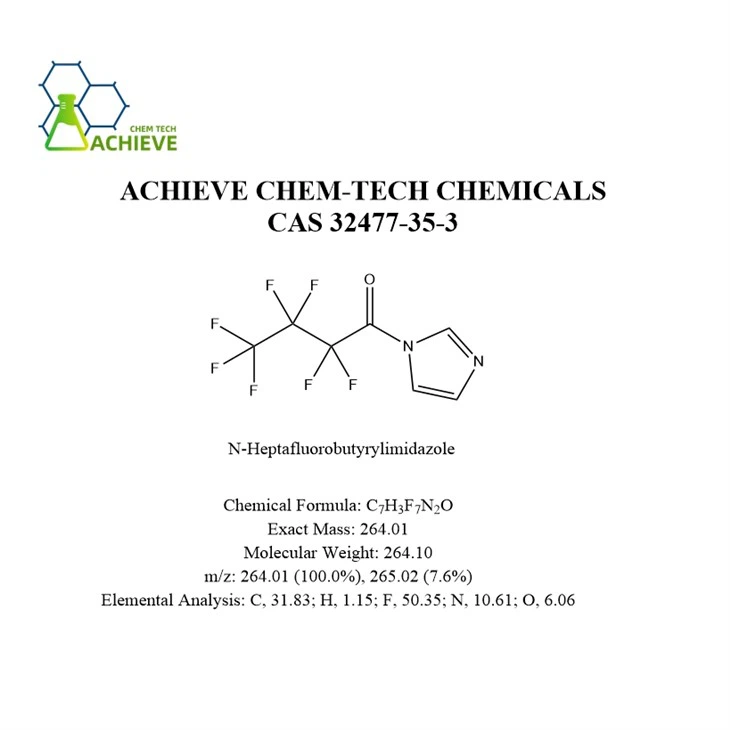
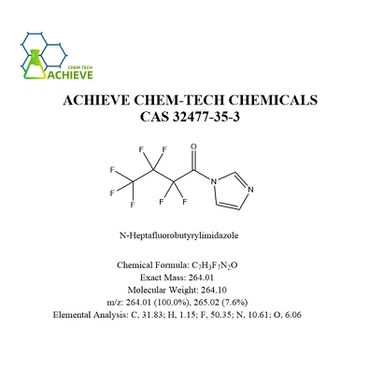
N-Heptafluorobutyrylimidazole (HFBI) is a highly active acylation reagent with the chemical formula C₇H₂F₇NO and a molecular weight of 249.09 g/mol. Its structure is formed by connecting the perfluorobutyryl group (C₃F₇CO-) to the nitrogen atom of the imidazole ring, which has a strong electron-withdrawing effect and significantly enhances the electrophilicity of the acyl group.
HFBI is commonly used in efficient acylation reactions, such as converting alcohols, amines and thioalcohols into corresponding perfluorobutyl derivatives. It is widely applied in derivatization (to enhance volatility and detection sensitivity) in mass spectrometry analysis. This reagent is sensitive to water and should be stored and used in an anhydrous environment. It is prone to decomposition upon contact with water. Its high reactivity and perfluoroalkyl characteristics make it of significant value in organic synthesis and analytical chemistry. However, protective equipment must be worn during operation to avoid skin contact or inhalation.

|
|
|
|
Chemical Formula |
C7H3F7N2O |
|
Exact Mass |
264.01 |
|
Molecular Weight |
264.10 |
|
m/z |
264.01 (100.0%), 265.02 (7.6%) |
|
Elemental Analysis |
C, 31.83; H, 1.15; F, 50.35; N, 10.61; O, 6.06 |

N-Heptafluorobutyrylimidazole, as an organic compound with a specific chemical structure, has a wide and diverse range of applications, involving multiple fields such as chemical analysis, materials science, pharmaceutical synthesis, and environmental protection.
1. In the field of chemical analysis
It is mainly used as a derivatization reagent in chemical analysis. Derivatives refer to the process of converting a test substance into a more easily detectable, separable, or selective compound through chemical reactions. Its specific chemical structure enables it to react with various functional groups, generating derivatives with higher sensitivity and selectivity.


In the detection of soy sauce chloropropanol, as a derivatization reagent, it can undergo esterification reaction with chloropropanol to generate easily detectable and separable derivatives, thereby improving the accuracy and sensitivity of detection. In addition, it can also be used for the derivatization of other organic compounds, such as alcohols, phenols, amines, etc., providing strong support for the quantitative analysis of these compounds.
In addition to serving as a derivatization reagent, it can also act as a catalyst and reaction medium, participating in certain chemical reactions. Its unique chemical structure enables it to exhibit excellent catalytic activity and selectivity in certain chemical reactions. By adjusting the reaction conditions, the catalytic effect can be optimized, and the reaction rate and yield can be improved.

2. Materials Science Field

Synthesis and modification of polymer materials
Can be used as a synthetic monomer or modifier for polymer materials. Polymer materials with specific properties can be prepared by copolymerization or graft polymerization with other monomers. For example, introducing the substance into the polymer chain can improve the thermal stability, oxidation resistance, and corrosion resistance of the polymer. In addition, it can also be used to prepare functional polymer materials such as ion exchange membranes, conductive polymers, etc.
Surface modifier
It can also be used as a surface modifier to improve the surface properties of materials. Introducing HFBI onto the surface of materials through chemical bonding or physical adsorption can alter the wettability, adhesion, wear resistance, and corrosion resistance of the surface. This surface modification technology is widely used in surface treatment of materials such as metals, ceramics, glass, plastics, etc.

3. Pharmaceutical synthesis field

Synthesis of drug intermediates
It has important application value in pharmaceutical synthesis. It can be used as a synthetic raw material for pharmaceutical intermediates to prepare compounds with specific pharmacological activities through a series of chemical reactions. These compounds have broad application prospects in drug research and production, such as anti-tumor drugs, antibacterial drugs, antiviral drugs, etc.
Preparation of drug carriers
In addition, it can also be used to prepare drug carriers. By combining it with drug molecules to form stable complexes, the stability and bioavailability of drugs can be improved. This drug carrier technology can be applied to various routes of administration such as oral, injection, and topical use, providing new solutions for drug delivery and release.

4. Environmental protection field

Water treatment agent
It also has certain application value in the field of water treatment. It can be used as a water treatment agent to remove harmful substances such as heavy metal ions and organic pollutants from water. By undergoing chemical reactions or adsorption with these pollutants, they can be removed from water, thereby improving water quality and protecting water resources.
Soil remediation agents
In addition, it can also be used as a soil remediation agent for repairing contaminated soil. By undergoing chemical reactions or biodegradation with pollutants in the soil, pollutants can be transformed into harmless or low toxic substances, thereby restoring the ecological functions and productivity of the soil.

5. Other fields

Fuel additives
HFBI can also be used as a fuel additive to improve the combustion efficiency and calorific value of fuel. By adding it to fuel, the combustion performance of the fuel can be improved, pollutant emissions during combustion can be reduced, and energy utilization efficiency can be improved.
Electronic materials
In the field of electronic materials, it also has potential application value. It can serve as a synthetic raw material or modifier for electronic materials, used to prepare materials with specific electrical, optical, or magnetic properties. These materials have broad application prospects in fields such as electronic devices, optoelectronic devices, and magnetic storage devices.


Surfactants
It can also be used as a surfactant to improve the surface tension of liquid and foam performance. By reducing the surface tension of the liquid, the wettability and dispersibility of the liquid can be improved; By increasing the stability of foam, the durability and stability of foam can be improved. This surfactant is widely used in detergent, emulsifier, foam agent and other fields.
Synthetic Biology and Artificial Cells
Synthetic biology is an interdisciplinary field that combines biology, engineering, and informatics, aiming to design, construct, and optimize biological systems through engineering methods to achieve specific functions. Artificial cells, as an important branch of synthetic biology, provide a new platform for biological manufacturing, drug delivery, and environmental remediation by simulating the structure and function of natural cells.
Gene editing techniques in synthetic biology, such as CRISPR-Cas9, rely on efficient interactions between nucleases and guide RNA. N-Heptafluorobutyrylimidazole can enhance its stability and targeting by acylation modification of nucleases or guide RNA. For example, fluorinated nucleases may be more easily able to penetrate cell membranes and act on specific gene loci, thereby improving gene editing efficiency.


In addition, it can also be used as a key enzyme in synthetic metabolic engineering, regulating enzyme activity through acylation modification and optimizing metabolic pathways. The construction of artificial cells requires simulating the membrane structure, metabolic network, and signaling system of natural cells. HFBI can be used as an acylation reagent for synthesizing phospholipid bilayers of artificial cell membranes.
For example, it can acylate phospholipid molecules, enhancing membrane stability and fluidity. In addition, it can also be used to synthesize signaling molecules in artificial cells, such as acylated modified cyclic adenosine monophosphate (cAMP), to regulate intracellular signaling.


The acylation reaction of the product can be used to synthesize biosensors for detecting metabolites or signaling molecules within cells. For example, it can acylate fluorescent probes to enhance their binding affinity with target molecules, thereby improving detection sensitivity. In addition, it can also be used to synthesize electrochemical sensors by acylating the electrode surface to enhance electron transfer efficiency.
The scaffold structure of artificial cells is the foundation for their functional implementation. The product can modify polymer molecules through acylation to construct artificial cell scaffolds. For example, it can acylate polyethylene glycol (PEG) or polylactic acid (PLA) to enhance the mechanical strength and biocompatibility of the scaffold. In addition, it can also be used to synthesize hydrogels.


The pore size and degradation rate of hydrogels can be controlled by acylating the crosslinking agent. The metabolic network of artificial cells needs to simulate the energy metabolism and substance synthesis of natural cells. HFBI can regulate the activity and specificity of metabolic enzymes through acylation modification.
For example, it can acylate key enzymes in the glycolysis pathway, such as hexokinase and phosphofructokinase, to optimize glucose metabolism efficiency. In addition, it can also be used for the synthesis of artificial metabolic pathways, through acylation modification of non natural enzymes, to achieve the biosynthesis of novel compounds. The signal transmission system of artificial cells needs to simulate the signal recognition and response mechanisms of natural cells.


HFBI can modify receptor proteins through acylation, enhancing their binding affinity with signaling molecules. For example, it can acylate G protein coupled receptors (GPCRs) to regulate intracellular signaling. In addition, it can also be used to synthesize artificial signaling molecules, such as acylated modified neurotransmitters, to regulate intercellular communication.

I. R&D Background: Demand for GC Derivatization Reagents (1970s)
In the 1970s, gas chromatography (GC) coupled with mass spectrometry (MS) developed rapidly. However, polar, non-volatile, and thermally labile compounds containing hydroxyl or amino groups (such as antibiotics, mycotoxins, and alkaloids) were difficult to analyze directly.
Traditional acylating reagents (e.g., acetic anhydride) suffered from numerous side reactions, low derivatization efficiency, and tendency to damage chromatographic columns. There was an urgent need in the scientific community for novel acylating reagents with high reactivity, low acidity, and easily removable byproducts, leading to the emergence of N-heptafluorobutyrylimidazole (CAS: 32477-35-3).
II. Molecular Design and First Synthesis (Late 1970s)
This reagent was jointly developed by teams in fluorine chemistry and analytical chemistry. Imidazole was used as the nucleophilic activating scaffold, and a perfluorobutyryl group was introduced to enhance electronegativity and derivatization reactivity.
Its first synthesis was completed around 1978:starting from imidazole and heptafluorobutyryl chloride, the target compound was prepared in one step via N-acylation in anhydrous dichloromethane with triethylamine as the acid scavenger.
The product was purified by vacuum distillation to achieve a purity of over 97%.Its structure is 1-(2,2,3,3,4,4,4-heptafluoro-1-oxobutyl)-1H-imidazole, combining strong acylating ability and good thermal stability.
III. Application Validation and Commercialization (1980s–1990s)
In the 1980s, it was extensively validated as a mild derivatization reagent: it could rapidly acylate hydroxyl and amino groups at room temperature, with only imidazole as a byproduct (volatile and non-corrosive), significantly reducing column degradation.It performed excellently in the analysis of food samples (deoxynivalenol), pharmaceuticals (gentamicin, morphine), and biological specimens, becoming a standard reagent for GC-MS detection.
In the early 1990s, companies including Sigma-Aldrich achieved commercial mass production, cataloged as NSC 151966. It remains a commonly used reagent in analytical laboratories to this day.
IV. Technological Iteration and Sustained Application (2000s to Present)
After 2000, the synthetic process was optimized to a continuous-flow reaction, raising the yield from 75% to 88%, and high-purity grades (≥99%) were developed.It has become a key reagent in the detection of chloropropanols, trace alkaloid analysis, and other fields, driving advances in food and pharmaceutical safety testing.To this day, it maintains an important position among fluorinated acylating reagents.
Hot Tags: n-heptafluorobutyrylimidazole cas 32477-35-3, suppliers, manufacturers, factory, wholesale, buy, price, bulk, for sale, 3 Nitrobenzaldehyde 99 , 9 3 4 4 5 5 tetramethyl 1 3 2 dioxaborolan 2 yl phenyl 9H carbazole 3 carbonitrile, 14 4 phenylquinazolin 2 yl 14H benzo c benzo 4 5 thieno 2 3 a carbazole, 3r 5r 7r 1 3 bromophenyl adamantane, CAS 606129 90 2, 2 5 dibromo 1 1 4 1 terphenyl