


1. Chemical formula:
The chemical formula of Orphenadrine citrate(https://www.bloomtechz.com/synthetic-chemical/api-researching-only/orphenadrine-citrate-powder-cas-4682-36-4.html) is C18H23NO·C6H8O7. This chemical formula tells us that the compound is made of a variety of elements, including carbon (C), hydrogen (H), oxygen (O), and nitrogen (N).
2. Structural diagram:
Through the structural diagram, we can more intuitively understand the molecular structure of Orphenadrine citrate and the connection relationship between atoms. Below is the structure diagram of Orphenadrine citrate:
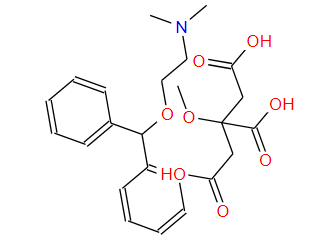
It can be seen from the structural diagram that the molecular structure of Orphenadrine citrate is mainly composed of two parts: the Orphenadrine part and the citrate part.
- Orphenadrine section: The section on the left side of the structure diagram. This is a structure containing benzene rings and spiro rings, made of multiple carbon atoms and a nitrogen atom. There is a methylbenzyl group on the benzene ring. The nitrogen atom is connected to a carbon atom on the spiro ring, and there is also a hydrogen atom and a hydroxyl (OH) atom on the nitrogen atom.
- Citrate section: The section located on the right side of the structure diagram. This is a citrate, made of multiple carbon, hydrogen and oxygen atoms. Its structure contains three carboxyl groups (COOH) and one hydroxyl group (OH), which form multiple ester bonds with carbon atoms.
The orphenadrine part and the citrate part are combined by ionic bonds or ionic interactions to form the complete molecular structure of orphenadrine citrate.
Orphenadrine citrate is a drug that is primarily used to relieve muscle spasms and associated pain.
1. Relieve muscle spasms:
Orphenadrine citrate is widely used to treat various diseases and conditions that cause muscle spasms such as muscle sprains, muscle strains, neck muscle spasms, spinal problems, etc. It works by reducing muscle tension and spasms, thereby relieving associated pain and discomfort.
2. Analgesic effect:
In addition to reducing muscle spasms, Orphenadrine citrate also has analgesic properties. It can reduce the perception of pain by affecting the central nervous system. This makes it useful in relieving pain associated with muscle spasms, as well as other forms of pain such as headaches, neuralgia, etc.
3. Anticholinergic activity:

Orphenadrine citrate belongs to the anticholinergic class of drugs. It reduces cholinergic neurotransmission by inhibiting the action of cholinergic receptors, thereby producing anticholinergic effects. This action makes Orphenadrine citrate useful in certain conditions to treat problems caused by an overactive cholinergic nervous system, such as Parkinson's disease, tremors, and some movement disorders.
4. As an adjuvant therapy drug:
Orphenadrine citrate may also be used as an adjunct to other medications in certain conditions. For example, in some cases it may be used in combination with nonsteroidal anti-inflammatory drugs (NSAIDs) or other muscle relaxants to provide more effective relief of muscle spasms and pain.
Briefly introduce four common synthetic methods of Orphenadrine citrate:
Method 1: the synthetic method of Tropane alkaloid
This is a synthetic method using tropane bases as starting materials.
Step 1: React tropane bases with methanol to generate the corresponding alkoxides.
Step 2: react alkoxide with isopropyl ammonium bromide to generate quaternary ammonium salt.
Step 3: react the quaternary ammonium salt with phenylglycinium chloride to generate the phenylglycate of the quaternary ammonium salt.
Step 4: reacting phenylglycate with citric acid to generate the target product Orphenadrine citrate.
Method two: the synthetic method of amphetamine compound
This is a synthetic method using amphetamine-like compounds as starting materials.
Step 1: Reaction of amphetamine compound with acid chloride to generate corresponding amide.
Step 2: Reaction of the amide with isopropylphosphorus trioxide produces the corresponding phosphoramidite.
Step 3: react phosphoramidite with halogenated hydrocarbon to generate quaternary ammonium salt.
Step 4: react the quaternary ammonium salt with phenylglycinium chloride to generate the phenylglycate of the quaternary ammonium salt.
Step 5: reacting phenylglycate with citric acid to generate the target product Orphenadrine citrate.
Method 3: Synthesis of benzyl compounds
This is a synthetic method using benzyl compounds as starting materials.
Step 1: Reaction of benzyl compound with formaldehyde to produce N-benzyl dehydration Altokylmethylethylenediamine.
Step 2: Reaction of N-benzyl dehydroaltoxymethylethylenediamine with isopropylphosphorus trioxide to generate the corresponding phosphoramidite.
Step 3: react phosphoramidite with halogenated hydrocarbon to generate quaternary ammonium salt.
Step 4: react the quaternary ammonium salt with phenylglycinium chloride to generate the phenylglycate of the quaternary ammonium salt.
Step 5: reacting phenylglycate with citric acid to generate the target product Orphenadrine citrate.
Method Four: Synthesis of Orphenadrine Derivatives
This is a synthetic method using a derivative of Orphenadrine as a starting material.
Step 1: The derivative of Orphenadrine is reacted with acetic anhydride to generate the corresponding acetate.
Step 2: reacting acetate with citric acid to generate the target product Orphenadrine citrate.
These are just some of the four common synthetic methods, and the actual synthetic process may be more complicated and involve other intermediates and reaction steps. Please note that the synthesis of Orphenadrine citrate is the subject of a specialized field of research requiring a laboratory setting with specialized training and facilities. For precise and detailed synthetic methods, please refer to the relevant scientific literature and professional resources, and consult an expert in the field of chemistry. At the same time, any chemical synthesis needs to be carried out in accordance with local laws and regulations and safety requirements, and the operation should be guided by professionals.