




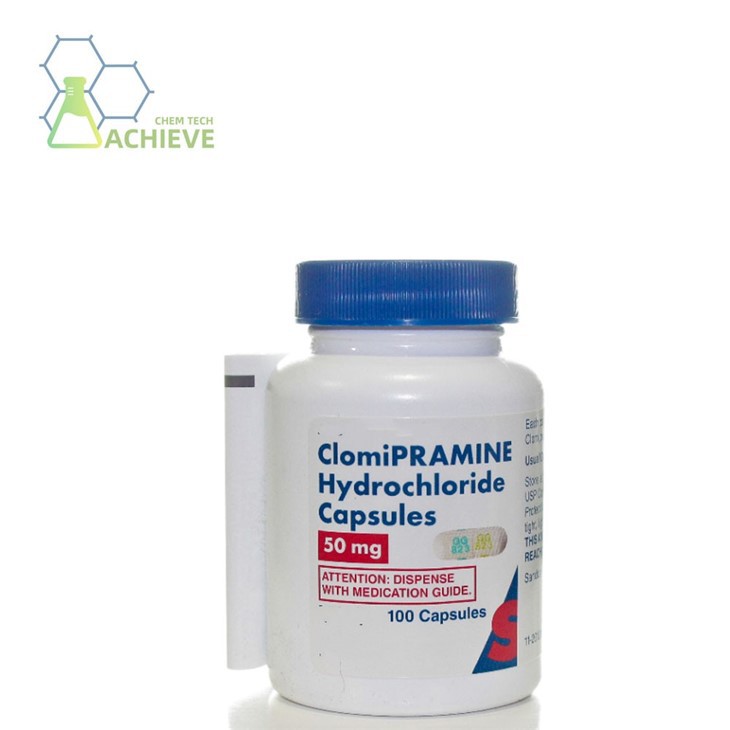


Shaanxi BLOOM Tech Co., Ltd. is one of the most experienced manufacturers and suppliers of clomipramine hydrochloride capsules in China. Welcome to wholesale bulk high quality clomipramine hydrochloride capsules for sale here from our factory. Good service and reasonable price are available.
Clomipramine Hydrochloride Capsules are tricyclic antidepressants that exert antidepressant, anti anxiety, and anti obsessive-compulsive effects by inhibiting the reuptake of serotonin and norepinephrine. They are mainly used to treat depression, obsessive-compulsive disorder, panic disorder, phobia, and chronic neuropathic pain. It is necessary to strictly follow medical advice and monitor adverse reactions. It can effectively inhibit the serotonin (5-HT) transporter (SERT) and weakly inhibit the norepinephrine (NE) transporter (NET), exerting antidepressant and anti anxiety effects by increasing central 5-HT and NE levels. The strong blocking effect on 5-HT reuptake is the core mechanism of its treatment for obsessive-compulsive disorder, which is relatively independent of its antidepressant effect. It has sedative, anticholinergic (such as dry mouth and constipation), and alpha 1 adrenergic activity (which may cause orthostatic hypotension).
At the same time, our company not only provides pure powders, but also tablets and injections. If needed, please feel free to contact us at any time.
Our products

Clomipramine Hydrochloride Tablets

Clomipramine Hydrochloride Capsules


 |
 |
Clomipramine Hydrochloride COA

Promoting neuroimaging research: connecting chemistry and circuits
The rapid development of neuroimaging technology, especially breakthroughs in functional magnetic resonance imaging (fMRI), positron emission tomography (PET), and magnetic resonance spectroscopy (MRS), has provided unprecedented tools for analyzing human brain function and disease mechanisms. At the same time, the field of psychotropic drug development is undergoing a paradigm shift from "target oriented" to "circuit oriented", emphasizing the achievement of therapeutic effects by regulating specific neural circuits. In this context, Clomipramine Hydrochloride Capsules, as a classic tricyclic antidepressant (TCA), have become a bridge connecting chemical structures, neurotransmitter systems, and brain functional circuits research due to their unique chemical properties and neuropharmacological effects.
Chemical structure: Dual effect of tricyclic skeleton and chlorine atom substitution
The chemical name of Clomipramine Hydrochloride is 3- (3-chloro-10,11-dihydro-5H-dibenzo-5-yl) propylamine hydrochloride, with a molecular formula of C ₁ H ₂ Cl ₂ N ₂ and a molecular weight of 351.31. Its core structure consists of a tricyclic parent nucleus (dibenzazabenzene) and a side chain of propylamine, with the chlorine atom substituent located at the 3rd position of the benzene ring. This structure endows it with unique physicochemical properties:
Lipid solubility
The introduction of chlorine atoms enhances the molecular lipid solubility, making it easy to pass through the blood-brain barrier (BBB) and reach higher concentrations in brain tissue. Experiments have shown that after intraperitoneal injection of a dose of 20 mg/kg in mice, the drug concentration in the brain is 3-5 times that of plasma, providing a material basis for regulating central neurotransmitters.
Stability
It presents a stable crystalline state at room temperature and is easily soluble in dimethyl sulfoxide (DMSO) and water (with a solubility of about 35 mg/mL), making it suitable for formulation as a capsule form. Its stability ensures the consistency of drug activity in vitro and in vivo, providing a reliable tool for pharmacological evaluation in neuroimaging research.
Chiral isomerism
There is a phenomenon of isomerism, but the racemic form used in clinical practice has been tested for purity by high performance liquid chromatography (HPLC) (purity ≥ 99.14%), ensuring the reproducibility of experimental results.
Pharmacological mechanism: Dual regulation of serotonin and norepinephrine
Chlorpromazine hydrochloride exerts antidepressant effects by inhibiting the reuptake of presynaptic membrane neurotransmitters, and its mechanism exhibits the characteristics of "selective serotonin (5-HT) dominance and norepinephrine (NE) synergy":
5-HT reuptake inhibition
The affinity for 5-HT transporter (SERT) is extremely high, with a half maximal inhibitory concentration (IC ₅₀) of 1.5 nM, significantly stronger than the inhibition of NE transporter (NET) (IC ₅₀ ≈ 54 nM). This selectivity makes it one of the preferred drugs for treating obsessive-compulsive disorder (OCD), as OCD is closely related to abnormal 5-HT function in the prefrontal striatal thalamic circuit.
NE reuptake inhibition
Although the inhibitory effect on NET is weak, at high doses (≥ 150 mg/day), the anticholinergic effect can be enhanced by increasing NE levels, improving the symptoms of motor deficiency in depressed patients.
Receptor interaction
In addition to reuptake inhibition, chlorpromazine hydrochloride also exhibits alpha adrenergic receptor antagonism, muscarinic acetylcholine receptor (M ₁) antagonism, and histamine H ₁ receptor antagonism. These multi-target effects lead to common adverse reactions such as dry mouth, constipation, and drowsiness, but also provide an opportunity for neuroimaging research to explore the neural mechanisms of drug side effects.
Application of neuroimaging: paradigm breakthrough from target to circuit
The neuroimaging research of Clomipramine Hydrochloride Capsules focuses on the following three levels, achieving a leap from "molecular targets" to "functional circuits":
PET imaging study: Using the radioactive ligand [¹¹ C] DASB (a 5-HT transporter specific tracer), researchers can quantitatively evaluate the occupancy rate of Chlorpromazine Hydrochloride on SERT. For example, a PET study on healthy volunteers showed that after oral administration of 150 mg of clomipramine hydrochloride, the occupancy rate of SERT in the basal ganglia region reached over 80%, and the occupancy rate was positively correlated with plasma drug concentration. This discovery provides imaging evidence for optimizing drug delivery regimens.
MRS technology: By detecting changes in the concentration of 5-hydroxyindoleacetic acid (5-HIAA, 5-HT metabolite) in the brain, MRS can indirectly reflect the activity of the 5-HT system. Research has shown that after 4 weeks of treatment with clomipramine hydrochloride, the levels of 5-HIAA in the prefrontal cortex of patients with depression significantly increase, and the magnitude of the increase is positively correlated with the improvement of Hamilton Depression Rating Scale (HAMD) scores, suggesting that the recovery of 5-HT system function is the neurochemical basis of antidepressant effects.

Neural circuit regulation of obsessive-compulsive disorder: dynamic changes in the prefrontal striatal thalamic circuit

The core pathological mechanism of obsessive-compulsive disorder involves the weakened inhibitory function of the prefrontal cortex (PFC) on the striatum (especially the caudate nucleus), leading to an imbalance in the "executive control habit formation" circuit. Chlorpromazine hydrochloride can repair this imbalance by enhancing 5-HT signaling:
FMRI task state study: In the Go/No Go task, patients with obsessive-compulsive disorder showed increased activation of the right dorsolateral prefrontal cortex (dlPFC) and decreased activation of the caudate nucleus after treatment with clomipramine hydrochloride, indicating that the drug improved impulse control ability by enhancing PFC inhibition of the striatum.
Resting state functional connectivity (rsFC) analysis: A study found that the functional connectivity between the ventral striatum and anterior cingulate cortex (ACC) was enhanced in patients with obsessive-compulsive disorder before treatment, while after 8 weeks of treatment with clomipramine hydrochloride, this abnormal connectivity was significantly weakened, and the change in connectivity strength was negatively correlated with the improvement of the Yale Brown Obsessive Compulsive Scale (Y-BOCS) score. This result supports the hypothesis that 5-HT enhancement can reset the compulsive related circuit.
The anticholinergic side effects of chlorpromazine hydrochloride, such as dry mouth and constipation, are associated with M ₁ receptor antagonism, while drowsiness is associated with H ₁ receptor antagonism. Neuroimaging techniques provide a new perspective for revealing the neural basis of these side effects:
Dry mouth and brainstem salivary gland circuit: An fMRI study showed that after healthy volunteers took 75 mg of clomipramine hydrochloride orally, the activation of the solitary tract nucleus (NTS) in the brainstem was weakened, which is a key center regulating saliva secretion. This discovery suggests that drugs reduce saliva secretion by inhibiting NTS activity, leading to dry mouth.
Sleepiness and default mode network (DMN): The H ₁ receptor antagonistic effect of clomipramine hydrochloride may lead to drowsiness by enhancing DMN activity. Research has shown that at therapeutic doses, the blood oxygen level dependent (BOLD) signal in the posterior cingulate cortex (PCC, DMN core node) of patients is enhanced, and the magnitude of enhancement is positively correlated with the drowsiness score.

Future direction: Precision medicine and multimodal fusion
The neuroimaging research of Clomipramine Hydrochloride Capsules is deepening in the following directions:
Individualized treatment
Combining genomics (such as CYP2D6 polymorphism affecting drug metabolism) with imaging biomarkers (such as SERT occupancy rate) to develop personalized dosing regimens. For example, for CYP2D6 slow metabolism patients, the dosage can be adjusted by monitoring SERT occupancy rate through PET to avoid excessive cardiac toxicity.
Multimodal fusion
Combining fMRI, PET, and EEG to comprehensively analyze the synergistic effects of drugs on neural oscillations, metabolism, and blood flow. For example, a preliminary study showed that clomipramine hydrochloride can enhance neural oscillations in the theta frequency band (4-8 Hz), which are closely related to the function of the prefrontal striatal circuit.
New formulation development
In response to the short half-life of Chlorpromazine Hydrochloride (approximately 17-37 hours), researchers are developing sustained-release capsules or nano formulations to reduce dosing frequency and stabilize blood drug concentrations. Neuroimaging techniques can be used to evaluate the improvement effect of novel formulations on drug distribution and circuit regulation in the brain.
The value of Clomipramine Hydrochloride Capsules as a scientific tool: revealing the interactive dialogue of the nervous system
The nervous system, as the most complex regulatory network in the human body, perceives, integrates, and responds to external stimuli through the transmission of electrochemical signals between neurons. This process not only involves independent activity of a single brain region, but also relies on dynamic interaction and collaboration among multiple brain regions. In recent years, research in the field of neuroscience on the interaction and dialogue of the nervous system has gradually deepened from the macroscopic behavioral level to the molecular and cellular mechanisms. Drug intervention, due to its precise regulation of the neurotransmitter system, has become a key tool for revealing the mechanisms of neural interaction. Clomipramine Hydrochloride Capsules, as a classic tricyclic antidepressant, provide an important research paradigm for analyzing the complex interactions between neurotransmitter systems due to their unique pharmacological properties and clinical applications.
Pharmacological properties and neural regulatory basis of chlorpromazine hydrochloride
Chlorpromazine hydrochloride (chemical name: 3-chloro-5- [3- (dimethylamino) propyl] -10,11-dihydro-5H-dibenzo [b, f] azazine hydrochloride) belongs to the tricyclic antidepressant (TCA) class. Its core pharmacological effect is to inhibit the reuptake of monoamine neurotransmitters by neurons, thereby changing the concentration of neurotransmitters in the synaptic cleft and regulating neural signal transmission. Specifically, clomipramine hydrochloride has a strong inhibitory effect on serotonin (5-HT) transporter (SERT), with a half maximal inhibitory concentration (IC50) of only 1.5 nM, while its inhibitory effect on norepinephrine transporter (NET) is about 50 times lower than 5-HT, demonstrating significant selectivity. In addition, the drug also has anticholinergic, α 1-adrenergic receptor blocking, and histamine H1 receptor antagonistic effects, which together form its complex neural regulatory network.
5-hydroxytryptamine system: the core hub of neural interaction
5-hydroxytryptamine (5-HT), as an important neurotransmitter in the central nervous system, is widely involved in physiological processes such as emotion regulation, cognitive function, sleep wake cycle, and pain perception. Its signal transmission relies on the binding of 5-HT released from the presynaptic membrane to 5-HT receptors on the postsynaptic membrane, while the dynamic balance of 5-HT concentration in the synaptic cleft is regulated by SERT mediated reuptake processes. Chlorpromazine hydrochloride effectively inhibits SERT, significantly prolongs the residence time of 5-HT in synaptic cleft, enhances postsynaptic membrane receptor activation, and amplifies 5-HTergic neural signals. This mechanism not only explains its clinical efficacy in treating depression and anxiety, but also provides an ideal tool for studying the interaction between the 5-HT system and other neurotransmitter systems such as norepinephrine, dopamine, and glutamate.
Norepinephrine system: a regulator of energy and motivation
Norepinephrine (NE), as the main neurotransmitter of the sympathetic nervous system, plays a crucial role in stress response, attention regulation, and motivation drive. The weak inhibitory effect of chlorpromazine hydrochloride on NET (IC50 of approximately 75 nM) is weaker than its effect on SERT, but it can still moderately increase the concentration of NE in the synaptic cleft and enhance NE neurotransmission. This dual inhibitory effect (5-HT and NE reuptake) gives clomipramine hydrochloride a unique advantage in the treatment of complex psychiatric disorders such as obsessive-compulsive disorder (OCD) and panic disorder, and also provides an experimental model for studying the synergistic or antagonistic relationship between 5-HT and NE systems in neural interaction.
Multi target effects: complex neural network interactions
In addition to monoamine neurotransmitters, the anticholinergic (such as blocking M1 receptors), antihistamine (such as blocking H1 receptors), and α 1-adrenergic blocking effects of clomipramine hydrochloride further expand its neural regulatory range. For example, anticholinergic effects may lead to side effects such as dry mouth and constipation, but they can also affect cognitive function by regulating the balance between the acetylcholine system and the 5-HT system; The blocking effect of alpha 1 can cause orthostatic hypotension, but it may also indirectly regulate emotional states by reducing sympathetic nervous tension. Although these multi-target effects increase the complexity of drug action, they also provide a more physiological model for studying the interaction dialogue between neurotransmitter systems.
Hot Tags: clomipramine hydrochloride capsules, suppliers, manufacturers, factory, wholesale, buy, price, bulk, for sale