




Shaanxi BLOOM Tech Co., Ltd. is one of the most experienced manufacturers and suppliers of enclomiphene citrate capsules in China. Welcome to wholesale bulk high quality enclomiphene citrate capsules for sale here from our factory. Good service and reasonable price are available.
Enclomiphene citrate capsules are oral nonsteroidal selective estrogen receptor modulators (SERMs) primarily used for the treatment of male secondary hypogonadism and infertility. Its core component is trans-clomiphene citrate, which is the trans isomer of clomiphene. Compared with traditional clomiphene (containing a mixture of cis and trans isomers), it has higher selectivity and lower side effects.
Our products
|
|
|
|
|




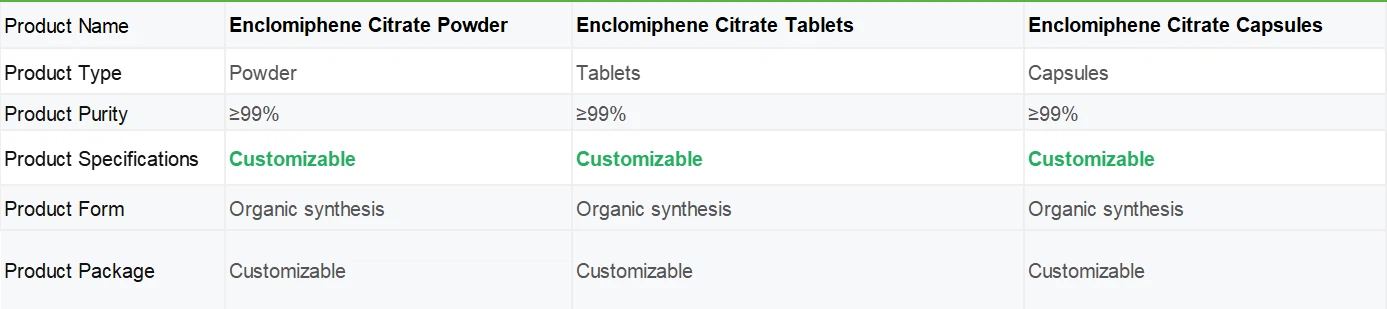
Our product
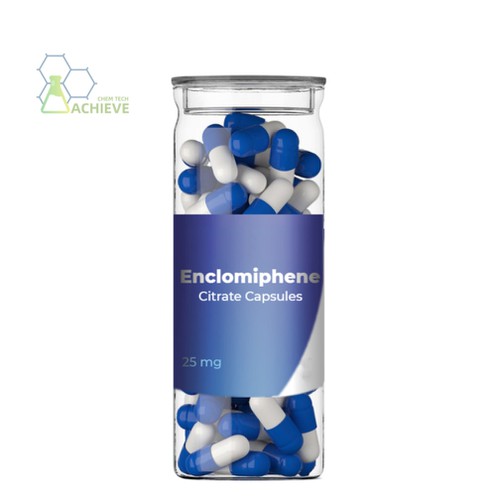
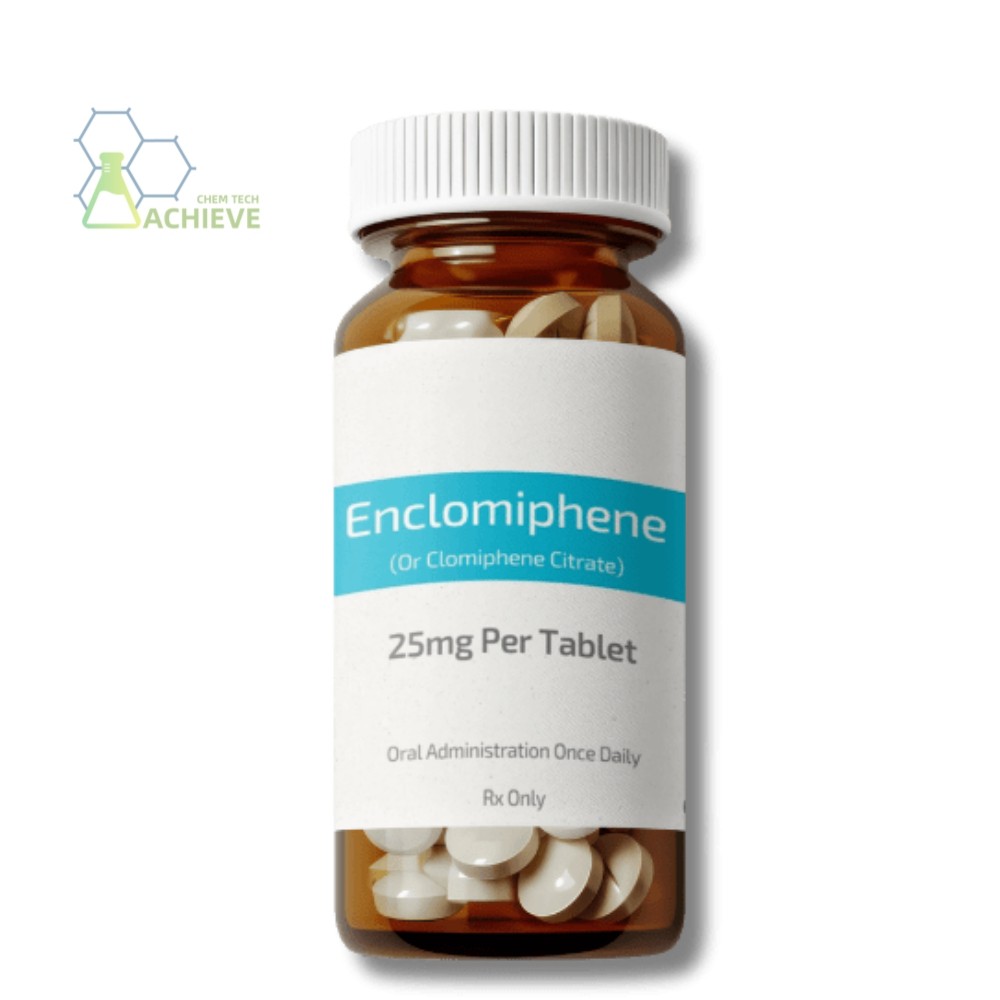
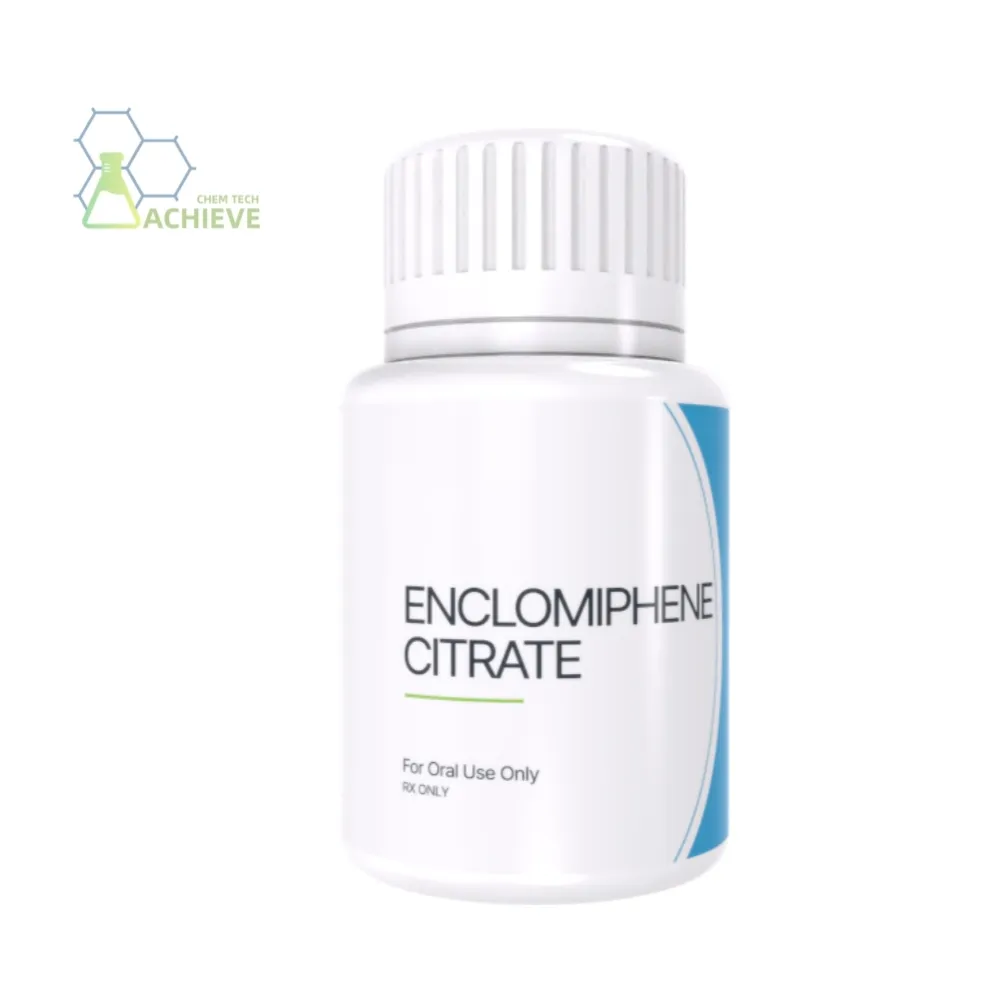
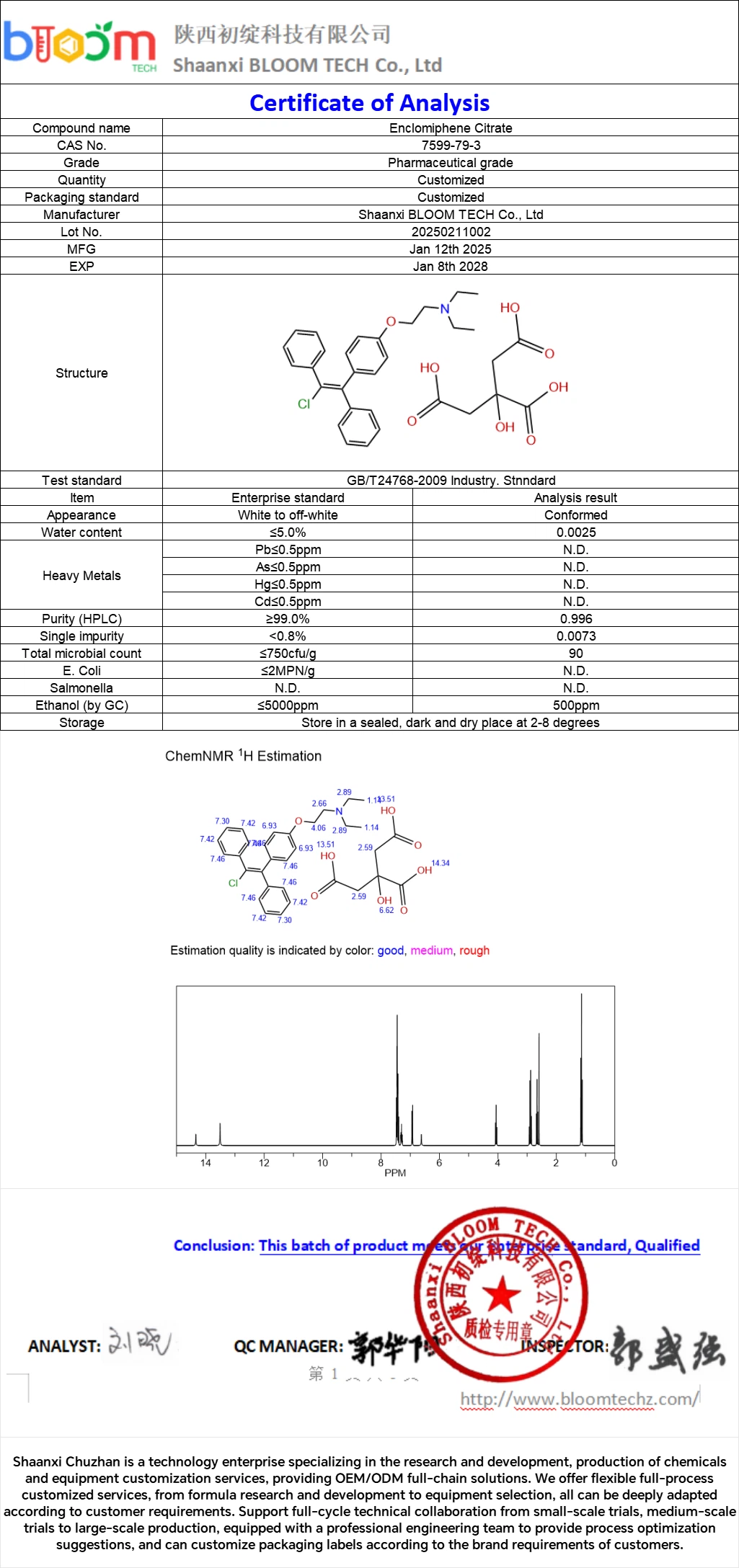
Enclomiphene Citrate COA

Detailed introduction of dosage form and specifications
Enclomiphene citrate capsules are an oral nonsteroidal selective estrogen receptor modulator (SERM) primarily used for the treatment of male secondary hypogondism and infertility. Its dosage form is capsules with various specifications to meet the treatment needs of different patients.
Dosage form
Adopting capsule dosage form, this dosage form has the following advantages:
Easy to take: The capsule shell can mask the unpleasant odor of the medication and improve the patient's medication adherence.
Good stability: Capsule formulations can protect drugs from external environmental factors such as humidity and light, improving drug stability.
Accurate dosage: Capsule formulations can ensure the accuracy of drug dosage and reduce dosage errors.
Specifications
Provide multiple specifications to meet the treatment needs of different patients. Common specifications include:
5 mg: Suitable for patients who are sensitive to drug dosage or as a low-dose starting point for initial treatment.
12.5 mg: is one of the commonly used starting doses in clinical practice, suitable for most patients with secondary hypogondism.
25 mg: For patients with low testosteron levels or poor response to a dose of 12.5 mg, the dose can be adjusted to 25 mg.
50 mg: Although not common, in certain special cases (such as severe hypogondism), higher doses may be necessary. However, in actual clinical practice, 25 mg is usually sufficient, while the 50 mg specification is more commonly used for research or special adjustment scenarios.

Enclomiphene citrate capsules are an orally administered nonsteroidal selective estrogen receptor modulator (SERM), with its core component trans-clomiphene citrate being the trans isomer of clomiphene. Compared with traditional clomiphene (containing a mixture of cis and trans isomers), trans-clomifene selectively blocks estrogen receptors, precisely regulates the hypothalamic pituitary gonadal axis (HPG axis), restores endogenous testosteron secretion, and avoids inhibition of fertility. The following systematically explains its mechnism of action from four aspects: molecular mechnism, physiological effects, clinical advantages, and side effect control.
1.1 Differential binding of estrogen receptor subtypes
Its molecular structure belongs to the class of tristyrene compounds, and its trans conformation makes its binding to estrogen receptor alpha (ER alpha) highly selective. ER α is highly expressed in the hypothalamus and anterior pituitary gland, and is a key target for estrogen negative feedback regulation. By occupying the ligand binding domain of ER α, estrogen (such as estradiol) is prevented from binding to receptors, thereby blocking estrogen mediated gene transcription activation.


Function details:
Receptor conformational changes: After binding to ER α, the receptor undergoes conformational changes, causing Helix-12 to be unable to locate correctly, resulting in the inability to recruit co activators (such as SRC-1), thereby inhibiting estrogen responsive element (ERE) - mediated gene expression.
Organizational specificity: Unlike the cis isomer cis-clomiphene, trans-clomifene does not exhibit estrogenic activity in tissues such as the breast and endometrium, avoiding the side effects of traditional clomiphene such as breast tenderness and endometrial thickening.
1.2 Blocking the estrogen signaling pathway
Estrogen regulates the HPG axis through the classical genomic pathway (transcriptional regulation) and non genomic pathway (membrane receptor activation) mediated by ER α. Trans-clomifene mainly blocks genomic pathways:
Hypothalamic level: Inhibits the negative feedback of estrogen on gonadotropin-releasing hormone (GnRH) neurons and increases the frequency of GnRH pulsatile secretion.
Pituitary level: Block the inhibition of estrogen on the anterior pituitary gland, promote the secretion of luteinizing hormone (LH) and follicle stimlating hormone (FSH).


Experimental evidence:
In vitro studies have shown that trans-clomifene has three times the affinity for ER α compared to cis-clomiphene, and can completely block estradiol induced ER α activation at low concentrations (10 ⁻⁸ M).
In animal experiments, the levels of LH and FSH in the trans-clomifene treated group were 2-3 times higher than those in the control group, while the cis-clomiphene group showed only a 1.5-fold increase in LH due to the partial excitatory effect of the cis isomer.
2.1 Recovery of GnRH pulse secretion
The hypothalamus regulates pituitary function through pulsatile release of GnRH. Excessive estrogen can inhibit the electrical activity of GnRH neurons and reduce pulse frequency. Trans-clomifene releases this inhibition by blocking ER α:
Neuroelectrophysiological changes: The firing frequency of GnRH neurons increased from once every 90 minutes to once every 30 minutes, approaching a physiological state.
Clinical significance: The recovery of GnRH pulse frequency is a prerequisite for LH and FSH secretion, directly determining the persistence of testosteron synthesis.


2.2 Collaborative secretion of LH and FSH
The gonadotropin cells in the anterior pituitary gland simultaneously express LH and FSH. The synergistic secretion of the two is achieved through the following mechnism:Upregulation of GnRH receptors: An increase in GnRH pulse frequency leads to an increase in the number of GnRH receptors on the surface of gonadotropin cells, enhancing sensitivity to GnRH.
Calcium ion influx promotion: After GnRH binds to the receptor, it activates calcium channels through the phospholipase C (PLC) pathway, promoting the release of LH and FSH.
Dose effect relationship:
Low dose (12.5 mg/day) trans-clomifene mainly stimulates LH secretion and increases testosteron levels.
High doses (25 mg/day) simultaneously promote FSH secretion and have additional benefits for sperm production.
2.3 Synergistic Generation of Testosteron and Sperm
LH and FSH act on the interstitial cells and Sertoli cells of the testis, respectivelyThe function of LH: It binds to LHR receptors on the surface of stromal cells, activates cholesterol side chain lyase (CYP11A1), and promotes testosteron synthesis.
The function of FSH: It binds to FSHR on the surface of supporting cells, upregulates the expression of androgen binding protein (ABP), maintains the concentration of testosteron in interstitial cells, and promotes spermatogenesis.


Clinical data:
After 12 weeks of treatment with trans-clomifene in patients with secondary hypogondism, serum testosteron increased from baseline 280 ng/dL to 580 ng/dL, and sperm concentration increased from 8 × 10 ⁶/mL to 25 × 10 ⁶/mL.
Compared with traditional testosteron replacement therapy (TRT), the trans-clomifene group showed a 40% increase in sperm motility (proportion of forward moving sperm), while the TRT group showed a 25% decrease in sperm motility due to exogenous testosteron inhibiting endogenous secretion.
3.1 Differences in Isomer Composition
Traditional clomiphene is a 1:1 mixture of cis (cis-clomiphene) and trans (trans-clomifene) isomers:
Side effects of cis-clomiphene: It has weak estrogenic activity and can activate ER α in tissues such as the breast and endometrium, causing breast tenderness, endometrial thickening, and visual abnormalities (such as flashes).
Purity of trans-clomifene: After removing cis-clomiphene, the estrogenic effect disappears and the incidence of side effects decreases by 80%.
3.2 Optimization of pharmacokintics
Half life: The half-life of trans-clomifene is 10 hours, which is shorter than the 18 hour half-life of clomiphene, reducing the risk of tissue accumulation.
The peak time of blood drug concentration: Trans-clomifene reaches its peak 2-3 hours after oral administration, while clomiphene takes 4-6 hours for faster onset.


As a selective estrogen receptor modulator (SERM), its pharmacokintic characteristics include absorption, distribution, metabolism, and excretion processes. The specific analysis is as follows:
By oral administration, it is rapidly absorbed and has a high bioavailability (about 80%), and is not affected by first pass metabolism.
Dose range: The commonly used clinical dose is 12.5 mg to 25 mg/day, with some studies using a flexible regimen of 6.25 mg to 50 mg/day.
Peak time: After a single oral administration, the serum drug concentration reaches its peak (Cmax) within 2-3 hours.
PH dependent dissolution: The solubility in gastric acid environment (pH 1.2) is significantly higher than that in neutral environment (pH 7.4), which may affect its absorption efficiency.
Food impact: There is currently no clear evidence to suggest that food has a significant effect on its absorption, but a high-fat diet may slightly delay peak time.
Widely distributed in the body, with tissue accumulation phenomenon.
Apparent distribution volume: Due to the lack of direct data, it can be inferred from its chemical structure that it has a high tissue affinity.
Receptor binding: As a SERM, it mainly binds to the estrogen receptor (ER α) in the hypothalamus and pituitary gland, promoting the secretion of gonadotropin-releasing hormone (GnRH) by blocking the negative feedback inhibition of estrogen, thereby stimlating the release of luteinizing hormone (LH) and follicle stimlating hormone (FSH).
Organizational Accumulation: If the serum drug concentration does not fully decrease to baseline levels within 24 hours, it suggests that the drug may accumulate in the target tissue (such as the hypothalamic pituitary axis), thereby prolonging the duration of action.
Metabolism mainly relies on the liver cytochrome P450 enzyme system (CYP450), especially CYP2D6 and CYP3A4.
Metabolic pathway: The tertiary amine structure may be oxidized to nitrogen oxides, while the styrene backbone may undergo hydroxylation or dehalogenation reactions.
Metabolites: Currently, the active metabolites have not been identified, but nitrogen oxides may have partial pharmacological activity.
Drug interactions: CYP2D6 inhibitors (such as fluoxetine and quinidine) may slow down their metabolism, leading to increased blood drug concentrations; And CYP3A4 inducers (such as rifampicin and carbamazepine) may accelerate metabolism and reduce efficacy.
Enclomiphene citrate capsules is mainly through the kidneys, with a half-life of approximately 10 hours.
Half life: A half-life of 10 hours supports a once daily dosing regimen, but individual differences may affect the actual clearance rate.
Clearance pathway: mainly excreted through the kidneys, which may include the prototype drug and metabolites.
Long term accumulation: Due to its short half-life, the risk of drug accumulation is low under long-term use, but patients with abnormal liver function need to be monitored.
Hot Tags: enclomiphene citrate capsules, suppliers, manufacturers, factory, wholesale, buy, price, bulk, for sale