




Shaanxi BLOOM Tech Co., Ltd. is one of the most experienced manufacturers and suppliers of enclomiphene citrate powder in China. Welcome to wholesale bulk high quality enclomiphene citrate powder for sale here from our factory. Good service and reasonable price are available.
Enclomiphene citrate powder, also known as clomiphene citrate, is an organic compound, CAS 7599-79-3, The chemical formula is C32H36ClNO8. White to off white solid powder with a bitter taste. Its anhydrous crystalline form was shown in the thermal stability test to have a decomposition onset temperature of 218 ± 3 ° C (determined by differential scanning calorimetry) and needs to be processed under temperature control. Slightly soluble in ethanol, chloroform, trichloromethane, and water, not soluble in ether. The solubility in phosphate buffer solution (pH 7.4) is only 0.12 mg/mL, while in 0.1 N hydrochloric acid (pH 1.2), the solubility increases to 52.3 mg/mL, indicating a significant pH dependence of its solubility. Mainly used as an anti estrogen drug, it is used to treat gynecological diseases such as functional uterine bleeding, polycystic ovary syndrome, menstrual disorders, and drug-induced amenorrhea.


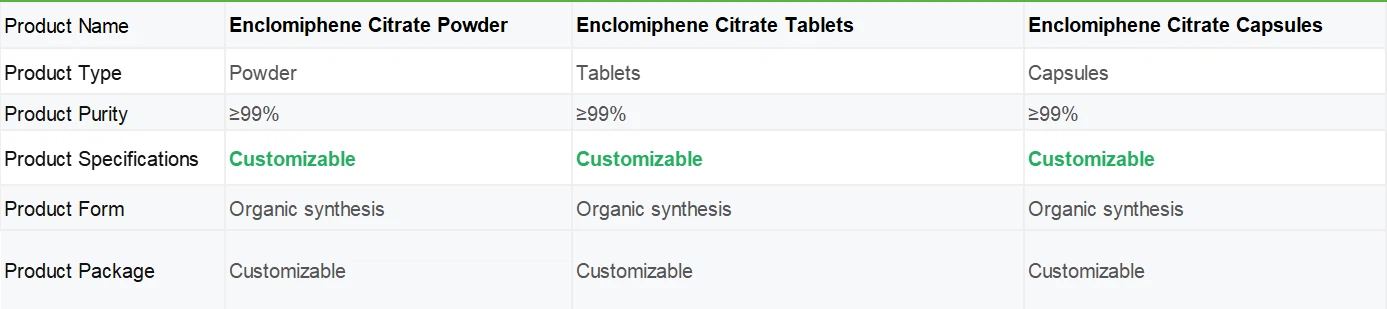
Our product
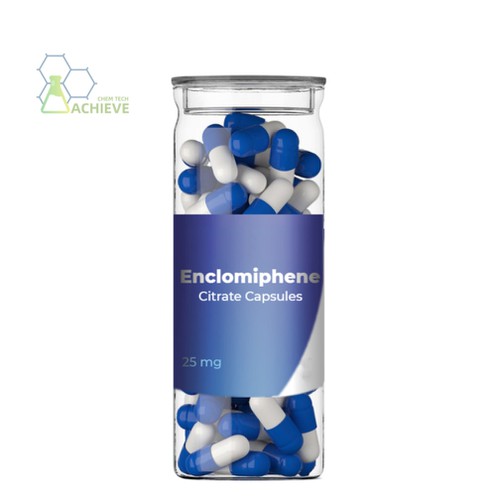
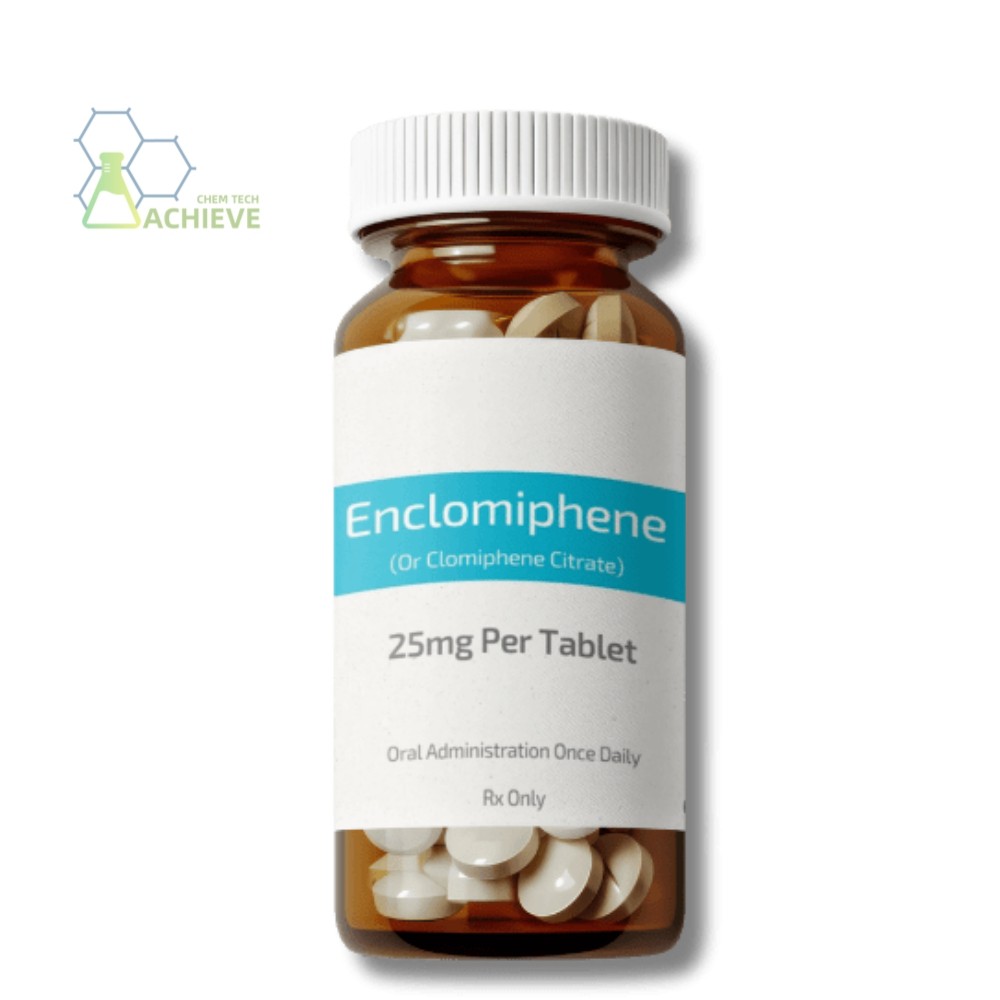
Enclomiphene Citrate COA
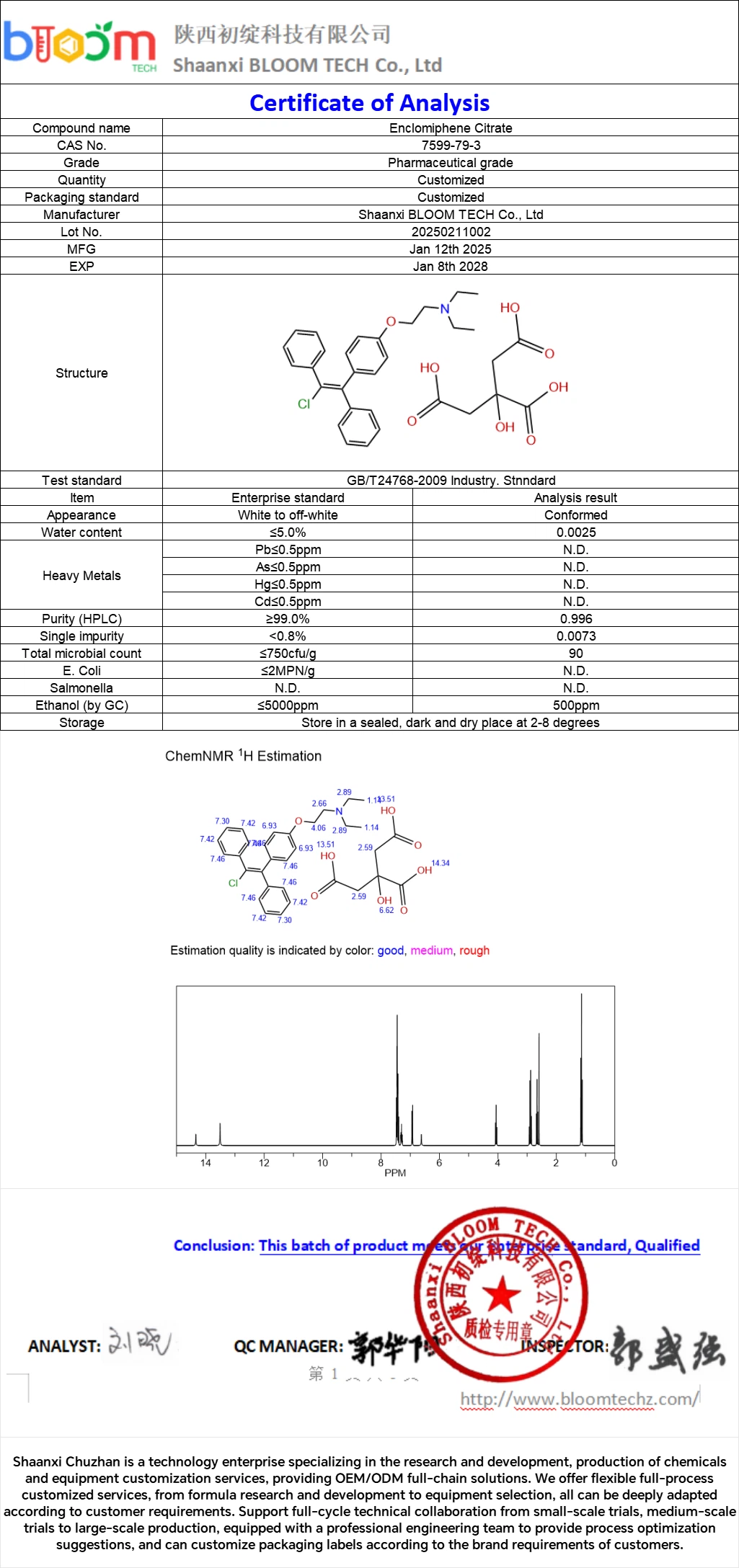

Enclomiphene citrate powder is a selective estrogen receptor modulator (SERM), whose active ingredient is the E-isomer (trans structure) of clomiphene. It has a pure estrogen antagonistic effect and is widely used in the treatment of male hypogonadism. Its synthesis needs to take into account stereo selectivity, purity control, and industrial feasibility. The following provides a detailed analysis from three dimensions: classical multi-step synthesis method, single solvent optimization process, and crystal morphology control technology.
Classic multi-step synthesis method: stereoselective pathway based on Horner Wadsworth Emmons reaction
1. Reaction mechanism and intermediate system preparation
The classic synthetic route starts with 4-hydroxyacetophenone and N - (2-chloroethyl) - diethylamine, and constructs the target molecule through two key reactions:
Step 1: Synthesis of Phenol Ether Intermediates
4-Hydroxyacetophenone undergoes nucleophilic substitution reaction with N - (2-chloroethyl) - diethylamine under alkaline conditions (such as K2CO3/DMF) to produce 4- (2-diethylaminoethoxy) acetophenone. The reaction needs to be controlled at a temperature of 60-80 ℃ to avoid the formation of by-products, with a yield of about 85%.
Step 2: Horner Wadsworth Emmons (HWE) reaction
Phenolic ether intermediates and dimethyl chloride (benzyl) phosphonate are deprotonated in THF via NaH to generate phosphoryl carbanions, which then undergo stereoselective addition with aldehyde groups to form E-olefin structures. The reaction needs to be carried out at a low temperature of -78 ℃ to suppress the formation of Z-isomer, and the final proportion of E-isomer can reach over 95%. The post-treatment is separated by column chromatography, with a total yield of approximately 60-65%.
2. Process optimization and impurity control
Solvent selection:
THF, as a polar non proton solvent, can effectively dissolve reactants and stabilize carbon negative ion intermediates. Alternative solvents such as dioxane can lead to a 30% decrease in reaction rate.
Stereoscopic control mechanism:
The volume effect of the phosphoryl reagent promotes the carbon anion to attack the aldehyde group in a trans conformation, and the E-isomer structure is confirmed by monitoring the double bond coupling constant (J=15-16 Hz) through ¹ H NMR.
Impurity source:
Z-isomer (zuclomiphene) is the main impurity, and its content needs to be controlled at<2% through optimization of crystallization conditions (such as ethyl acetate/n-hexane mixed solvent).
Our Products


Single solvent optimization process: efficient synthesis in dichloromethane system
1. Technological innovation points
In response to the complex solvent system and tedious post-processing issues of the classic route, the single solvent method uses dichloromethane (DCM) as the reaction medium to achieve a "one pot" synthesis:
Reaction conditions:
Mix 4-hydroxyacetophenone, phosphoryl reagent, and NaH in DCM, react at -40 ℃ for 12 hours, generate carbon negative ions in situ and directly add them, eliminating the intermediate separation step.
Yield improvement:
The single solvent method increases the total yield to 70-75%, which is 10-15 percentage points higher than the classical route, while reducing solvent usage by 40%.
Purity control:
By controlling the reaction temperature (-40 ℃ vs -78 ℃ of the classical method), the Z-isomer content can be stabilized at<1.5%, meeting pharmaceutical standards.


2. Industrial adaptability
Equipment requirements:
The DCM system requires the use of an explosion-proof reactor and is equipped with a low-temperature circulating cooling system. The initial investment is 15% higher than the classic route, but the long-term operating cost is reduced by 20%.
Environmental advantages:
DCM recovery rate can reach 90%, significantly reducing waste liquid emissions compared to THF system (recovery rate of 75%), in line with green chemistry principles.
Case verification:
A pharmaceutical company used a single solvent method to produce enclomiphene citrate, with a single batch yield increased from 50 kg to 80 kg, and HPLC purity remained stable at over 99.5%.
Crystal morphology control technology: needle shaped crystals and process stability
1. The influence of crystal morphology on formulations
There are various crystal forms of Enclomiphene citrate, among which Needle shaped Crystal has better fluidity and compressibility, suitable for capsule filling:
Traditional crystallization defects: The classic ethyl acetate/ethanol mixed solvent crystallization method is prone to generating block shaped crystals, resulting in poor powder flowability (angle of repose>45 °), requiring the addition of additional flow aids.
Advantages of needle shaped crystals: By adjusting the solvent ratio (such as ethyl acetate/water=85:15) and crystallization temperature (5-10 ℃), needle shaped crystals with a length to diameter ratio>5 can be obtained, and the angle of repose can be reduced to below 35 °, directly meeting the requirements for capsule filling.
2. Key points of process control
Solvent screening: The ethyl acetate/water system is more prone to form needle shaped crystals than the acetone/water system, and the crystallization time is reduced by 50% (from 24 hours to 12 hours).
Temperature gradient control: Adopting programmed cooling method (from 25 ℃ to 5 ℃) to avoid local supercooling causing crystal distortion.
Stability verification: Differential scanning calorimetry (DSC) was used to confirm that the needle shaped crystals were of type I amorphous type, and no crystal transformation occurred within 6 months in the accelerated stability test (40 ℃/75% RH).
Quality Control and Standards
1. Critical Quality Attribute (CQA)
Purity:
HPLC detection shows that the content of enclomiphene is ≥ 99%, and the Z-isomer is ≤ 1%.
Crystal form:
X-ray diffraction (XRD) confirms that there is no crystal form in Type I.
Residual solvent:
GC detection of dichloromethane residue ≤ 600 ppm (ICH Q3C standard).
2. Analysis methods
|
|
|
|
|


HPLC conditions:
C18 column (4.6 × 150 mm, 5 μ m), mobile phase of acetonitrile/water (60:40), detection wavelength of 254 nm.
XRD parameters:
Cu K α radiation, scanning range 5 ° -40 ° (2 θ), step size 0.02 °.

Enclomiphene citrate powder, as a selective estrogen receptor modulator (SERM), exhibits chemical reactivity primarily in terms of photosensitivity, redox properties, thermal decomposition behavior, and pH dependent solubility.
The tristyrene unit (C6H ₅ - CH=CH-C6H4-O -) in the molecule has a conjugated π - electron system and is prone to photoisomerization under ultraviolet light (250-400 nm) irradiation. Experiments have shown that its E-isomer can partially convert to the Z-isomer (zuclomiphene) under 365 nm light, leading to a decrease in activity. This photochemical reaction requires strict protection from light. In industrial production, amber glass bottles should be used for packaging and stored in a dark environment at 4 ℃ to prevent the generation of photodegradation products (such as phenolic derivatives).
The tertiary amine structure (- N (CH2CH3) 2) in the molecule endows it with redox activity. In the presence of strong oxidants such as hydrogen peroxide and potassium permanganate, tertiary amines can be oxidized to nitrogen oxides (R3N → O), accompanied by electron transfer to generate free radical intermediates. For example, in a pH 7.4 phosphate buffer solution, a nitrogen oxide yield of 15% can be achieved within 30 minutes by reacting 0.1 mM with 10 mM H2O2. This oxidation reaction may lead to drug inactivation, and antioxidants (such as vitamin C) need to be added to the formulation to stabilize it.
By differential scanning calorimetry (DSC) measurement, the anhydrous crystalline form of enclomiphene citrate begins to decompose at 218 ± 3 ℃, releasing toxic gases such as CO, CO2, and NO. The decomposition process is divided into two stages:
First order decomposition (218-250 ℃): Partial decarboxylation of citrate produces intermediate enclomiphene free radicals.
Secondary decomposition (>250 ℃): The framework of styrene is broken, forming small molecule fragments such as phenol and chlorobenzene.
Industrial drying requires temperature control of ≤ 80 ℃ to avoid thermal decomposition. The accelerated stability test (40 ℃/75% RH) showed a purity decrease of<0.5% within 6 months, demonstrating its thermal stability during storage at room temperature.
Solubility changes significantly with pH:
Acidic conditions (pH 1.2, 0.1 N HCl): solubility reaches 52.3 mg/mL, due to the protonation of citrate ions (C6H ₅ O ₇³ ⁻) to form H3C6H ₅ O ₇, weakening the ionic bond with enclomiphene.
Neutral conditions (pH 7.4, phosphate buffer solution): The solubility is only 0.12 mg/mL, as deprotonation of citrate ions enhances ion interactions.
This pH dependence leads to rapid release in the gastric acid environment, with a bioavailability of 80%, while intestinal absorption is limited. Enteric coating technology should be used in the formulation to optimize the absorption site.
Its E-isomer maintains conformational stability through steric hindrance effect. In the tristyrene unit, the chlorine atom (Cl) forms van der Waals forces with the adjacent benzene ring, inhibiting Z-isomerization. X-ray crystallography shows that the dihedral angle (C-C=C-C) of the E-isomer is 165 °, close to a planar configuration, while the Z-isomer is 35 °. This three-dimensional rigidity makes it less prone to isomerization in the blood, with a half-life of up to 10 hours.
The carboxylic acid groups (- COOH) and tertiary amines in the Enclomiphene citrate molecule can form chelates with divalent metal ions (such as Ca ² ⁺, Mg ² ⁺). In simulated body fluids (containing 1.5 mM Ca ² ⁺), its solubility decreases by 40%, which may affect drug absorption. Avoid using fillers containing calcium/magnesium in the formulation and switch to neutral excipients such as microcrystalline cellulose.
Light stabilization: Adding 0.1% titanium dioxide (TiO2) as a UV absorber extends the half-life of photodegradation from 2 hours to 24 hours.
Oxidation protection: Add 0.05% propyl gallate (PG) to the capsule formula to reduce the generation of nitrogen oxides by 90%.
PH adjustment: A citric acid sodium dihydrogen phosphate buffer system (pH 4.5) is used to balance solubility and stability.
The chemical reactivity of enclomiphene citrate powder is determined by its molecular structure and needs to be controlled through measures such as avoiding light, controlling temperature, adjusting pH, and adding stabilizers. Future research can focus on developing more stable crystal forms (such as eutectic) or novel derivatives to further enhance their chemical stability.
FAQ
1. What are the main uses of Enclomiphene Citrate?
In the field of research, it is used to study the mechanism of its effect on gonadotropin levels, and it is a commonly used reference substance in related biomedical experiments.
2. How to store this product correctly?
It is recommended to store it in a sealed container away from light, in a dry and cool place (typically at 2-8°C) to maintain its long-term stability.
3. How should this product be operated and handled?
This is only for use in laboratory research environments. During operation, appropriate protective equipment must be worn and it should be carried out under conditions of compliant ventilation to ensure safety.
Hot Tags: enclomiphene citrate powder, suppliers, manufacturers, factory, wholesale, buy, price, bulk, for sale