




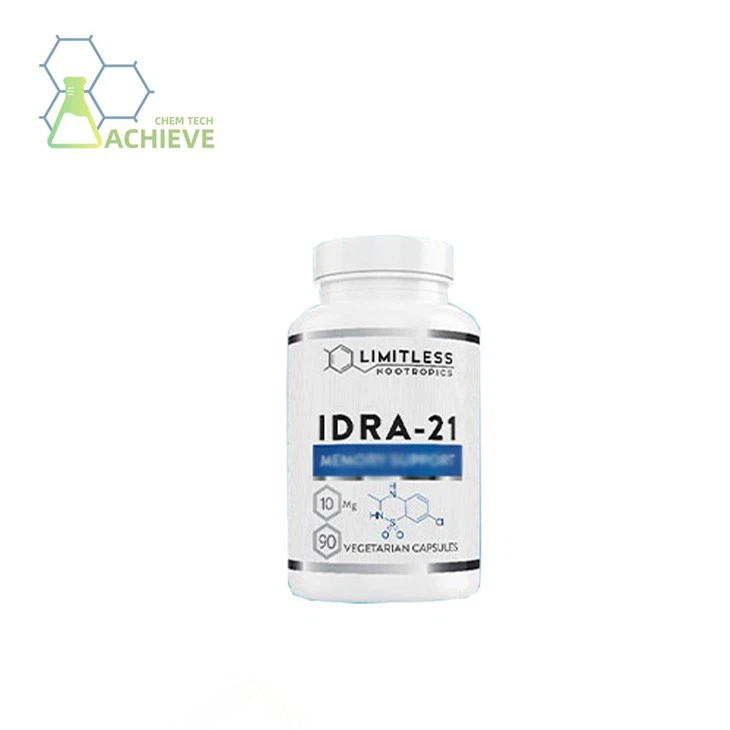


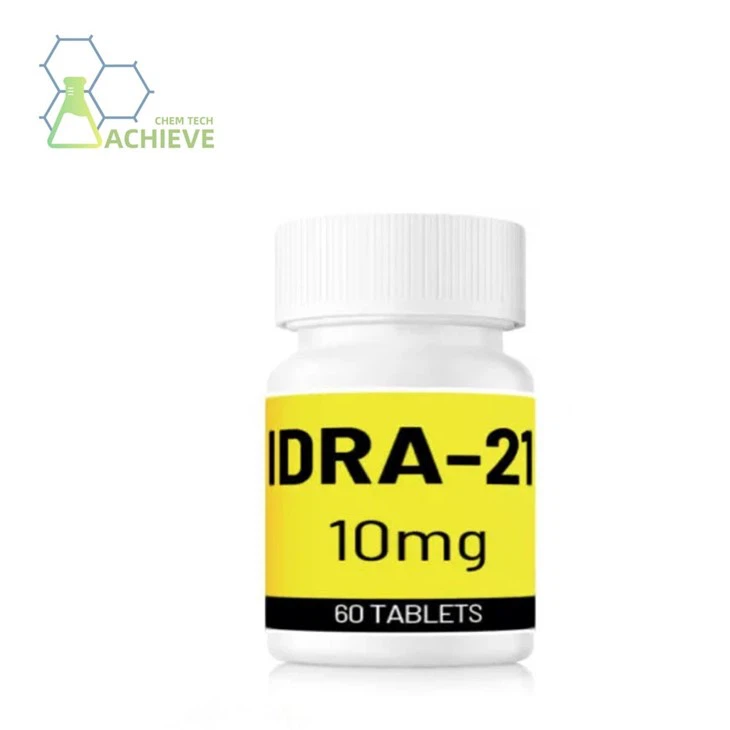


Idra 21 Capsules is a capsule preparation mainly composed of IDRA-21, a novel ampakine puzzle drug mainly used for cognitive enhancement and memory improvement research. Its chemical name is 7-chloro-3-methyl-3,4-dihydro-2H-1,2,4-benzothiazide 1,1-dioxide, which is an artificially synthesized ampakine compound. It regulates AMPA receptors through positive conformational changes, enhances excitatory signaling of glutamate, promotes the formation of long-term potentiation (LTP) between synapses, and thus improves learning and memory function. In animal experiments, IDRA-21 has shown significant improvement in learning and memory abilities. Compared to traditional drugs such as amphetamines, IDRA-21 has shown stronger efficacy and longer duration in reversing cognitive impairment (lasting up to 48 hours after a single dose), and may also have a protective effect against age-related cognitive decline. IDRA-21 may have potential therapeutic value for certain mental illnesses, such as schizophrenia.
 |
 |


 |
|
|
|
|


The following provides a detailed explanation from the dimensions of raw material characteristics, manufacturing process, quality control, and regulatory compliance:
Raw material preparation: Extraction and purification of IDRA-21
IDRA-21 (chemical name: 7-Chloro-3-methyl-3,4-Dihydro-2H-1,2,4-benzothiazine 1,1-dioxide) is an artificially synthesized compound of the Ampaglutide class, which requires high-purity raw materials for production
Chemical synthesis
IDRA-21 is prepared by organic synthesis process, which requires precise control of reaction conditions (such as temperature, pressure, catalyst dosage) to ensure the yield and purity of the target product. The synthetic route usually involves multiple reactions, including key steps such as cyclization, chlorination, oxidation, etc., and each step requires strict monitoring of the quality of intermediates.
Purity control
The purity of raw materials directly affects the efficacy and safety of capsules. According to public information, the purity of research grade IDRA-21 needs to reach over 98%, and some suppliers provide products with a purity of 99%. Purification methods may include recrystallization, column chromatography, or high-performance liquid chromatography (HPLC) to remove impurities such as unreacted raw materials and by-products.
Stability testing
The raw materials need to undergo stability testing under specific conditions (such as long-term storage at -20 ℃) to confirm that they will not degrade or produce toxic metabolites during storage. For example, the solubility of IDRA-21 in DMSO can reach 100 mM, but repeated freeze-thaw cycles should be avoided to prevent degradation.
Accessory selection: Balancing solubility and stability
Capsule formulations require the addition of excipients to improve the flowability, filling ability, and bioavailability of the drug. The selection of excipients for IDRA-21 capsules should consider the following factors:

Fillers
Commonly used include microcrystalline cellulose, lactose, or starch to increase the volume of capsule contents and ensure even filling. For example, if a single capsule contains 10 mg of IDRA-21, an appropriate amount of filler needs to be added to achieve the standard weight (such as 200 mg).
Lubricants
Such as magnesium stearate or silica can reduce friction between particles and equipment, preventing adhesion or blockage during capsule filling. The amount of lubricant used is usually 0.5% -2% of the total weight.


Disinfectant
If IDRA-21 requires rapid release, disintegrants such as cross-linked carboxymethyl cellulose sodium (CCNa) or carboxymethyl starch sodium (CMS Na) can be added to promote the dissolution of the capsule in the gastrointestinal tract. The dosage of disintegrant needs to be adjusted according to the solubility of the drug, usually 2% -5% of the total weight.
Coating material (optional)
If you need to mask the drug odor or control the release rate, you can coat the capsule. Common materials include hydroxypropyl methylcellulose (HPMC), polyvinylpyrrolidone (PVP), or acrylic resin.

Capsule filling: precise control of dosage and uniformity
Capsule filling is a core step in the manufacturing process, ensuring that the IDRA-21 content of each capsule meets the indicated amount and that the contents are evenly distributed
Mixing process
Mix IDRA-21 raw materials and auxiliary materials in a predetermined ratio, usually using a V-type mixer or a three-dimensional motion mixer. The mixing time should be long enough (such as 30 minutes) to ensure uniformity. After mixing, samples need to be taken to test the uniformity of the content, ensuring that the fluctuation of IDRA-21 content in each gram of the mixture is within ± 5%.
Filling equipment
Use a fully automatic capsule filling machine to fill the mixture into hollow capsules through a measuring disc or vacuum suction system. During the filling process, it is necessary to monitor the weight of the capsules in real time, automatically remove overweight or underweight capsules, and ensure that the weight deviation of a single capsule does not exceed ± 3%.
Environmental control
The filling workshop needs to maintain cleanliness (such as ISO level 8), with temperature controlled at 18-26 ℃ and humidity controlled at 45% -65% to prevent moisture absorption or agglomeration of raw materials.
Encapsulation and packaging: protecting drugs from external influences
The packaging and packaging process aims to prevent the capsules from getting damp, oxidized, or contaminated, and extend their shelf life

Capsule encapsulation
The filled hollow capsules need to be sealed by locking or banding processes to prevent leakage of the contents. Some high-end products may use plant-based capsules (such as hydroxypropyl methylcellulose capsules) to meet vegetarian or special dietary needs.

Packaging materials
Commonly used blister packaging (PVC/PVDC or APET/PE) or bottled (HDPE bottle), with desiccant (such as silica gel) attached to absorb moisture. The packaging should have good sealing to prevent the infiltration of water vapor or oxygen.

Labels and instructions
The packaging should indicate information such as the drug name, specifications, batch number, expiration date, usage and dosage, and precautions. The instruction manual should provide detailed information on indications, contraindications, adverse reactions, and drug interactions.
Quality control: Full process monitoring to ensure compliance
Quality control runs through the entire manufacturing process and requires multiple stages of testing to ensure that products meet standards:
Raw material testing
Conduct identity identification (such as HPLC, NMR), purity testing (such as HPLC area normalization method), and impurity analysis (such as LC-MS) on each batch of IDRA-21 raw materials to ensure compliance with predetermined specifications.
Intermediate detection
Sampling is taken after key steps such as mixing and filling to detect indicators such as content uniformity, moisture content, and particle size distribution. For example, the uniformity of content needs to comply with the relevant requirements of the Chinese Pharmacopoeia or the United States Pharmacopoeia.
Finished product testing
Conduct appearance, weight difference, disintegration time limit, dissolution rate, and microbial limit tests on finished capsules. For example, the disintegration time limit needs to be completed within 30 minutes, and the dissolution rate needs to reach 80% or more of the labeled amount within 45 minutes.
Stability study
Place the finished capsules under accelerated conditions (such as 40 ℃/75% RH) and long-term conditions (such as 25 ℃/60% RH), and regularly test indicators such as content, related substances, and dissolution to determine the expiration date.
The mechanism of Idra 21 Capsule and AMPA receptor in memory encoding
Memory encoding is a neural process in which the brain converts instantaneous perceptual information into long-term storage, and its core mechanism relies on synaptic plasticity - the dynamic adjustment of the strength of connections between neurons. In the mammalian brain, key brain regions such as the hippocampus and prefrontal cortex facilitate memory formation through glutamatergic neurotransmission, with AMPA type glutamate receptors (AMPAR) serving as the primary receptors mediating rapid excitatory synaptic transmission and playing an irreplaceable role in memory encoding.
AMPAR positive allosteric modulators (PAMs) represented by Idra 21 Capsules have become important tools for studying memory encoding mechanisms due to their ability to specifically enhance receptor function without directly activating receptors. AMPAR is a tetramer ion channel composed of GluA1-GluA4 subunits, and its functional state directly affects changes in postsynaptic membrane potential.
When glutamate binds to AMPAR, the channel opens to allow Na ⁺/K ⁺ transmembrane flow, triggering rapid depolarization and activating downstream signaling pathways (such as CaMKII, PKA, etc.), ultimately achieving persistent changes in synaptic strength through long-term potentiation (LTP) or long-term inhibition (LTD).
This process constitutes the molecular basis of memory encoding: LTP enhances related neuronal connections, forming memory traces; LTD weakens irrelevant connections and improves information processing efficiency.

IDRA-21 was developed in the early 1990s as a benzothiadiazine derivative and pharmacological congener of aniracetam, structurally related to cyclothiazide, with the goal of modulating AMPA receptor function to enhance cognition while minimizing neurotoxicity associated with earlier compounds.
It was first described in a 1995 study demonstrating its ability to abate AMPA receptor desensitization and reverse pharmacologically induced cognitive impairments in animal models.The compound was synthesized to target learning and memory disorders by potentiating excitatory synaptic transmission without the adverse effects seen in some prior AMPA modulators. A key milestone occurred in 1995 with the filing of a patent for the use of IDRA-21 and related benzothiadiazines as nootropic agents to treat memory and learning impairments, highlighting its potential in counteracting amnesia induced by GABAergic agents in rodents.Initial studies that year also reported its efficacy in patas monkeys, where oral doses reversed learning deficits caused by alprazolam, establishing early evidence of its cognitive restorative properties in primates.These findings positioned IDRA-21 as a promising candidate within the emerging class of ampakines.
Research on IDRA-21 progressed through animal models in the late 1990s and early 2000s, including 1996 investigations into its facilitation of long-term potentiation (LTP) in hippocampal slices, a cellular correlate of learning.Subsequent work from 1996 to 2004 explored its effects on delayed matching-to-sample (DMTS) tasks in rats and monkeys, demonstrating improvements in working memory performance.
Development by Fidia Farmaceutici was discontinued in October 2003 for cognition disorders.As of November 2025, IDRA-21 remains a preclinical research chemical with no advancement to human clinical trials, though the ampakine class continues to generate interest for potential applications in neurodegenerative conditions such as Alzheimer's disease.
By 2011, studies extended to visual recognition memory trials in young macaques, further supporting its nootropic profile.The compound's development was led by researchers affiliated with the Fidia-Georgetown Institute for the Neurosciences and the University of California, Irvine, focusing on safer alternatives for cognitive enhancement.
Frequently Asked Questions
Does it can produce neurotoxicity?
+
-
IDRA-21 may not produce neurotoxicity under normal conditions,although it may worsen neuronal damage following global ischemia after stroke or seizures.
Which is better compared to Anisitan?
+
-
IDRA-21 shows nootropic effects in animal studies, significantly improving learning and memory. It is around 10–30 times more potent than aniracetam in reversing cognitive deficits induced by alprazolam or scopolamine.
What does IDRA-21 benifits?
+
-
IDRA-21 shows nootropic effects in animal studies, significantly improving learning and memory.
Hot Tags: idra 21 capsules, suppliers, manufacturers, factory, wholesale, buy, price, bulk, for sale