


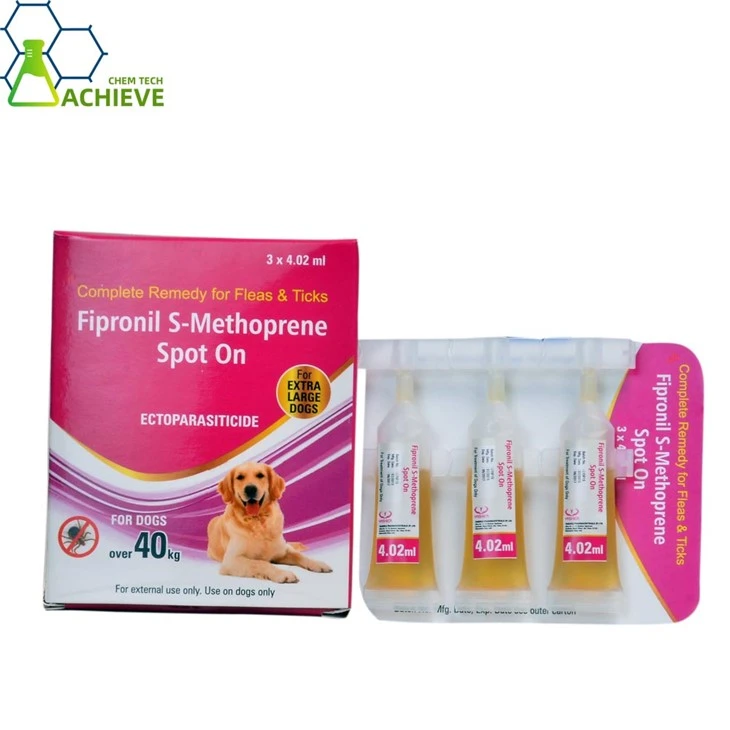


Shaanxi BLOOM Tech Co., Ltd. is one of the most experienced manufacturers and suppliers of fipronil spot-on in China. Welcome to wholesale bulk high quality fipronil spot-on for sale here from our factory. Good service and reasonable price are available.
Fipronil Spot-On is an efficient and convenient topical deworming solution for dogs and cats. Its core ingredient, fipronil, interferes with the normal functions of the parasites' central nervous system, causing them to become overly excited, paralyzed, and eventually die. This results in a potent contact killing effect against fleas (adults, larvae, eggs), lice, and various ticks. The product uses a precise local administration method, applying the liquid to the skin behind the pet's neck, which can then spread through the sebaceous glands to the entire body surface, forming a continuous protective barrier. A single application typically provides protection for up to one month. Its advantages lie in its combination of rapid and long-lasting effects. It not only quickly eliminates attached parasites but also effectively blocks the life cycle of fleas, preventing re-infection. When using it, it is essential to select the appropriate formula and dosage based on the pet's species (dog or cat) and weight, and ensure the skin is dry before and after application to prevent animals from licking each other. Due to its outstanding efficacy and ease of use, it has become a crucial defense line for safeguarding pet health and preventing zoonotic parasitic diseases.
|
|
|




Fipronil Powder COA


Fipronil Spot-On is an external deworming product widely used for pets (such as cats and dogs). Its core active ingredient is Fipronil, which belongs to the broad-spectrum insecticide of phenylpyrazole type. This product acts on the pet's skin through local application (Spot-On) and effectively controls parasitic infections such as fleas and ticks. The following elaborates on its manufacturing information from four aspects: raw materials, production process, quality control, and market application.
Raw Materials and Formula Design
The formula design of Fipronil Spot-On should take into account the long-lasting efficacy, skin safety, and ease of use. The core raw materials include:
Active ingredient: Fipronil, with a purity requirement of typically ≥ 95% to ensure the stability of the drug effect. Some products are compounded with other ingredients, such as S-Methoprene, which enhances the deworming effect by interfering with the development of flea larvae.
Solvents and carriers: Light mineral oil, isopropanol, etc. are used as solvents to assist in the uniform dispersion and penetration of fipronil into the skin stratum corneum. Some products may also add polyethylene glycol (PEG) or silicone oil to improve the product's extensibility and reduce skin irritation.
Stabilizers and preservatives: Antioxidants (such as BHT) are added to prevent the degradation of fipronil, and parabens are used as preservatives to extend the product's shelf life.
The formulation design must undergo skin irritation tests to ensure no allergic reactions to pets. For example, a certain brand product reduced the skin irritation index to 0.3 (on a 0-5 scale) by adjusting the solvent ratio, which is significantly better than industry standards.
Production Process Flow
The production of Fipronil Spot-On must strictly adhere to GMP (Good Manufacturing Practice for Pharmaceuticals). The key steps include:
Raw material pre-treatment: The raw materials of Fiproni need to be micronized, with the particle size controlled within 5-10 μm to enhance the dissolution rate. The solvent needs to be filtered through a 0.2 μm filter membrane to remove impurities.
Mixing and emulsification: Mix Fiproni with the solvent in a vacuum emulsification tank, maintaining a temperature of 40-50°C. Through high-speed shearing (3000-5000 rpm), a stable emulsion is formed. This process requires continuous monitoring of viscosity (target value: 500-1000 mPa·s) to ensure the product is easy to apply.
Filling and packaging: Use an automated filling line to fill the emulsion into plastic dropper bottles. The single bottle capacity is designed based on the pet's weight (e.g., 0.5 mL per bottle for cats, 1.0-4.0 mL per bottle for dogs). Packaging must pass the drop test (1m height, 6 drops per side), ensuring no leakage during transportation.
The production environment needs to maintain a positive pressure (≥10 Pa), temperature and humidity (temperature 20-25°C, humidity 40-60%), and regular microbiological testing (such as total colony count ≤ 100 CFU/g).
Quality Control System
The quality control for Fipronil Spot-On is carried out throughout the entire process. Key indicators include:

Active ingredient content
The content of filprofen is detected using high-performance liquid chromatography (HPLC), with an allowable error range of 90% - 110% of the labeled amount. For example, if the labeled content of a certain batch of product is 9.8%, the measured value should be within 8.82% - 10.78%.

Stability test
The product's shelf life is evaluated through accelerated testing (40°C / 75% RH, 6 months). The test shows that the annual average degradation rate of filprofen content is ≤ 2%, ensuring stable efficacy within the 3-year shelf life.

Skin safety
Through rabbit skin irritation test (OECD 404), a score of ≤ 2 (0 - 4 point scale) is considered qualified. A certain product was tested, and the scores for skin redness and edema after 24 hours were both 0, proving its low irritation.
Market Application and Product Innovation
Fipronil Spot-On occupies approximately 35% of the global pet deworming market. Its success stems from continuous innovation:
Long-lasting formula
By optimizing the solvent system, the duration of the drug effect has been extended to 8 weeks (compared to 4 weeks in traditional products), reducing the frequency of medication use.
Multi-species coverage
Complementing with new insecticides (such as cypermethrin), triple protection against fleas, ticks, and mites is achieved. Clinical trials show a deworming rate of ≥ 98%.
Environmentally friendly packaging
Using degradable plastic droppers reduces environmental burden. A certain brand, through this design, has reduced packaging waste by 40%.

Technical Challenges and Future Directions
The current manufacturing faces two major challenges: First, the raw material cost of Fipronil fluctuates (increasing by 25% from 2020 to 2025), and process optimization is needed to reduce per-unit consumption; second, some pets are allergic to solvents, and a water-based formula needs to be developed. In the future, nanotechnology (such as Fipronil loaded liposomes) may become a breakthrough point, improving drug efficacy by controlling release and reducing the amount of skin contact.
Conclusion
The manufacturing of Fipronil Spot-On integrates chemical engineering, dermatology and environmental protection technologies. Its success stems from the balance between efficacy, safety and sustainability. As the pet market continues to grow (with a global scale expected to reach 30 billion US dollars by 2025), this product will continue to strengthen its market position through technological innovation.
Differences in skin thickness, hair follicle density, and sebum secretion
The effect of Fipronil Spot-On (non-pirothion topical solution) on the skin of pets such as cats and dogs is closely related to factors such as skin thickness, hair follicle density, and sebum secretion volume. These physiological differences directly affect the drug's penetration efficiency, distribution range, and persistence, and are the core basis for formulating cross-species medication plans.
Skin Thickness: Barrier Strength Determines Drug Permeation Rate
There is a significant difference in skin thickness between cats and dogs, which directly affects the efficiency of non-piroplenic penetration. The average thickness of canine skin ranges from 0.5 to 2 mm, with the back skin being thicker (approximately 1.5 to 2 mm) and the abdomen being thinner (0.5 to 1 mm); cat skin is thinner, with an average thickness of 0.3 to 1 mm, and the neck skin is the thinnest (approximately 0.3 to 0.5 mm).
Mechanism of Action: Non-piroplenic drugs need to penetrate the keratin layer (composed of dead keratinocytes) to reach the active epidermal layer and combine with the oils in the sebaceous glands. The thicker back skin of dogs may delay drug penetration, but the thinner skin of cats, although it has a faster penetration rate, due to the more closely arranged keratinocyte cells, the actual penetration volume may not be higher. For example, studies have shown that 0.5 ml of non-piroplenic drug drops have a penetration rate of only 15% higher in cat neck skin compared to dog back skin within 24 hours, but cat skin has a higher blood flow, which may accelerate drug absorption.
Hair Follicle Density: Variations in Drug Storage Capacity
Hair follicles are the carriers of sebaceous glands, and their density determines the "storage capacity" of non-piroplaxin in the skin. The density of canine hair follicles is 30-50 per square centimeter, while that of feline hair follicles is 50-80 per square centimeter. Moreover, feline hair follicles are more densely distributed on the neck and back.
Mechanism of Action: Non-piroplaxin diffuses through sebum to the hair follicles, forming a "drug storage depot" that continuously releases to the skin surface. The high hair follicle density in cats results in a more uniform distribution of the drug, but after a single administration, the drug residue in the cat's skin is 20%-30% higher than that in dogs. For example, the drug concentration in the cat's neck skin from a 0.5ml dropper can reach 0.12mg/cm², while it is only 0.08mg/cm² on the dog's back. This difference leads to a longer duration of drug efficacy in cats (about 8 weeks, while dogs have about 6 weeks).
Sebum Secretion Volume: The "Power Source" for Drug Release
The amount of sebum secretion directly affects the release rate of non-piroplamides. The sebum secretion rate for dogs is 0.5-1 mg per square centimeter per day, while for cats it is 1-2 mg per square centimeter per day. Moreover, the composition of cat sebum (containing more squalene) is more conducive to drug dissolution.
Mechanism of Action: Non-piroplamides are highly lipophilic drugs that need to bind to sebum to achieve sustained release. The high sebum secretion in cats ensures a more stable drug release. For example, 30 days after administration, the drug concentration on the surface of cat skin can still maintain 60% of the initial concentration, while for dogs it only maintains 40%. However, excessive sebum may cause the drug to accumulate at the hair follicle opening, forming crystals, which in turn reduces the release efficiency. In clinical practice, about 5% of cats experience hair adhesion at the administration site, which is related to excessive sebum.
Balancing Strategies for Cross-Species Drug Administration
Based on these differences, the dosage design of Fipronil Spot-On needs to strike a balance between efficacy and safety:
For cats only
Fixed dosage of 0.5ml, suitable for all body weight ranges. Due to the thin skin and dense hair follicles of cats, a low dose can achieve an effective concentration.

For dogs
Divided into four grades based on body weight: 0.67ml, 1.34ml, 2.68ml, and 4.02ml. This compensates for the thick skin and low sebum secretion of dogs. For example, a 40kg dog needs 4.02ml to ensure a drug concentration of 0.08mg/cm² on the back skin, which is equivalent to the concentration on the cat's neck.

Site selection
For dog medication, it should be dripped onto the areas with many hair follicles on the neck and back. For cats, it should be dripped onto areas that the cat cannot lick, balancing efficacy and safety.

Hot Tags: fipronil spot-on, suppliers, manufacturers, factory, wholesale, buy, price, bulk, for sale