




Shaanxi BLOOM Tech Co., Ltd. is one of the most experienced manufacturers and suppliers of desmopressin spray in China. Welcome to wholesale bulk high quality desmopressin spray for sale here from our factory. Good service and reasonable price are available.
Desmopressin Spray is a synthetic vasopressin analogue administered intranasally, characterized by its convenient and efficient spray formulation. It is a clear, colorless solution equipped with a metered-dose spray pump, which delivers a precise 10 μg dose of desmopressin per 0.1 mL spray. The dosage is controllable and administration is user-friendly, requiring no professional operation and allowing self-administration by patients.
Our Products Form


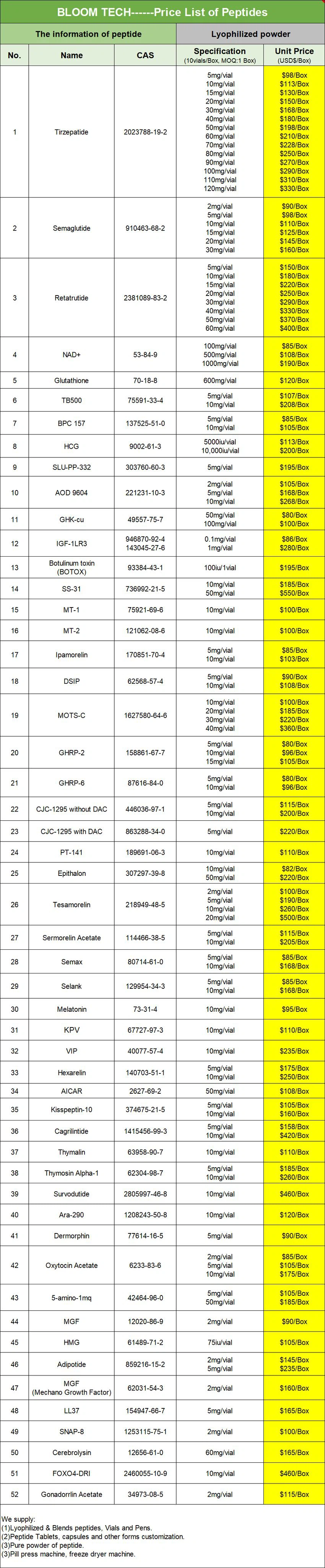
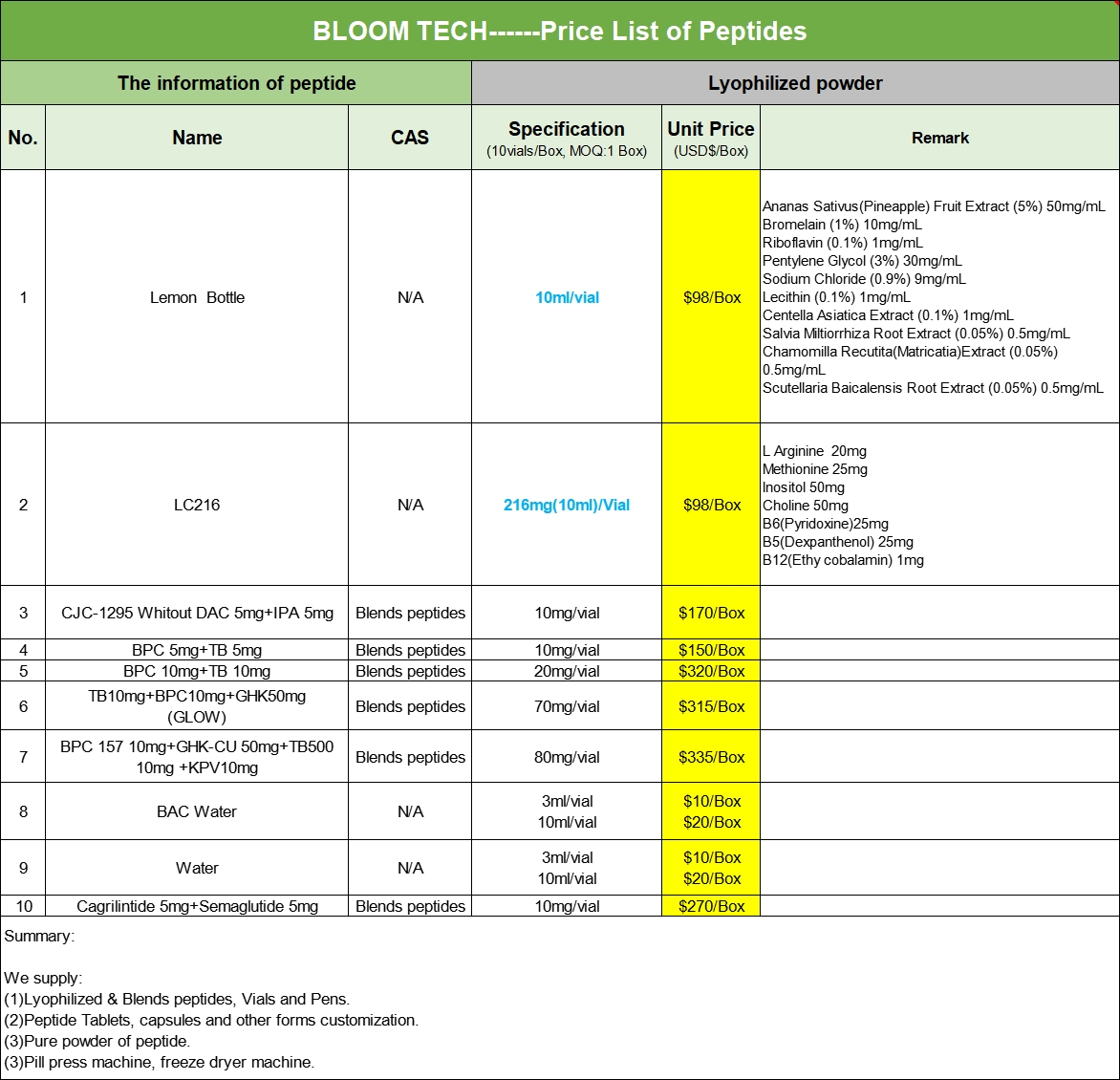

Desmopressin COA


Application as an Alternative to Behavioral Therapy

Behavioral therapies (including bedwetting alarms, bladder training, reward systems, etc.) are first-line interventions for conditions such as nocturnal enuresis and nocturnal polyuria associated with central diabetes insipidus. Their core mechanism is to help patients establish normal micturition reflexes and nighttime urinary control through reinforced behavioral intervention, with the advantages of being free from drug side effects and suitable for long-term management.
However, in clinical practice, some patients cannot tolerate behavioral therapy due to individual differences, disease characteristics, or environmental constraints, or show poor responses after standardized intervention. In such cases, Desmopressin Spray, as a safe and convenient pharmacological intervention, has become the preferred alternative to behavioral therapy.
As a synthetic vasopressin analogue, the product acts precisely on the body's antidiuretic system via its unique intranasal formulation, providing rapid symptom relief and filling the application gap of behavioral therapy. Its use as an alternative to behavioral therapy is supported by clear clinical evidence and practical value.

Specific Clinical Scenarios for Replacing Behavioral Therapy

Based on clinical practice and authoritative guidelines, the use of the product as an alternative to behavioral therapy mainly applies to two categories: patients unsuitable for behavioral therapy and those unresponsive to behavioral therapy. Dosing regimens and precautions vary across scenarios to ensure the safety and effectiveness of alternative treatment.
First Core Scenario: Patients Unsuitable for Behavioral Therapy
These patients are not necessarily unresponsive to behavioral therapy but cannot receive standardized behavioral intervention due to physical or environmental limitations. They mainly fall into three groups:
1. Children unable to cooperate with behavioral therapyEspecially young children aged 4–6 years with immature cognitive development, who cannot understand the purpose of behavioral training and refuse to use bedwetting alarms, undergo bladder training, or be awakened at night. The product can serve as the first-choice alternative, as effective treatment can be achieved with family-assisted administration without active cooperation from the child.Clinical Practice Guideline for Integrated Traditional Chinese and Western Medicine in Pediatric Enuresis (2025) states that desmopressin-based medications may be prioritized for young children with enuresis who cannot cooperate with behavioral therapy; among them, the nasal spray is more suitable for children due to its ease of use.


2. Patients with physical defects or underlying diseasesFor example, patients with central diabetes insipidus, who suffer from insufficient antidiuretic hormone secretion, cannot improve urine concentration through behavioral therapy. The product can directly replace antidiuretic hormone as a long-term treatment. For patients with neurogenic bladder, who cannot establish normal micturition reflexes through behavioral training due to abnormal bladder function, the product reduces nocturnal urine volume and relieves enuresis.According to the Chinese Expert Consensus on Clinical Diagnosis and Treatment of Nocturia (2018), desmopressin-based medications are the first-line treatment for nocturnal polyuria caused by insufficient antidiuretic hormone secretion and can effectively replace behavioral therapy by addressing the underlying cause.
3. Patients with environmental constraintsAdults with frequent business travel or those living in shared accommodations, where bedwetting alarms may disturb others and nighttime awakening training is impractical. Desmopressin Spray enables convenient administration and rapid control of nocturnal polyuria without affecting others, making it an ideal alternative.

Second Core Scenario: Patients Unresponsive to Behavioral Therapy
These patients show no significant improvement or fail to reach clinical expectations in enuresis or nocturnal polyuria after standardized behavioral intervention (usually 3–6 months), requiring timely switching of treatment regimens. The product is the preferred alternative drug in clinical practice.

1. Children with monosymptomatic nocturnal enuresis unresponsive to bedwetting alarm therapyMost of these patients have abnormal nocturnal antidiuretic hormone secretion rhythm or a high sleep arousal threshold. Even with long-term alarm training, they cannot establish a normal awakening reflex. The product supplements nocturnal antidiuretic hormone, reduces nighttime urine output, and fundamentally reduces enuresis frequency.A meta-analysis on ResearchGate showed that bedwetting alarms were slightly superior to it in per-protocol analysis. However, due to a dropout rate 2.2 times higher for alarm therapy, the efficacy was comparable in intention-to-treat analysis. It is the best alternative for patients unresponsive to alarm treatment.
2. Patients with central diabetes insipidus or nocturnal polyuria unresponsive to behavioral therapiesSuch as bladder training and reward systems. The root cause lies in deficient or abnormal antidiuretic hormone secretion, which cannot be corrected by behavioral therapy. The product acts directly on the kidneys to regulate water metabolism and effectively relieve symptoms.A study by Tehran University of Medical Sciences showed that it nasal spray effectively controls daytime and nighttime polyuria in patients with central diabetes insipidus with stable efficacy, providing a significant alternative effect for patients unresponsive to behavioral therapy.

Precautions and Authoritative Standards for Alternative Application
Although the product offers significant advantages as an alternative to behavioral therapy, its clinical use must strictly follow authoritative guidelines to ensure medication safety, avoid adverse reactions, and maintain rational and effective alternative treatment.

1. Strictly control contraindications and cautious-use populations
The product is contraindicated in patients with cardiac insufficiency, severe hypertension, hyponatremia, primary polydipsia, polyuria due to alcohol abuse, type IIb von Willebrand disease, or thrombotic thrombocytopenic purpura (TTP).It should be used with caution in pregnant women, patients with coronary heart disease, renal insufficiency, or cystic fibrosis, who require close monitoring and dose adjustment.For patients with nasal diseases (e.g., severe rhinitis, nasal congestion), the nasal cavity should be cleared first to avoid impaired absorption. If nasal conditions are severe, switching to an alternative formulation is recommended to ensure efficacy.
2. Standardize dosage and administration
The dosage of the product should be individualized based on age and disease severity.A 2025 study published by the National Center for Biotechnology Information (NCBI) noted that although it nasal spray had its indications adjusted due to a relatively high incidence of adverse reactions when used for nocturnal enuresis, it exhibits good safety and a low adverse reaction rate under standardized dosage and fluid restriction. Adverse events are mainly mild headache and nasal irritation, which resolve spontaneously without specific treatment after drug withdrawal.


3. Emphasize combined intervention and long-term managementAs an alternative to behavioral therapy, Desmopressin Spray does not completely replace behavioral intervention. Concomitant simple behavioral instructions (e.g., reduced fluid intake before bedtime, regular schedule) can further enhance therapeutic efficacy.Patients on long-term therapy require regular monitoring of serum electrolytes, urine osmolality, and renal function. Dosage should be adjusted according to symptom improvement to avoid adverse reactions such as fluid retention and hyponatremia caused by long-term excessive use.The Chinese Expert Consensus on Clinical Diagnosis and Treatment of Nocturia (2018) recommends that alternative therapy with desmopressin-based medications should be individualized based on patient condition and accompanied by regular follow-up to ensure safe and effective use.

I. A Core Method for Pharmaceutical Quality Control
HPLC is the preferred routine quality control method for desmopressin formulations (tablets, injections), mainly applied for assay determination, related substance screening, and dissolution testing. A C8 column is commonly used, with phosphate buffer and acetonitrile as the mobile phase. After optimization, this method eliminates excipient interference and achieves efficient separation between the main peak and impurities.With excellent precision and accuracy, it is suitable for rapid testing of batch formulations and is a statutory test method specified in the Chinese Pharmacopoeia (2020 Edition) and imported drug registration standards.

Information source: Related 2025 studies in Chinese Journal of Pharmacovigilance and 2025 method validation studies published by the National Center for Biotechnology Information (NCBI).
II. In Vivo Analysis and Stereoisomer Separation
Hyphenated mass spectrometry techniques (e.g., LC‑MS, IM‑MS) are mainly used for plasma concentration determination of it in vivo and stereoisomer identification.
LC‑MS/MS enables low-concentration detection (pg level). After pretreatment such as protein precipitation and solid‑phase extraction, it can accurately quantify drug levels in plasma and support pharmacokinetic studies.
Ion Mobility Mass Spectrometry (IM‑MS) allows rapid separation of it stereoisomers, distinguishing enantiomers based on differences in gas‑phase collision cross‑section, ensuring high detection specificity.
These methods comply with relevant FDA validation standards and are widely used in therapeutic drug monitoring and anti‑doping testing.
Information source: 2026 PMC studies, 2025 Wiley pharmacokinetic analysis, and 2026 technical documents from Merck Millipore.
References
Cochrane. Simple treatments for bedwetting in children. 2026.
Chinese Expert Consensus Working Group on Clinical Diagnosis and Treatment of Nocturia.Chinese Journal of Urology, 2018, 39(8): 561–564.
Electronic Medicines Compendium (emc). Desmopressin Spray 10 micrograms/dose Nasal Spray solution. 2025.
Shang-jen Chang, et al. Systematic Review and Meta-analysis of Alarm versus Desmopressin Therapy for Pediatric Monosymptomatic Enuresis. ResearchGate, 2025.
National Center for Biotechnology Information (NCBI). Desmopressin and the management of bedwetting. 2025.
FAQ
What is the age limit for it?
+
-
It can be used in children from five years of age who are able to comply with fluid restriction for an hour prior to its administration and for eight hours after.
What happens when you stop taking it?
+
-
The management can be complex, as discontinuation of it can lead to profuse diuresis and a rapid rise in sodium levels as a result of suppressed antidiuretic hormone levels.
Hot Tags: desmopressin spray, suppliers, manufacturers, factory, wholesale, buy, price, bulk, for sale