




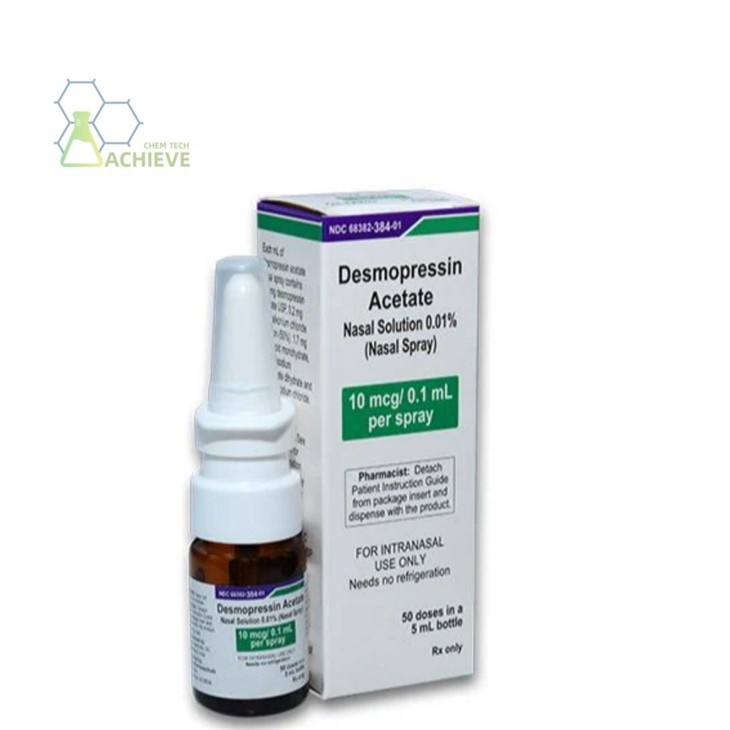

Shaanxi BLOOM Tech Co., Ltd. is one of the most experienced manufacturers and suppliers of desmopressin acetate spray in China. Welcome to wholesale bulk high quality desmopressin acetate spray for sale here from our factory. Good service and reasonable price are available.
Desmopressin acetate spray represents a clinically essential therapeutic pharmaceutical agent that undertakes a central modulatory function within the standardized diagnosis and treatment system for a wide spectrum of bleeding-related diseases and abnormal hemorrhagic conditions across multiple clinical departments. From a chemical structural perspective, this preparation is artificially synthesized to serve as a structural analog of arginine vasopressin, the natural endogenous antidiuretic and vasoactive hormone naturally secreted inside the human hypothalamic-pituitary system.
Once delivered via nasal mucosal absorption after spray administration, the active ingredient can selectively bind to specific receptors distributed on vascular endothelial cells and other interstitial vascular tissue components, thereby activating intracellular signaling pathways to induce the rapid release of two indispensable bioactive substances for hemostasis, namely coagulation factor VIII and von Willebrand factor, commonly abbreviated as VWF. This distinct pharmacological cascade can raise the plasma functional activity of coagulation factor VIII to a level two to six times higher than the original baseline value before medication, accompanied by a marked, measurable increase in the concentration of circulating von Willebrand factor within peripheral blood.
Our Products Form


Desmopressin Acetate COA
 |
||
| Certificate of Analysis | ||
| Compound name | Desmopressin Acetate | |
| Grade | Pharmaceutical grade | |
| CAS No. | 16789-98-3 | |
| Quantity | 30g | |
| Packaging standard | PE bag+Al foil bag | |
| Manufacturer | Shaanxi BLOOM TECH Co., Ltd | |
| Lot No. | 202601090055 | |
| MFG | Jan 9th 2026 | |
| EXP | Jan 8th 2029 | |
| Structure |
|
|
| Item | Enterprise standard | Analysis result |
| Appearance | White or almost white powder | Conformed |
| Water content | ≤5.0% | 0.48% |
| Loss on drying | ≤1.0% | 0.30% |
| Heavy Metals | Pb≤0.5ppm | N.D. |
| As≤0.5ppm | N.D. | |
| Hg≤0.5ppm | N.D. | |
| Cd≤0.5ppm | N.D. | |
| Purity (HPLC) | ≥99.0% | 99.90% |
| Single impurity | <0.8% | 0.56% |
| Total microbial count | ≤750cfu/g | 170 |
| E. Coli | ≤2MPN/g | N.D. |
| Salmonella | N.D. | N.D. |
| Ethanol (by GC) | ≤5000ppm | 400ppm |
| Storage | Store in a sealed, dark, and dry place below -20°C | |
|
|
||
|
|
||


| Chemical Formula: | C50H72N14O16S2 |
| Exact Mass: | 1188 |
| Molecular Weight: | 1189 |
| m/z: | 1188 (100.0%), 1189 (49.8%), 1070 (12.1%), 1070 (9.0%), 1069 (5.2%), 1071 (4.5%), 1070 (2.6%), 1070 (2.5%), 1069 (1.6%), 1071 (1.2%), 1071 (1.1%), 1072 (1.1%) |
| Elemental Analysis: | C, 51.67; H, 6.03; N, 18.34; O, 17.96; S, 6.00 |

The substantially elevated VWF content further reinforces the adhesion capacity of circulating platelets at the damaged sites of blood vessel walls, synergistically improving platelet aggregation performance and comprehensively regulating the whole-body blood coagulation cascade. Through the above multi-link regulatory effects on hemostatic factors and platelet function, the spray can steadily generate stable, predictable and effective hemostatic effects to control acute and persistent bleeding symptoms in clinical practice.
It is widely used in the treatment of various hemorrhage diseases. For patients with mild to moderate hemophilia A, it can control minor daily hemorrhage such as nosebleeds and gum hemorrhage, and can also be used for preventing hemorrhage before small surgeries and stopping hemorrhage during surgery. After use, patients with hemophilia can improve symptoms such as nosebleeds and excessive menstruation, and reduce their dependence on blood transfusion products. In terms of platelet dysfunction related hemorrhage, whether induced by drugs (such as antiplatelet drugs).


Or diseases (such as uremia and cirrhosis), it can reduce the risk of hemorrhage by enhancing platelet adhesion. In addition, for patients with unexplained prolonged hemorrhage, it can be used as an experimental treatment drug to assist in determining the cause of hemorrhage.Hemorrhagic diseases are a type of disease that seriously affects the health and safety of patients, covering various etiologies and pathological mechanisms. Effective hemostasis management is crucial for improving patient prognosis. As a drug with a unique mechanism of action, it plays an important role in the management of hemorrhagic diseases.
Mechanism of action
Desmopressin acetate spray is a structural analogue of natural arginine vasopressin and a derivative of vasopressin. It exerts hemostatic effects through a series of complex physiological processes, and its key mechanism is to promote the release of coagulation factors from storage sites such as vascular endothelium, increasing the activity of coagulation factor VIII in plasma by 2-6 times. At the same time, it increases the concentration of von Willebrand factor (VWF) and tissue plasminogen activator, and significantly increases platelet adhesion. This mechanism of action makes it potentially valuable for the treatment of various hemorrhagic diseases.

Application in hemophilia - Mild to moderate hemophilia A

It is an important treatment for mild to moderate hemophilia A patients. Hemophilia A is a hemorrhagic disease caused by a deficiency of coagulation factor VIII, and patients often experience spontaneous or mild hemorrhage after trauma. By stimulating the release of endogenous coagulation factor VIII, the activity of coagulation factor VIII in plasma is increased, thereby improving the coagulation function of patients and reducing the occurrence of hemorrhage events. For such patients, using it can effectively control minor bleeding during daily activities, such as nosebleeds, gum hemorrhage, etc., and improve the patient's quality of life. Related studies have reported its efficacy and safety in the treatment of hemophilia A, providing practical basis.
Von Willebrand (VWD)
Von Willebrand is a common hereditary hemorrhagic disease, mainly caused by a deficiency or functional abnormality of von Willebrand factor (VWF). It also plays an important role in the treatment of hemophilia. It can promote the release of VWF from endothelial cells, increase the level and activity of VWF in plasma, and enhance platelet adhesion function, thereby improving the hemostatic ability of patients. For patients with mild to moderate hemophilia, it can be used to control common hemorrhage symptoms such as nosebleeds, gum hemorrhage, and excessive menstruation, reduce patients' dependence on blood transfusion products, and lower the risk of infection. Related studies have explored its application effect and dosage adjustment methods in the treatment of hemophilia, providing guidance for rational drug use in clinical practice.


Preoperative prevention of bleeding and intraoperative hemostasis
The use of it can effectively prevent intraoperative hemorrhage in patients with mild to moderate hemophilia A and hemophilia before undergoing minor surgeries or invasive procedures. By increasing the levels of coagulation factor VIII and VWF in plasma in advance, the patient's coagulation function is enhanced.
During the surgery, depending on the patient's specific condition, timely re administration can be given to maintain sufficient levels of coagulation factors and ensure the smooth progress of the surgery. Related studies have reported on its application cases and effectiveness evaluation in preventing hemorrhage before surgery and stopping hemorrhage during surgery, demonstrating its effectiveness in surgical management.


Desmopressin acetate spray may also have some therapeutic effects on individuals with moderate to severe hemophilia A and hemophilia. However, its efficacy may vary depending on individual differences and needs to be evaluated and monitored according to the specific situation of the patient. During use, the patient's hemorrhage and coagulation function indicators should be closely monitored, and the treatment plan should be adjusted in a timely manner. Related studies have focused on its application effectiveness and safety in patients with special conditions, providing reference for the expansion of clinical applications.
Application in platelet dysfunction related bleeding
(1) Drug induced platelet dysfunction
The use of certain medications such as antiplatelet drugs (aspirin, clopidogrel, etc.) may lead to inhibition of platelet function and increase the risk of hemorrhage. For patients who experience mild hemorrhage symptoms due to the use of these drugs, enhancing platelet adhesion and improving platelet hemostatic function can reduce bleeding. For example, in the long-term use of aspirin for antiplatelet therapy in patients with coronary heart disease, if there is nosebleeds, gum hemorrhage, etc.


It can be considered for hemostatic treatment. Related studies have explored its potential and mechanism of action in drug-induced platelet dysfunction hemorrhage, providing new ideas for clinical management of such hemorrhage.
(2) Abnormal platelet function caused by uremia, cirrhosis, etc
Diseases such as uremia and cirrhosis are often accompanied by abnormal platelet function, and patients are prone to hemorrhage. It also has certain application value in the treatment of hemorrhage related to these diseases.
It can significantly optimize the adhesion and aggregation functions of circulating platelets, thereby remarkably boosting the overall hemostatic performance of the body. As a typical clinical application scenario, hemodialysis patients suffering from uremia often face persistent oozing and continuous hemorrhage at vascular puncture sites after dialysis procedures, and this preparation can be applied as an effective auxiliary hemostatic agent to control such hemorrhage conditions promptly.


Multiple clinical research papers and retrospective trials have documented abundant real-world application cases and systematic efficacy observations regarding its intervention against bleeding symptoms induced by platelet dysfunction stemming from chronic diseases including uremia and liver cirrhosis.
These accumulated clinical data deliver solid practical evidence and theoretical support to guide standardized clinical medication and comprehensive treatment planning for relevant hemorrhagic complications.
Application in prolonging unexplained bleeding time
For patients with unexplained prolonged bleeding, it can be used as an experimental treatment drug. Observing the changes in bleeding time after medication use can help determine whether the cause of bleeding is related to coagulation factor deficiency or platelet dysfunction. If the bleeding time is significantly shortened after use, it suggests the possibility of release disorders of coagulation factor VIII or VWF, providing clues for further diagnosis and treatment. Related studies have explored its application value in the diagnosis and treatment of patients with prolonged unexplained bleeding, providing a method for clinical management of such difficult cases.


Desmopressin acetate spray has wide application value in the management of hemorrhagic diseases. By promoting the release of coagulation factors and von Willebrand factor, enhancing platelet function, it plays an important role in the treatment of various bleeding disorders such as mild to moderate hemophilia A, von Willebrand, platelet dysfunction related bleeding, and prolonged unexplained bleeding time. However, it is necessary to pay attention to water intake restrictions, dosage adjustments, and drug interactions during use, and strictly adhere to contraindications to ensure the safety and efficacy of medication for patients.
References
1-deamino-8-d-arginine vasopressin: a new pharmacological approach to the management of haemophilia and von Willebrands' diseases, 1977
Treatment of Central Diabetes Insipidus in Adults and Children With Dasmopressin: A Synthetic Analogue of Vasopressin, 1978
Dasmopressin acetate (DDAVP) for preventing and treating acute bleeds during pregnancy in women with congenital bleeding disorders, 2013
Effects of dasmopressin acetate and pituitrin on proliferation, contraction, and secretion of hepatic stellate cells (https://pmc.ncbi.nlm.nih.gov/articles/PMC12770225//0
FAQ
Q1: What are the core indications of dasmopressin acetate?
A1: This pharmaceutical agent is clinically indicated for the systematic treatment of three major types of disorders, including central diabetes insipidus triggered by insufficient endogenous vasopressin secretion in the hypothalamus-pituitary axis, primary nocturnal enuresis in children and adolescents without organic urinary tract lesions, as well as mild congenital bleeding disorders such as mild type I von Willebrand disease and mild hemophilia A accompanied by platelet adhesion dysfunction.
Q2: How does dasmopressin acetate produce its antidiuretic effect?
A2: It activates renal V2 receptors to reduce urine volume and raise urine osmolarity.
Q3: What is the key safety precaution during medication?
A3: Strict fluid intake control to prevent hyponatremia and water retention.
Hot Tags: desmopressin acetate spray, suppliers, manufacturers, factory, wholesale, buy, price, bulk, for sale