




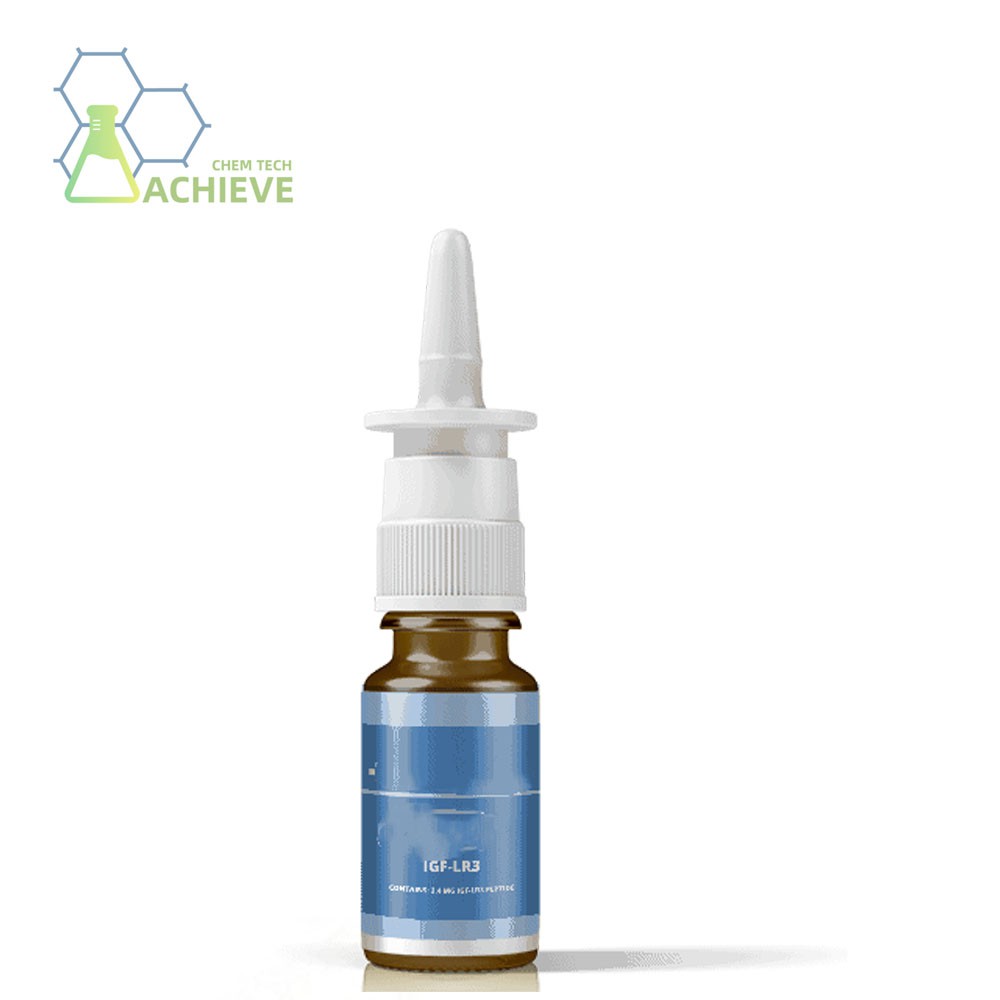
The core component of IGF 1 LR3 Spray is IGF-1 LR3 (Long R3 Insulin like Growth Factor-1), a genetically engineered insulin-like growth factor-1 (IGF-1) analogue. It can reverse muscle loss by inhibiting protein breakdown and promoting muscle synthesis, but currently limited to preclinical studies. Animal experiments have shown that IGF-1 LR3 can improve muscle fiber structure, but human trials have not yet been conducted. The neurotrophic effect of IGF-1 LR3 may promote axonal regeneration and neuronal survival, but its ability to penetrate the blood-brain barrier needs further validation. It accelerates wound healing by stimulating fibroblast proliferation, but caution should be taken against the risk of hypoglycemia.
|
|
|


IGF 1 LR3 COA


Raw materials and genetic engineering modification
product key technologies

Gene source and host selection
IGF 1 LR3 Spray is produced through genetic recombination technology, and its gene sequence is modified based on human insulin-like growth factor-1 (IGF-1). The host for expression is usually selected from Escherichia coli (such as COH strains) or mammalian cells (such as CHO cells), among which the E. coli system is widely used due to its high efficiency and low cost in high-density fermentation.
Amino acid sequence modification
R3 mutation: The third amino acid of natural IGF-1 is glutamic acid (Glu), which is replaced by arginine (Arg) by IGF-1 LR3, forming the "R3" marker. This mutation significantly reduces its affinity for insulin-like growth factor binding proteins (IGFBPs), increases its free concentration by more than 1000 times, and enhances its biological activity by 2-3 times.
N-terminal extension: Add 13 amino acid residues at the end of the B chain to form a chain structure of 83 amino acids (some literature mentions 93 amino acids, which may be due to differences in purification processes or detection methods), further optimizing its function.

Fermentation and purification process
fermentation process
High density fermentation: Escherichia coli expression is induced by heat shock at 42 ℃, and the fermentation tank can reach a capacity of 50L. The target protein accounts for 30% -40% of the total bacterial protein.
Optimization of culture medium: Control the accumulation of metabolic byproducts (such as acetic acid) and improve product purity through feeding batch cultivation strategy.

Purification process
Rough and Pure Stage:
Ion exchange chromatography: utilizing protein charge difference separation to increase purity to over 90%.
Hydrophobic interaction chromatography: further removes impurities, achieving a purity of over 95%.
Pure stage:
Molecular exclusion chromatography (SEC-HPLC): Separate target proteins from dimers or oligomers with a purity of ≥ 95% (detected by SDS-PAGE).
Ultrafiltration concentration: Concentrate the protein using tangential flow filtration technology, while replacing the buffer with PBS (pH 7.4) system.
Terminal filtration: Use 0.22 μ m filter membrane for sterilization to ensure sterility.

quality control
Activity verification: The biological activity was measured by serum free proliferation test of MCF-7 human breast cancer cells, and the ED50 value was ≤ 1.5 ng/mL.
Purity testing: SDS-PAGE and SEC-HPLC combined detection, purity ≥ 95%.
Impurity control: endotoxin content ≤ 10 EU/mg, host protein residue ≤ 0.005%, exogenous DNA residue ≤ 10 ng/mg.

Preparation process and stability
Freeze drying protectant formula
Using 8% trehalose or 5% mannitol as freeze-drying protectants, combined with 0.01% Tween 80 (solubilizer), liquid protein is converted into white powder through freeze-drying technology, with a moisture content of less than 3%.
Stability guarantee
Long term storage
Freeze dried powder can be stored for 36 months at -20 ℃ to -80 ℃, and after reconstitution, it can be placed under sterile conditions at -20 ℃ to -80 ℃ for 6 months, and at 2 ℃ to 8 ℃ for 7-10 days.
Transportation conditions: Blue ice packs are refrigerated for transportation, ensuring that the temperature is maintained at 2-8 ℃ and avoiding repeated freezing and thawing.
Production equipment and GMP compliance
Core Equipment
Fermentation system: 50L fully automatic fermentation tank (equipped with pH, dissolved oxygen, temperature online monitoring system).
Purification system: AKTA Avant protein purifier (supporting automated chromatographic separation).
Preparation equipment: Mini Spray Dryer B-290 (spray dryer) or freeze-drying machine (for powder preparation).
Analytical instruments: HPLC-MS (molecular weight confirmation), dynamic light scattering analyzer (particle size distribution detection), enzyme-linked immunosorbent assay (ELISA).
GMP compliance
The production environment complies with the "Good Manufacturing Practice for Drugs (Revised in 2010)" and strictly controls indicators such as bacterial endotoxins and host protein residues.
Provide complete quality documentation, including COA (Certificate of Quality), MSDS (Safety Data Sheet), and regulatory support documents.
IGF 1 LR3 Spray distorts the metabolic phenotype and functional differentiation of glial cells
IGF 1 LR3 Spray is a preparation containing IGF-1 LR3 component, which is an artificially modified long-acting insulin-like growth factor. It has higher activity than natural IGF-1, a longer half-life in the body, and better growth promoting effects, which can promote the division, migration, and differentiation of most cells. In the field of medicine, IGF-1 LR3 has received widespread attention due to its unique biological characteristics and has been studied for exploring the therapeutic potential of various diseases.
Glial cells are an important component of the central nervous system, including microglia, astrocytes, and others. They play an indispensable role in maintaining the normal function of the nervous system, supporting neuronal survival, and participating in immune responses. The metabolic phenotype and functional status of glial cells are closely related to the health of the nervous system, and any factors that affect their metabolism and function may have a significant impact on the nervous system.
Metabolic phenotype and function of glial cells
Types and distribution of glial cells
The glial cells in the central nervous system mainly include microglia and astrocytes. Microglia are immune cells in the central nervous system, widely distributed throughout the brain and spinal cord. They act as the "guardians" of the nervous system, constantly monitoring changes in the surrounding environment and playing a crucial role in maintaining the immune homeostasis of the nervous system.Astrocytes are the most abundant type of glial cells in the central nervous system, possessing various forms and functions. Astrocytes form close connections with neurons, blood vessels, etc. through their processes, participate in the formation of the blood-brain barrier, provide nutritional support to neurons, regulate the uptake and metabolism of neurotransmitters, and have an important impact on the normal function of neurons and the transmission of neural signals.


Metabolic phenotype of normal glial cells
Under normal physiological conditions, glial cells have specific metabolic phenotypes. Microglia perform immune surveillance functions in a resting state, and their metabolic activity is relatively low, mainly relying on oxidative phosphorylation pathways to obtain energy. When stimulated by pathogen invasion, tissue damage, etc., microglia are activated, and their metabolic phenotype undergoes significant changes, shifting towards a metabolic mode dominated by glycolysis, rapidly producing energy and bioactive molecules to cope with external challenges.Under normal circumstances, the metabolic activity of astrocytes is adapted to the metabolic needs of neurons. They provide energy support for themselves and neurons through aerobic oxidation by ingesting glucose. At the same time, astrocytes also participate in the glutamate glutamine cycle, converting glutamate released by neurons into glutamine and transporting it back to neurons to synthesize glutamate again. This process is crucial for maintaining neurotransmitter balance and normal neuronal function.
Functions of glial cells
Glial cells have multiple important functions in the central nervous system. As immune cells, microglia can recognize and eliminate pathogens, damaged cells, and abnormal protein aggregates, and participate in the regulation of neuroinflammatory responses. During neural development, microglia also participate in synaptic pruning, helping to shape the normal connections of neural circuits.
The functions of astrocytes are more extensive. They not only provide nutritional and structural support for neurons, but also participate in regulating the release and uptake of neurotransmitters, maintaining neurotransmitter homeostasis. In addition, astrocytes regulate cerebral blood flow and participate in maintaining the function of the blood-brain barrier by interacting with blood vessels, protecting the nervous system from harmful substances in the periphery.

The effect of IGF-1 LR3 Spray on the distorted metabolic phenotype of glial cells

Changes in metabolic pathways
IGF-1 LR3 in IGF-1 LR3 Spray may activate downstream signaling pathways by binding to IGF-1 receptors on the surface of glial cells, thereby affecting the metabolic pathways of glial cells. In terms of energy metabolism, activation of the IGF-1 signaling pathway may promote the transition of glial cells from oxidative phosphorylation to glycolysis. Under normal circumstances, oxidative phosphorylation is the main way for cells to produce energy, with high efficiency but relatively slow speed; Although glycolysis produces less energy, it can quickly provide energy in a short period of time.
When IGF-1 LR3 acts on glial cells, it may upregulate the expression of glycolytic enzymes and enhance glycolytic activity by activating signaling pathways such as PI3K/Akt and Ras/MAPK. The alteration of this metabolic pathway may lead to a "distortion" in the energy supply mode of glial cells, resulting in abnormal regulation of energy metabolism when facing different physiological or pathological states.
Hot Tags: igf 1 lr3 spray, suppliers, manufacturers, factory, wholesale, buy, price, bulk, for sale