




Shaanxi BLOOM Tech Co., Ltd. is one of the most experienced manufacturers and suppliers of lypressin nasal spray in China. Welcome to wholesale bulk high quality lypressin nasal spray for sale here from our factory. Good service and reasonable price are available.
Lypressin nasal spray, as a synthetic peptide active substance, has targeted application scenarios in clinical diagnosis and treatment. Its auxiliary pituitary reserve function assessment, auxiliary pressor effect in shock state, and wide application of nasal spray all have unique pharmacological characteristics and clinical adaptability. The following will focus on these three core dimensions, combined with pharmacological mechanisms, clinical practice, and dosage form advantages, to provide a detailed explanation from multiple dimensions, helping to comprehensively understand their application value and characteristics.
Products Forms


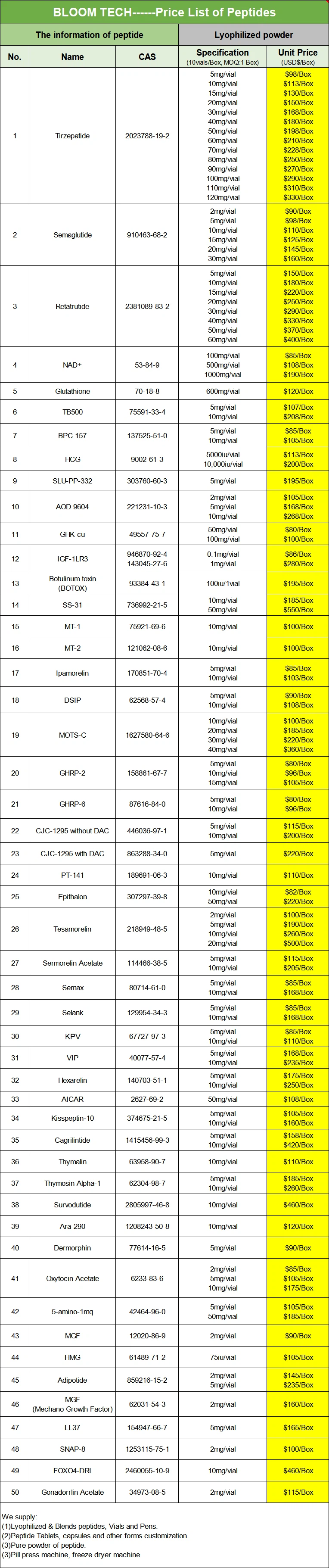
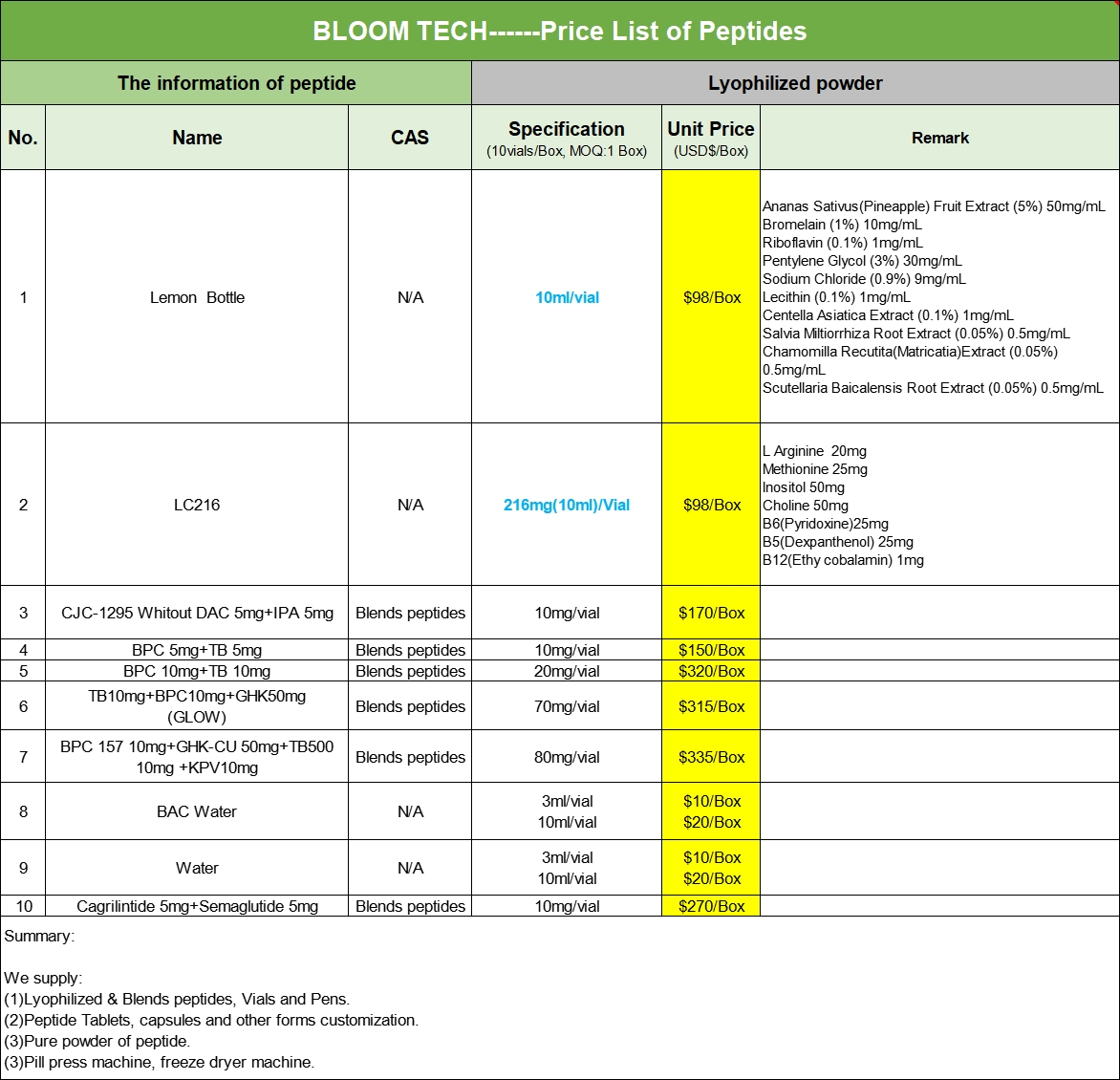

lypressin COA
 |
||
| Certificate of Analysis | ||
| Compound name | lypressin | |
| Grade | Pharmaceutical grade | |
| CAS No. | 50-57-7 | |
| Quantity | Customized | |
| Packaging standard | Customized | |
| Manufacturer | Shaanxi BLOOM TECH Co., Ltd | |
| Lot No. | 202501090065 | |
| MFG | Jan 9th 2026 | |
| EXP | Jan 8th 2029 | |
| Structure |  |
|
| Item | Enterprise standard | Analysis result |
| Appearance | White or almost white powder | Conformed |
| Water content | ≤5.0% | 0.54% |
| Loss on drying | ≤1.0% | 0.42% |
| Heavy Metals | Pb≤0.5ppm | N.D. |
| As≤0.5ppm | N.D. | |
| Hg≤0.5ppm | N.D. | |
| Cd≤0.5ppm | N.D. | |
| Purity (HPLC) | ≥99.0% | 99.98% |
| Single impurity | <0.8% | 0.52% |
| Total microbial count | ≤750cfu/g | 95 |
| E. Coli | ≤2MPN/g | N.D. |
| Salmonella | N.D. | N.D. |
| Ethanol (by GC) | ≤5000ppm | 500ppm |
| Storage | Store in a sealed, dark, and dry place below -20°C | |
|
|
||


The core mechanism and practical points of Lypressin assisted assessment of pituitary reserve potential
The auxiliary value of lypressin nasal spray in the assessment of pituitary reserve function lies in its specific stimulating effect on pituitary secretion function. It can indirectly reflect the pituitary secretion reserve capacity by accurately regulating the release of relevant hormones, providing reliable basis for clinical differential diagnosis. This can be carried out from three aspects:
The texture of the stimulating effect.
This can specifically act on pituitary related secretory cells, activating receptor-mediated signaling pathways to promote the release of adrenocorticotropic hormone and other related active substances from the pituitary gland. The intensity of its stimulation is positively correlated with the pituitary gland's own reserve capacity. If the pituitary reserve function is complete, the release of hormones will show a significant increase in response, otherwise the response will be weak or no response. This characteristic makes it an important auxiliary tool for evaluating pituitary function.


The practical path of clinical evaluation.
In clinical applications, low-dose this drug stimulation tests are commonly used. After subcutaneous injection or intravenous infusion, peripheral blood samples are collected at different time periods to detect the concentration change curve of relevant hormones. Combined with the peak value and rising rate of the curve, the integrity of pituitary reserve function is judged. Compared with other stimulation reagents, its effect is mild and specific, which can reduce interference with other systems of the body.
Evaluate the adaptation scenarios and limitations of the application.
This auxiliary evaluation method is mainly suitable for preliminary screening of suspected pituitary dysfunction, hypothalamic pituitary axis dysfunction and other diseases, especially for distinguishing hypothalamic and pituitary functional abnormalities, which has certain reference value. However, it should be noted that some patients may have false negative or false positive results due to individual differences, and comprehensive judgment should be made based on other clinical examination results. At the same time, for patients with severe pituitary damage, the stimulating effect may not be obvious, and the evaluation plan needs to be adjusted.

Source of information:
Lypressin spray: pharmacokinetics and clinical utility in pituitary function assessment
Clinical Observation and Analysis of Lysine Vasopressin Assisted Evaluation of Pituitary Reserve Function
Application Characteristics and Adaptation Scenarios of Lypressin in Shock Assisted Boosting
Lypressin has mild vasoconstrictive activity and can be used as an auxiliary pressor in shock. Its pressor effect has unique advantages compared to other pressor preparations, and there is also a clear clinical applicability range, which can be analyzed from three aspects:

01.The core mechanism of the boosting effect.
Lypressin nasal spray can selectively activate specific receptors on the surface of vascular smooth muscle, promote moderate contraction of peripheral blood vessels, thereby increasing peripheral vascular resistance and achieving the effect of assisting in hypertension elevation. Its vasoconstrictive effect has a certain degree of selectivity and has a weak impact on vascular contraction of important organs, which can to some extent avoid organ hypoperfusion caused by excessive vascular contraction.
02.Types of shock suitable for clinical use and timing of use.
This drug is mainly suitable for the adjuvant treatment of vasodilatory shock, especially for patients with poor response to adrenergic drugs in septic shock. It can be used as a second-line auxiliary pressor preparation to supplement vasoconstrictive effects, help maintain basal blood pressure in the body, and seize time for etiological treatment. The timing of use is often chosen during the stage when blood pressure cannot be maintained stably after fluid resuscitation. The dosage should be adjusted according to the patient's blood pressure level, heart rate, and organ perfusion situation.


03.The advantages and clinical limitations of assisted voltage boosting.
Its advantage lies in its mild and moderate duration of pressure boosting effect, which is less likely to cause sudden increases or decreases in blood pressure, and has less interference with the body's metabolism. Compared with potent pressure boosting agents, its incidence of adverse reactions is lower, making it suitable for long-term or intermittent auxiliary use.
The limitation is that the pressure boosting intensity is limited and cannot be used alone for the rescue of severe shock. It needs to be used in combination with other pressure boosting drugs, liquid resuscitation, and other treatment methods.
At the same time, for patients with severe insufficient blood volume, the pressure boosting effect will be significantly affected, and blood volume needs to be replenished before use.

Source of information:
CRH and lysine-vasopressin stimulation tests in the diagnosis of hypoadrenalism secondary to hypothalamic or pituitary disorders
Observation of the therapeutic effect of lysine vasopressin in assisting pressor in septic shock
Lypressin has become a commonly used clinical drug delivery mode
Lypressin's nasal spray is the most widely used in clinical application. The core reason is that it can perfectly adapt to the pharmacological characteristics of drugs, while taking into account the convenience of drug administration and clinical practicality, which can be carried out from three aspects:

The absorption advantage of nasal mucosal infiltration is that the surface of the nasal mucosa is rich in capillaries and mucosal epithelial cells. As a peptide substance, Lypressin nasal spray can quickly penetrate and absorb through the nasal mucosa, avoiding degradation and damage through the gastrointestinal tract during oral administration, improving the bioavailability of the drug, and the absorption rate is fast. It usually takes effect within one hour after administration, which can quickly meet clinical needs. Compared with injection administration, it does not require invasive procedures, reducing the pain and infection risk of patients.
Optimization of medication convenience and compliance. The nasal spray type is simple in operation and can be administered by patients themselves without the assistance of professional medical staff. It is especially suitable for patients who need long-term medication or home care, effectively improving medication compliance. At the same time, the spray type can achieve precise control of the dose. Each spray dose is fixed, and can flexibly adjust the number and dose of medication according to the patient's condition needs, avoiding adverse reactions caused by dose deviation.The safety and clinical compatibility of the dosage form. Nasal mucosa administration belongs to the local administration mode.


The drug mainly enters the blood circulation after local absorption. The systemic exposure is low, which can significantly reduce the incidence of systemic adverse reactions. Moreover, the irritation of the dosage form to the nasal mucosa is weak, and long-term use of the dosage form is not easy to lead to serious local damage. Only a few patients may have mild nasal congestion, mucosal irritation and other symptoms, which can be quickly alleviated after drug withdrawal. In addition, the storage and carrying of the spray form are relatively convenient, suitable for clinical emergency, outpatient, home and other scenarios, further improving its clinical applicability.
Source of information:
Nasal absorption characteristics of lypressin and its influence factors
Exploration of the Application Value of Lysine Vasopressin in Pituitary Reserve Function Stimulation Test
References
The role of lypressin in adjuvant treatment of vasodilatory shock
Pharmacokinetic characteristics and clinical application of lysine vasopressin in nasal spray
Lypressin: clinical application progress in adjuvant treatment of shock and pituitary function assessment
FAQ
A: Patients with severe dehydration and electrolyte imbalance prior to evaluation may inhibit pituitary secretion response, leading to false negative evaluation results; In addition, patients who use glucocorticoids and other medications for a long time may interfere with the excitatory effect of Lypressin, affecting the accuracy of the assessment. It is recommended to discontinue the relevant interfering drugs before the assessment and correct dehydration and electrolyte imbalances.
A: Before administration, it is necessary to clean the nasal cavity, remove nasal secretions, and avoid secretions obstructing the contact between the drug and the nasal mucosa; When administering medication, the nozzle should face the outer wall of the nasal cavity, avoiding direct alignment with the nasal septum to prevent uneven distribution of medication; After administration, gently press the sides of the nose to promote drug penetration and absorption. At the same time, avoid blowing your nose, drinking water, or eating immediately to ensure that the drug has sufficient absorption time.
Hot Tags: lypressin nasal spray, suppliers, manufacturers, factory, wholesale, buy, price, bulk, for sale