


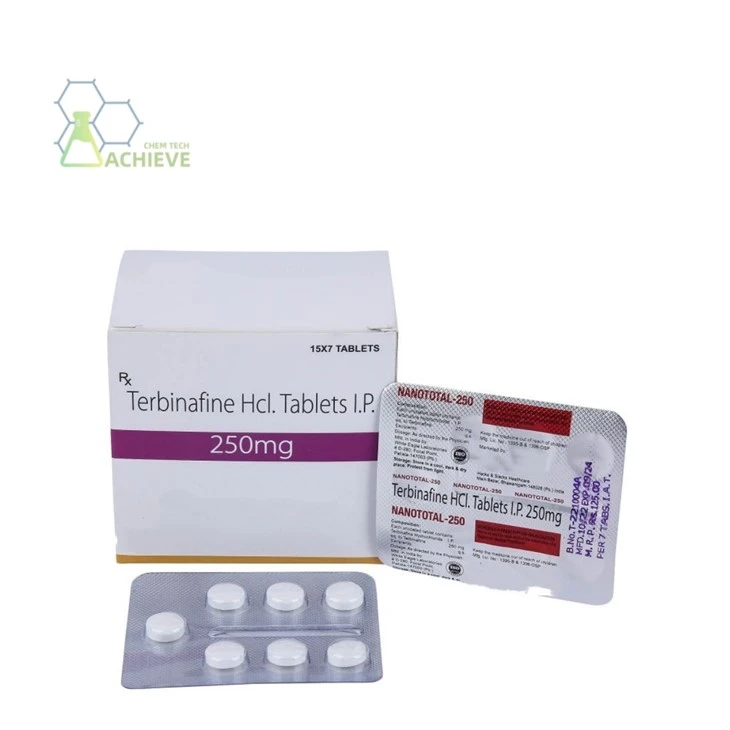


Shaanxi BLOOM Tech Co., Ltd. is one of the most experienced manufacturers and suppliers of terbinafine hydrochloride tablet in China. Welcome to wholesale bulk high quality terbinafine hydrochloride tablet for sale here from our factory. Good service and reasonable price are available.
Terbinafine hydrochloride tablet is an orally administered antifungal agent that falls within the allylamine class of pharmaceutical compounds. It functions by selectively inhibiting the fungal enzyme squalene epoxidase, which in turn halts the biosynthesis of ergosterol-a vital component of the fungal cell membrane-and triggers the intracellular buildup of squalene. This dual mechanism disrupts the structural integrity of the fungal cell membrane, leading to both fungicidal and fungistatic actions against a broad spectrum of pathogenic fungi. Primarily indicated for the management of infections affecting the skin, hair, and nails, terbinafine hydrochloride tablets are highly effective against dermatophytes including Trichophyton rubrum, Trichophyton mentagrophytes, Microsporum canis, and Epidermophyton floccosum. For onychomycosis, commonly known as fungal nail infections affecting both fingernails and toenails, the standard treatment duration ranges from 6 weeks to 3 months, with more severe cases potentially requiring an extended course of up to 6 months. In the case of superficial fungal skin infections such as tinea corporis (ringworm), tinea cruris (jock itch), tinea pedis (athlete's foot), and tinea capitis (scalp ringworm), the typical treatment period is between 2 to 6 weeks. For cutaneous candidiasis caused by Candida albicans, the recommended duration of therapy is generally 2 to 4 weeks.


Formulation specifications
The commercially available pieces have a standard dose of 250 mg/piece, and common packaging forms include:
Bottled: 30 pieces/bottle, 100 pieces/bottle, 500 tablets/bottle, 1000 pieces/bottle;
Bubble wrap packaging: 30 pieces/box (packaged in aluminum-plastic bubble wrap).
The appearance of the piece is a white to light yellow circular double convex film coated piece, and some products have markings printed on the surface (such as "LAMISIL 250" or "IG 209"). Auxiliary materials such as colloidal silica, hydroxypropyl methylcellulose, magnesium stearate, etc. are often added to formulations to improve drug stability and compressibility. The allylamine group in its chemical structure is a key functional group that inhibits fungal enzyme activity.
Additional information of chemical compound:

Our product form


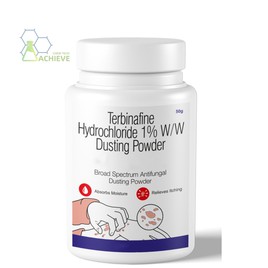


terbinafine hydrochloride +. COA


Terbinafine hydrochloride tablet is a broad-spectrum antifungal drug that inhibits key enzymes involved in fungal cell lining biosynthesis, blocking ergosterol synthesis and inducing squalene accumulation, ultimately leading to fungal cell death. Its mechanism of action has high selectivity, dual destructive effects, and persistence, making it a core drug for treating skin, hair, and nail fungus infections. The following systematically explains its mechanism of action from the aspects of molecular targets, metabolic interference, antibacterial spectrum, and pharmacokinetic characteristics.
1. Chemical basis of enzyme inhibition
The molecular structure of terbinafine hydrochloride contains an allylamine group, which covalently binds to the active site of fungal squalene epoxidase to form an irreversible enzyme inhibitor complex. Experiments have shown that its inhibition constant (Ki value) for enzymes is as low as 30 nM, indicating its extremely high binding affinity. In contrast, there are differences in the active center structure of homologous enzymes in human cells, resulting in the sensitivity of terbiafine to human cells being only one ten thousandth of that of fungi, thereby ensuring the safety of remey.


2. Biological consequences of enzyme inhibition
Squalene cyclooxygenase is a key rate limiting enzyme in the biosynthesis pathway of ergosterol, responsible for catalyzing the conversion of squalene to 2,3-oxidosqualene. This step is the starting reaction for the synthesis of ergosterol, which is the main component of fungal cell linings and is crucial for maintaining lining integrity and fluidity. Terbiafine directly interrupts the synthesis of ergosterol by blocking the activity of the enzyme, while causing a large accumulation of squalene in fungal cells.
1. Toxic effects of squalene accumulation
The abnormal accumulation of squalene in cells has dual toxicity:
Physical damage: Squalene is a non-polar molecule, and its excessive accumulation can damage the lipid bilayer structure of cell linings, leading to changes in lining fluidity and loss of function.
Oxidative stress: Squalene can be catalyzed by intracellular oxidases to generate reactive oxygen species (ROS), leading to lipid peroxidation and protein oxidation, ultimately resulting in cell death. The experiment confirmed that after remey with terbiafine, the intracellular ROS level of Candida albicans cells significantly increased and was positively correlated with drug concentration.


2. Direct damage caused by ergosterol deficiency
The deficiency of ergosterol leads to abnormal lining structure of fungal cells, manifested as increased lining permeability, ion leakage, and outflow of cellular contents. Electron microscopy observation showed that the cell lining of Trichophyton rubrum treated with terbiafine wrinkled and ruptured, ultimately leading to cell lysis. In addition, ergosterol deficiency can interfere with the function of lining related proteins such as ATPase and transporters, further weakening the metabolic capacity of fungi.
1. Strong bactericidal effect on dermatophytes
Terbinafine has rapid bactericidal activity against dermatophytes such as Trichophyton rubrum, Trichophyton rubrum, and Microsporidia canis. In vitro experiments have shown that its minimum inhibitory concentration (MIC) is 0.001-0.01 μ g/mL, and the bactericidal effect is related to the drug concentration. In clinical studies, the cure rate of terbiafine in treating onychomycosis is 80% -95%, significantly better than azole antifungal drugs such as itraconazole and fluconazole.
2. Dual effects of antibacterial and bactericidal effects on yeast
Candida albicans: Terbinafine exhibits concentration dependent antibacterial or bactericidal effects on it.


Low concentrations (0.1-1 μ g/mL) inhibit hyphal formation and growth, while high concentrations (≥ 10 μ g/mL) directly kill yeast phase cells.
Other yeast strains: For non Candida species such as Candida parapsilosis and Candida tropicalis, the MIC range of terbiafine is 0.125-2 μ g/mL, and its efficacy is comparable to fluconazole.
3. Activity against certain molds
The MIC of terbiafine against Aspergillus species (such as Aspergillus niger and Aspergillus flavus) is 0.5-4 μ g/mL, which is weaker than amphotericin B but significantly better than azole drugs. In addition, terbinafine hydrochloride tablet also exhibits certain activity against biphasic fungi such as Blastomyces dermatidis and Histoplasma capsule.

1. Absorption and distribution
Oral absorption: The bioavailability is 70% -90%, but due to first pass effects, the absolute bioavailability is about 40% -50%.
Peak time: After a single take orally of 250 mg, the peak plasma concentration (Cmax) is 0.7-1.0 μ g/mL, and the peak time (Tmax) is 1.5-2 hours.
2.Organizational penetration: The concentration of drugs in the skin, hair, and skin is significantly higher than in plasma, and their half-life in the stratum corneum is up to 100 hours, which can last for several months in the skin. This is the basis for their long-lasting therapeutic effect in treating onychomycosis.
3. Metabolism and excretion
Metabolic pathway: Mainly metabolized by liver CYP2D6 enzyme, producing inactive metabolites.
4.Excretion method: About 70% is excreted in the form of metabolites through bile, and only a small amount (<0.03%) is excreted in the urine as the prototype drug.
Half life: The plasma elimination half-life (T1/2) is 16-19 hours, but the tissue half-life is significantly prolonged.


5. pharmacokinetics of special populations
Liver dysfunction: Metabolism slows down, dosage adjustment or prohibition is required.
Renal insufficiency: As it is mainly excreted through bile, there is no need to adjust the dosage, but patients with severe renal failure should use it with caution.
Children: For those weighing less than 40 kg, the dosage should be adjusted to 0.625 mg/kg.
- Absorption and distribution
Oral bioavailability: 70% -90%, food has no significant effect on its absorption;
Peak time: 1.5-2 hours;
Protein binding rate:>99%, mainly bound to plasma proteins;
Organizational permeability: can be widely distributed in the stratum corneum, nail matrix, and hair follicles, with a concentration maintained in the deck for up to 6 months.
- Metabolism and excretion
Metabolic pathway: Liver CYP450 enzyme system (mainly CYP2C9, CYP1A2, CYP3A4);


- Metabolites: demethylated terbinafine (activity only 10% of the original drug);
- Excretion method:Urine:<0.3% prototype drug;Fecal: The main excretion pathway, containing the prototype drug and metabolites.
- pharmacokinetics of special populations
- Liver dysfunction: The AUC of patients with end-stage liver disease increases by about 2 times, and the dosage needs to be adjusted;
- Renal insufficiency: No need to adjust dosage, as drugs and metabolites are mainly excreted through bile.
Usage, Dosage and Operation Guide
1. Standard dose regimen
Infection type, dosage, remey course, precautions
Fungal disease of toenails: 250 mg/day, take orally for 12 weeks, combined with topical medication to eliminate residual fungi
Nail fungus disease 250 mg/day, take orally for 6 weeks. After the end of the remey, continuous observation for 3 months is required
Tinea corporis/tinea crus 250 mg/day, taken orally for 1-2 weeks. After the skin lesions subside, consolidation remey is required for 3 days
Tinea pedis 250 mg/day, take orally for 2-4 weeks, scaly keratinization type needs to be extended to 6 weeks
Tinea versicolor 250 mg/day, taken orally for 2 weeks, requires the use of antifungal bath products
2. Operating standards
(1) Administration method
Take orally: whole tabella swallowed, can be taken with food to reduce gastrointestinal irritation;
Crush take orally: For animals that cannot swallow the entire tabella, the tabella can be crushed and mixed into food.
(2) Storage conditions
Temperature: 20-25 ℃ (room temperature), stored away from light;
Humidity: Relative humidity ≤ 60%, avoid tabellas from absorbing moisture and clumping;
Packaging: The original bottle should be sealed and stored, and used up within 6 months after opening.
(3) Waste disposal
Expired pills: classified and recycled according to medical waste, prohibited from being discarded at will;
Empty bottle: After cleaning, it should be disposed of as regular garbage.
Hot Tags: terbinafine hydrochloride tablet, suppliers, manufacturers, factory, wholesale, buy, price, bulk, for sale