






Shaanxi BLOOM Tech Co., Ltd. is one of the most experienced manufacturers and suppliers of carbaryl powder cas 63-25-2 in China. Welcome to wholesale bulk high quality carbaryl powder cas 63-25-2 for sale here from our factory. Good service and reasonable price are available.
Carbaryl powder is a broad-spectrum carbamate insecticide. Its appearance is usually a white or off-white crystalline powder. The mechanism of its action lies in irreversibly inhibiting the acetylcholinesterase in insects, causing excessive accumulation of neurotransmitters and triggering continuous neural excitation until death. It shows highly effective contact and stomachicidal effects on various chewing and sucking mouthpart pests such as aphids, caterpillars, and beetles. This pesticide was widely used in agriculture, forestry, and horticulture to control pests on fruits, vegetables, and grains. However, cypermethrin is also toxic to non-target organisms such as humans, livestock, bees, and aquatic organisms. Especially its metabolites may pose potential risks to human health. Therefore, its use has been strictly restricted or banned in many countries and regions, highlighting the profound trade-offs and reflections it has triggered between ensuring agricultural production, ecological environment, and food safety.

|
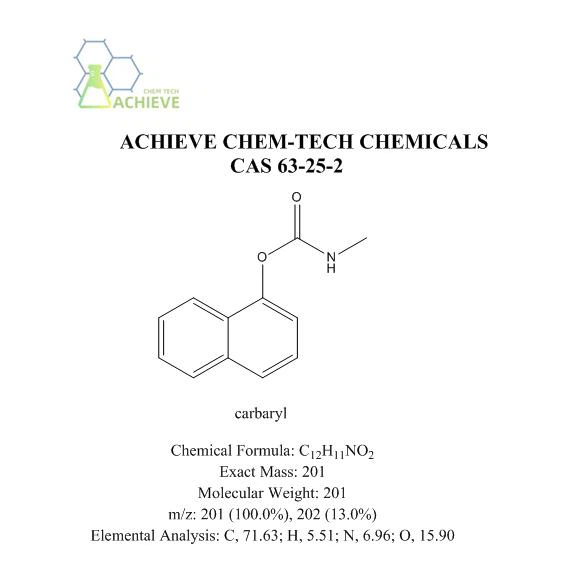
Chemical Formula |
C12H11NO2 |
|
Exact Mass |
201 |
|
Molecular Weight |
201 |
|
m/z |
201 (100.0%), 202 (13.0%) |
|
Elemental Analysis |
C, 71.63; H, 5.51; N, 6.96; O, 15.90 |

There are two main processes, namely the cold method (methyl chloroformate method) and the hot method (methyl aminoacyl chloride method). But in terms of synthesis methods, there are the following three.
Preparation of methyl isocyanate methylamine and phosgene are directly subjected to gas phase color reaction at high temperature. The reactor is a pipe. The reaction temperature is higher than 400 ℃, and the reactor is made of steel lined graphite. The key to production is to prevent the formation of by-products and the blockage of reactors.
The main equipment of the methyl isocyanate separation and refining system is the degassing tower. The methyl isocyanate refining tower is a float valve tower with 90 trays, all of which are made of high nickel alloy steel.
The synthesis of carbaryl was carried out in the presence of solvent at a temperature of 60 ~ 80 ℃ with a slight negative pressure. The resulting mixed solution is distilled, and excess methyl isocyanate is distilled off from the top of the distillation column together with part of the solvent, and then reused. Carbaryl powder is purified in solution.
Preparation of naphthalene chloroformate: dissolve 100kg of naphthol and 200kg of toluene, pump it into a reactor containing 600kg of toluene, stir it, cool it down to below - 10 ℃, stop stirring, inject about 224kg of phosgene, and complete it in 4H. Start to drop alkali, control the temperature below 0 ℃, drop 400 ~ 500kg of 20% alkali balance solution in about 2h, make the pH of the brine layer equal to 6, drain the salt foot water, and wash menaphthyl chloroformate twice with water, generally the ester content is 14% ~ 15%.
Synthesis of carbaryl: keep the synthesis temperature at 10 ~ 20 ℃, drop about 80 kg of 40% dimethylamine in about 40 minutes, then drop 120 kg of 20% liquid alkali in about 20 minutes at about 10 ℃, stir for 10 minutes, drop 80 kg of 30% hydrochloric acid, and measure the pH value as 5 ~ 6. After separation, water washing and drying, the product is obtained.
Preparation of methyl carbamoyl chloride methyl carbamoyl chloride was synthesized by chloroformylation of methylamine. Liquid phase method and gas phase method are commonly used in industry, among which the gas phase method has high yield and is convenient for continuous production. The gas-phase method is to heat methylamine to more than 200 ℃ and phosgene to more than 150 ℃. After the two gases are mixed, they pass through a 240-300 ℃ pipeline reactor, and the reaction is completed instantaneously. Then, they are condensed into liquid or recycled and absorbed with precooled chlorobenzene or carbon tetrachloride. The main process conditions are as follows: the ratio of methylamine to phosgene is 1:1.3 (volume ratio), the preheating temperature of methylamine and phosgene is 220 ~ 240 ℃, the reaction temperature is 280 ~ 300 ℃, and the absorption temperature is 0 ~ 20 ℃.
Synthesis of carbaryl sodium carbaryl is prepared from carbaryl and dilute alkali solution. When the temperature reaches 0 ~ 5 ℃, methyl carbamoyl chloride is added dropwise. The alkali solution is continuously added during the dropping process. When the pH value reaches 7.5 ~ 8.0, the reaction reaches the end point, and the reaction time is about 30 ~ 40min. Centrifuge, wash and dry the finished product, with a content of more than 90%.

Carbaryl powder, as a moderately toxic carbamate insecticide, was developed by J A. Since its synthesis, Lambridge has received widespread attention for its high efficiency, low toxicity, and broad-spectrum insecticidal properties. In 1956, carbendazim was officially developed, produced, and put into the market. Its application scope is extensive, not only limited to agricultural pest control, but also covers multiple fields such as medical care and household use. Below, we will provide a detailed introduction to all the uses of carbendazim.

Agricultural pest control
As a broad-spectrum insecticide, carbendazim has significant control effects on various pests. Its unique insecticidal mechanism lies in its ability to inhibit acetylcholinesterase in the body of pests, thereby blocking nerve conduction, leading to pest paralysis and death. Therefore, carbendazim is widely used to control various agricultural pests such as cotton bollworms, leaf rollers, cotton aphids, bridge worms, thrips and rice leafhoppers, rice leaf rollers, rice bracts, and rice thrips.
In the pest control of economic crops such as cotton, rice, and corn, carbendazim plays an important role. For example, in cotton cultivation, the cotton bollworm is an important pest, and its larvae feed on cotton buds, flowers, and boll shells, leading to a significant decrease in cotton yield. And carbendazim can effectively control cotton bollworm, improve cotton yield and quality. In addition, carbendazim can also be used to control rice pests such as rice planthoppers and rice thrips, as well as corn pests such as corn borer.
Prevention and control of fruit tree pests
In addition to agricultural crops, carbendazim also plays an important role in the control of fruit tree pests. There are various types of fruit tree pests, such as red spider, aphid, and carnivorous insects, which can harm the leaves, fruits, and branches of fruit trees, leading to poor growth and decreased yield. As a broad-spectrum insecticide, carbendazim has good control effects on various fruit tree pests. For example, in the pest control of apple, pear and other fruit trees, carbendazim can effectively control aphids, red spider and other pests, protecting the healthy growth of fruit trees.


Rapid disinfection and hygiene protection
In addition to pest control, carbendazim also has certain rapid disinfection and hygiene protection effects. Due to its broad-spectrum bactericidal and insecticidal properties, metformin can be used in fields such as field rapid drinking water disinfection, air conditioning circulating water cooling system disinfection, and medical disinfection. In field environments, carbendazim can quickly kill plankton, algae, and some bacteria in water, ensuring the safety of drinking water. In the medical field, benazepril can be used for disinfection in operating rooms, wards, and other places, effectively reducing the risk of infection.
Household and horticultural purposes
Carbaryl powder also has certain application value in the fields of home and horticulture. In households, metformin can be used to control household pests such as ants and cockroaches, ensuring the hygiene and health of the household environment. In the field of horticulture, carbendazim can be used to control pests on plants such as flowers and lawns, protecting their growth and ornamental value.

Health Impact
► Acute Toxicity
Carbaryl powder is considered to have moderate acute toxicity to humans. Exposure can occur through inhalation, ingestion, or skin contact. Symptoms of acute carbaryl poisoning may include nausea, vomiting, diarrhea, dizziness, headache, muscle weakness, and in severe cases, respiratory failure and coma. Workers who handle carbaryl powder, such as farmers and pest control operators, are at a higher risk of acute exposure if proper safety precautions are not taken.
► Chronic Toxicity
Long - term exposure to low levels of carbaryl has been associated with various health effects. Studies have suggested a possible link between carbaryl exposure and an increased risk of certain cancers, such as non - Hodgkin's lymphoma. Chronic exposure can also affect the nervous system, leading to symptoms such as fatigue, anxiety, and cognitive impairment. Additionally, carbaryl may have endocrine - disrupting effects, interfering with the normal functioning of hormones in the body, which can have implications for reproductive health and development.
► Occupational and Residential Exposure
Occupational exposure to carbaryl powder is a significant concern, especially in agricultural settings. Farmers and farm workers may be exposed to carbaryl during mixing, loading, and application of the insecticide. Residential exposure can occur when carbaryl - based products are used in and around the home for pest control. Children, in particular, may be more vulnerable to the effects of carbaryl due to their developing bodies and higher exposure potential through hand - to - mouth behavior and playing on treated surfaces.
Carbaryl powder has been a valuable tool in pest control for many years, with its broad - spectrum activity and effectiveness against a variety of pests. However, its environmental persistence, potential for bioaccumulation, and health risks have raised concerns about its long - term use. As regulations become stricter and public awareness of environmental and health issues increases, there is a need to transition towards more sustainable pest management practices. The development of alternative pesticides, the adoption of IPM strategies, and research on carbaryl degradation and remediation will play crucial roles in shaping the future of pest control and ensuring the protection of human health and the environment.
Hot Tags: carbaryl powder cas 63-25-2, suppliers, manufacturers, factory, wholesale, buy, price, bulk, for sale, epinephrine hydrochloride powder, Methylergonovine Powder CAS 113 42 8, Iodomethane d3, Isoflurane Solution, Atropine Sulfate Monohydrate CAS 5908 99 6, Primidone powder