


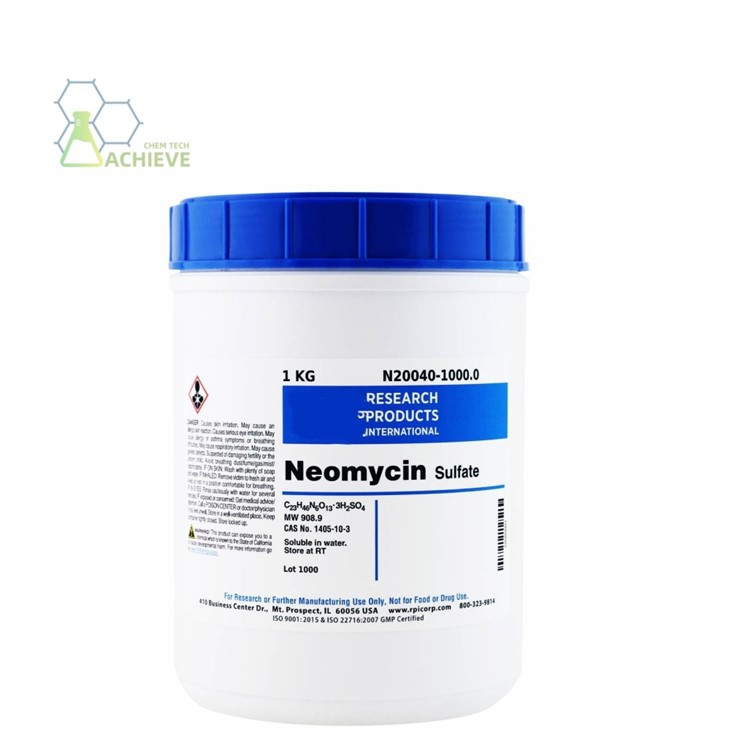


Shaanxi BLOOM Tech Co., Ltd. is one of the most experienced manufacturers and suppliers of neomycin sulfate powder cas 1405-10-3 in China. Welcome to wholesale bulk high quality neomycin sulfate powder cas 1405-10-3 for sale here from our factory. Good service and reasonable price are available.
Neomycin sulfate powder, CAS 1405-10-3, molecular formula C23H48N6O17S, is an aminoglycoside antibiotic. A white or off white powder; Odorless; Extremely prone to moisture; The aqueous solution exhibits right-handed optical rotation. This product is highly soluble in water and almost insoluble in ethanol, ether, acetone, or chloroform. The clinical drug of this product has good antibacterial activity against Enterobacteriaceae bacteria such as Staphylococcus (methicillin-resistant strains), Corynebacterium, Escherichia coli, Klebsiella, and Proteobacteria, but has poor activity against various groups of Streptococcus, Streptococcus pneumoniae, Enterococcus, etc. Pseudomonas aeruginosa, anaerobic bacteria, etc. are resistant to this product. Bacteria have partial or complete cross resistance to streptomycin, neomycin, kanamycin, and gentamicin.


Our product


|
|
|


|
Chemical Formula |
C23H48N6O17S |
|
Exact Mass |
712.28 |
|
Molecular Weight |
712.72 |
|
m/z |
712.28 (100.0%), 713.28 (24.9%), 714.28 (4.5%), 714.28 (3.5%), 714.29 (3.0%), 713.28 (2.2%), 715.28 (1.1%) |
|
Elemental Analysis |
C, 38.76; H, 6.79; N, 11.79; O, 38.16; S, 4.50 |

Neomycin sulfate powder, as an aminoglycoside antibiotic, plays an important role in antibacterial activity.
Neomycin sulfate has significant antibacterial effects on various bacteria, mainly due to its unique antibacterial mechanism. Neomycin sulfate can inhibit bacterial protein synthesis, thereby blocking bacterial growth and reproduction. Specifically, it interferes with the normal translation process of mRNA by binding to small subunits of bacterial ribosomes, causing bacteria to be unable to synthesize necessary proteins and ultimately leading to bacterial death.


1. Treatment of respiratory infections
Neomycin sulfate has shown good efficacy in treating respiratory infections. These respiratory infections include diseases such as pneumonia, bronchitis, and lung abscess. Due to its strong bactericidal effect on respiratory bacteria, neomycin sulfate can effectively eliminate these bacteria, alleviate patients' symptoms, and accelerate the recovery process of the disease.
2. Treatment of urinary system infections
Neomycin sulfate is also suitable for the treatment of urinary system infections. Urinary system infections such as urethritis, cystitis, and other diseases are usually caused by bacteria. Neomycin sulfate can quickly eliminate these bacteria, alleviate patients' pain and discomfort, and prevent further spread of infection.


3. Treatment of intestinal infections
Neomycin sulfate is also of great significance in the treatment of intestinal infections. Intestinal infections are usually caused by bacteria, viruses, or parasites, and neomycin sulfate has significant antibacterial effects on various intestinal bacteria. Therefore, it is widely used to treat intestinal diseases such as bacterial enteritis, bacterial diarrhea, and bacterial diarrhea. In addition, neomycin sulfate can also be used for intestinal preparation before colon surgery to reduce the risk of infection during the surgical process.
4. Prophylactic antibiotic treatment after surgery
Neomycin sulfate can also be used for prophylactic antibiotic treatment after surgery. After surgery, the patient's immune system usually decreases and they are more susceptible to bacterial infections. Neomycin sulfate can effectively inhibit the growth and reproduction of bacteria, thereby reducing the risk of surgical site infections and preventing the spread of infections.


5. Treatment of eye infections
Neomycin sulfate eye drops can be used to treat eye infections caused by sensitive bacteria. These infections include conjunctivitis, keratitis, etc., usually caused by bacteria such as Staphylococcus aureus and Escherichia coli. Neomycin sulfate eye drops can quickly eliminate these bacteria, alleviate eye discomfort and pain in patients, and accelerate the recovery process of eye infections.
6. Treatment of skin and mucosal infections
Neomycin sulfate ointment can be used to treat skin and mucosal infections caused by sensitive bacteria. These infections include pyoderma, pyogenic dermatitis, etc., usually caused by bacteria such as Staphylococcus aureus. Sulfuric acid neomycin ointment can directly act on the infected site, quickly eliminate bacteria, alleviate patients' pain and discomfort, and accelerate the recovery process of infection.


Antibacterial spectrum of neomycin sulfate
The antibacterial spectrum of neomycin sulfate is relatively broad, and it has significant antibacterial effects on various bacteria. Specifically, it has good antibacterial effects on both Gram negative bacteria (such as Escherichia coli, Salmonella, etc.) and Gram positive bacteria (such as Staphylococcus aureus, etc.). In addition, neomycin sulfate also has certain antibacterial effects on tuberculosis bacteria and mycoplasma. However, it should be noted that the antibacterial effect of neomycin sulfate on Pseudomonas aeruginosa and anaerobic bacteria is relatively weak.
Neomycin sulfate powder, as an important aminoglycoside antibiotic, has a wide range of applications in the pharmaceutical field. After years of research and development, its synthesis method has formed multiple mature process routes. The following is a detailed introduction to the common synthesis methods of neomycin sulfate:
Method 1: Fermentation synthesis of neomycin sulfate
Fermentation is one of the main methods for synthesizing neomycin sulfate. This method utilizes the fermentation process of microorganisms to convert specific nutrients into neomycin sulfate. The process of synthesizing neomycin sulfate by fermentation usually includes the following steps:
Preparation of fermentation broth:
Raw material selection:
The main raw materials include glucose, flour, fermentation agent, sulfuric acid, and neomycin bacteria.
Mixing and Sterilization:
Mix glucose and flour in a certain proportion, add an appropriate amount of water and stir evenly to obtain glucose flour paste. Then heat the paste to 80-90 ° C, killing the bacteria and yeast to ensure the smooth progress of the fermentation process.
Culture of bacterial strains:
Spore insertion:
Add neomycin spores to the prepared fermentation broth for preliminary cultivation.
Breeding monitoring:
After 1-2 days of cultivation, the next step of fermentation can be carried out once the growth of the new streptomycin strain reaches a certain level.
Fermentation process:
We offer a variety of transmission components
Inoculation and Fermentation:
Inoculate the cultured neomycin strain into the fermentation broth for fermentation. The fermentation process requires control of temperature, pH value, and oxygen supply to promote bacterial growth and accumulation of metabolites.
Fermentation condition optimization:
By adjusting the nutritional components, pH value, temperature and other parameters in the fermentation broth, the fermentation process can be optimized to increase the yield of neomycin sulfate.
Harvesting and Separation:
We offer a variety of transmission components
Fermentation ends:
When the yield of neomycin in the fermentation broth reaches a certain level, fermentation is stopped.
Solid liquid separation:
The fermentation broth is subjected to solid-liquid separation through centrifugation or filtration to obtain a liquid fraction containing neomycin.
Purification:
Removing impurities:
Further purify the obtained liquid portion to remove impurities and harmful substances.
Purification technology:
Typically, steps such as acid-base precipitation, solvent extraction, and membrane separation are used to obtain pure neomycin sulfate.
Crystallization and drying:
Crystallization process:
Crystallize the purified solution of neomycin sulfate, and promote the crystallization process through heating, cooling, and stirring.
Drying treatment:
After obtaining the crystal of neomycin sulfate, drying treatment is carried out to remove the moisture and obtain the finished product of neomycin sulfate.
The fermentation method for synthesizing neomycin sulfate has the advantages of easy availability of raw materials, mature process, and stable yield. However, this method also has some limitations, such as a long fermentation cycle and sensitivity to environmental conditions.
Method 2: Chemical synthesis method
In addition to fermentation, chemical synthesis is also an important method for the synthesis of neomycin sulfate. Chemical synthesis usually utilizes the principle of chemical reactions to convert raw materials into neomycin sulfate through a series of chemical reactions. However, due to the complex process, high cost, and significant environmental pollution of chemical synthesis methods, they are not as widely used in practical applications as fermentation methods.
Method 3: Fermentation Extraction Refinement Method
Fermentation extraction refining method is another commonly used method for the synthesis of neomycin sulfate. This method combines the advantages of fermentation and extraction methods, obtaining a fermentation broth containing neomycin through fermentation, and then obtaining pure neomycin sulfate through extraction and refining steps.
Fermentation:
Similar to the fermentation method, fermentation is carried out using neomycin strains under specific fermentation conditions to obtain a fermentation broth containing neomycin.
Extraction:
Fermentation liquid treatment:
Pre treat the fermentation liquid, such as adjusting the pH value, filtering, etc., to remove impurities and solid particles.
Adsorption and elution:
Use adsorbents (such as cationic resins) to adsorb neomycin from the fermentation broth, and then elute the neomycin from the adsorbent through the elution step.
Refined:
Solution treatment:
Further treatment of the eluted neomycin solution, such as adjusting pH, filtering, etc., to remove impurities and harmful substances.
Crystallization and drying:
Crystallize the treated solution of neomycin to obtain the crystal of neomycin sulfate, and then dry it to obtain the finished product of neomycin sulfate.
The fermentation extraction refining method has the advantages of relatively simple process, stable yield, and high product quality. However, this method also has some limitations, such as cumbersome extraction and refining steps, and high costs.
Optimization and improvement of synthesis process
In order to improve the yield and product quality of neomycin sulfate, researchers have continuously optimized and improved the synthesis process. These optimization and improvement measures include:
(1) Strain screening and improvement:
By screening high-yielding strains and using genetic engineering technology to improve strains, the fermentation performance of neomycin strains can be improved, thereby increasing the production of neomycin sulfate.
(2) Fermentation condition optimization:
By adjusting the nutritional components, pH value, temperature, oxygen supply and other parameters in the fermentation broth, the fermentation conditions are optimized to improve the fermentation efficiency of neomycin.
(3) Improvement of extraction and refining technology:
Adopting more efficient extraction and refining techniques, such as ion exchange technology, membrane separation technology, etc., to improve the extraction efficiency and product quality of neomycin sulfate.
(4) Wastewater treatment and environmental protection measures:
Strengthen wastewater treatment and environmental protection measures to reduce environmental pollution during the synthesis process.
The synthesis methods of neomycin sulfate powder mainly include fermentation, chemical synthesis, and fermentation extraction refining methods. Among them, fermentation method is one of the most widely used methods, with advantages such as easy availability of raw materials, mature technology, and stable yield. However, with the advancement of technology and the increasing demand for environmental protection, researchers are constantly exploring more efficient and environmentally friendly synthesis methods. By optimizing and improving the synthesis process, the yield and product quality of neomycin sulfate can be further increased, making greater contributions to the development of the pharmaceutical industry.

The development prospects of Neomycin Sulfate mainly depend on its sustained demand and technological innovation in medical, scientific research, and industrial applications. The following is a detailed analysis of its development prospects:
Industrial application potential
Neomycin sulfate also has broad application potential in the industrial field. For example, in animal husbandry, it can be used as a feed additive to prevent and treat animal infections; In the field of water treatment, it can be used as a disinfectant for disinfection and purification of water quality. With the increasing awareness of environmental protection and the growing demand for efficient and environmentally friendly antibacterial agents in industrial production, the application prospects of neomycin sulfate powder in the industrial field will be even broader.
Technological Innovation and Market Demand
With the continuous advancement of biotechnology and changes in market demand, the production process and product quality of neomycin sulfate will be continuously improved. This will help reduce production costs, improve product purity, and meet a wider range of application needs. At the same time, as people's attention to antibiotic resistance increases, the demand for new, efficient, and low toxicity antibiotics will continue to grow, providing new opportunities for the development of neomycin sulfate powder.
Development prospects and outlook
Taking into account the above factors, the development prospects of neomycin sulfate are relatively broad. In the medical field, it will continue to be one of the important antibiotics used to treat various infectious diseases; In the field of scientific research, it will serve as an important research reagent, promoting the in-depth development of life science and molecular biology research; In the industrial field, it will serve as an efficient antibacterial and water treatment agent, providing strong support for environmental protection and industrial production.
Adverse reactions
Neomycin Sulfate is an aminoglycoside antibiotic that exerts broad-spectrum antibacterial effects by inhibiting bacterial protein synthesis. It is commonly used to treat intestinal infections and preoperative intestinal preparation. The adverse reaction spectrum of its powder formulations (such as oral powders and topical powders) varies depending on the route of administration, but is closely related to drug toxicity, allergic reactions, and medication methods.
Ototoxicity
Medications accumulate in the lymphatic fluid of the inner ear, damaging hair cells and auditory nerves, leading to sensorineural hearing loss.
Manifested as vestibular damage: dizziness, nausea, vomiting, and imbalance (early symptoms).
Cochlear damage: Tinnitus, progressive high-frequency hearing loss, and ultimately permanent deafness.
Risk factors include high doses (>4g/day) or long-term use (>7 days), renal dysfunction (reduced drug excretion), combination with other ototoxic drugs (such as vancomycin, diuretics), and genetic susceptibility (such as mitochondrial DNA mutations).
Nephrotoxicity
Drug accumulation in the renal cortex damages the epithelial cells of the proximal tubules, leading to acute tubular necrosis.
Manifesting as early stage: elevated blood creatinine and urea nitrogen, decreased urine output, late stage: oliguria or anuria, electrolyte imbalance (hyperkalemia, hyponatremia).
Risk factors include daily dose>2g or course of treatment>5 days, dehydration, low blood volume or concomitant use of nephrotoxic drugs (such as NSAIDs, contrast agents), and elderly individuals (decreased glomerular filtration rate).
NMB
The drug binds to acetylcholine receptors at the neuromuscular junction, inhibiting the transmission of nerve impulses and leading to respiratory muscle paralysis.
Manifested as worsening muscle weakness (especially in patients with myasthenia gravis), respiratory depression, and asphyxia (which can be fatal in severe cases).
The risk factors are the combined use of muscle relaxants (such as succinylcholine) or anesthetics, electrolyte imbalances (hypokalemia, hypomagnesemia).
Allergic Reaction
The drug acts as a hapten and binds to proteins in the body, triggering IgE mediated type I hypersensitivity reactions.
Mild symptoms include rash, itching, and urticaria, while severe symptoms include anaphylactic shock (sudden drop in blood pressure, laryngeal edema, and loss of consciousness).
The risk factors are a history of previous aminoglycoside allergies and rapid intravenous infusion (sudden increase in blood drug concentration).
Hot Tags: neomycin sulfate powder cas 1405-10-3, suppliers, manufacturers, factory, wholesale, buy, price, bulk, for sale, Chenodeoxycholic Acid CDCA CAS 474 25 9, Organic Intermediate, Peptide, 1 Butyl 3 Methylimidazolium Tetrafluoroborate, Benzobarbital CAS 744 80 9, L Sulforaphane CAS 142825 10 3