




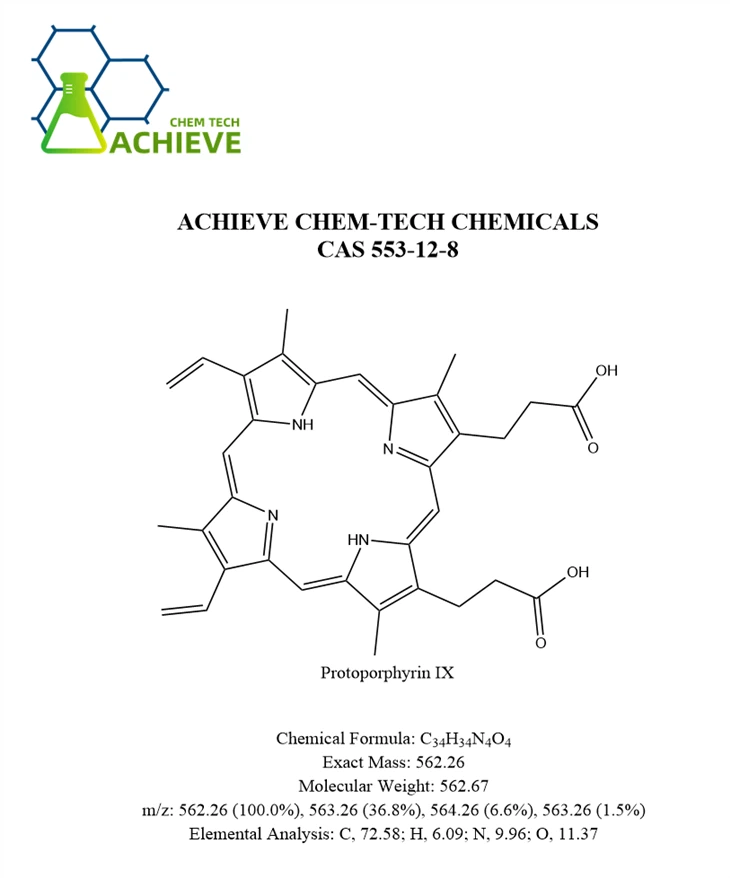


Shaanxi BLOOM Tech Co., Ltd. is one of the most experienced manufacturers and suppliers of protoporphyrin ix cas 553-12-8 in China. Welcome to wholesale bulk high quality protoporphyrin ix cas 553-12-8 for sale here from our factory. Good service and reasonable price are available.
Protoporphyrin IX, also known as protoporphyrin, appears as a purple brown crystalline powder (usually in the form of water-soluble sodium salts), soluble in water and methanol, insoluble in dilute acids, and insoluble in chloroform, ether, acetone, etc. It is a compound with a specific chemical structure and biological activity, and also an important intermediate in the heme biosynthesis pathway. It serves as a "photosensitizer" in photodynamic therapy and sonodynamic therapy, significantly enhancing the killing effect of laser on cancer cells. At the same time, it has significant effects in improving liver function, anti complement binding, animal experiments, and anti-tumor activity.

|
|
|


|
Chemical Formula |
C34H34N4O4 |
|
Exact Mass |
562.26 |
|
Molecular Weight |
562.67 |
|
m/z |
562.26 (100.0%), 563.26 (36.8%), 564.26 (6.6%), 563.26 (1.5%) |
|
Elemental Analysis |
C, 72.58; H, 6.09; N, 9.96; O, 11.37 |

Biological activity and function
Improve liver function
As a liver function enhancer, it has the effect of promoting cellular tissue respiration, improving protein and glucose metabolism.
Anti complement binding
Having the ability to resist complement binding may help regulate immune responses.
Animal experiment results
In animal experiments, it has a significant effect on reducing transaminase and other enzymes in liver injury caused by carbon tetrachloride, improving amino acid metabolism, increasing liver blood flow, and enhancing liver cell protein.
Antitumor activity
Some studies have shown that the substance has significant anti-tumor activity under specific conditions, such as when used in combination with ultrasound, which can reduce tumor volume and prolong average animal survival time. However, in some cases alone, it may not show significant effects.

Protoporphyrin IX (PPIX) is a non-metallic tetra-pyrrole compound with the chemical name 7,12-dialkyl-3,8,13,17-tetramethyl-2,18-dipropionic porphyrin. As a precursor for biological molecules such as hemoglobin, cytochrome c, and chlorophyll, PPIX demonstrates extensive application value in fields such as biomedical research, photodynamic therapy, cancer diagnosis and treatment, liver disease treatment, and basic research.


I. Photodynamic Therapy (PDT) and Photodynamic Diagnosis (PDD)
PPIX is one of the core photosensitizers in photodynamic therapy (PDT). Its mechanism of action is based on the production of reactive oxygen species (ROS) by the photosensitizer under specific wavelength light irradiation, which induces cell apoptosis or necrosis. PPIX has a selective enrichment property in tumor tissues, especially when its precursor 5-aminolevulinic acid (5-ALA) is externally administered. Tumor cells, due to their active metabolism, synthesize large amounts of PPIX, while normal cells accumulate less due to the regulatory effect of rate-limiting enzymes. This difference makes PPIX an ideal tool for tumor-targeted therapy.
In the treatment of skin diseases, PPIX-mediated PDT has been widely applied in the treatment of non-melanoma skin tumors (such as basal cell carcinoma, squamous cell carcinoma of the skin), actinic keratosis and condyloma acuminatum. For example, after topical application of 5-ALA to patients with basal cell carcinoma, PPIX accumulates in the tumor tissue. After activation by 405nm red light, it can selectively destroy cancer cells while preserving the normal tissue structure. Studies have shown that the sensitivity of PPIX-PDT for the treatment of basal cell carcinoma is 92.74%, and the specificity is 95.77%. In addition, the PPIX fluorescence diagnostic technique can achieve precise localization of skin lesions by detecting the red fluorescence (wavelength 630nm) emitted by the tumor tissue, guiding the delineation of the treatment area, significantly improving the efficacy and reducing recurrence.
In the field of vascular diseases, PPIX-PDT is used to treat vascular restenosis. Experiments have shown that PPIX can induce apoptosis of vascular smooth muscle cells, and the mechanism is related to the decrease in mitochondrial membrane potential. When the concentration of PPIX increased from 0.5 μg/mL to 20 μg/mL, the viability of smooth muscle cells decreased from 93% to 36%, and the apoptosis rate was positively correlated with the light dose. This discovery provides a theoretical basis for PDT treatment of atherosclerosis.
II. Multimodal Application in Cancer Treatment
PPIX demonstrates multimodal potential in cancer treatment. As a sonosensitizer, PPIX can be used in sonodynamic therapy (Sonodynamic Therapy, SDT), where ultrasound activates reactive oxygen species to induce tumor cell death. Animal experiments have shown that PPIX (5-25mg/kg) combined with ultrasound (5W/cm²) can significantly inhibit the growth of S180 xenograft tumors and prolong the survival time of mice. Its synergistic effect is superior to that of ultrasound or PPIX treatment alone.
In the treatment of bladder cancer, PPIX-PDT is administered locally through a urinary catheter, combined with intravesical light irradiation, to selectively eliminate superficial tumor cells. Clinical studies have shown that this therapy achieves a complete remission rate of 70%-80% for bladder carcinoma in situ, with mild side effects. Additionally, PPIX can be used in fluorescence-guided surgery. By real-time monitoring of the fluorescence signal of tumor tissue, it assists surgeons in precisely removing the lesion and reducing residual tumor cells.
III. Treatment of Liver Diseases
PPIX has dual mechanisms of action in the treatment of liver diseases. On one hand, as a precursor of hemoglobin, PPIX can participate in the synthesis of hemoglobin, thereby improving anemia conditions. On the other hand, its derivative, protoporphyrin sodium, has the functions of promoting liver cell respiration, regulating protein and sugar metabolism. Animal experiments have confirmed that protoporphyrin sodium can reduce the levels of aminotransferases in the carbon tetrachloride-induced liver injury model, improve amino acid metabolism, increase liver blood flow, and enhance the protein synthesis ability of liver cells. Clinical studies have shown that protoporphyrin sodium has certain therapeutic effects on acute hepatitis, chronic persistent hepatitis, chronic active hepatitis, and liver cirrhosis, and can significantly improve patient symptoms, reduce liver enlargement, and lower serum aminotransferase and jaundice indices.
IV. Basic Research and Drug Development
As a model compound, PPIX is used in basic research to explore the heme synthesis pathway, photodynamic reaction mechanism, and cell apoptosis regulatory network. For instance, studies have shown that PPIX can inhibit the interaction between tumor suppressor protein p53 and ubiquitin ligases MDM2/MDM4, stabilize the level of p53 protein, and induce p53-dependent apoptosis. This mechanism provides new ideas for the application of PPIX in the treatment of p53 wild-type tumors such as lymphoblastic leukemia.
Furthermore, as a radiation sensitizer, PPIX can still enhance ROS production and induce DNA damage under hypoxic conditions. This property makes it potentially valuable in the field of radiotherapy sensitization. Researchers are exploring the delivery of PPIX through nanocarriers to increase its enrichment efficiency in tumor tissues and reduce systemic toxicity.
V. Other Application Fields
PPIX also has certain applications in the agricultural field. As an inhibitor of protoporphyrinogen oxidase, a key target for herbicides of this type, the regulation of the metabolic pathway of PPIX can be utilized to develop new herbicides. Additionally, the fluorescence detection technology of PPIX is employed for the screening of lead poisoning and the diagnosis of iron deficiency anemia. By detecting the level of zinc protoporphyrin (ZPP) in red blood cells, the iron metabolism status in the body can be rapidly assessed.

Photodynamic Therapy
As a photosensitizer, it is used in photodynamic therapy to generate reactive oxygen species through light irradiation, which has a destructive effect on diseased tissues. This treatment is used to treat many types of cancer, including bladder cancer and basal cell carcinoma.
Antibacterial photodynamic therapy
It is also used in antibacterial photodynamic therapy to combat bacterial pathogens, including Escherichia coli, by generating singlet oxygen.
Diagnostic markers
Zinc protoporphyrin, as an inhibitor of heme oxygenase-1 (HO-1), is used as a screening biomarker for iron deficiency in pregnant women and children, and can also be combined with hemoglobin concentration to evaluate the iron status of the population.
Therapeutic agents and imaging tools
It and its metalized derivatives are often used as therapeutic agents, imaging tools, catalysts, sensors, and light capture devices
Drug Development
It also has applications in drug development, for example, by utilizing its synthetic derivatives to interact with biomolecules such as DNA and heme binding proteins to develop molecular devices with new functions and discover potential therapeutic bases.
Photosensitization
In certain types of cells and tissues, its synthesis rate depends on the synthesis rate of 5-aminolevulinic acid (ALA), which is regulated through a feedback control mechanism controlled by the concentration of free hemoglobin. The presence of exogenous ALA bypasses feedback control and may induce the accumulation of photosensitive concentration in cells.
What are the detection methods for Protoporphyrin IX as a diagnostic marker?
Fluorescence Related Spectroscopy (FCS)
This is an ultra sensitive single-molecule detection technique that can be used to directly determine its content in serum. Through the analysis of FCS data in normal human serum samples and suspected cancer patient serum samples, it was found that there was a significant difference in the concentration of PPIX-HSA between patient serum and normal human serum.
Fluorescence enhancement technology
5-aminolevulinic acid (5-ALA) induced PpIX fluorescence enhancement has become the standard for surgical resection of high-grade gliomas in nursing care. By using flow cytometry, fluorescence enzyme-linked immunosorbent assay, and confocal microscopy to analyze PpIX fluorescence, it can be quantitatively measured.
Fluorescence colorimetric method
Using acidic solution to destroy red blood cells and extract the substance, which emits fluorescence under ultraviolet irradiation. FEP content can be determined by fluorescence colorimetric method, mainly used to detect the content of free protoporphyrin (FEP) in red blood cells of human and animal blood, reflecting the degree of iron deficiency anemia.
High performance liquid chromatography (HPLC)
Establish a high-performance liquid chromatography fluorescence detection method for simultaneous determination of protoporphyrin and zinc protoporphyrin in whole blood. By optimizing the mobile phase, chromatographic column, sample processing method, etc., the optimal parameters are determined, and the fluorescence detector is used to scan and select the optimal excitation and emission wavelengths.
Time-resolved delayed fluorescence spectroscopy
This is a minimally invasive method for monitoring oxygen levels in cells and tissues, achieved by measuring its delayed fluorescence lifetime.
Confocal microscopy imaging
Using confocal microscopy for high-throughput imaging can determine the level of protoporphyrin in cells, which is suitable for drug screening and cancer diagnosis.

As an important endogenous metabolite, it has broad application prospects in the medical field.
Therapeutic agents and imaging tools:It and its metalized derivatives are often used as therapeutic agents, imaging tools, catalysts, sensors, and light capture devices.
Photodynamic effect:Its role in photodynamic effect is the basis of its application, as it can enhance ROS (reactive oxygen species) generation even under hypoxic conditions and induce DNA damage.
Hot Tags: protoporphyrin ix cas 553-12-8, suppliers, manufacturers, factory, wholesale, buy, price, bulk, for sale, Alizarin Red Powder CAS 130 22 3, paracetamol powder, articaine hydrochloride powder, Clascoterone Powder CAS 19608 29 8, Orlistat Powder CAS 96829 58 2, pure Sevoflurane