


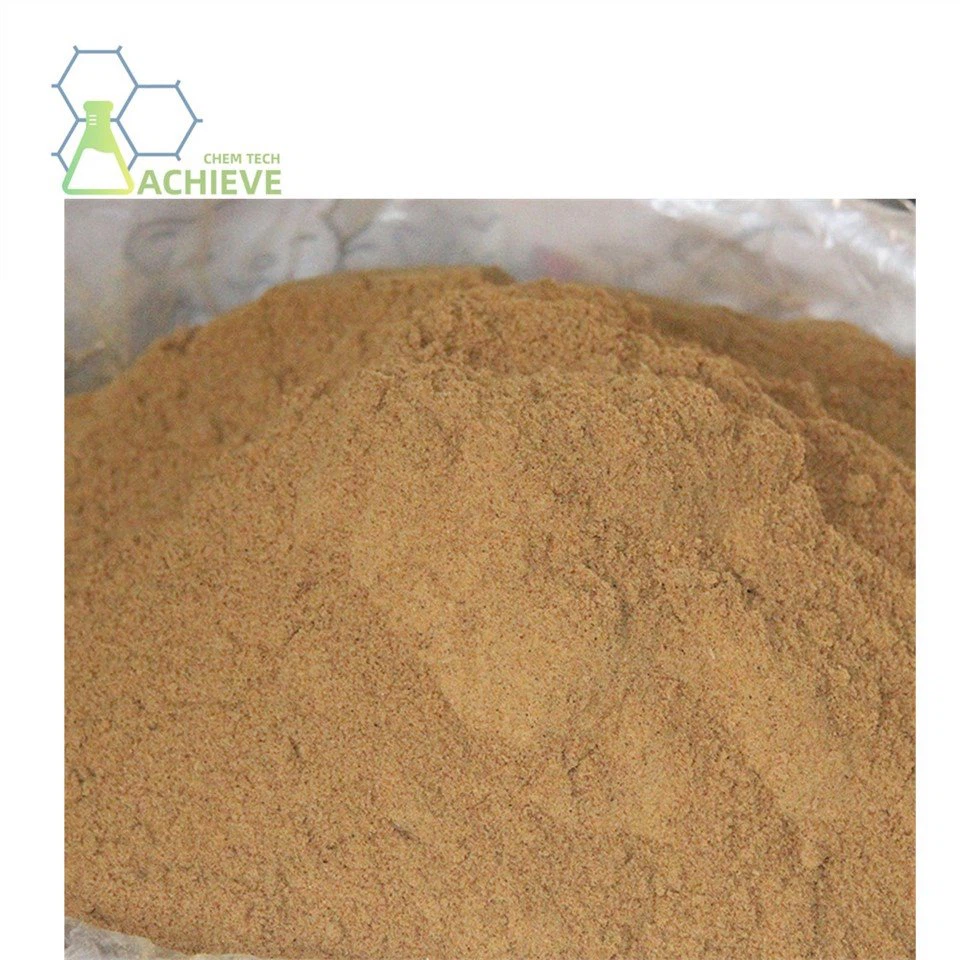


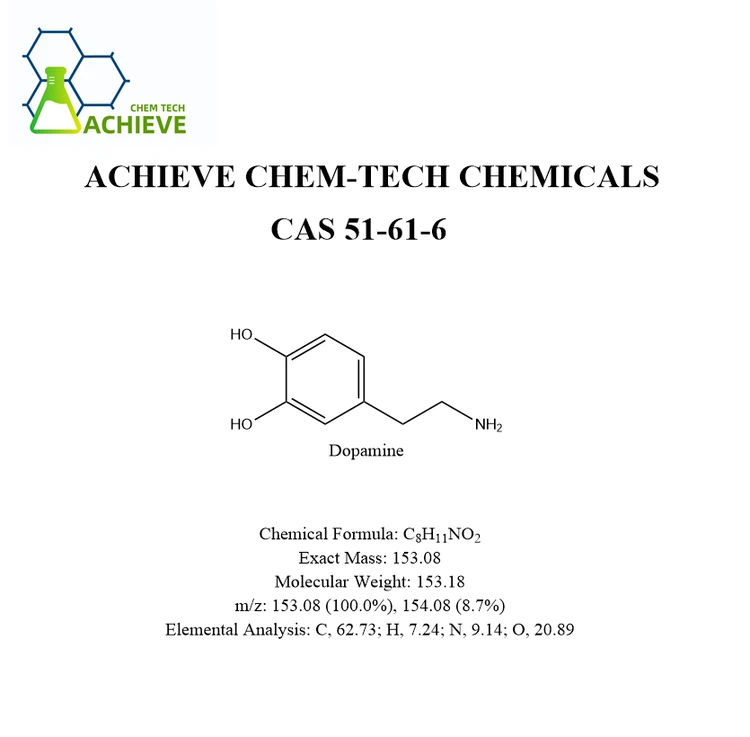
Pure dopamine also known as 3,4-dihydroxyphenethylamine or simply dopamine, is a naturally occurring neurotransmitter found primarily in the brain and central nervous system of animals, including humans. It plays a crucial role in regulating various physiological functions and behaviors, making it a vital component of the body's intricate communication system.
Dopamine acts as a chemical messenger, facilitating the transmission of signals between neurons (nerve cells). Its primary functions encompass motor control, emotion, pleasure, motivation, reward-seeking behaviors, learning, memory, and even addiction. The release of dopamine in response to certain stimuli, such as eating palatable food, sexual activity, or achieving a goal, contributes to the feeling of satisfaction and reinforces these behaviors.
 |
|
|
Melting Point |
218-220 º C |
|
Boiling Point |
276.1 ° C (rough estimate) |
|
Density |
1.1577 (rough estimate) |
|
Acidity Coefficient ( pKa ) |
8.9(at 25℃) |
|
Refractive Index |
1.4770 (estimate) |
|
Storage Conditions |
Hygroscopic, -20°C Freezer, Under inert atmosphere |
|
Solubility |
Soluble in acidic aqueous solution (slightly), DMSO (slightly, heated), methanol (slightly) |

Although Pure dopamine was synthesized as early as 1910, compared with its closely related biological catecholamines (i.e. epinephrine and norepinephrine), it has been neglected for a long time because of its relatively weak sympathetic activity until it was found in animal tissues α- DOPA decarboxylase and dopamine were observed as components in normal human urine. The fact that the concentration of dopamine in the normal brain is at least as high as that of norepinephrine suggests that dopamine may have other functions in addition to being a precursor of norepinephrine.
 |
 |
Medical Applications
Vascular Activity Regulation
Dopamine is a commonly used vasoactive drug in medicine. It acts in a dose-dependent manner to stimulate dopamine receptors, β1, and α1 receptors, leading to various physiological effects.
- Low doses (1-2 µg/kg·min): Causes vasodilation in the kidney, coronary, brain, and mesenteric vessels, increasing renal blood flow, glomerular filtration rate, urine output, and sodium excretion.
- Medium doses (2-10 µg/kg·min): Increases heart rate, myocardial contractility, and cardiac output, with minimal increase in systemic vascular resistance.
- High doses (>10 µg/kg·min): Causes vasoconstriction in both arterial and venous vessels, with effects similar to norepinephrine at doses >20 µg/kg·min.
Treatment of Shock and Hypotension
Dopamine is used in the treatment of shock, particularly in patients with low urine output, hypotension, and low cardiac output. It is initiated at doses of 5-10 µg/kg·min and titrated upwards as needed.
Heart Failure
In heart failure, dopamine can improve cardiac contractility and increase cardiac output, making it a useful adjunct in the management of this condition.
In the context of neurology and psychiatry, imbalances in dopamine levels have been linked to various conditions, including Parkinson's disease (characterized by low dopamine levels), schizophrenia (where dopamine transmission may be abnormally high), and addiction disorders, where the pursuit of reward-triggering activities can lead to excessive dopamine release.
Moreover, Pure Dopamine is not directly consumed as a supplement or medication in its pure form due to its highly regulated and delicate nature within the body. Instead, treatments targeting dopamine-related disorders often involve medications that either mimic the effects of dopamine or modulate its receptors, aiming to restore balance and alleviate symptoms.
 |
 |
Neuroscience & Psychology
Reward System
Dopamine plays a crucial role in the brain's reward system, influencing motivation, pleasure, and addiction. It is involved in the reinforcement of behaviors that are beneficial for survival and reproduction.
Mood and Emotion
Dysregulation of dopamine levels has been implicated in various psychiatric disorders, including depression, schizophrenia, and addiction.
Parkinson's Disease
The loss of dopamine-producing neurons in the substantia nigra pars compacta (SNpc) is the defining pathological hallmark of Parkinson's disease. Dopamine replacement therapy, such as levodopa, is a cornerstone of treatment for this condition.

synthesis method
Enzymatic tree synthesis method
- At present, the synthesis of 3-hydroxytyramine by Enzymatic tree synthesis method is relatively common, which has the advantages of environmental protection, high accuracy and high yield. The method is to use tyrosinase to carry out grafting reaction to phenylpropionic acid, and then reduce the raw material tyrosine added in the grafting process to 3-hydroxytyramine through reductase catalysis. The reuse of enzymes greatly improves the yield and maximizes the economic benefits.
- Enzymatic dendritic synthesis is an enzyme-catalyzed reaction-based synthesis method that enables highly efficient chemical transformations under mild conditions. This method sequentially converts substrates into products through enzyme-catalyzed reactions, which has the advantages of environmental protection and high efficiency. In the process of preparing dopamine chemical, this method can be used to realize high-efficiency synthesis at a lower cost.

Abderhalden ammonia synthesis method
- The Abderhalden ammonia synthesis method is a novel synthesis method of 3-hydroxytyramine, which is characterized in the synthesis of 3-hydroxytyramine by the reduction reaction of metal amino groups in the absence of solvent and catalyst. This method is still in the research stage, but it has the characteristics of simplicity, high yield, and easy operation, and it is expected to become one of the main synthetic methods in the future.
- The Abderhalden ammonia synthesis method is a method for synthesizing 3-Hydroxytyramine through multi-step reactions using Piperonal and formaldehyde as raw materials. The key to this method is the conversion of Piperonal to 3,4-dimethoxyphenylethylamine (DMPEA), followed by ammoniation to obtain 3-Hydroxytyramine. The advantages of this reaction are that the raw materials are readily available, the operation is simple and the yield is high, but there are also some disadvantages at the same time, such as long reaction time and complicated synthetic routes.

Pure dopamine used of chelating agent:
The hydroxyl and amine functional groups in 3-Hydroxytyramine can form complexes with metal ions and exert different biological effects. For example, 3-Hydroxytyramine can form complexes with copper salts and interact with marine microorganisms to have antibacterial and antibiotic activities. In addition, 3-Hydroxytyramine can also form complexes with iron ions, manganese ions, and cobalt ions to exert biological effects.
1. Catalyzed reactions with enzymes
3-Hydroxytyramine has an electrophilic group that can bind to enzymes and catalyze reactions with them. For example, 3-Hydroxytyramine can be used as a substrate of tyrosine kinases to participate in the regulation and regulation of cell signal transduction pathways. In addition, 3-Hydroxytyramine can also react with some oxidases, such as polyphenol oxidase and copper ion-catalyzed oxidase, thereby affecting the metabolism and release of neurotransmitters.
2. Has nucleotide acylation activity
Studies have shown that in some cases, 3-Hydroxytyramine has nucleotide acylation activity and can esterify nucleotides on other molecules. This activity is thought to be related to the function of 3-Hydroxytyramine in several cell signaling pathways.
3. Can be used as a ligand for metal ions to form chelates
The hydroxyl and amine groups in 3-Hydroxytyramine can be used as ligands to combine with metal ions to form chelates of metal ions. For example, 3-Hydroxytyramine can combine with copper ions to form Cu2+ complexes, which are blue or green. Many biochemical reactions depend on the interaction of 3-Hydroxytyramine with metal ions.

Dopamine, the main catecholamine neurotransmitter in the mammalian brain, is able to control motor, cognitive, affective, positive reinforcement, feeding, endocrine regulation, and many other functions, and its principles are mainly derived from its binding to dopamine receptors and its role in different brain circuits. Below is a detailed explanation of these principles and practical examples:
Principles
Binding to dopamine receptors: Dopamine regulates neuronal excitability and neurotransmitter transmission by binding to dopamine receptors in the brain, thereby affecting a variety of physiological functions.
Role in different brain circuits:
- DESIRE CIRCUIT: The dopamine desire circuit passes primarily through the midbrain limbic circuit, and when this circuit is activated, impulses and desires are generated. For example, when we see a good meal or a desired object, the desire circuit is activated, releasing dopamine, which gives us the urge to acquire it.
- CONTROL CIRCUITS: Dopamine control circuits, on the other hand, primarily go through midbrain cortical circuits and are responsible for calculating and planning to manage the uncontrollable impulses of desire dopamine, directing this raw energy to an end point that is favorable to us. For example, when we are faced with a choice, the control circuit evaluates the options and develops a strategy to achieve our goal.
Practical Examples
Motor control:
dopamine plays an important role in regulating motor function. Parkinson's disease is a neurological disorder associated with a decrease in dopamine, with patients exhibiting symptoms such as muscle stiffness and slowed movement. This is due to damage to dopaminergic neurons, which leads to a decrease in dopamine production and an inability to effectively regulate motor function.
Emotional and cognitive:
Dopamine is closely related to emotional and cognitive functions. For example, when we experience something pleasant, the brain releases dopamine, creating a sense of pleasure. At the same time, dopamine is also involved in learning and memory processes, helping us form new memories and consolidate old ones.
Positive Reinforcement:
Dopamine is associated with positive reinforcement, i.e., when we are rewarded or satisfied after performing a certain behavior, the brain releases dopamine, which enhances that behavior. For example, in animal experiments, when rats are rewarded with food by pulling a lever, dopamine levels in the brain rise, making the rats more inclined to repeat the behavior.
Overeating regulation:
dopamine also plays an important role in the regulation of eating. When we see a food item, desire circuits are activated, releasing dopamine, which makes us feel hungry and want to eat. At the same time, control circuits evaluate the value of the food and our needs to decide whether and how much to eat.
Endocrine regulation: Dopamine is also involved in endocrine regulation, such as regulating the secretion of prolactin and growth hormone. These hormones have an important influence on the body's growth, development, metabolism and other processes.
Specific case illustration
Taking gambling as an example, the uncertainty of the outcome during gambling will stimulate the brain to secrete abundant dopamine. While waiting for the outcome, the gambler experiences feelings of excitement and impulsiveness due to the secretion of dopamine. Even though gamblers are aware of the possible negative consequences of gambling, they still find it difficult to resist the temptation to gamble due to the effect of dopamine. This illustrates the role of dopamine in positive reinforcement and desire regulation.
In summary, dopamine controls a wide range of physiological functions in mammals through its binding to receptors and its action in different brain circuits. These functions have a wide range of applications and implications in real life, and an in-depth understanding of the mechanism of action of dopamine helps us to better understand the physiological and behavioral characteristics of humans.
FAQ
1. Can pure dopamine be directly used as a "happiness supplement"?
Absolutely not. Pure dopamine is a raw material for prescription drugs and a research chemical. It cannot enter the brain by oral intake (it will be completely blocked by the blood-brain barrier). Direct use is extremely risky and has nothing to do with the brain's natural "pleasure" mechanism.
2. What are its legitimate medical applications?
In the intensive care unit of a hospital, pure dopamine is precisely prepared into an injection solution and used as a blood pressure-raising drug. It increases the blood pressure of critically ill patients by constricting blood vessels and enhancing the contractility of the heart muscle, and is used to treat life-threatening conditions such as shock. Its main function is cardiovascular emergency treatment, rather than influencing emotions.
3. What are the main dangers?
Pure dopamine is a highly active and highly risky substance. Even a minor mistake in its use can lead to fatal arrhythmias, sudden high blood pressure (which can cause cerebral hemorrhage), and excessive contraction and necrosis of organ blood vessels. It can only be administered intravenously under the supervision of professional medical staff.
4. Can individuals purchase or own them?
It is strictly prohibited for individuals to purchase, possess or use. It is a strictly controlled raw material for pharmaceuticals. Any unauthorized acquisition and use for non-medical purposes is illegal and extremely dangerous.
Hot Tags: pure dopamine cas 51-61-6, suppliers, manufacturers, factory, wholesale, buy, price, bulk, for sale, benzocaine 200mesh, IPTG reagent, Pure Dexmedetomidine CAS 113775 47 6, tetracaine powder, levamisole hydrochloride powder, tetravisc