




Shaanxi BLOOM Tech Co., Ltd. is one of the most experienced manufacturers and suppliers of sustanon cas 58-22-0 in China. Welcome to wholesale bulk high quality sustanon cas 58-22-0 for sale here from our factory. Good service and reasonable price are available.
Sustanon, also known as testosterone, testosterone and testosterone, with the molecular formula of C19H28O2, is a white crystalline powder, which is soluble in ethanol, ether and organic solvents, but insoluble in water. It is a kind of steroid hormone, which is secreted by male testes or female ovaries. The adrenal gland also secretes a small amount of testosterone. It has the functions of maintaining muscle strength and quality, maintaining bone density and strength, refreshing and improving physical strength.
Testosterone is a secreted glycoprotein originally identified from the enrichment medium of mouse testis sertoli cells. It is a cytoskeleton associated protein with small molecular weight, which can tightly bind to the cell surface through receptor associated protein.

|
Chemical Formula |
C27H40O3 |
|
Exact Mass |
412 |
|
Molecular Weight |
413 |
|
Elemental Analysis |
C, 78.60; H, 9.77; O, 11.6 |
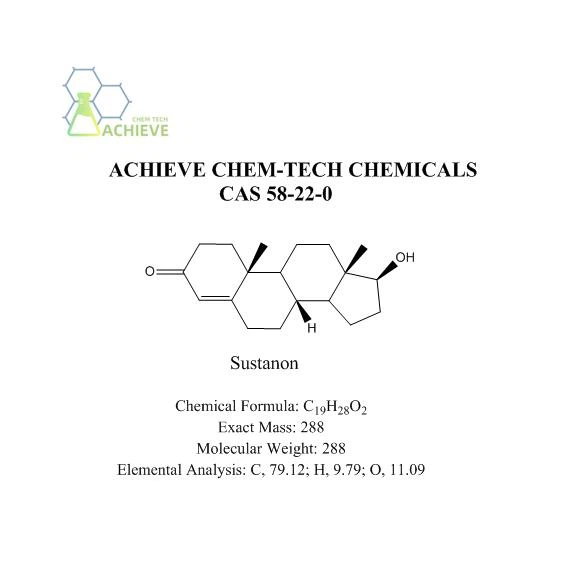

Use of sustanon:
Medical use: It is used for alternative treatment of orchitis, male menopause syndrome, impotence and other diseases.
Sports use: increase the number of muscles. Some people who exercise to increase their muscle mass use a dose 250 times the therapeutic dose.
Other uses: biochemical research; Natural androgen, which controls the development and growth of male sexual organs and male parasexual signs.
Risk: Acne, edema.

Testosterone synthesis sustanon:
Report I
Step 1: Dissolve 30g androstenedione in 10 times weight of mixed solvent (dichloromethane: tetrahydrofuran=1 ∶ 1), and cool it to - 15 ℃.
Step 2: Dissolve 3g potassium borohydride in 30ml distilled water or pure water.
Step 3: add the aqueous solution of potassium borohydride obtained in the second step to the reaction system at - 8 ℃ obtained in the first step with a peristaltic pump, and the flow rate is 0.2ml/min.
Step 4: After addition, react at - 5 ℃ to - 10 ℃ until androstenedione reaction is complete (HPLC tracking), add 1g glacial acetic acid to destroy the excessive potassium borohydride, spin to recover the solvent, add 450ml distilled water, cool to 10 ℃, filter, wash, vacuum dry to obtain crude product.

Step 5: Dissolve the crude product with 10 times the weight of absolute ethanol, add 5wt% active carbon for decolorization, filter while hot, concentrate 85wt% ethanol under reduced pressure, freeze, crystallize, filter, wash with frozen absolute ethanol, and vacuum dry at 80 ℃ to obtain white crystals. The quality is tested and the results are as follows:
Melting point: 153-156 ℃ (literature value: 152-156 ℃); The content is 98.5% (w/w) (HPLC method); Mass spectrum: 289 [M - H]+; Nuclear magnetic resonance 1HNMR (CDCl3) 0.79 (s, 3H, CH3), 1.12 (s, 3H. CH3), 3.66 (t, 1H), 5.72 (s, H, CH); IR (KBr, v/cm-1): 352933813027294328732847165616101056.
After testing, the product is testosterone. The byproduct 3,17 diol content was 0.45% (w/w), and the yield of testosterone was over 93% (w/w).
Report II:
Step 1: Construction of recombinant Y.lipolytica Polh strain
Using the fully synthesized gene in the laboratory as the template, the gene of the enzyme was obtained by PCR, and the cloning vector was connected to achieve a large number of gene amplification. 17 that will be greatly amplified β- After purification, the hsd3 and gdh gene fragments were respectively connected to pINA1292 and pYLSC vectors. After verification, the model strain Y.lipolytica Polh was transformed. The positive transformants were screened on the resistant plate, inoculated in shake flask for fermentation, and the product TS in the fermentation broth was detected by HPLC. TS was detected, indicating that the recombinant strain with AD to TS was successfully constructed. The invention finally obtains Y.lipolytica Polh strain which can efficiently transform AD into TS.
Step 2: Determination of enzyme activity of recombinant strain
Enzyme activity determination method: HPLC method was used. The specific methods are as follows: take 50mL of bacteria solution cultured for 24h, centrifugate at 4 ℃ at 8000r/min for 5min, collect the bacteria, wash it twice with 50mL Tris HCl buffer solution with pH 7.0, and then re suspend it in 5ml of the buffer solution. 40% power ultrasonic crushing in ice bath, working for 2s and 5s intermittently, working for 10min. The supernatant was obtained by centrifugation at 10000r/min for 30min, and the supernatant was the target protein. Enzyme activity measurement method is as follows: enzyme activity measurement system 1mL includes 0.5mM NADPH, 200 μ M AD (dissolved in methanol), and then add an appropriate amount of enzyme solution. Definition of enzyme activity unit: 1 minute conversion at 37 ℃ μ The amount of TS produced by mol AD is defined as one enzyme activity unit (U). Determination method of glucose dehydrogenase activity: 1mL reaction system includes 50mM sodium phosphate buffer (pH 6.5), 10mM glucose and 1 μ M NADP+. Determine the activity according to the change of NADPH absorbance value at 340nm. The definition of enzyme activity unit is: 1 per minute μ The amount of enzyme required for mol NADPH. The enzyme activity reached 7.35U/mg and 4.23U/mg respectively.
Step 3: Detection of whole cell transformation performance of recombinant strain
The strain was inoculated in 100mL BMGY medium with 5% inoculation amount for 24h, and then inoculated in 5L fermentation tank with 2L BMGY medium with 5% inoculation amount for 4 days. Centrifuge the cell, wash it twice, re dissolve it with a certain amount of 50mM Tris HCl pH 7.5 buffer solution, add the substrate AD for conversion, and the conversion conditions are: the conversion temperature is 37 ℃, the conversion pH is 7.5, and the substrate cosolvent is methylated- β- Cyclodextrin (molar ratio: 1:1), biomass: 200g/L, substrate concentration: 5g/L. After three times of feeding whole cell transformation, 15g/L androstenedione is transformed into 14.3g/L testosterone, which is the first time at home and abroad to use androstenedione to produce testosterone in Pichia pastoris by constructing sustanon coenzyme recycling system, and finally to achieve the goal of improving the transformation rate and efficiently producing testosterone.
Hot Tags: sustanon cas 58-22-0, suppliers, manufacturers, factory, wholesale, buy, price, bulk, for sale, IPTG reagent, larocaine hydrochloride, articaine hydrochloride powder, epinephrine hydrochloride powder, Tetracaine hydrochloride powder, Procaine Hydrochloride