




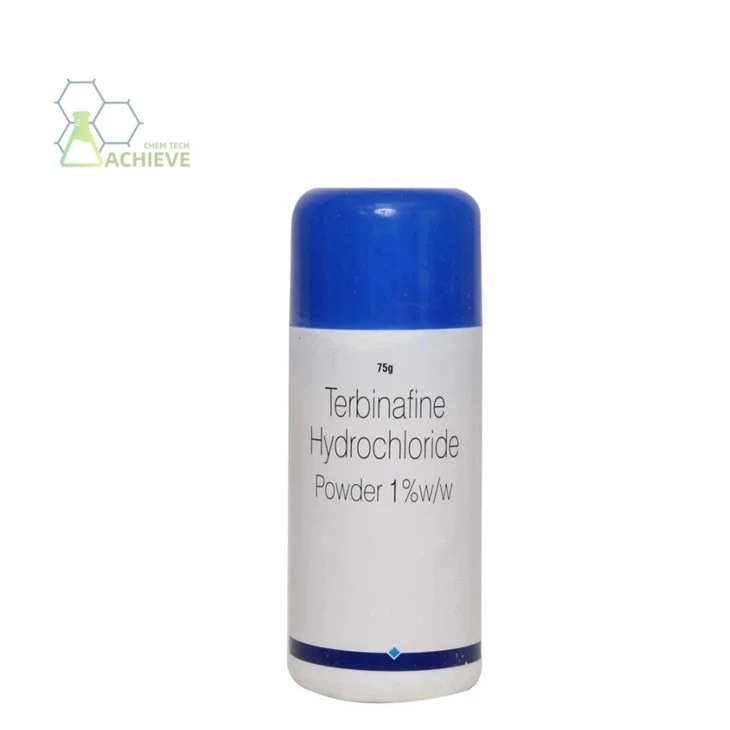

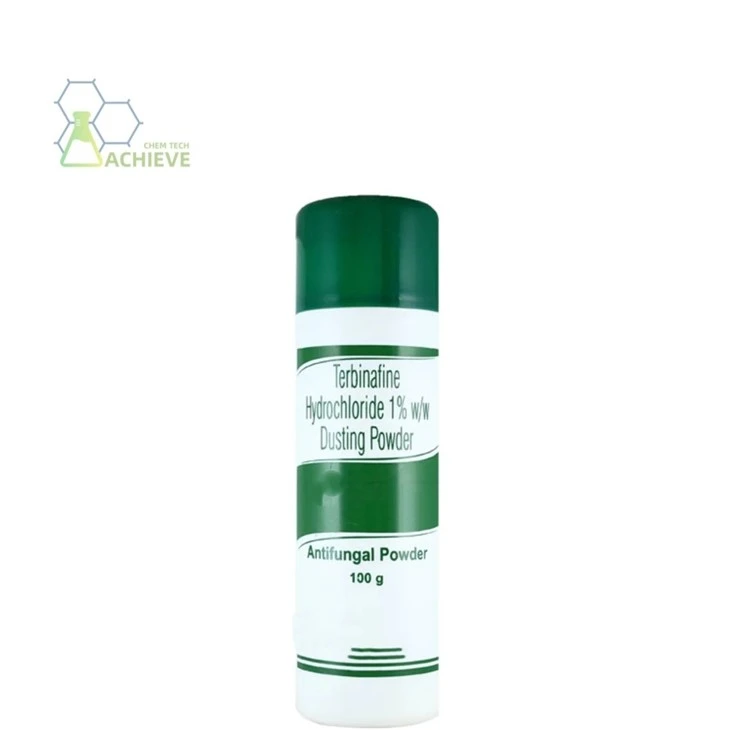


Shaanxi BLOOM Tech Co., Ltd. is one of the most experienced manufacturers and suppliers of terbinafine hydrochloride powder in China. Welcome to wholesale bulk high quality terbinafine hydrochloride powder for sale here from our factory. Good service and reasonable price are available.
The chemical name of terbinafine hydrochloride powder is (E) -N- (6,6-dimethyl-2-hepten-4-alkynyl) - N-methyl-1-naphthalimine hydrochloride, with the molecular formula C21H26ClN, CAS 78628-80-5, and a molecular weight of 327.9 g/mol. It usually appears as a white to off white crystalline powder, with some literature describing it as having a slight yellow hue. This color difference may be due to differences in crystallization conditions or purity, but both meet pharmaceutical grade standards (purity ≥ 98.5%). This molecule is formed by a salt bond between a terbinafine base and hydrochloric acid. The base portion contains a naphthalene ring, an allylamine side chain, and a tert butyl structure. This structure endows it with unique physicochemical properties, with the naphthalene ring providing hydrophobicity, the allylamine side chain enhancing its binding ability with fungal enzymes, and the hydrochloride form improving the solubility and stability of the drug.



Additional information of chemical compound:

Our product form




terbinafine hydrochloride +. COA


Terbinafine hydrochloride powder is a broad-spectrum antifungal drug that exerts bactericidal effects by specifically inhibiting fungal squalene cyclooxygenase and blocking the biosynthesis of ergosterol. Its molecular formula is C ₂₁ H ₂₆ ClN, with a molecular weight of 327.9 g/mol. It appears as a white crystalline powder with a melting point of 195-208 ℃. It is slightly soluble in water and easily soluble in organic solvents such as methanol and ethanol.
Overview of Classic Synthesis Routes
The synthesis of Terbinafine Hydrochloride is centered around the naphthalene ring and allylamine structure, and the molecular skeleton is assembled by constructing the 6,6-dimethyl-2-hepten-4-yne side chain. The current mainstream synthetic routes can be divided into three categories:
Raw materials: tert butyl acetylene, N-methyl-1-naphthalimine steps:
Side chain construction: Using tert butyl acetylene as the raw material, 3,3-dimethyl-1-butenyllithium or Grignard reagent is generated through metalization reaction, and then reacted with halogenated reagent to prepare intermediate 1-halogen-6,6-dimethyl-2-hepten-4-yne.
Condensation reaction: Heat and condense the above intermediate with N-methyl-1-naphthalimine under alkaline conditions (such as NaOH/chloroform system) to generate N - (6,6-dimethyl-2-hepten-4-yne) - N-methyl-1-naphthalimine.


Salt purification: Adjust the pH to acidity by introducing hydrogen chloride gas, and selectively precipitate the target product using the ethyl acetate methanol; crystallization system, ultimately obtaining high-purity terbinafine hydrochloride.
Advantages: The route is simple, the raw materials are easy to obtain, and the total yield can reach 56% -60%;
Challenge: Strict control of metallization reaction conditions is required to avoid the generation of by-products, and the condensation step requires optimization of the solvent system to improve stereoselectivity (E/Z isomer ratio).
2. Route 2: Aldehyde Reduction Amination Method
Raw materials: (E) -6,6-dimethylhept-2-en-4-yn-1-aldehyde, N-methyl-1-naphthalimine
Steps:
Aldehyde reduction: In the presence of formaldehyde and sodium borohydride, naphthylamine undergoes a reductive amination reaction with aldehyde to produce the target amine intermediate.
Purification crystallization: Separation and purification through column chromatography or recrystallization, ultimately resulting in salt formation to obtain the product.
Advantages: fewer reaction steps and high theoretical atomic utilization rate.
Limitations: The synthesis of raw material (E) -6,6-dimethylhept-2-ene-4-acetyl-1-aldehyde is difficult, and the reductive amination step is prone to producing cis isomers, requiring complex purification methods.
Raw materials: 6,6-dimethyl-1-hepten-4-yn-3-ol, hydrobromic acid steps:
Bromination rearrangement: Using hydrobromic acid to directly brominate hydroxyl groups, triggering the pinal rearrangement reaction, generating an E/Z ratio stable allyl bromide mixture (E/Z ≈ 3:1).
Condensation into salt: The brominated product is condensed with N-methyl-1-naphthalimine, and the trans isomer is selectively precipitated through the crystallization system of ethyl acetate methanol, resulting in the formation of high-purity salt product.

Innovation point:
Avoid using highly toxic catalysts (such as mercuric chloride) and promote product miscibility through methanol to increase reaction rate.
Utilizing the solubility difference between cis/trans isomers to achieve efficient separation under mild conditions.
Industrialization potential: This route has mild conditions, simple post-processing, and a total yield of 56.7%, making it suitable for large-scale production.


Breakthrough in key intermediate system preparation technology
1. High stereoselective side chain synthesis
In traditional methods, the synthesis of 1-halogen-6,6-dimethyl-2-hepten-4-yne easily generates cis isomers, leading to difficulties in subsequent purification. The latest research optimizes through the following strategies:
Substitution method of p-toluenesulfonyl chloride (TsCl):
4-methylbenzenesulfonyl chloride was used instead of phosphorus tribromide, and reacted with 6,6-dimethyl-3-hydroxy-4-acetyl-1-heptene in dichloromethane and triethylamine system to increase the E/Z ratio from 3:1 to 40:1, with a yield of 85%.
Catalytic rearrangement of pinal magnesium:
Pinal magnesium catalyst is generated in situ by magnesium shavings and mercuric chloride, promoting the conjugated rearrangement of allyl alcohol double bond and tert butyl acetylene triple bond, and generating an intermediate with uniform stereoisomerism.
2. Optimization of solvent system for condensation reaction
In the alkaline condensation step, the choice of solvent directly affects the reaction rate and stereoselectivity:
Chloroform/water biphasic system:
Utilizing the solubility of organic compounds in chloroform and inorganic bases in water, efficient mass transfer is achieved, reducing reaction time to 3 hours.
Application of phase transfer catalyst (PTC):
Adding PTC such as tetrabutylammonium bromide (TBAB) can significantly improve the condensation yield (from 75% to 88%) and reduce the generation of by-products.
Process Innovation in Industrial Production
In response to the problem of intense heat release in condensation reactions, a certain enterprise adopts a microchannel continuous flow reactor. By precisely controlling the temperature (40-50 ℃) and residence time (5 minutes), the reaction conditions are homogenized, and the yield is stable at over 90%, while avoiding the increase of isomers caused by local overheating.
Gradient cooling crystallization: In the ethyl acetate methanol system, stepwise cooling (from 60 ℃ to 0 ℃ in three steps) can effectively control the crystal particle size distribution and improve product flowability.
Mother liquor recycling: By recovering unreacted raw materials and cis isomers from the crystallization mother liquor, catalytic isomerization is carried out to convert them into trans products, increasing the overall yield to 65%.
Solvent recovery system: Membrane separation technology is used to recover methanol and ethyl acetate, with a recovery rate of 95%, significantly reducing production costs.
Cyanide free reduction process: using terbinafine hydrochloride powder instead of sodium cyanoborohydride as a reducing agent to avoid the use of highly toxic cyanide and meet environmental requirements.
Quality control and standard setting
1. Critical Quality Attribute (CQA)
Purity: HPLC method is used for detection, with a requirement of ≥ 99.5% (USP standard).
Isomer ratio: The E/Z isomer content is determined by chiral HPLC, and the trans isomer is specified to be ≥ 98%.
Residual solvents: According to ICH guidelines, control the residual levels of methanol, ethyl acetate, and other solvents at the ppm level.
2. Online monitoring technology

PAT (Process Analysis Technology): Install near-infrared (NIR) probes in the condensation reactor to monitor real-time changes in reactant concentration and achieve precise endpoint control.
Raman spectroscopy: used for monitoring the crystallization process, determining the nucleation and growth stages of crystals through changes in characteristic peak intensity.
The synthesis of Terbinafine Hydrochloride has formed a technical system mainly based on alkyne condensation and pinal rearrangement. Through technological innovations such as stereoselective control, continuous flow reaction, and green chemistry, efficient, environmentally friendly, and sustainable industrial production has been achieved. In the future, with the integration of biocatalysis and intelligent manufacturing technology, its synthesis process will evolve towards higher selectivity and lower energy consumption, providing a solid guarantee for the global supply of antifungal drugs.


Unique advantages of the mechanism of action
1. Highly selective
The inhibitory effect of terbinafine on fungal squalene cyclooxygenase is not dependent on the cytochrome P450 enzyme system, therefore the risk of interaction with human hormone metabolism, anticoagulants, and immunosuppressants is significantly lower than that of azole drugs.
2. Dual action mode
Its bactericidal effect originates from the synergistic effect of ergosterol deficiency and squalene accumulation, while azole drugs only exert antibacterial effects by inhibiting ergosterol synthesis. Therefore, the efficacy of terbinafine is more long-lasting and the recurrence rate is lower.
3. Strong organizational penetration
The high concentration distribution of drugs in the skin, hair, and skin makes them the preferred medication for treating superficial fungal infections, especially for diseases such as onychomycosis that require long-term treatment.
The correlation between clinical application and mechanism of action
1. Treatment of onychomycosis
The persistent distribution of terbinafine hydrochloride powder in the deck makes it the gold standard for treating onychomycosis. Oral administration of 250 mg/day for 12 consecutive weeks can achieve sustained inhibition of fungal growth by drug concentration in the deck, with a cure rate of over 80%.
2. Rapid relief of skin fungal infections
After topical application of terbinafine cream or spray, the rapid penetration of the drug in the stratum corneum can quickly relieve symptoms such as tinea corporis and tinea cruris. 1% cream is used 1-2 times a day for a treatment period of 2-4 weeks, with a clinical cure rate of over 90%.
3. Drug resistance management
Due to the unique target of action of terbinafine, the risk of fungal resistance to it is relatively low. However, long-term monotherapy may lead to mutations in the squalene cyclooxygenase gene, so it is recommended to use combination therapy or alternate treatment plans to delay the onset of drug resistance.
Hot Tags: terbinafine hydrochloride powder, suppliers, manufacturers, factory, wholesale, buy, price, bulk, for sale, epinephrine powder, tetracaine hcl powder, 3-Hydroxytyramine, 18 Glycyrrhetinic Acid CAS 471 53 4, Chrysophanic Acid CAS 481 74 3, Peptide